



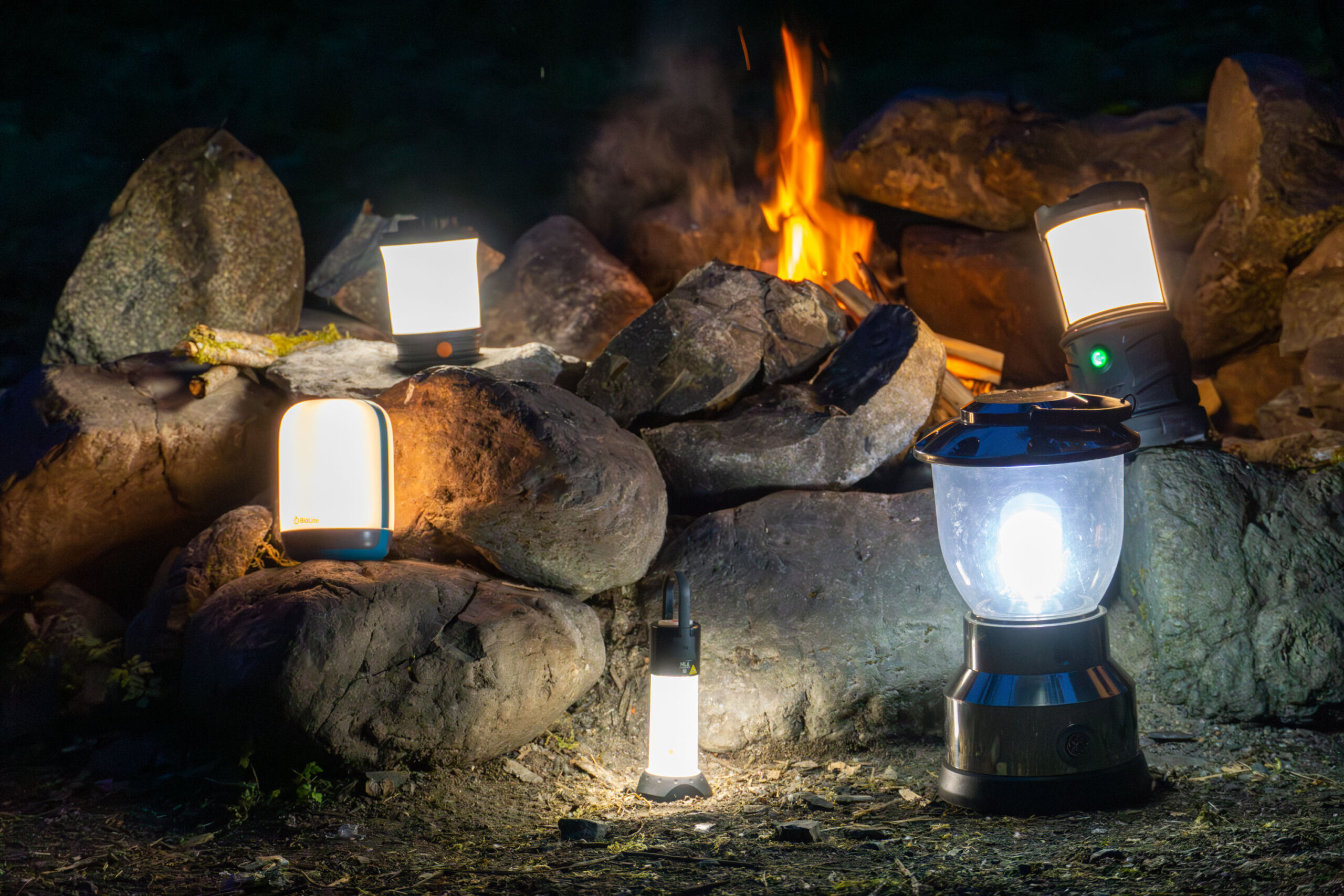

While there isn’t a single best camping lantern for everyone, we sure looked for one. During our most recent proving session, lead gear tester Nick Belcaster camped with five new lanterns across 25+ camping overnights in Washington state to ensure our suggestions are tip-top.
Sure, you could just use a flashlight or headlamp, but a top-pick lantern like the BioLite AlpenGlow 500 lights up the entire camp. Even budget options like the Duracell Tri-Power put out enough to illuminate the inside of your tent. Then there are big party options like the Goal Zero Skylight, or intimate mood-setters like the UCO Original Candle Lantern.
During our testing, we charged up, gassed up, and lit up our campsites with lanterns — paying special mind to light output, power supply, burn time, durability, and more. We’ve tested nearly 45 different light sources across half a decade of camping seasons to pull together a list of the most worthy light sources to bring on your next wilderness outing. Check them out (and more) below.
Editor’s Note: We updated our Camping Lantern guide on May TKTK, 2026 to add the new COAST EAL35R, a lantern you can talk to. We also revised our buyer’s guide information to be more helpful and get you up to speed on lanterns faster.
The Best Camping Lanterns of 2026
Best Overall Camping Lantern
8.9/10 RATING
Best Budget Camping Lantern
6.3/10 RATING
Best Solar-Powered Lantern
8.5/10 RATING
Best Candle Lantern
6.0/10 RATING
Best Camping Overhead Lantern
7.6/10 RATING
Best String Lights
7.9/10 RATING
Best Gas Camping Lantern
6.8/10 RATING
See more picks
Lumens
500 lm max; 5 lm min
Power Source
6,400 mAh Li-ion rechargeable battery
Burn Time
200 hrs. on low; 5 hrs. on high
Water Resistance
IPX4 water resistant
USB Port
Micro-USB in; USB-A out
Pros
- Ability to recharge electronics from the 6,400 mAh power bank
- Many different modes to choose from and suit the mood
- ChromaReal LED technology provides excellent full-spectrum light
Cons
- Shake to change functionality isn’t the most intuitive, sometimes doesn’t register
- We wished all new rechargeable electronics would come standard with USB-C, but this does not
The Quick & Dirty: This is the best camping lantern for most people, and it balances output, light modes, and battery life well. It doesn’t charge via USB-C, which is one of our only complaints.
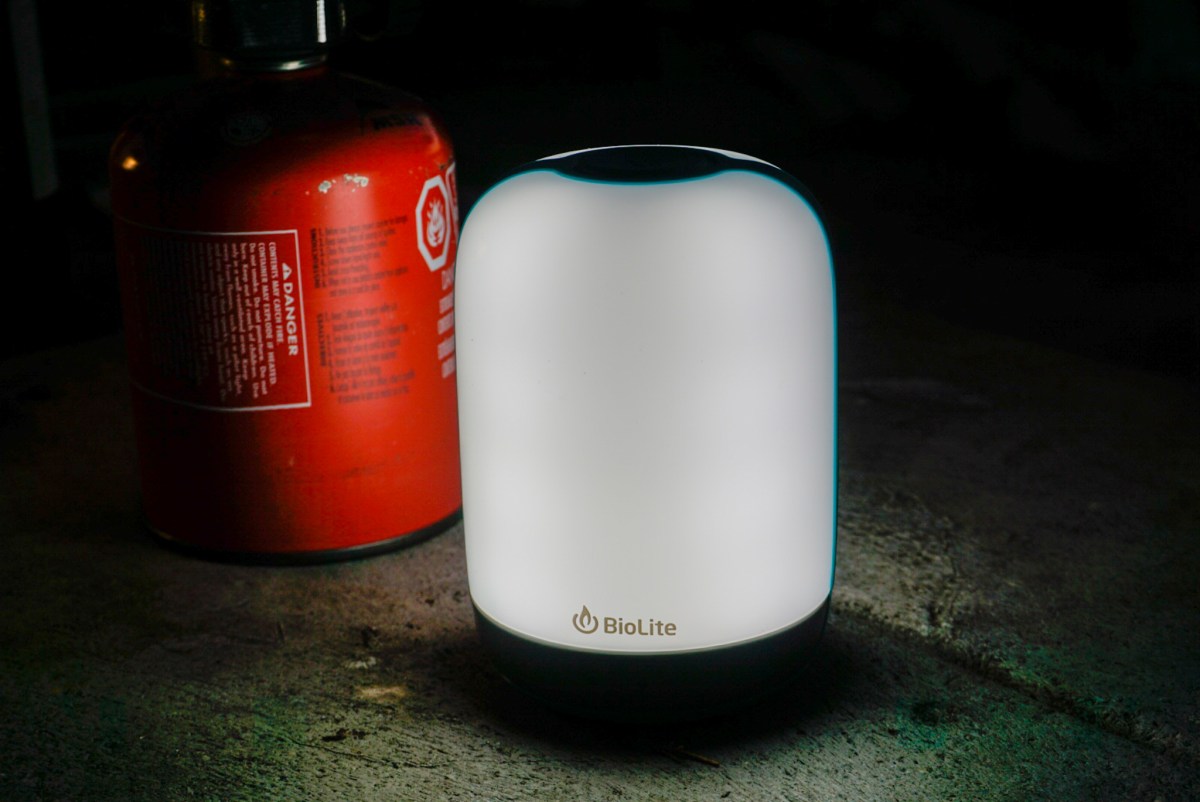
BioLite didn’t miss when they brewed up the AlpenGlow 500 Lantern ($80), a light that’s as versatile in the backcountry as it is for car camping. There’s little we could come up with that we would have done differently, which easily landed it the title of best overall. If you’re after a straight-ahead camping light source that has a few tricks up its sleeve, the AlpenGlow is your lantern.
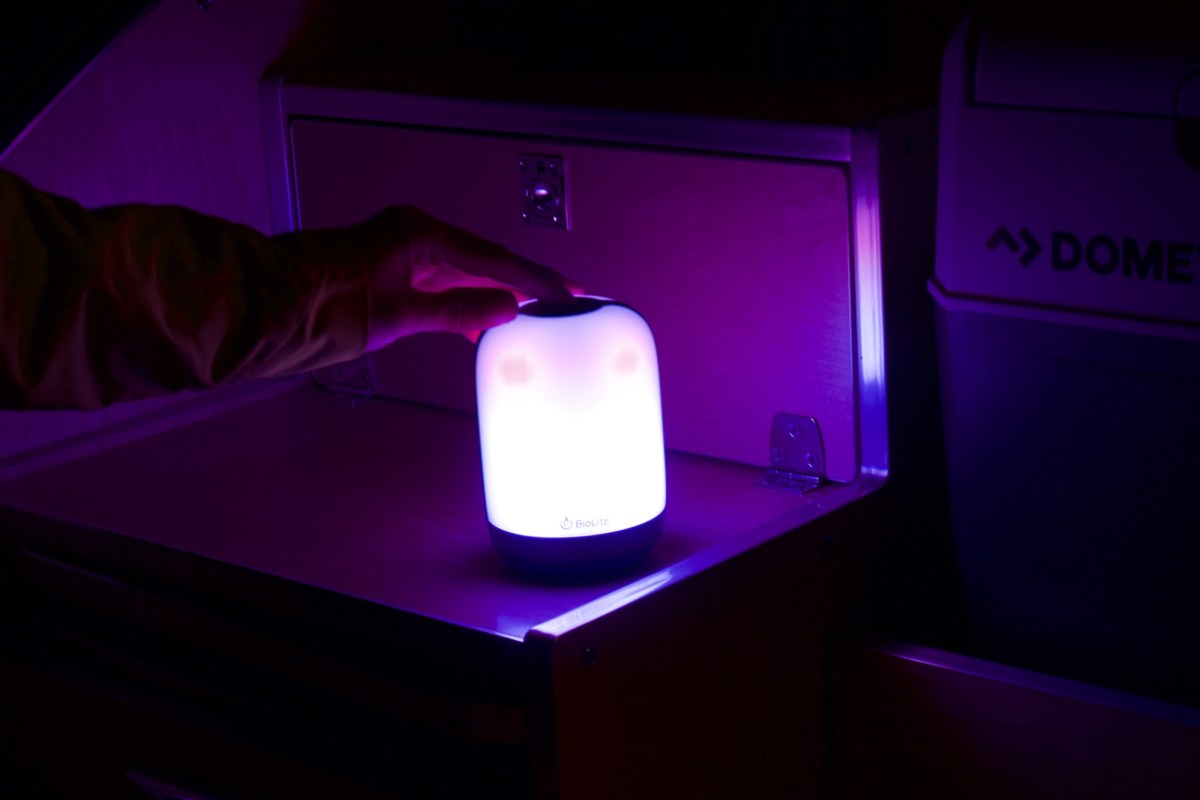
Need a quick burst of white light? One tap. Feeling a little more natural? Tap again. A third tap brings the color, and a fourth ignites color-changing ChromaReal LEDs. BioLite also incorporated some secondary modes to each, giving you the ability to limit the light to only one side of the lantern or imitate a candle flicker.
There’s even a third press option triggered by a quick shake of the lantern. While we do applaud the unique way of integrating an accelerometer, we found this to be a little hit-and-miss. Eventually, the lantern will catch on — it may just take an extra shake to get there. These different lighting options take a minute to memorize, but the tiered setup means you can blitz through them pretty quickly if you pass the one you’re after.
In addition to its impressive lighting capabilities (500 lumens is dang bright), the AlpenGlow incorporates several features we’ve come to expect in a lantern, such as an integrated 6,400 mAh power bank to charge your electronics (which, unfortunately, is USB-A output only for now).
Looking forward to the bright future of portable electronics, we’d love to see a pivot to USB-C here, which BioLite got right in the later offering of the AlpenGlow Mini. And for those looking for all the same functions in a middle-ground package, there’s the AlpenGlow 250.
Beyond the BioLite offerings, those after a generalist lantern like the AlpenGlow 500 with a few more mounting and lighting options would be well-served to consider the Black Diamond Orbiter 650 — a lantern that sports both tripod legs and a top-down mode to spot-illuminate your camp table at night.
Our decision to choose the AlpenGlow over the Orbiter for our top spot was difficult, and it came down to light quality and color. Across the board, the ChromaReal LEDs in this lantern provide a richer and more pleasing light compared to the Black Diamond lantern.
Night after night, the AlpenGlow 500 puts out impressively natural-looking light, which we greatly appreciate. Anyone searching for an all-around powerhouse of a lantern would likely find it in the AlpenGlow.
Black Diamond Orbiter 650 Lantern: A Closely-Matched Alternative Lantern
The Orbiter 650 is a solid pivot from the AlpenGlow 500, and there are a few good reasons you might consider it over this lantern. For one, it pumps out just a bit more light compared to the AlpenGlow (650 to 500 lumens), and uses a future-proof USB-C charging port to stay topped off, while the AlpenGlow still uses USB-Mini. The Orbiter also has a few more display modes, with a set of three legs that can elevate the lantern over your camp table, and a straight-down light mode for hanging in your tent. You will get a longer run time on the BioLite lantern with an extra 1,200 mAh of battery, and the overall light quality of the ChromaReal LEDs used is more vibrant compared to what the Black Diamond lantern is capable of. Both are the same price, and it’s tough to go wrong choosing between them.
BioLite Luci Charge 360: No Fun Colors, But Can Recharge Itself
The Luci Charge 360 is another lantern in the BioLite lineup that packs a lot of good camp functionality, just in a collapsible form factor. The more minimal design does limit the overall specs a bit, but for the space it does take, it does a lot with. Light output will be a bit less at 360 lumens to the 500 coming from the AlpenGlow 500, and you also won’t get any of the color-changing ability (the warm white light of the Charge 360 is a great choice, however). Waterproofing, interestingly, is actually much better in the Luci lantern at an IP67 rating, while the AlpenGlow only sports IPX4, which is good for splashes from any direction. If you want a lantern that you can take backpacking as easily as you take it camping, the slight performance ding on the Charge 360 could be worth it. You’ll also save $20 by making the pivot.
Lumens
2,000 lm max; 65 lm min
Power Source
Integrated rechargeable battery, solar panel, or 4 D batteries
Burn Time
50 hrs on low; 200 hrs on high
Water Resistance
IPX4 water resistant
USB Port
USB-A out, USB-C in
Pros
- Great price
- Sufficient lighting for large tent or cook space
- Good runtime
Cons
- No steady red light
- Turns on at full power
- Slow charging
The Quick & Dirty: A spend-wise camp lighting option that does a whole lot for a lot less out of pocket. There are some kinks to work out (like the instant full-power mode), but it’s forgiven for the price.
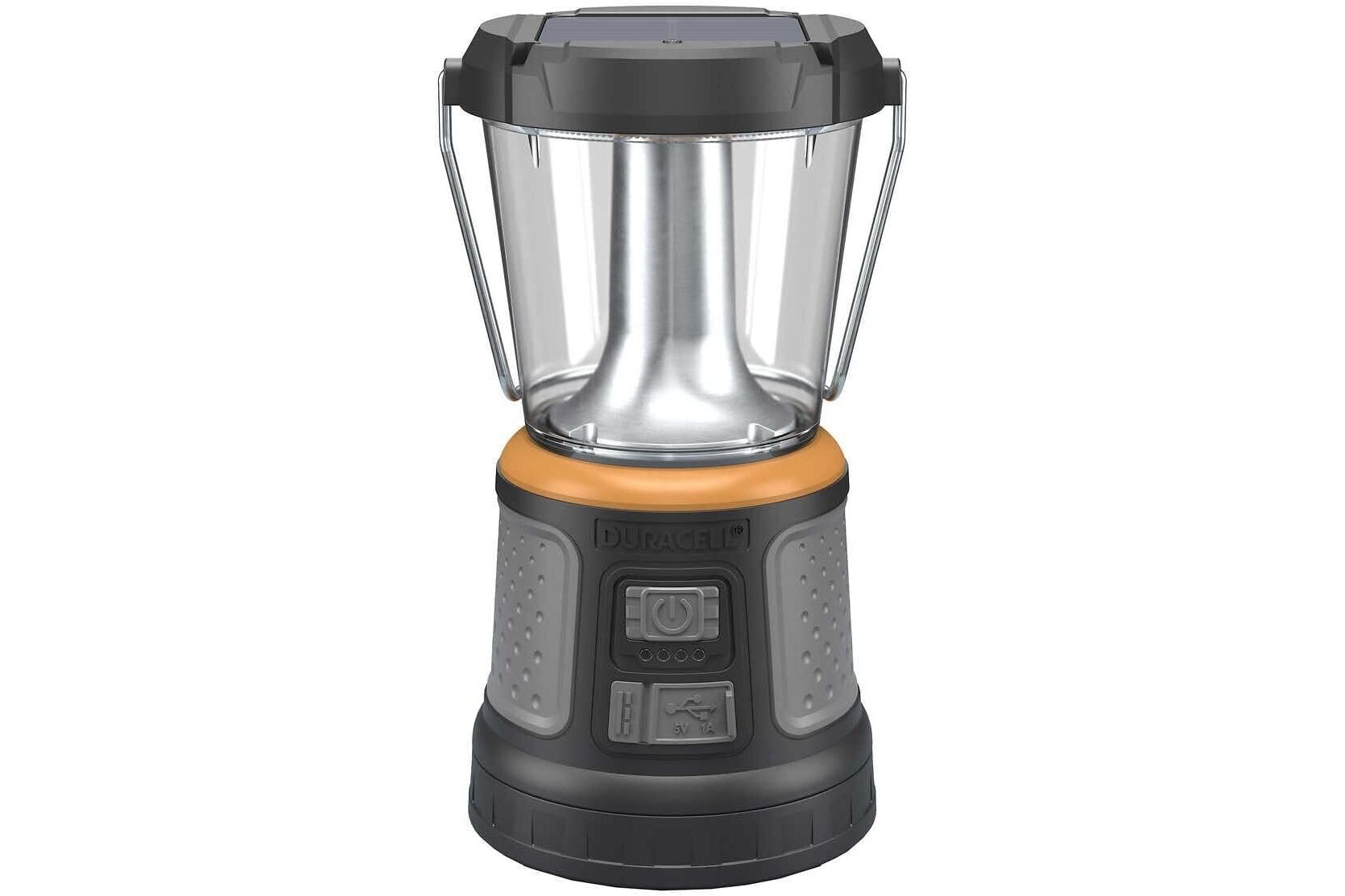
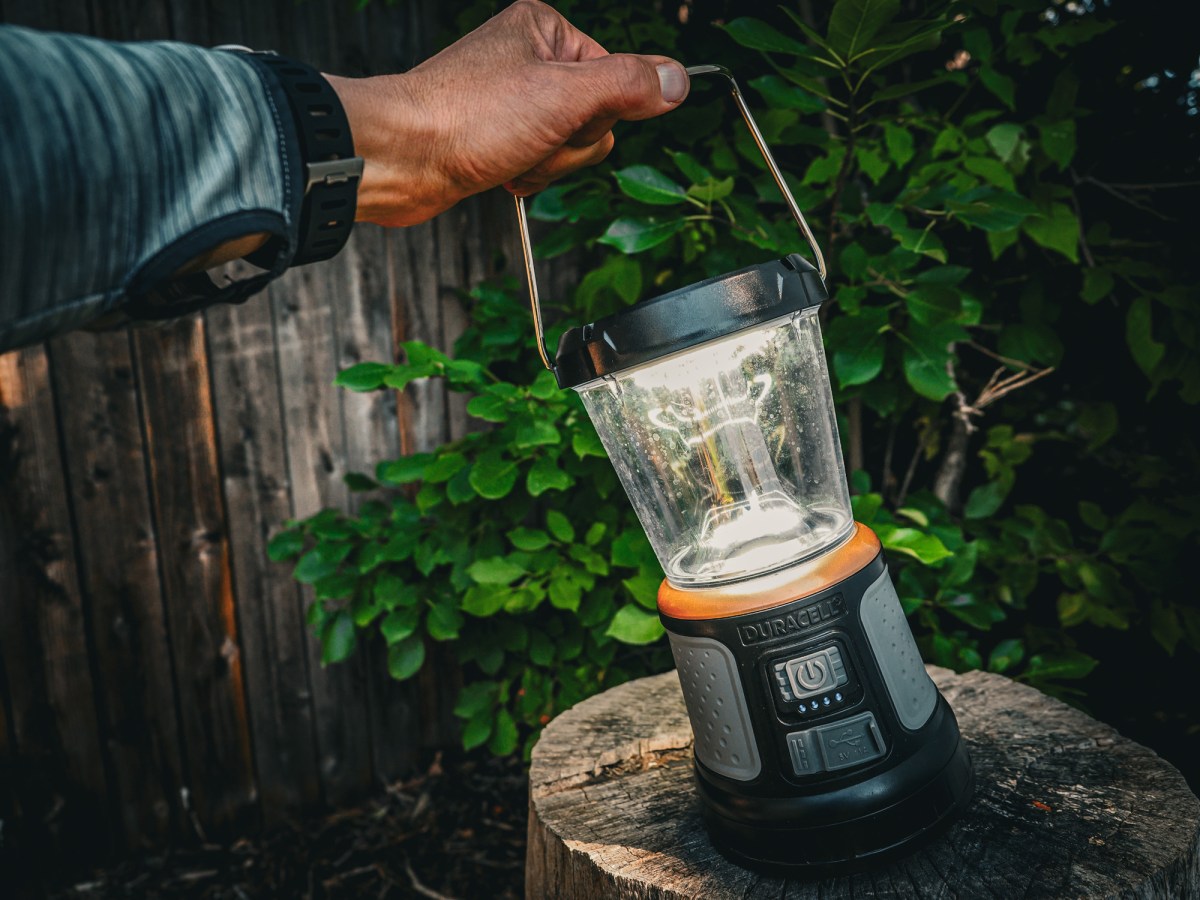
For $30, we’re willing to forgive the ‘surprise’ nature of the Duracell 2000 Lumen Tri-Power, which turns on at a full blast of 2,000 lumens. Get beyond that, and this is one excellent budget camp lighting option, with two separate ways to power it and just as many ways to charge it.
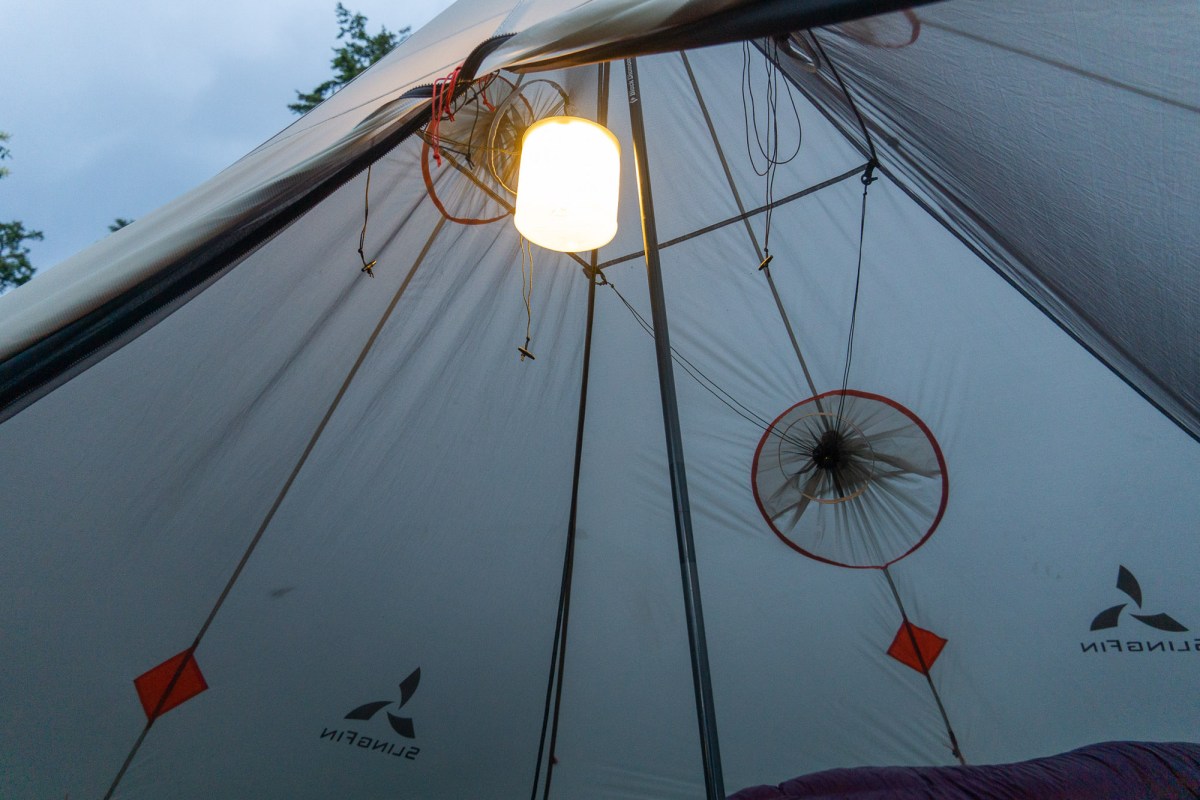
Editorial Director Sean McCoy tested the Tri-Power recently while base camped during an elk hunt, and found the little lantern could hang (and illuminate the interior of an entire 13-foot canvas tent). Unlike some camp lanterns (where feature bloat makes for a difficult-to-use light), the Tri-Power is simple: you have high, medium, and low power, as well as a flashing red light. That’s it.
But tech-trickle down has certainly improved this Duracell lantern, and we were pleased to see it sport both a solar panel and a USB-C port for charging the internal cells. The lantern will also run off of classic D batteries, which make for a great backup. We also used the USB-A output to keep our phones topped off, but wouldn’t count on getting multiple full charges out of it.
The Tri-Power isn’t perfect, and besides turning on at full bore, we find that solar panels are best suited to lower-output lanterns, like the BioLite Luci Charge 360. Even still, we found that the Tri-Power would recharge itself enough to run for a couple of hours on medium after sitting in the sun all day. The red light will also only flash and not stay steady, which isn’t great if you’re trying to use it to preserve your night vision.
For more than half of what our best overall pick will run you, the Tri-Power is an excellent budget lantern.
BioLite Luci Original Clear: Same Price, But Nowhere Near As Bright
The classic Luci Lantern is the same $30 price as the Duracell 2000, but unless you really need the collapsible ability (or plan on leaving it out in the rain often), the Tri-Power is likely a better budget lantern. The BioLite lantern will put out 75 lumens at max output, meaning it’s better mood lighting than serious coverage in camp. You’ll also get double the run time with the Duracell lantern, and multiple power options from D-cell batteries to the integrated solar panel and USB-C-charged internal battery. The Tri-Power is certainly clunky compared to the air-filled Luci Lantern, and if packability is your main concern, the BioLite lantern certainly wins out. For most budget-minded campers, the Duracell lantern still gets our nod.
Coast EAL22 Lantern: Impressive Budget Chops With A Few More Hanging Options
The EAL22 is a very close lantern when compared to the 2000 Lumen Tri-Power, and adds two integrated carabiner clips to either end of the light to make hanging it a breeze. The bail handle of the Duracell lantern can be made to work, but you’ll often need to rig it yourself for areas such as inside a tent or above a picnic table. An important difference between the two lanterns comes in the power source: both are dual-fuel lights that can run from D-batteries and an internal rechargeable battery pack, but only the Duracell comes with the rechargeable built in, while it’s a $44 add-on in the Coast lantern. Given that you can get more light out of the Tri-Lumen, we think it’s the one to get over the EAL22 (unless you need those handy hanging clips, or are fine running on D batteries).
Lumens
360 lm max; 5 lm min
Power source
4,000 mAh Li-ion rechargeable battery
Burn time
110 hrs. on low; 5 hrs. on high
Water resistance
IP67 water resistant
USB port
USB-C in; USB-A out
Pros
- Compact and affordable
- Lightweight
- Mood-light options
- Charge via solar
Cons
- Smallish solar panel and battery
- Not immune from popping
The Quick & Dirty: This is the collapsible camp lantern perfected, and is for campers who might be short on packed space, or who want a lantern that will keep itself charged on long trips.
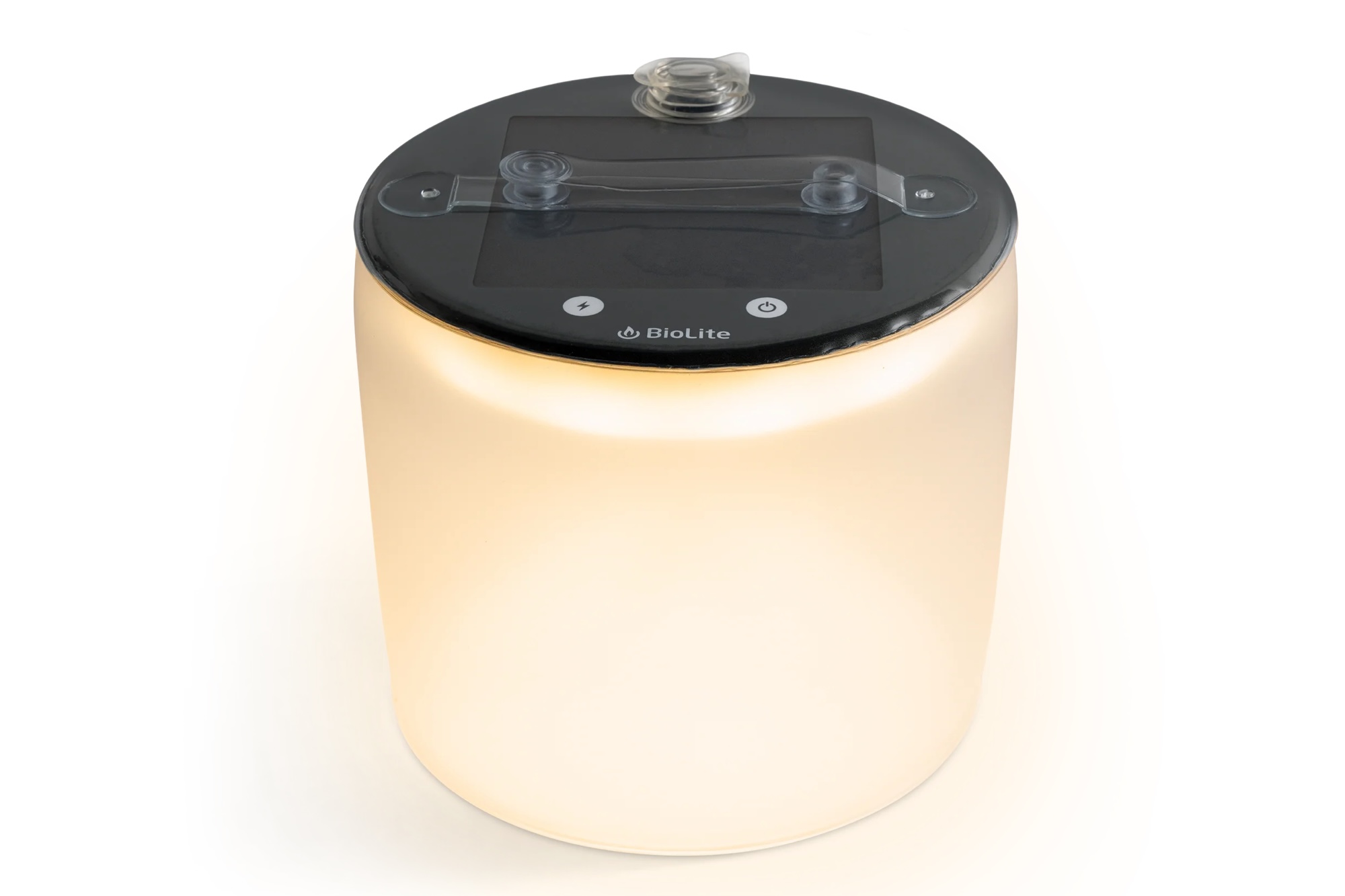
While we plucked the BioLite Luci Charge 360 ($60) for this award, similar praise can be heaped on all of the inflatable Luci (formerly MPOWERD products, now BioLite) light offerings. All are supremely portable, and range from the lovable, petite Luci Candle, which is only $20 and flickers with mock candlelight, to the larger Luci Charge models, which can charge electronics via USB.
Regardless of the model, all Luci lights are lightweight, collapsible, come with a handle for hanging, and can be recharged in a day of sunlight. On road trips, we put ours on the dashboard, which keeps them topped off. One time, the novelty of them there even got us through Mexican customs more smoothly, thanks to a chatty border agent.
The Luci Charge 360 is a great do-everything light. Its 31 LEDs give off a total of 360 lumens, which is enough for backcountry cooking or taking a shower in a dark state park campground stall. It also has a battery level indicator, and that 3.5″ square solar panel is large enough to keep the lantern self-sufficient on longer trips (something smaller solar lanterns struggle with). The internal 4,000 mAh battery pack isn’t quite as big as the one in the AlpenGlow 500, but it still will charge our phones at least once.
BioLite claims its lights can withstand up to 150 pounds of pressure, and the waterproofing has held up when we’ve left them in the rain. But we’ve found that, in general, the Luci lights aren’t particularly durable. We’ve purchased more than a dozen of them over the years, in various models, and about half of them fail after a year or two of heavy use. Some tear, which isn’t a big deal because even if they don’t hold air, they still function.
Still, the Luci Charge 360 is our go-to solar-powered lantern for most situations. Some version of these lanterns has traveled with us for many years, miles, and nights under the stars, and when we run into friends camping, they almost always want to show off their Luci lights, too.
BioLite Luci Original Clear: More A One-Trick Pony, But Half The Price
The Luci Original is just that: the OG, and if you don’t need the special features baked into the Charge 360, you can save a good bit by getting the lo-fi version. The 360 maximum lumens from the Charge version makes it a good functional light source for detailed tasks like food prep, while the 75 highbeam on the Original is better for ambiance or tight quarters like tents. You also get quadrupal(!) the run time on the low light setting by going with the Charge lantern. In our opinion, the Charge 360 makes a better all-around lantern, while the Original is better used in groups across a large space. It’s half the price of the Charge 360, so you can get at least two for a more versatile camp lantern set up.
UCO Original Candle Lantern: An Even More Cozy Light
If the warm light of the Luci Charge 360 just isn’t enough for you, a true candle lantern like the UCO might be the trick. The BioLite lantern will have it beat in just about every metric, but it’s tough to recreate the ambiance of a true candle flicker. The price of the UCO is about half of the $60 Luci Charge 360, but it’s important to remember that the candles are an ongoing expense, with a trio of the quality beeswax candles going for $16. We’ve found that we can get around a 12-hour burn time out of the candles, so a pack of three can supply many weekends of summer. We think a good battery-powered lantern is an essential these days, but the UCO makes a good ambiance add-on.
Pros
- Can add a little warmth to a chilly campout
- Natural candle-lit lighting
- Very easy to use, just light and go
Cons
- Need to be mindful of spilling wax and hot glass
- No turning up this lantern, the light you get is what you get
The Quick & Dirty: A simple camp candle lantern that adds some nice ambiance to your evening. Don’t expect to light up the forest with it, but its inexpensive enough to grab a few.
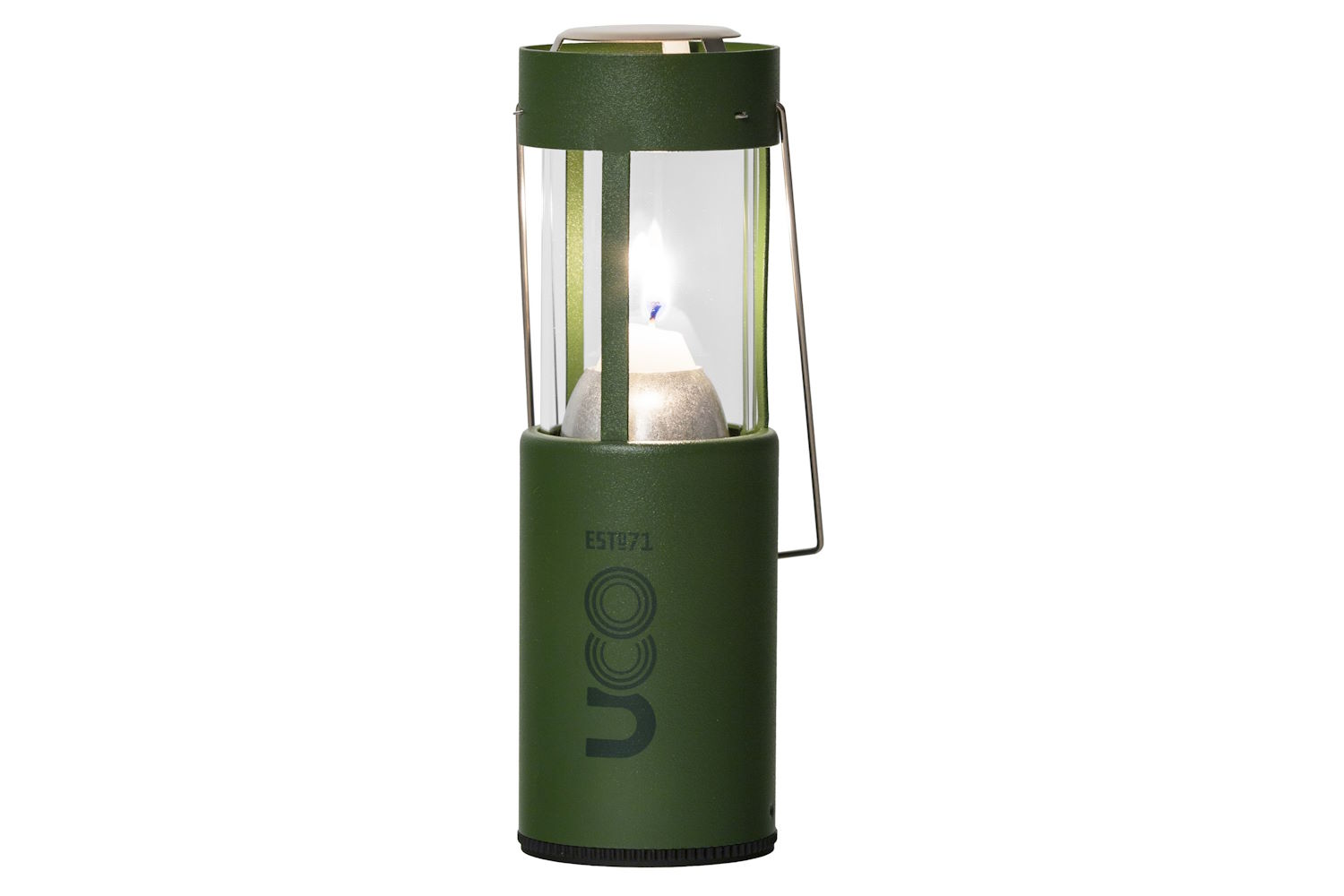
The little UCO Original Candle Lantern ($30) is a must-have for your emergency kit, bugout bag, or go-to camp kit. It’s extremely easy to use — just slide the glass down and light the candle for instant light. The included reflector clip directs the light where you need it most.
A single candle burns for nearly 9 hours, and the spring-loaded system keeps the flame at a consistent height. It does get hot, so use caution when extinguishing or moving. It packs down to 4.25 inches long and weighs just 6.4 ounces.
The neoprene case protects everything during transport and makes it a convenient addition to your camp kit. We’ve used one exclusively at camp when we wanted a classic, soft firelight. And it’s always in our chuck kit, just in case.
Need a little longer-burning light? UCO also sells natural beeswax candles that burn for an extended 12 hours. For those buggy summer nights, there are even citronella candles that’ll keep the skeeters at bay.
To be sure, this lantern is an ambiance-first option — don’t expect to use this as your only source of camp light. While the warm glow is an inviting one, there’s only so much of it, and trying to cook dinner by candlelight can feel a bit limiting when there are so many other electric options out there.
While many lanterns these days incorporate some type of ‘candlelight’ option, a great middle ground to consider is compact gas lanterns like the Snow Peak GigaPower or Mini Flame. These provide a warm glow that is adjustable and often brighter.
But for the real deal, it’s tough to beat the OG, and the UCO is certainly that. It’s also a top pick for emergency preparedness — whether you live in a hurricane zone or have frequent blizzard-induced power outages, it’s a good idea to have a backup light available. The Candle Lantern is an affordable, easy-to-use, reliable option for both camping and emergencies.
UCO Candlelier Candle Lantern: Triple the Candles, Double The Price
The ‘Candlelier’ puts three of the UCO candles in a larger enclosure and puts out more light, warmth, and burn time. The ability to burn one candle at a time triples the run time of this lantern, but also the expense in running it at full blast. The light put out by three candles is impressive and likely worth whatever little you’ll spend on wax if you want to use the lantern with bigger groups. The final trick the Candlelier has to play is its upper heat shield that can rewarm a cup of coffee. If that added bonus is worth about double the price, grab the triple candle version.
Snow Peak Mini Flame Lantern: A Camp Stove Fueled Flicker-Maker
The Mini Flame Lantern burns isobutane backpacking stove fuel, and makes a lovely little flame that emulates a candle perfectly. That flame is also adjustable in intensity, making the light output also adjustable. Both lanterns have a consumable to purchase, but the Mini Flame runs just fine on low camp fuel cans you’d otherwise not use backpacking. The $60 price on the Snow Peak lantern feels a bit steep for what is a simple lantern (and often emulated at a lower price). Buy the $30 UCO if you want a lantern that has an added emergency functionality; the Snow Peak if you backpack more than you camp.
Lumens
6,000 lm max; 350 lm low
Power Source
33 Wh Li-Ion rechargeable battery, solar panel
Burn Time
8 hrs. on low; 1 hr. on high
Water Resistance
IPX4 water resistant
Pros
- 150 feet of illumination in all directions with adjustable petals
- Impressive durability, including the case
- Incredible operating time
Cons
- Life of the internal battery isn’t great
- Requires set-up each time
The Quick & Dirty: A big-camp lantern that brings the daylight back, and the choice for campers who want to keep the party going into the night. You’ll pretty much need to also own a portable power station, and the lantern isn’t cheap itself, but it’s worth it for some.
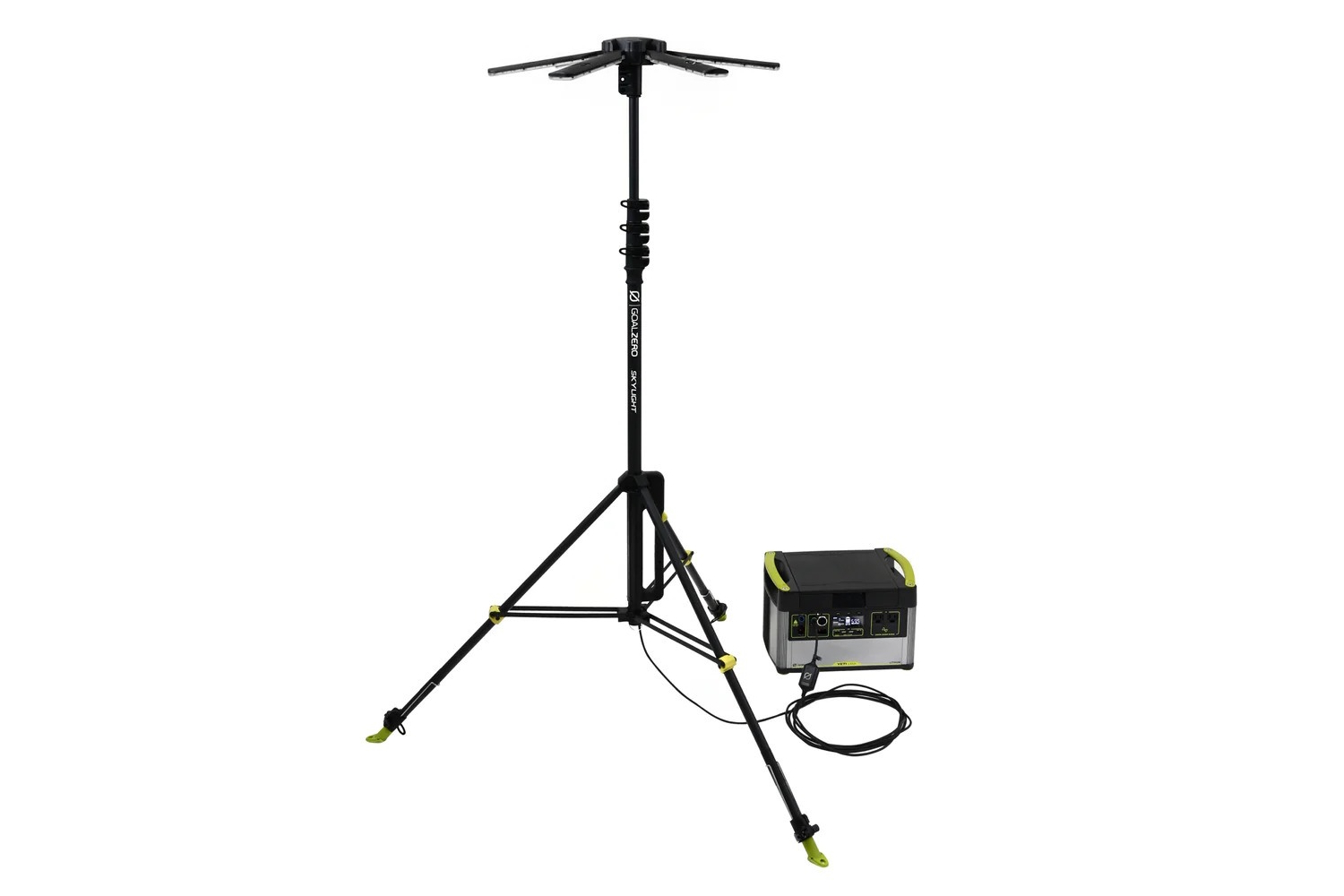
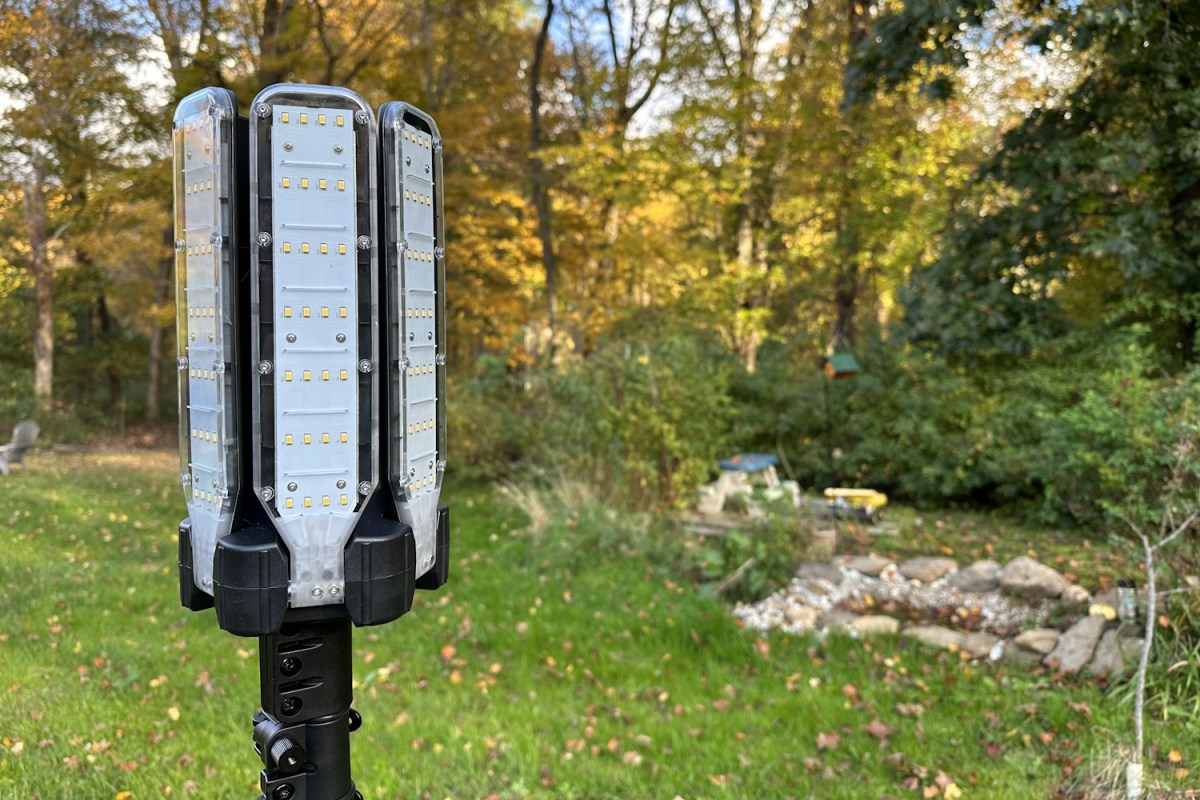
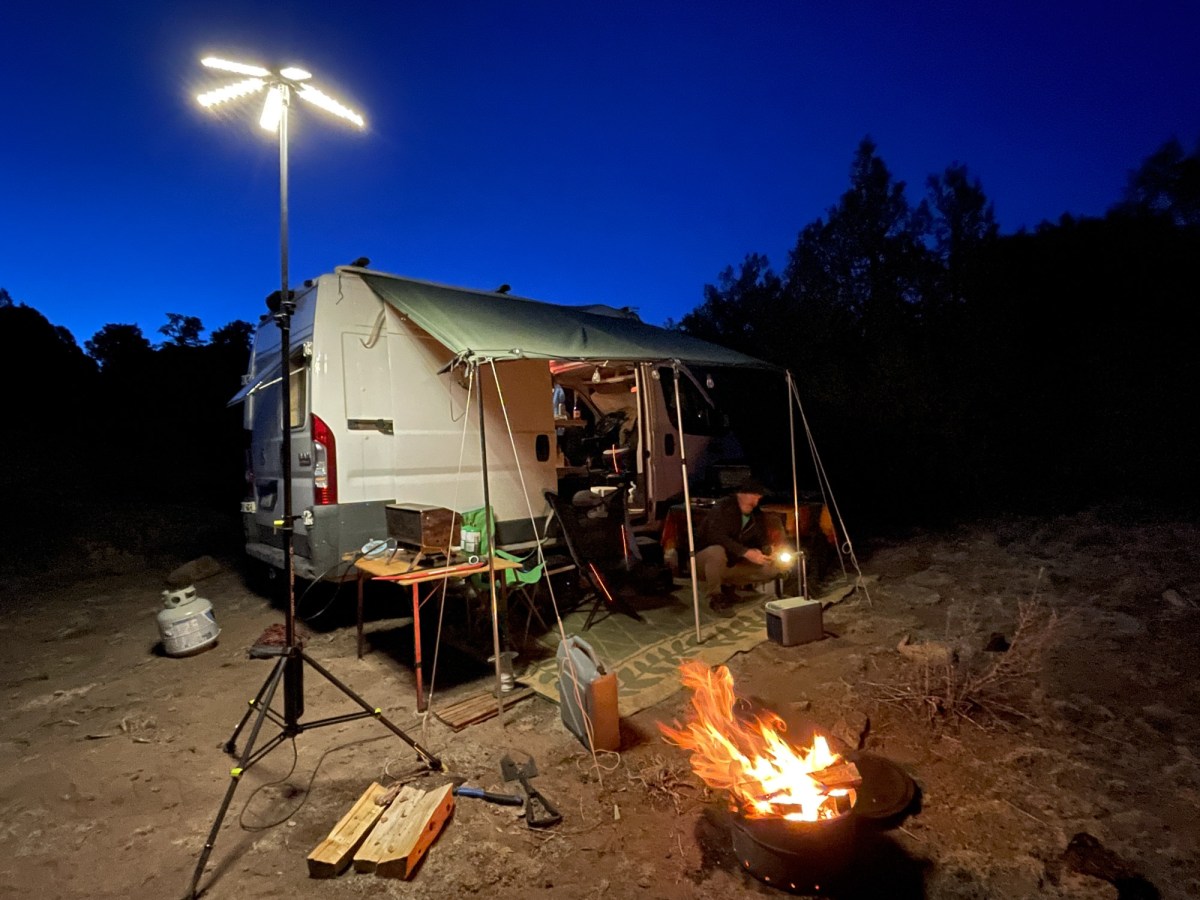
With up to 6,000 lumens (!) and casting light a full 150 feet in every direction, the Goal Zero Skylight Portable Area Light ($400) is a portable sun for your next overlanding, basecamp, or outdoor group shindig. Utilizing our typical go-to for lighting up large campsites, we’d need whole spools of string lights to accomplish the same lighted area, but the Skylight does it with ease.
The design of the Skylight borrows from the world of worksite lights but puts a much more user-friendly bent on it with a warmer light profile (3250K) that casts a cozy glow across your entire campsite. The six LED-covered petals atop the light are all individually adjustable as well, meaning you can direct light where you need it (or away from neighboring camps).
The whole apparatus is planted atop a 12-foot telescoping pole that anchors itself securely with a broad tripod base. Being able to raise the light this high not only increases the spread but also keeps buzzing insects that might be attracted to it out of your orbit. During testing, even the sandy soils of the Northeast that typically give camp chairs trouble weren’t an issue for the Skylight, which incorporates staking holes in each leg to secure it.
The Skylight does sport an internal battery (of 33 Wh, or ~8 hours on low), but was designed to ideally be run off of an external battery source, such as Goal Zero’s Yeti Power Stations, or from a 12V cigarette lighter plug. When powered by one of these large battery banks, run time increases tremendously, up to 375 hours on low with the Yeti 1500X.
Rounded out with four different lighting levels — including a ‘boost’ option — the Skylight has become standard issue on our overlanding excursions where we need light for a broad area in between vehicles. Complemented with a few close-quarters lanterns like the Black Diamond Moji or Goal Zero Crush, you’ve got a backcountry lighting system to rival many rock concerts.
Devos Outdoor LightRanger 1200: Less Light, Less Height, Less Expensive
The $150 LightRanger 1200 takes a little bit of a different design tack as the Skylight, but accomplishes many of the same goals and hosts a few added functionalities. It won’t match the Goal Zero lantern for overall output (6,000 lumens on ‘Boost’ mode) as it does 1,200 flat out, but for most tasks this is plenty, and matches the Goal Zero’s ‘medium’ output. The more moderate output is partnered with a 10,400 mAh internal battery that gives this lantern a much better standalone run time of 80 hours on minimum (at 60 lumens); the Goal Zero will only do 8 hours off the cord. The lantern element isn’t petaled like the Skylight, and also stands on a shorter 8-inch stand. If you don’t already own a portable power station, the LightRanger might be a better standalone overhead choice.
BougeRV T1 Telescopic Camping Lantern: A Bargain That Packs On Versatility
At $120, the new 2026 T1 lantern from BougeRV undercuts both the LightRanger 1200 and Goal Zero Skylight, and adds even more functionalities than either. Overall height is going to be the biggest tradeoff in an otherwise feature-rich lantern, and the 5.5′ tall stand doesn’t give you much overhead lighting capability. That said, you do get: a large 15,600 mAh internal battery, 90-hour maximum run time, a very-suitable 3,000-lumen high mode, and three different light colors (cool white, warm, and red). Like the LightRanger, consider this lantern if you don’t already own a power station to run it from. The standalone nature of this lantern makes it very comptitive with the Goal Zero Skylight, just keep the lower overhead height in mind before pivoting.
Lumens
140 lm max; 20 lm low
Power source
4,000 mAh Li-ion rechargeable battery, solar panel
Burn time
40 hrs. on low; 8 hrs. on high
Water resistance
IPX4 water resistant
USB port
USB-C in; USB-C and USB-A out
Pros
- Ability to light up a broad area, focus on specific zones
- String lights store on the lantern, limiting tangles
- Detachable power hub powers your electronics with USB-A and USB-C ports
- Warm light tone is softer on the eyes
Cons
- The solar panel is small, and the charging capacity is limited
- Take care not to snag the lights, as the wiring can break
The Quick & Dirty: The best option for covering a wide area in camp with soft light. This won’t be the brightest option, but it will run for a long time, and enhance the camp energy.
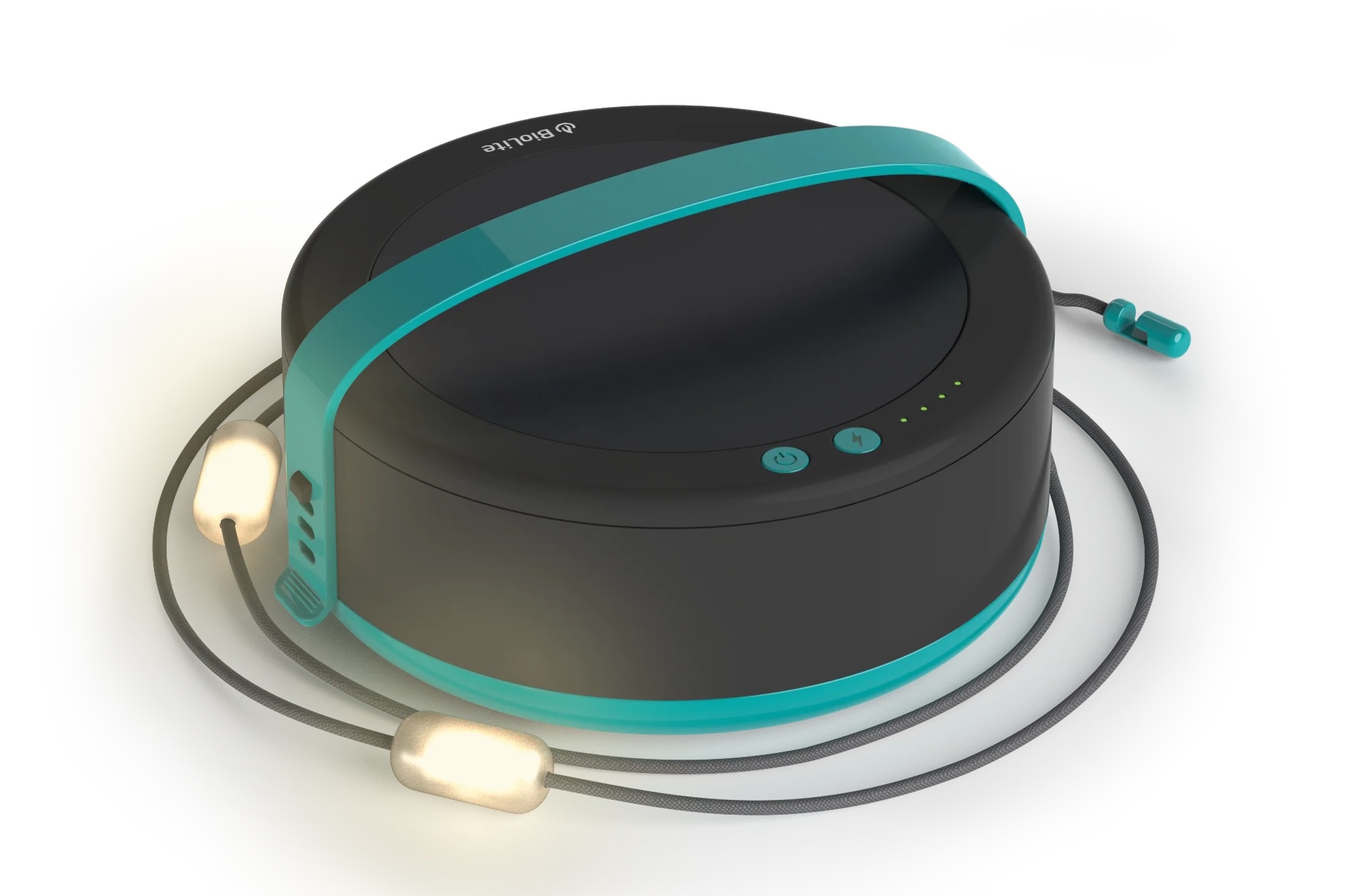
The BioLite Luci Solar String Lights ($100) are everything we loved about the old MPOWERD version of these twinkling stars, just with a new name. Twenty individual light pods are spread across 44 feet of braided nylon cord, allowing you to light up a large area. It’s all the camp ambiance you need in a neat package.
In practice, we were able to light up entire campsites with these string lights, stretching from tents to picnic tables and back again. You’ll need to get creative to secure the lights on either end (we quite like the Nite Ize Gear Ties for this), but once you’re set up, the lights will run a full 8 hours on high. At a more mellow ‘medium’ setting, we were able to get close to the full 24 hours of run time that the brand claims.
We particularly like the way these lights store in themselves. Simply wrap the string lights into the solar base and twist closed. Pro tip from our testing: Be sure to avoid too many overlapping bulbs or it will become too bulky to close.
Because of its small form factor, the integrated solar panel does struggle a bit to charge the lantern from flat dead (something we also noticed with other solar-powered lanterns). It charges fully in about 3-5 hours via USB-C or 16 hours via solar, so we recommend charging it up prior to camping and then using solar to keep it topped off throughout.
We’ve used these string lights nearly every day for many months, and they’re still going strong. The color is a pleasing, natural warm light, and we’ve been impressed with how bright it gets on the highest setting. The Luci Solar String Lights are a favorite option for adding a bit of camp ambiance or brightening up the backyard.
Revel Gear Trail Hound 30 Ft. Camping Light: Less Expensive Fairy Lights For Tents
The Trail Hound string lights are best for smaller camp spaces, such as inside of a tent or while car camping. They are powered via the USB cord, meaning you’ll need to provide your own portable power station or power block to run them. This does make the the BioLite String Lights a bit more of an all-in-one solution, but also fairly bulky to pack around if you’ve got far to get to your camp. The $25 price for the Revel Gear lights also affords you some more wiggle room in getting a few sets; for the same $100 spent on the BioLite’s, you could get four of the Revel Gear strands and cover 120 feet. Simply: if you’ve already got a camp power source you like, consider the Trail Hound string lights; if you want a self-contained lantern, look to the Luci Solar String Lights.
BioLite Luci Site Lights: Versatile, But Easy To Lose
The Luci Site Lights are interesting little bulbs that both interface with a tent stake to provide some low-level ambiance lighting, or can be strung along guylines for the same effect overhead. They aren’t that bright (BioLite doesn’t publish a lumen spec), and you’ll only have six of them compared to the 20 bulbs on the String Lights, but for sprucing up the lighting around a tent, they’re a solid choice. The 20 hours you’ll get out of each of the Site Lights is about half of what the String Lights will run for, but both cases recharge via solar, so your run time will be better with clear days inbetween your camp overnights. If you want to illuminate a big space, the string lights are a better choice. But for tighter quarters, these are a good consideration.
Burn Time
13 hours on low
Pros
- Classic styling and natural lighting
- Broad footed base limits risk of tipping
- Convenient carrying case
- Makes an excellent place to gather around
Cons
- Requires consumable propane, which can add up
- Glass lens can become hot during use
- Fairly large footprint
The Quick & Dirty: The classic propane camp lantern choice for ambiance and dependability. Uses the same fuel as your camp stove likely does, but also requires a little user care to be safe.
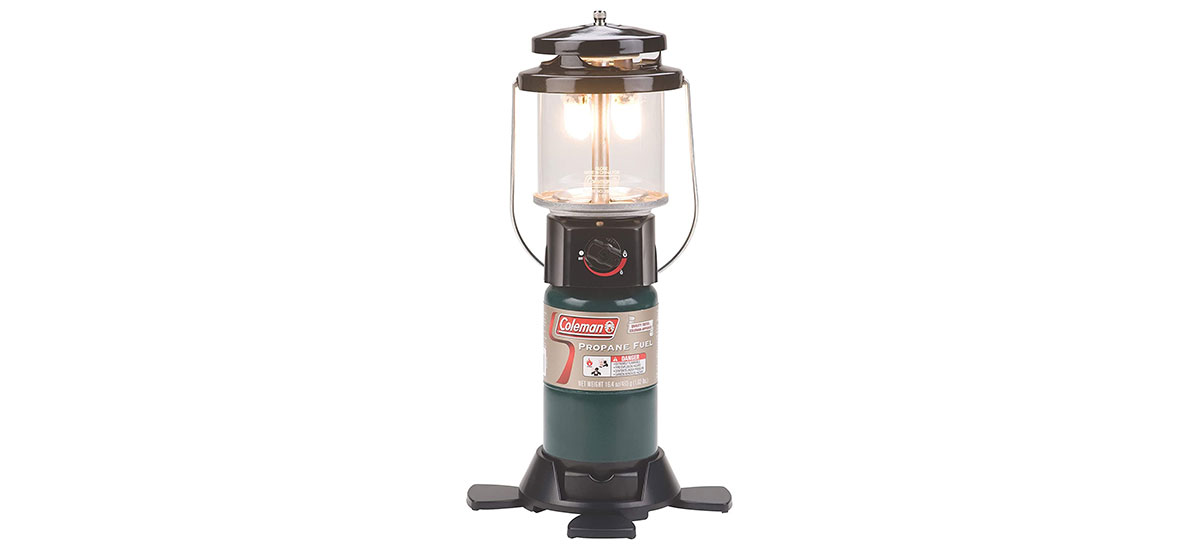
No lantern review would be complete without this classic Coleman Deluxe Propane Lantern ($65). If you’ve never used a gas lantern, it’s important to make note of a few things. First, in lieu of light bulbs, it uses mantles that fill with fuel and burn brightly. The glass can become extremely hot, and caution should be used when handling it.
That said, it’s a solid lantern that will last for years. And it clocks in at just $65. The dual-mantle design pumps out 1,000 lumens on high, and it will run for nearly 7.5 hours on high before needing a new fuel canister. The green propane cylinders run about $10 for a single 1-pound canister. While this isn’t outrageously expensive, it does add up and should be a consideration when lantern shopping.
We found it easy to thread the light onto the propane cylinder and appreciated the footed base that prevents tipping. It’s worth noting that you will need a match to light this lantern. But once it’s up and running, it’s easily manageable for the entire evening. There’s even a plastic base that interfaces with the propane canister to ensure tipping won’t be an issue.
When it comes to versatility, the era of gas lanterns has largely moved away from propane-fueled options like this in favor of smaller, isobutane-fueled options like the Snow Peak GigaPower, in our opinion. That doesn’t mean that the Deluxe is lacking in any old-school charm, however (it’s got it in surplus), but that you should consider potentially having a few other lanterns on hand for more functional use. This lantern makes a killer place to gather around, and when supported by a few electric modern options, it’s a winner.
When you’re ready to turn the lights out, be sure to let the Coleman Deluxe cool down before disassembling. Thankfully, the lantern ships with a hardshell case to port it around in between camping trips.
Coleman Powerhouse Dual Fuel Lantern: Grandad-Approved Gasser
The Powerhouse Dual Fuel Lantern from Coleman is even more of a throwback than the Deluxe Propane lantern, and runs on either camping white gas or gasoline. This makes it a bit more involved than plugging in a new propane canister on the Deluxe, but it is more versatile if you already run your camp stove on the same fuel. Both white gas and gasoline both pack in more BTU energy per liter compared to propane, and do better at freezing temperatures, making the Powerhouse both more efficient and dependable in all conditions. If refilling a lantern doesn’t bother you, the Dual Fuel Lantern can be a great pivot.
Coleman Classic Recharge 800 Lumens Lantern: Classic Looks With A Battery and LEDs
The Coleman Classic Recharge is styled to look like the gas-fueled Powerhouse and Deluxe lanterns, but is powered by an internal 4,800 mAh battery. The LED bulb will put out up to 800 lumens on high, which is just about what both of the older designs will do as well. Run time, however, is much longer in the battery-powered lantern, which can dial back to 100 lumens and run for 45 hours. You also get the ability to use the lantern as a power source for your other electronics, making it more versatile. We can’t deny the old school charm of a gas lantern burning, however, so think hard on if the battery-powered update is worth it to you before jumping up to it.
Other Lanterns to Light Your Way
The lineup of lanterns above is enough to keep any campsite well-illuminated long into the evening, but they aren’t the only lights we’re fans of. Consider our alternative options below as stellar runner-ups.
Lumens
650 lm max; 25 lm low
Power source
5,200 mAh Li-Ion rechargeable battery
Burn Time
240 hrs on low; 4 hrs on high
UAB Port
USB-C in; USB-C and USB-A out
Pros
- Nice and bright at 650 lumens
- Multiple charge in and out options, with modern USB-C
- Can be hung or used on tabletop
- Full spectrum color modes
Cons
- 5,200 mAh battery isn’t as large as top-tier lanterns
- Bit heavy to hang from inside tents
The Quick & Dirty: This is a solid alternative to my top pick, and even bests it in a few areas. The battery isn’t quite as large as other lanterns, however, and the colors aren’t as vibrant.
So bright you can see it from space — well, not quite, but at 650 lumens, the Black Diamond Orbiter 650 Lantern ($80) can still more than light up your next campout. With a hefty amount of smart functionality onboard, this lantern absolutely impressed in our testing. Compared to top lanterns like the BioLite AlpenGlow 500, its honestly neck-and-neck, and your choice will come down to a few slight differences.
Looking like it’s liable to blast off your camp table, the Orbiter lantern combines a number of different hanging and folding modes with six different lighting settings, each of which is dimmable or color-changing. The folding leg design is reminiscent of the Goal Zero Lighthouse lantern, but better executed, in our opinion, as it sports three legs to the two on the Lighthouse.
This design allows the lantern to be both propped up above cluttered picnic tables, as well as hung from above with the double-hook metal loops to attach to tent webbing loops or cordage around camp. An additional LED at the base of the lantern provides the illumination for this mode, and we found in our testing that it’s a targeted light that’s perfect for positioning over camp stoves or board games.
Moving through the lighting modes, the lantern offers up a bright white, along with the additional downward spotlight, the spotlight on its own, a flickering campfire mode, solid colors, and a color cycling mode. It’s the most feature-packed lantern we’ve encountered to date with this many modes, and they all can be dimmed to as low as 25 lumens and cranked to as high as 650.
Rounding out the Orbiter 650 is a forward-thinking USB-C charging port (recharge takes about 3.5 hours), as well as not one but two options for charging other devices: a USB-A port and a USB-C port. The 5,200 mAh internal battery bank can recharge your electronics, and while it’s not quite as large as the 6,400 mAh cell the BioLite AlpenGlow 500 sports, the additional charging options go well beyond that lantern.
Black Diamond Orbiter 450: Cute, But Just Buy The Big One
The Orbiter 450 is pretty much the same lantern as the 650, with the only differences being the weight, lack of colapsible legs, and smaller battery. The 4-hour run time (at the 250 lumen ‘medium’ setting) is a little brief compared to the 10 hours you’ll get from the 650 version, and we’d rather have enough run time for an entire night rather than most of it. The 450 will also charge-out to your phone, but the 2,000 mAh battery won’t have much left over if you recharge your phone and want to use the lantern later. You’ll save $20 by getting the smaller version, but we think the extra spend here is called for.
Goal Zero Lighthouse 600 Lantern: A Versatile Charger
The Lighthouse 600 Lantern from Goal Zero ticks a lot of the same boxes the Orbiter 650 does, and the collapsible legs are the strongest tie between the two. The light they put out is also similar at around 600 lumens, but you won’t get the colors and different whites that the Orbiter can do in the Lighthouse. The Goal Zero lantern instead covers the emergency supply side of lanterns and adds a hand-crank dynamo and a red light function. Both lanterns are the same price, so draw the line between more fun-functionality and always-ready reliability when deciding between the two.
Power Source
Li-ion or alkaline
Water Resistance
IP54 (water- and dust-resistant)
Measured Weight
1 lb., 4 oz.
Pros
- Voice control works great
- Several modes for color, temp, and brightness
- Lightweight and easy to pack
- Dual power options (rechargeable and alkaline)
Cons
- Max runtime 16 hours
- Voice control shuts off after 15 minutes of inactivity when off
The COAST EAL35R doesn’t bring raw power or a huge run time, but instead something we’ve never seen before: “SpeakEasy” voice-control technology. This might seem like a gimmick in a lantern, but Editor in Chief Adam Ruggerio found it oddly transformative, especially when you’re tucked deep into a sleeping bag, and the last thing you want to do is fumble for a power button. By simply saying “COAST off,” you can kill the lights without inviting in the chill.
Constructed with a polycarbonate diffuser that Adam confirmed is ‘punch-proof,’ the EAL35R delivers up to 1,000 lumens of white light. It also hosts warm and red light modes, which are essential for preserving night vision. While its IP54 rating protects against dust and splashes, it’s the Dual Power capability that adds real-world security; the lantern runs on an internal rechargeable lithium-ion battery but can also run on four AA alkalines, ensuring you aren’t left in the dark if you exceed the modest 16-hour runtime.
When compared to category leaders like the BioLite AlpenGlow 500 or the Goal Zero Lighthouse 600, the EAL35R trades extreme battery longevity for hands-free convenience and an aggressive $40 price point. While the AlpenGlow offers more sophisticated color-mixing and the Lighthouse provides superior runtimes of over 300 hours, neither allows you to control the ambiance from across the tent.
However, it’s worth noting a technical limitation: the voice-activation feature automatically shuts off after 15 minutes of inactivity to save power, meaning you’ll still have to manually turn it on when you wake up in the morning.
For the price, the EAL35R is an impressive little lantern that serves as both a light source and a backup power bank. It may not be the most featured or bright, but for casual car camping or wall-tent hunting trips, it eliminates one of the small annoyances of camp life. If you prioritize convenience over the week-long battery life of a Fenix or Goal Zero, this lantern is a standout choice for your kit.
Power source
1,000 mAh Li-ion rechargeable battery
Burn time
24 hrs. on low; 6 hrs. on high
Water resistance
IP67 waterproof
Pros
- High-definition cool white light is great for detail work like food prep at camp
- Budget price
- Tough design can withstand water and abuse
- Recharges in 7 hours with full sun
Cons
- Not the longest burn time on high power
- Cool white light without matte finish can be tough to look directly at
The Quick & Dirty: The lo-fi classic inflatable lantern, perfect for adding some light around camp. Recharges itself, but doesn’t have the biggest built-in battery.
The BioLite Luci Lantern Original Clear ($30) is the inflatable lantern that everyone should own. While not quite as feature-packed as the Charge 360 model, this classic is affordable, bright enough, and has earned its keep around camp.
This little inflatable light source puts out up to 75 lumens. It keeps things simple with only four light modes: low, medium, high, and flashing. The cool white light is ideal for detail-oriented tasks like food prep, but if you need something a little softer, the lantern is also available in a matte finish that’s easier on the eyes.
The Luci Lantern’s solar charging has always been a big deal, mostly because it just works. Other cheaper lanterns might implement solar cells, but they are subpar and fail to recharge at a decent rate. The Luci Lantern will top off completely in 7 hours, meaning a full day of sun will keep you charged indefinitely.
The Luci Lantern has changed much since it hit the market 10 years ago, but thankfully, its kept up with modern technology and integrated a USB-C charging port. This gives you a failsafe backup to recharge your lantern if the sun isn’t shining.
Luci Lanterns aren’t bombproof, and our years of use have shown that they will eventually develop a hole or the hanging strap will rip off. Even still, we get a few solid years of use before this happens, and for the money, these are solid camping lanterns.
Goal Zero Crush Light Lantern: A Breathless Alternative
The Crush Light Lantern accordions open to similar dimensions to the Luci Lantern, but doesn’t inflate, meaning it can’t puncture. The Goal Zero is cheaper and arguably easier to deploy (no blowing required), but it offers a lower lumen count and a less durable plastic housing. Choose the Crush Light for casual backyard use; stick with the Luci Original for a more rugged, waterproof backcountry light.
BioLite Luci Charge 360: The Power Bank Upgrade
The Luci Original is the purist’s solar lantern, however, for $30 more, the Luci Charge 360 adds a USB-A output port to charge your phone and bumps the brightness from 65 to 360 lumens. The Original is thinner and lighter for ounce-counting backpackers, but the Charge 360 is a much more versatile tool for basecamp. In our opinion, the Original is better as a for a set it and forget it backup, while the Charge 360 is the choice if you need to juice your electronics.
Lumens
1,600 lm max, 5 lm min
Power Source
5,000 mAh Li-Po rechargeable battery
Burn Time
285 hours on low; 4 hours on high
Pros
- Highly adjustable color temp and brightness
- Rugged metal case
- Fast charging with USB-C
- Long burn time on low
- Small overall profile
Cons
- Heavy for backpacking
- Pricey
Read Review: More Than One Way to Light a Campsite: 3 Fenix Lanterns Compared
The Quick & Dirty: A rugged lantern with a metal build, great waterproofing, and light temperature adjustment. It’s more of a flood light than a camp lantern, so consider your use case.
Right out of the box, it’s easy to covet the Fenix CL27R ($85) because of its exceptionally sturdy feel. It has a rugged metal case and build that puts it head and shoulders above the other lanterns. On top of that, it’s also more compact than the previous CL30R lantern we’ve reviewed. If you want a camping lantern for the end of the world, this is it.
But the CL27R is more than just a tough face, and you can dial in the light not only in brightness but also in color temperature — a feature we haven’t seen in many other lanterns. These settings are step-less, meaning they progress as you turn a dial rather than change at incremental settings.
For temperature color, those ranges span from a charming 2,700K to a stark-white 6,500K. For brightness, it tops out at an alarmingly intense 1,600 lumens, which can cover a nearly 600-foot radius. It can also dim down to the more friendly glow of a soft candle. In spotlight mode, it has a narrow 14.5-degree beam, and in floodlight mode, a 105-degree beam. Spotlight and floodlight modes can be used together or independently.
Other stellar features of note are USB-C recharging, an IP66 waterproofing rating, and drop resistance to 1.5 meters. On the short end, it lasts nearly four hours (a claim we verified with testing). On the long end, it can eke out 285 hours on its lowest setting. It also has a red-light mode and recharges in about 2.5 hours. On our weight test, it came in at 10.5 ounces, which is actually slightly lighter than the company claims.
The Fenix CL27R also comes with a number of helpful and unique carrying and hanging options. Its handle rotates 360 degrees, which can prop up the beam at different angles, plus makes it easy to carry and hang. The handle is also magnetic and includes a tripod mount, which is particularly helpful for low-light filming and photography. Alternatively, you could couple it with a monopod to reenact your favorite Lord of the Ring scene — all fair game.
Jokes aside, camping with the CL27R really does give one a feeling of reassurance: it’s highly versatile and comforting, like that friend who’s always reliable no matter what hits the fan. And in a pinch, it has enough power to blind an intruder, and easily enough heft to knock out a rabid chupacabra.
Black Diamond Orbiter 650: A Softer Tabletop Ambiance
The CL27R looks a bit like camp lantern engineering with a magnetic base and a 1,600 lumen max output, but its light can feel a little industrial. The Orbiter 650 offers a softer and diffused glow that is better for social gatherings. We found that the Fenix makes a great work light for vehicle repairs or late-night camp repairs, and the Orbiter is more pleasant for the campfire or dinner table. The price is within $5 for either lantern, so for high-output utility look at the Fenix; and for camp vibes consider the Black Diamond.
Fenix CL30R: The Long-Haul Powerhouse
If you like the Fenix build but need even more runtime, the CL30R uses three replaceable 18650 batteries to provide a boost in endurance. The CL27R is more compact and hosts a unique dial for color temperature adjustment, which the CL30R lacks. Choose the CL27R for its versatility and adjustable tint; choose the CL30R if you need to light up a basecamp for a week straight without a recharge.
Burn Time
5 hours on a 4 oz. fuel can
Pros
- Burns isobutane, which you may already have on hand from making dinner
- Pleasant and warm light output
- Piezo ignition makes lighting easy
Cons
- Will need to be used with care, as the glass globe can break
- You may need an additional canister if you want to cook food and power the lantern
The Quick & Dirty: An isobutane-powered lantern that’s perfect for backpacking, or adding camp ambiance. There’s some care required, as well as an extra can of gas.
The Snow Peak GigaPower ($87) is a little lantern that runs on isobutane (just like your favorite backpacking stove) and doesn’t take up much room. It weighs in at just 4.6 ounces and measures about 3.75 inches around and is the perfect addition to your camp table come dinner time.
We found the light output particularly pleasant during our testing, yet plenty bright to complete all our camp chores. It has a max output of ~400 lumens and will run for about 5 hours in warm conditions. Similar to stoves, the run time decreases in colder weather. The benefit of running on stove fuel, however, is that you can use your depleted canisters that are too low to bring along for cooking. Genius!
The body of this lantern is machined aluminum, coupled with brass fittings that ensure a smooth attachment to a gas canister. The glass globe is held in place by a stainless steel cage and houses the lantern mantle that will be needed to illuminate this lantern. This takes a little finesse the first time, but once it’s in place the lifespan should be many nights before it needs replacement.
An added bonus? Since it’s burning fuel, this little lantern will give off a bit of hand-warming heat, perfect for when the chill sets in. Just remember to let it cool down before stowing — something we were (painfully) reminded of during our initial use.
Compared to the gas lanterns of olden times (we’re looking at you, Coleman Deluxe), our allegiances have shifted to compact backpacking fuel lanterns like this one. They are simply easier to use, don’t require bulky green propane canisters, and put out enough light to count.
It began raining while we were using this lantern, but it never went out or had any issues. Being made of glass, it is susceptible to breaking if dropped. But the included hard carrying case will keep it safe when packed. For a portable warm glow, the GigaPower Lantern is our top choice.
UCO Original Candle Lantern: The Real Deal Candle Flame
The GigaPower uses isobutane to produce a max of around 400 lumens of light and a bit of heat. The UCO Candle Lantern provides a similar real-flame aesthetic but at a fraction of the cost and brightness. The GigaPower is a high-performance tool for lighting a large area, whereas the UCO is a personal ambiance light. Choose the GigaPower if you need some more serious illumination; the UCO if you just want a cozy, silent flicker to eat dinner by.
Coleman Deluxe Propane Lantern: The Heavy-Duty Workhorse
For car campers who already carry 1 pound propane tanks, the Coleman Deluxe is much brighter and more stable. The Snow Peak is significantly smaller and lighter, making it the only gas lantern we’d consider for short backpacking trips. We found that the light cast by the Coleman is farther reaching, and better suited for larger camps or groups. The fact that the Deluxe Propane Lantern is less expensive also helps it, and makes it a good option for gas-powered light.
Power Source
5,200 mAh Li-ion rechargeable battery
Burn Time
320 hours on low; 2.5 hours on high
Water Resistance
Unpublished
USB Port
USB-A in; USB-A out
Pros
- Unique crank ability provides unlimited power supply
- Simultaneous recharge and discharge means you can provide light while charging
- Multiple mounting options, including hanging hooks and extendable legs
- Able to light only one side of the lantern at a time
Cons
- The permanently attached USB cord seems like a failure point
- Wire legs are a bit wobbly
- No light diffuser makes higher outputs difficult to look at
The Quick & Dirty: An emergency-ready lantern that can be charged by hand crank in a pinch. The multiple charging options make it versatile, while the tacked on USB cord dings it.
Leave it to solar-power guru Goal Zero to come up with a lantern that incorporates a number of smart charge and recharge features that turn the Lighthouse 600 Lantern ($80) into a light source you can trust to stay on when you need it.
With three methods of charging the lantern (solar panel, USB, or spinning the crank atop the unit), we never felt we’d see the flicker of this lantern running out of juice. When we tested the brand’s claim of 10 minutes of light for every minute of cranking, we found the numbers to be fairly accurate (and our wrists tired). It makes an excellent basecamp lantern, perched above a table or hung from the inside of a tent.
While the integrated charging USB cord is a handy touch, we do see this as a potential future failure point should the cable become snagged or kinked. A simple USB port with a cover would have been our preference.
Beyond this, there’s one Achilles heel to the Lighthouse that keeps it from ranking higher in our books, and that’s the diffuser — or the lack of one. With a clear plastic globe, the higher reaches of this lantern become too bright to look directly at, and multiple of our testers commented on this independently.
We also had some issues with the twin-leg design, which, unlike the three legs of the Black Diamond Orbiter 650, could be made to tip over when jostled.
Unlike some of the other lanterns on our list, the Lighthouse 600 doesn’t use an integrated solar panel to recharge from the sun. This means you’ll either need to already own a Goal Zero solar panel or purchase one (check out our favorite panels in our Buyer’s Guide). For those who use a panel regularly, the Lighthouse will be an obvious companion.
BioLite AlpenGlow 500: The Modern Alternative
The Lighthouse 600 is an old-school favorite with a hand crank and a classic lantern silhouette. The AlpenGlow 500 is a more modern take, offering high-CRI color modes and a sleeker aesthetic. While the Goal Zero is better for disasters where you might lose power for days, the AlpenGlow offers a more natural light that is easier on the eyes during a card game. Consider which side of the camp lighting spectrum you’re on before buying either.
Goal Zero Lighthouse Micro Flash: A Handheld Flashlight Version
If the 600 feels too bulky for your kit, the Micro Flash provides a similar rechargeable function in a pocket-sized flashlight/lantern hybrid. You lose the hand crank, the 600-lumen output, and the large power bank, but you gain extreme portability (the 2.5 ounce Micro Flash slips into your pocket). Choose the 600 for family basecamps when you need a classic lantern; choose the Micro Flash for solo adventures or as a backup light.
Camping Lantern Comparison Chart
| Camping Lantern | Price | Lumens | Burn Time | Measured Weight | Who Its For |
|---|---|---|---|---|---|
| BioLite AlpenGlow 500 Lantern |
$80 | 500 lm max; 5 lm min | 200 hours on low; 5 hours on high | 13.8 oz. | Most campers who want warm light, a good run time, and some charging ability |
| Duracell 2000 Lumen Tri-Power | $30 | 2,000 lm max | 50 hours on low | 1 lb., 14 oz. | Budget campers and backup-seekers |
| BioLite Luci Charge 360 | $60 | 360 lm max; 5 lm min | 110 hrs. on low; 5 hrs. on high | 10.1 oz. | Roadtrippers and those who forget to charge electronics |
| UCO Original Candle Lantern |
$26 | 20 lm max | 9-12 hrs. | 6.4 oz. | Warm ambiance seekers and emergency preppers |
| Goal Zero Skylight | $400 | 6,000 lm max; 350 lm low | 8 hrs. on low; 1 hr. on high | 12 lbs., 1.9 oz. | Trailhead tailgaters or big groups |
| BioLite Luci Solar String Lights | $100 | 140 lm max; 20 lm low | 40 hours on low; 8 hours on high | 1 lb., 10.2 oz. | Glampers and RVers |
| Coleman Deluxe Propane Lantern |
$65 | 1,000 lm max | 13 hours on low | 3 lbs., 11 oz. | Old-school campers who want that classic glow |
| Black Diamond Orbiter 650 | $80 | 650 lm max; 25 lm low | 240 hrs on low; 4 hrs on high | 1 lb., 1.9 oz. | Campers who want a lantern that doubles as a power bank |
| COAST EAL35R | $40 | 1,000 lm max; 120 lm low | 16 hrs on low; 3 hrs on high | 1 lb., 4 oz. | Those prioritizing hands-free convenience over ultimate performance |
| BioLite Luci Original Clear | $30 | 75 lm max | 24 hrs. on low; 6 hrs. on high | 4.4 oz. | Bargain hunters and car campers |
| Fenix CL27R | $85 | 1,600 lm max, 5 lm min | 285 hours on low; 4 hours on high | 10.5 oz. | Folks who need to illuminate a big camp and want robust durability |
| Snow Peak GigaPower Lantern Auto |
$87 | ~400 lumens | 5 hours on a 4-oz. fuel can | 4.5 oz. | Backpackers and minimal campers who want to keep their camp bins small |
| Goal Zero Lighthouse 600 Lantern |
$80 | 600 lm max | 320 hours on low; 2.5 hours on high | 1 lb., 1.6 oz. | Those who always want a back-up charging solution |
How We Tested the Best Camping Lanterns
Outdoor lighting technology is always advancing. Not too many years ago, the best you could buy were propane lanterns, which, while having a classic look, brought along some classic issues.
Today, most lanterns depend upon battery power for illumination, with improvements in lithium-polymer and lithium-ion batteries greatly extending burn times. Light element tech has also taken off, with smart LEDs that can change temperature and even color being the standard.
Our Testing Process & Testing Grounds
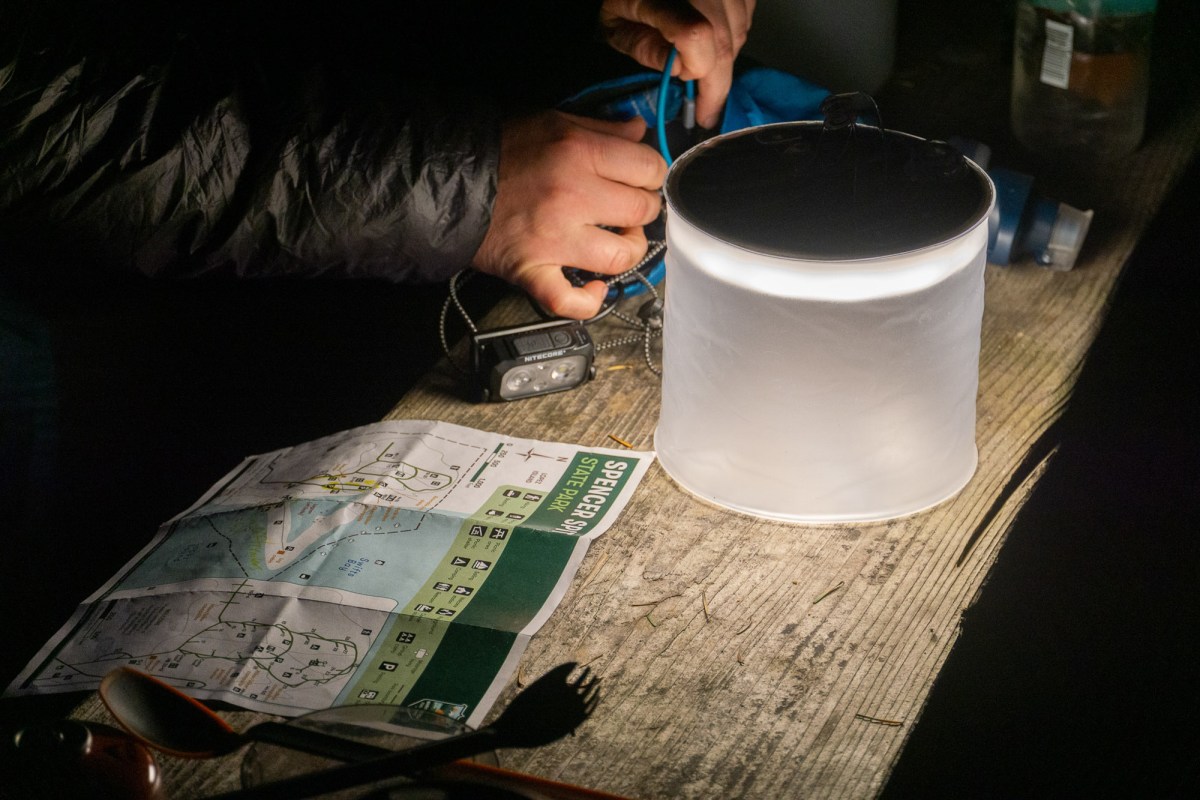
Our camping lantern testing begins when the day ends, and we’ve hit campsites across the country to test lights in all manner of settings and scenes. We busted out the large communal lanterns at front country campgrounds in Georgia and Utah, lighting up the night and getting a sense of total usable lit areas.
Backpackable lanterns were weighed and tucked into overnight packs on sections of the Pacific Crest Trail. Gas lanterns were run clear out, and we burned through a not-small number of batteries and candles to get a better sense of operating times.
Overall, we aimed to use these lanterns as they were intended. When we were done, we cycled them out to others on the testing team. Individual preferences vary, and we wanted to get a better-rounded opinion of these lanterns — no matter how you like to camp.
Our testing doesn’t end when the camping trip does, either. It extends to a set of bench tests designed to challenge manufacturer specifications and ensure accurate claims about these lanterns. One of our most important (and taxing) bench tests is our burn-time test, where we challenge claims on total run time with the lantern set on high. These tests can often last an entire day and end when the lantern finally winks out.
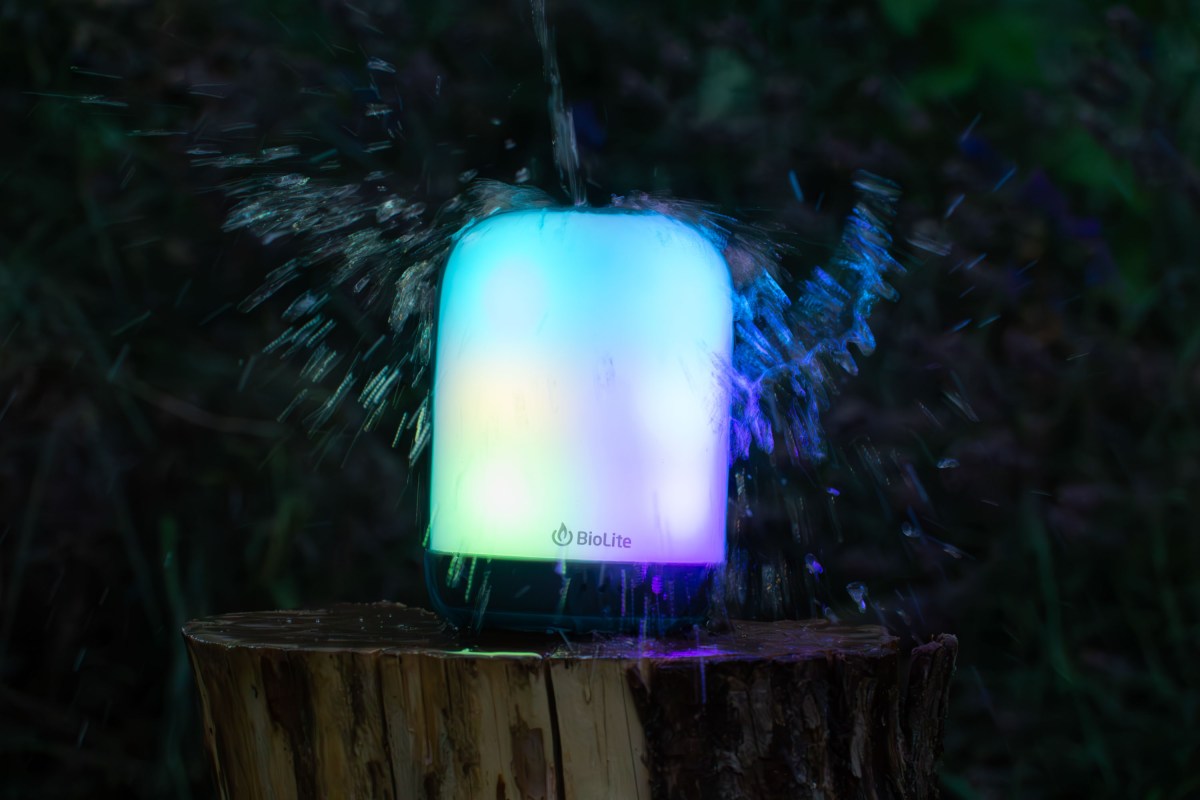
Our water-resistance test is equally rough. We break out the garden hose and spray each lantern from varying angles. We’ve only killed one lantern (so far) and find that most can hang in a light simulated rain.
Finally, a lantern isn’t much good if it’s not as bright as it claims to be, and we used a tool known as a lux meter to accurately measure the lumen output of each lantern, both on low and high. All of these tests aim to ensure that these lanterns do what they claim to do, and when they fall short, we make note of it.
Our Camping Lantern Rating System:
To provide an objective assessment of the 2026 lantern market, we grade each model against four core performance metrics. These scores allow you to compare technical specifications when deciding which light earns a spot in your kit.
- Brightness (30% weighted): We prioritize lanterns that offer a high ceiling for visibility. To earn a high rating, a lantern must consistently push 500 lumens or more. Units that break the 1,000-lumen threshold receive our top marks.
- Battery Life (30% weighted): We don’t just rely on the box specs. We run every lantern through multiple dead-flat discharge cycles in our lab to verify real-world runtimes. We expect a top-tier light to maintain its peak output for at least 5 hours and offer a low or eco mode that lasts a minimum of 100 hours for emergency use.
- Feature Set (20% weighted): We reward innovation that adds genuine utility rather than just tech bloat. We score lanterns higher if they include functional upgrades like USB-C Power Delivery, integrated solar panels, high-CRI LEDs for color accuracy, or advanced mounting solutions like magnetic bases and tripod legs.
- Field Durability (20% weighted): A lantern is only as good as its weakest seal. We rate durability based on IP ratings for water and dust resistance, as well as “drop-test” survival on hard surfaces. We also consider the long-term health of the battery cells and whether they are user-serviceable, ensuring your investment won’t end up in a landfill after a single season.
Our Expert Testers
While putting this list together, our lead tester, Austin Beck-Doss, was living off-grid and relying on a lantern every single night. His exploits range from rock to snow, but when the light tilts out, it’s a lantern that he always reaches for. With outdoor products he’s personally tested tallying into the hundreds, Austin has honed a keen eye on what flies and what falls flat when it comes to getting outside.
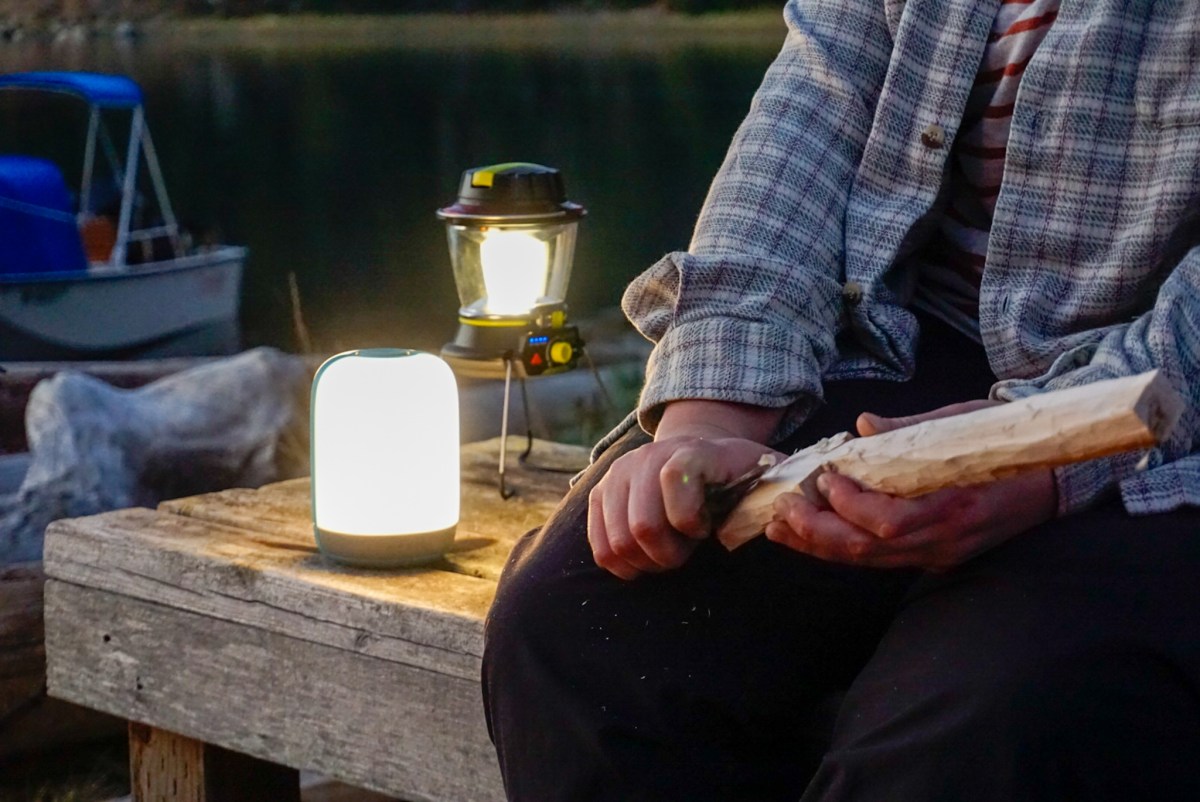
Adding to the tester pool is Senior Editor Nick Belcaster, who has spent months at a time outdoors where having the proper illumination is key. He’s to thank for our updated bench testing regimen, and he dutifully mans the hose and timers to ground truth claims. Outside of the nitty-gritty, it’s his every-weekend-outside philosophy that keeps lanterns tested on a regular basis.
Buyer’s Guide: How to Choose a Camp Lantern
Electric vs. Gas-Powered Lanterns
Choosing between an electric and a gas-powered lantern comes down to what features you prefer. Electric lanterns are quiet, lightweight, and safe to use inside a tent. In general, we believe that battery-powered lanterns are the best investment these days, and the ever-improving quality of LEDs and rechargeable cells only reinforces that.
However, alkaline batteries lose about half their capacity when temperatures drop below freezing, and rechargeable batteries may not last for multiday trips without recharging. Consider battery life when planning longer camping trips, as it’s a bummer to see your lantern flicker out.
Gas-powered lanterns like the Snow Peak GigaPower Lantern Auto are bright, have a long burn time, and work well in sub-freezing temperatures (the runtime drops, but not as much as when using alkaline batteries). Because they use a live flame, they are hot to the touch, need to be used away from flammable materials, and require ventilation. They are also more fragile than electric lanterns. But for the money, it’s hard to beat the old-school feel of the flame.
Lumen Output: Balancing Raw Power & Visual Comfort
When evaluating a lantern’s output, it is a common mistake to equate higher lumens with better light. In our 2026 bench tests, we’ve found that how a lantern manages its lumens is far more critical than its peak brightness rating.
- The Sweet Spot for Campsite Ambiance: While the sun puts out a staggering 35.73 octillion lumens, most high-performance camping lanterns operate between 200 and 500 lumens. This range is the industry standard for illuminating a four-person cooking area or a large tent. However, for intimate settings or interior tent use, we recommend dialing back to a 60 to 100 lumen output to avoid harsh glare and preserve a pleasant glow.
- Diffusion and Beam Quality: A lantern’s design dictates how usable its light truly is. For example, while the Goal Zero Lighthouse 600 and the BioLite AlpenGlow 500 may share a similar peak output, the AlpenGlow utilizes a translucent internal globe and high-CRI LEDs to provide a softer, more diluted light. This prevents hot spotting—the phenomenon where looking at the lantern causes temporary night-blindness—and results in a much more natural, eye-friendly environment.
Tester’s Tip: “Lumen output isn’t the end-all metric for camping lanterns, and you should pay as much attention to the light color, adjustability, and beam cast.” — Nick Belcaster, Lead Gear Tester
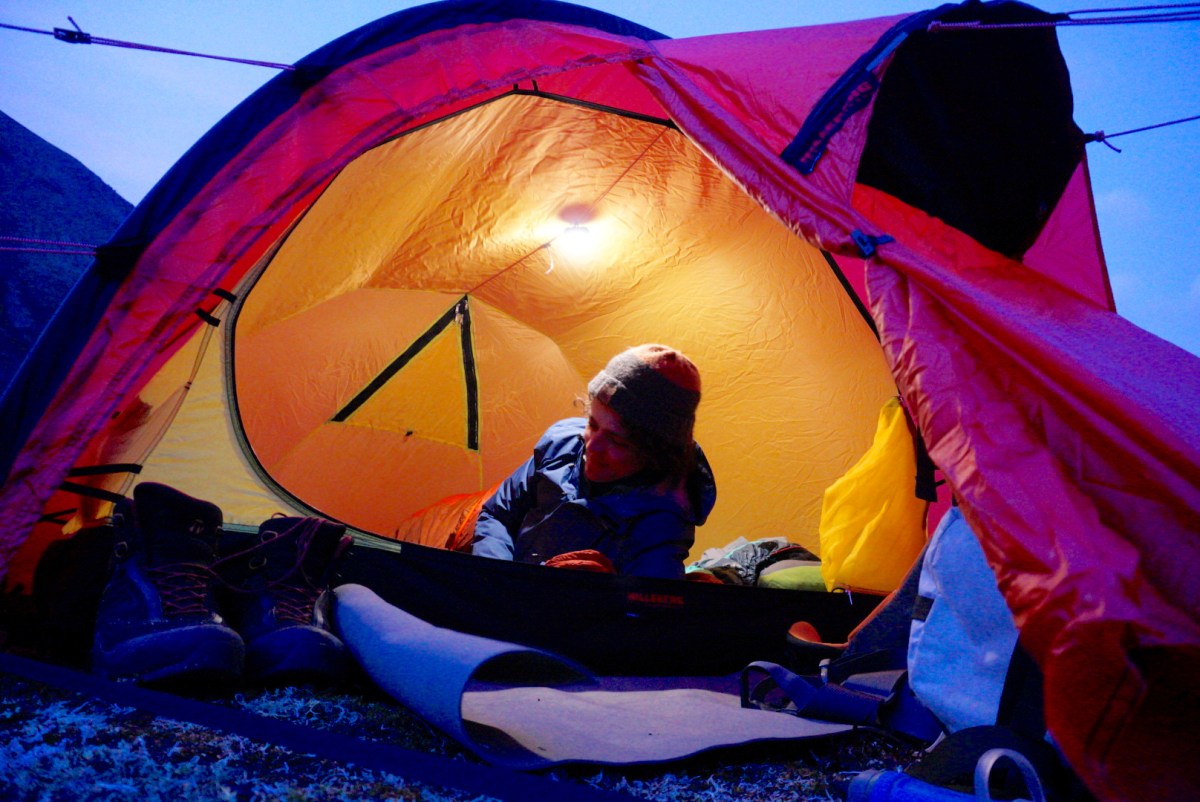
Advanced Lighting Modes
Modern lanterns have evolved from simple on/off switches into sophisticated lighting tools capable of mimicking everything from a sunset to an emergency beacon.
- Dimmability and Power Modes: We consider a continuous dimming range to be a mandatory feature for a top-tier rating. This allows you to scale from a turbo mode for late-night camp setup (like the high-output Fenix CL27R) down to single-digit lumens for a subtle nightlight. This adaptability not only protects your night vision but also exponentially increases your battery’s run-time efficiency.
- ChromaReal and Ambient Effects: High-end models, such as the BioLite AlpenGlow 500, offer diverse modes including ChromaReal white light, warm light, and multi-color cycles. Advanced units even utilize accelerometer-based controls, allowing you to shake the lantern to activate single-side lighting, flickering candle modes, or multi-color effects, which help set a specific mood without fumbling through menus.
- Tactical and Emergency Settings: For specialized scenarios, look for lanterns with a dedicated Red Light Mode. Red light is essential for navigating a tent or reading a map without dilating your pupils or disturbing a sleeping partner. Furthermore, we prioritize units like the COAST EAL35R, which includes safety-specific modes like a flashing SOS signal for backcountry emergencies and a high-intensity strobe for self-defense.
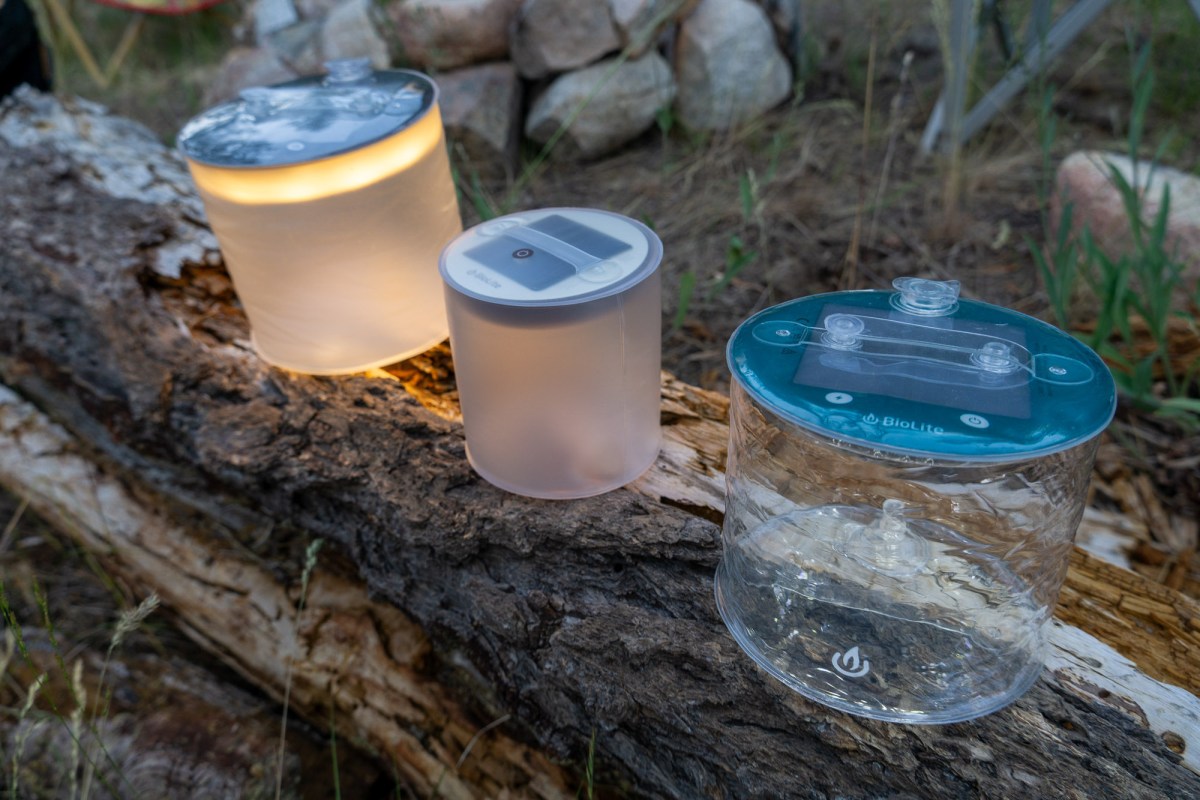
Application: Matching The Lantern to Your Use
Choosing the right illumination depends entirely on your hauling capacity and the radius of light required for your specific camp activities. We categorize lanterns based on their output-to-weight ratio and how they integrate into your existing gear kit.
- Backpacking & Hiking Lanterns: For trips where weight matters, collapsible architecture is the gold standard. Models like the MPOWERD Luci Original Clear utilize inflatable or folding designs to provide a 360-degree light cast while occupying negligible space in a pack. These units often weigh just a few ounces and are essential for long-distance trips where you need a dedicated area light that isn’t too bulky.
- Car Camping & Basecamp Systems: When weight and packed volume are secondary to performance, we recommend feature-rich units like the Black Diamond Orbiter 650 or the BioLite AlpenGlow 500. These lanterns typically hover around the 1-pound mark and prioritize battery size and a broad light distribution. Because they aren’t constrained by pack space, they often include integrated mounting solutions such as folding legs or magnetic bases.
- Alternative Fuel Lanterns: For those seeking a more organic experience, isobutane-powered or candle-based lanterns remain highly relevant. The Snow Peak GigaPower utilizes the same fuel canisters as your stove, providing a high-BTU output that adds both light and a small amount of ambient heat to a tent. Similarly, the UCO Candle Lantern offers a natural, flickering flame that provides a warm aesthetic LEDs struggle to replicate. These are excellent no-battery backups that ensure you have light even if your electronics fail in the cold.
- Ambient & Area Lighting: Beyond the traditional lantern shape, modern camp lighting includes string lights and telescoping towers. Systems like the MPOWERD Luci String Lights allow you to spread illumination across a wide perimeter, eliminating the harsh shadows created by a single central light source. For maximum area coverage, a high-lumen flood light like the Goal Zero Skylight can illuminate an entire basecamp, though it is strictly a car-camping luxury.
Tester’s Tip: “Investing in a pair of lanterns is never a bad idea: consider snagging a large basecamp-style lantern for groups, as well as a smaller lantern for detail work like cooking.” — Nick Belcaster, Lead Gear Tester
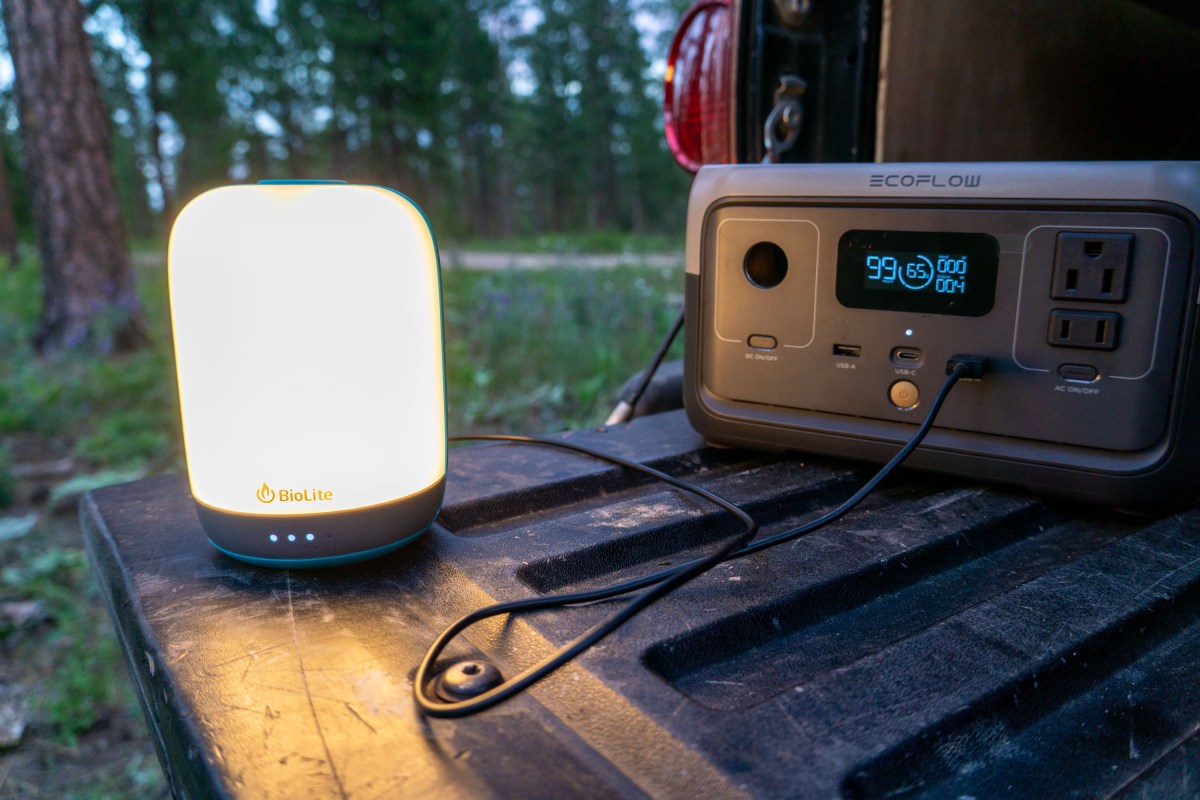
Powering Your Lantern: Battery Life & Fuel Types
Whether you’re heading out for a quick overnight or a week-long expedition, how you power your light is just as important as how bright it shines. In our testing, we’ve found that the best lanterns don’t just have a big battery; they use that energy efficiently.
- Modular Power: Some specialized lanterns, like the Fenix CL27R, use a standard rechargeable battery cell (the 18650) that you can actually take out. This is a game-changer because you can carry a few extra pre-charged cells and swap them in seconds, giving you the convenience of a rechargeable system with the instant-on backup of a disposable one.
- Understanding Burn Time: Most lanterns will last between 5 and 10 hours on their highest setting, which is plenty for a weekend of cooking and hanging out. However, if you dial the brightness down, the numbers get much more impressive. During our field tests:
- Disposable Batteries: Alkaline vs. Lithium: If your lantern uses AA or AAA batteries, you have two main choices.
- Alkaline: These are the standard, affordable batteries you find at any grocery store. They’re great for casual use, but they have a dimming effect. As the battery wears down, your light gets steadily weaker.
- Lithium: These are a significant upgrade for backpackers. They stay at full brightness until they are almost empty, weigh much less than alkaline, and won’t die on you when the temperature drops below freezing.
- The Rise of Rechargeable Lanterns: Most modern lanterns now come with built-in rechargeable batteries. They are incredibly convenient and save you money in the long run. Many even act as a portable battery bank for your phone. The only downside is that once they’re dead, you can’t just swap them; you’ll need to plug them into a power bank or use a solar panel, which can take a few hours to reach a full charge.
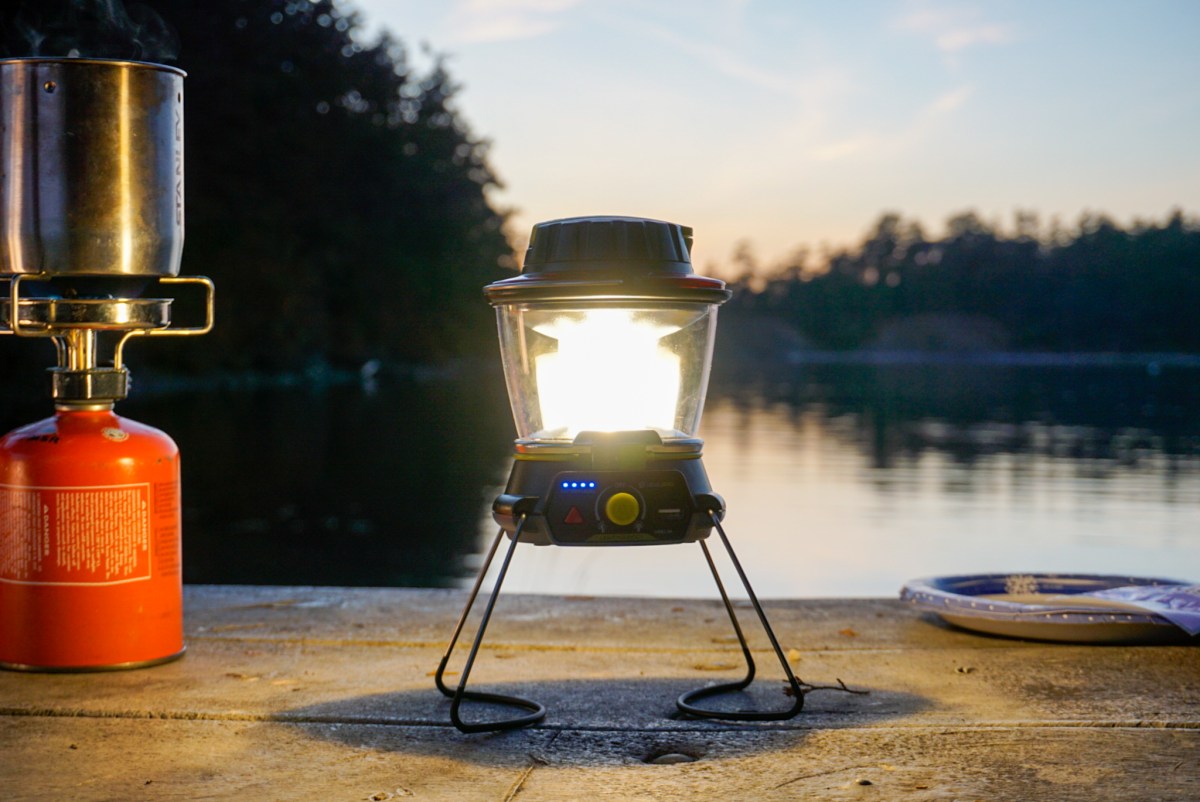
Ease of Use: Avoiding Tech Bloat
While modern lanterns are packed with more features than ever, the most reliable gear remains the most intuitive. Generally, electric lanterns are the gold standard for simplicity, while gas-powered models require attaching fuel canisters and carefully lighting a wick. However, as we head into 2026, we’ve seen a rise in feature creep. To avoid frustration in the dark, prioritize lanterns with a straightforward button cycle that is easy to remember under pressure.
- Smart Power Features: Look for small design touches that make a big difference in the field. Glow-in-the-dark buttons, integrated battery level indicators, and charging cables that wrap around the lantern body (like on Goal Zero models) eliminate the “where is my cord?” panic that often happens when packing for a trip.
- User Interface and Controls: We look for designs that don’t require a manual to operate. A great example of doing it right is the Goal Zero Lighthouse 600, which uses a single physical dial to both turn the light on and adjust the brightness. In contrast, while the BioLite AlpenGlow 500 offers incredible color options, its shake-to-change mode and multi-press sequences can feel a bit confusing until you’ve spent several nights with it.
- The USB-C Standard: One of the most important ease-of-use upgrades in recent years is the industry-wide move to USB-C charging. By 2026, USB-C has become the universal standard for everything from laptops to lanterns, meaning you can finally carry one single cable for all your electronics. In our testing, we were pleased to see high-end models like the Black Diamond Orbiter 650 and the BioLite Luci Charge 360 embrace this, but we were most surprised by the budget-friendly Duracell 2000 Lumen Tri-Power, which offers USB-C charging at a fraction of the price of premium competitors.
Tester’s Tip: “There’s a big difference in understanding power level between a three LED indicator and a four light unit, so look for the most detailed option you can find.” — Nick Belcaster, Lead Gear Tester
Mounting & Suspension: Optimizing Your Lighting
A lantern’s effectiveness is often dictated less by its brightness and more by its placement. To achieve a functional wash of light that covers your entire cooking or sleeping area, you need versatile mounting options that allow you to move the light source off the ground.
- Tripod Compatibility & Elevated Legs: To avoid blinding campmates while sitting at a table, look for lanterns with integrated tripod legs or a standard 1/4-20 threaded socket. Raising the light source just 6–10 inches off a tabletop significantly improves the downward light cast for tasks like map reading or food prep.
- Overhead Suspension (Hooks & Loops): Suspending a lantern from a tent’s gear loft or a nearby tree limb is the most effective way to eliminate harsh shadows and maximize the light’s radius. We look for dual-hook designs, like those found on the Black Diamond Orbiter 650, which snap together to create a secure loop that won’t slide off a thin guyline or a swaying branch.
- Magnetic Bases: For car campers and van-lifers, a magnetic base is a game-changer. High-strength magnets allow you to slap a lantern onto a tailgate, a magnetic gear rack, or the underside of a vehicle hood for hands-free engine repairs. The Fenix CL series often incorporates these, providing a rock-solid connection to any ferrous metal surface.
Durability & Weather Resistance: Protecting Your Investment
We’ve all been there: waking up after an unexpected midnight downpour to find a soggy lantern that won’t turn on. In the backcountry, your gear’s durability is your primary insurance policy against the elements. As of 2026, the industry has largely shifted away from delicate components toward expedition-grade construction, but understanding the specific ratings of your gear is vital to its longevity.
The Reality of Gas vs. Electric: Traditional gas lanterns, while nostalgic and warm, remain the most fragile option. They typically require glass globes and delicate silk mantles that can shatter from a simple tip-over or a rough ride in a gear bin. If you’re a fan of the fuel-powered glow, we strongly recommend a hardshell carrying case for transport. In contrast, modern electric lanterns utilize high-impact polycarbonate and rubberized overmolding designed to survive 2-meter drops onto granite—a standard we’ve personally verified with units like the Fenix CL series.
Decoding Ingress Protection (IP) Ratings: Most 2026 lanterns carry an IP rating, which provides a quantifiable score for dust and water resistance.
- IPX4: This is the baseline splash-proof rating (found on the BioLite AlpenGlow 500). It will survive a light drizzle, but should not be left out in a storm.
- IP65/IP66: These units are dust-tight and resistant to high-pressure water jets—essential for coastal camping where salt spray and driving rain are common.
- IP67/IP68: This is the gold standard (found on the BioLite Luci Charge 360). An IP67 rating means the lantern is fully dust-proof and can be submerged in up to 1 meter of water for 30 minutes. If you’re prone to leaving gear out overnight or traveling by boat, this is a non-negotiable metric.
Price & Value
Camping lanterns typically won’t be the priciest bit of camping kit you’ll ever purchase, but there are a few different levels of value to consider. If camping is an every-now-and-again thing for you, a simple budget lantern might be the ticket. Or, if this is your thing, going out and purchasing a bit of a legacy lantern can make a lot of sense.
Budget ($20-$50)
These lanterns often take shortcuts in size and durability to keep costs low. Most are designed for tent interiors, capping out around 200 lumens. However, technology is trickling down; the Duracell 2000 Lumen Tri-Power ($30) is a standout budget pick, offering a massive 2,000-lumen output and USB-C charging. For backpackers, the BioLite Luci Original Clear ($30) provides a lightweight, collapsible solution, while the COAST EAL35R ($40) offers high output and voice control at an entry-level price.
Mid-Tier ($50-$100)
This is the sweet spot for most campers. These tabletop lanterns typically max out at 500–600 lumens (perfect for cooking and camp tasks) and can run for 200–300 hours on low. You’ll gain advanced features like color-mixing and integrated power banks. The BioLite AlpenGlow 500 ($80) is a top all-rounder with a 6,400 mAh battery, while the Black Diamond Orbiter 650 ($80) adds versatility with integrated tripod legs. This tier also includes specialized fuel options like the Snow Peak GigaPower ($87).
Premium ($100+)
Above $100, you are investing in specialized performance or bombproof build quality. These lanterns often use all-metal housings or user-replaceable 18650 cells for long-term serviceability. The BioLite Luci Solar String Lights $100 prioritizes illumination across a wide space, while the Goal Zero Skylight ($400) represents the top of the market, blasting 6,000 lumens to illuminate an entire overlanding basecamp.
Frequently Asked Questions
The best camping lantern is the one best designed for how you plan to use it. Look for a lantern that’s bright enough to illuminate your camping space and one that is simple enough to use after a long day of hiking. For 2026, we found the BioLite AlpenGlow 500 Lantern to fit the bill for most of our camping outings, with the Black Diamond Orbiter 650 being a close second.
For backpackers, a lightweight lantern that doesn’t take up too much pack space is ideal. Also, an electric lantern should be able to give you several evenings of light without requiring a recharge.
For most campers, 100 lumens or above is enough to light up many camp spaces. If you prefer a more gentle glow, 50-75 lumens will be enough. Electric lanterns under 50 lumens are good for in-tent use.
For occasional use, a brighter lantern with replaceable batteries will work well. Replaceable batteries are ideal for situations in which an external charging source is unavailable. Candle lanterns will also work well, as they don’t require any fuel besides the candle.
We’re fans of the classic Coleman Lantern. For $65, Coleman has made a solid lantern that will give you years of use. It produces 1,000 lumens on high, and it will run for 7 hours on high before you need to switch propane canisters.
Lantern mantles are ceramic mesh sacks that encase the flame in gas-powered lanterns. They keep the flame small and contained inside the lamp.
If you take care of it, a lantern mantle can last years. You can lengthen the life of the mantle by not dropping or shaking your lantern excessively and by not exposing it to strong wind without the globe attached.
Read the full article here
