



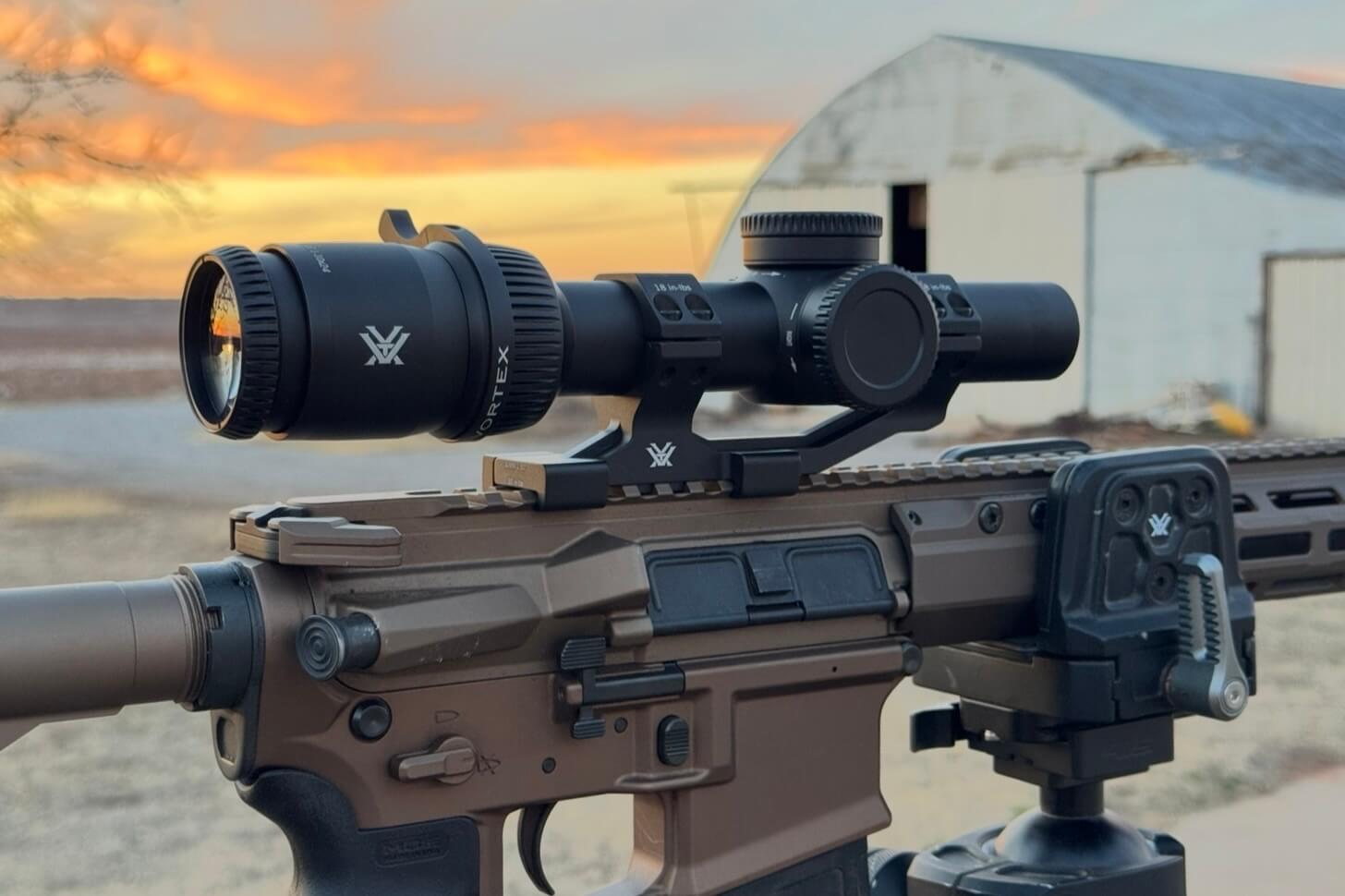

The Vortex Strike Eagle 1-10×24 FFP brings motion activation, a useful BDC-style reticle, and real LPVO versatility into a budget-conscious package. It is not flawless glass, but for shooters chasing reach without premium pricing, this optic has more fight in it than the price tag suggests.
Vortex Strike Eagle 1-10×24 FFP Review: Big Features Without Big Money
The Vortex Strike Eagle 1-10×24 FFP pairs motion-activated illumination with versatile magnification in a compact, budget-friendly package. It targets shooters who want performance without stepping into premium pricing. However, while it checks a lot of boxes on paper, real-world performance shows where compromises exist.
🛒 Check Current Price for Vortex Strike Eagle on GunsAmerica
First Impressions: A Budget 1-10x LPVO That Shows Up Ready
Right out of the box, the Strike Eagle feels purpose-built for practical shooting. It’s compact at 10 inches and weighs 21.6 ounces, which keeps it manageable on a general-purpose rifle. The included accessories are genuinely useful, including flip caps, a throw lever, a sunshade, a battery, a lens cloth, and a small tool. The finish is a low-glare matte anodize that holds up well, and while nothing feels premium, it also doesn’t feel cheap.
I mounted it using a Vortex Sport Cantilever Mount, which worked well for this setup. The mounting process was straightforward, and I especially appreciated the torque specs printed directly on the mount. That’s a small feature, but it saves time and removes guesswork. Overall, the initial setup was quick and hassle-free.
Motion Activation and Controls: The Smart Feature That Actually Matters
The motion activation feature on the illuminated reticle is one of the standout tricks on the Vortex Strike Eagle 1-10×24 FFP. This is very uncommon for scopes, but it is a very cool addition. I tested it using a timer, and it consistently shut off right at the 10-minute mark. As soon as the rifle moved, the reticle instantly reactivated. This feature is especially useful since LPVOs have shorter battery life than red dots. This makes it a better option as a bedside home defense rifle. Illumination is powered by a single CR2032 battery.
The illumination dial uses a single off position rather than multiple stops between settings. While I generally prefer more off positions, this setup still allows quick access to maximum brightness.
Turrets are capped and provide positive, tactile clicks, which is exactly what I want in an LPVO. After zeroing, I relied entirely on the reticle for holds, and the capped design prevented accidental adjustments during movement.
EBR-8 BDC Reticle: Hidden Holds Inside a Clean FFP Layout
The EBR-8 BDC reticle is more versatile than it first appears. At a glance, it looks like a standard FFP reticle, but it incorporates a hidden BDC system. Five dots correspond to approximate holds from 200 to 600 yards, and every other dot is illuminated to help with quick identification. This layout is intuitive once you spend some time behind the optic.
In testing, the BDC system performed reasonably well with 55gr 5.56 out of a 16” Aero Precision rifle. The holds weren’t perfect, but they consistently got me close enough to make fast corrections. With ammo closer to the recommended 60gr load, the system would likely be more precise. The MRAD version I tested feels more like a hybrid system, while the MOA version is closer to a traditional BDC design.
Illumination is functional but limited in bright conditions. It works well against darker targets, but it tends to wash out in full sunlight on lighter backgrounds. I would not consider it daylight bright, although it still adds value in low-light scenarios. At 1x, the thicker outer lines help draw the eye to the center, which improves speed on close targets.
Glass Quality: Clear Where It Counts, Softer at the Top
Glass clarity is solid for the price, but the Vortex Strike Eagle 1-10×24 review story gets more complicated once you start climbing past 7x. The image remains clear through about 7x, which covers most realistic use cases. However, once you push past that point, the image begins to soften noticeably. You can adjust the diopter to improve clarity at 10x, but that creates issues at 1x.
Because of this, the scope behaves more like a 1-8x in practical use. However, if time is not a factor, it’s easy enough to focus the diopter for shooting at high magnifications. Then simply tune it back in at 1X so you can shoot with both eyes open with proper focus. This is my biggest complaint, and it’s something to understand before buying. The eye box is forgiving, and eye relief is comfortable across the range. Additionally, there is no odd tint, although there is slight image warping around the outer 10% of the window.
On the Range: Fast Transitions, Real Distance, Honest Limits
On the range, the Strike Eagle 1-10×24 makes its best case when the clock is running and targets are scattered. This optic performs well in practical shooting scenarios. I ran stage-style drills and transitioned between targets at varying distances. In one instance, I moved from a 50-yard target to a 650-yard target in about five seconds while shooting off a tripod. That kind of versatility highlights the core strength of this optic. For those who want to see it in action, I posted a short video to my Instagram page.
The included throw lever plays a big role here. It mounts securely and makes rapid magnification changes easy under pressure. While spotting impacts at distance with 5.56 is always challenging, the reticle provides enough reference points to walk shots in effectively. However, the blurry image at higher magnification (when not adjusting the diopter from a proper setting at 1X) does limit feedback at longer ranges.
Parallax and Practical Limits: Where the 10x Promise Gets Real
The fixed parallax is set at 150 yards, which is typical for this category. It works well for general-purpose shooting, but it can introduce minor errors at other distances if your head position isn’t consistent. In most cases, this isn’t a major issue, but it’s something more precision-focused shooters may notice.
The biggest practical limitation is the 10x end of the magnification range, which is there, but not where this optic feels fastest. While it’s available, it’s not something you’ll rely on in fast-paced situations. Instead, the optic performs best in the 1-7x range where clarity and speed are optimized. Understanding this helps set realistic expectations.
Vortex Strike Eagle 1-10×24 FFP Specifications That Matter
| Model | Vortex Strike Eagle 1-10×24 FFP |
|---|---|
| Magnification | 1-10x |
| Objective Lens | 24 |
| Focal Plane | FFP |
| Reticle | EBR-8 BDC |
| Length | 10 inches |
| Weight | 21.6 ounces |
| Battery | CR2032 |
| Parallax | 150 yards |
| Test Rifle | 16” Aero Precision rifle |
| Test Ammunition | 55gr 5.56 |
| Recommended Load Mentioned | 60gr |
| Street Price | around $700 |
Pros and Cons: The Strike Eagle Hits Hard, But Not Everywhere
- Pros: Compact 10-inch body, manageable 21.6-ounce weight, useful included accessories, motion-activated illumination, capped tactile turrets, practical EBR-8 BDC reticle, forgiving eye box, comfortable eye relief, solid value around $700.
- Cons: Illumination is not truly daylight bright, only one off position on the illumination dial, image softens past about 7x, 10x requires diopter compromise, slight image warping around the outer 10% of the window, fixed 150-yard parallax can introduce minor error if head position is inconsistent.
Final Verdict: A Budget-Friendly LPVO With Reach and Reality Checks
The Strike Eagle 1-10×24 offers a strong feature set for its price point. It brings FFP functionality, a versatile reticle, motion activation, and solid build quality into a relatively affordable package. At a street price around $700, it competes well in the mid-range LPVO market.
However, it’s important to recognize its limitations. The illumination isn’t truly daylight bright, and the top-end magnification comes with tradeoffs. Still, it performs well in the roles it’s designed for. For shooters who want a capable, budget-friendly LPVO with extended reach, this is a practical and well-rounded option.
Read the full article here
