



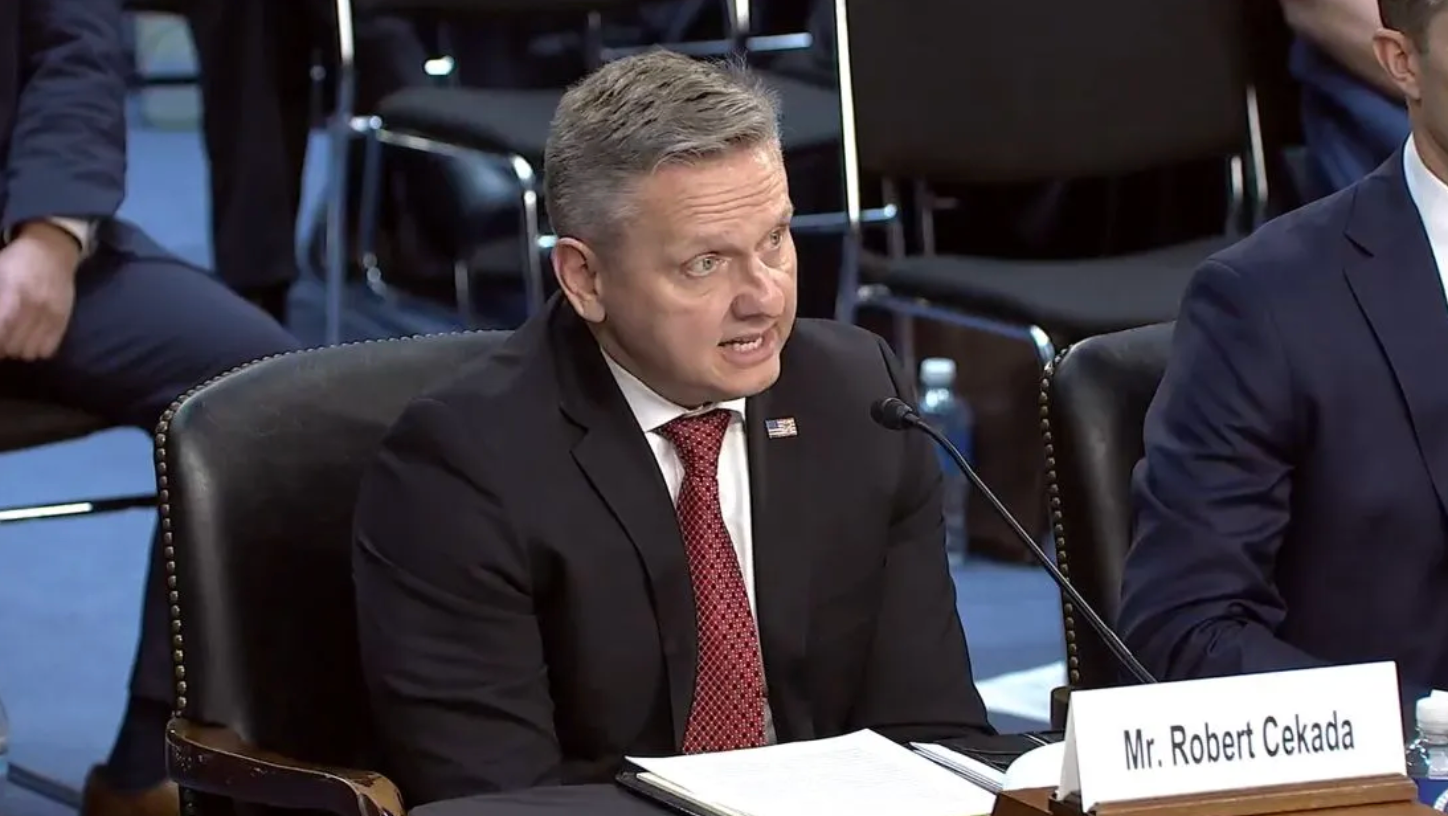

ATF Director Robert Cekada and Chief Counsel Robert Leider sat down with journalist Shermichel Singleton for a wide-ranging interview that ran on the We the Free Network and was subsequently broken down by Guns and Gadgets host Jared Yanis. The conversation marks one of the most candid public discussions of the agency’s reform direction since Cekada’s April 29 confirmation and the simultaneous announcement of 34 new rulemaking notices.
For an agency that gun owners have spent the better part of a decade viewing as an adversary, the substance of what Cekada and Leider said in the interview matters — and so does the fact that they said it on record, in front of cameras, to an audience of gun-rights advocates rather than mainstream press.
Guns and Gadgets host Jared Yanis breaks down the Singleton interview with key clips and analysis. The full unedited Singleton interview is available on the We the Free Network.
Who’s running ATF now?
Some context matters here, because the interview lands differently if you know the backgrounds of the people in it.
Cekada is a 21-year ATF veteran who rose through the NYPD ranks before joining the bureau in 2005. He started in the Baltimore Field Division working on transnational organized crime, then served in Tampa, then moved into ATF Headquarters in 2013, working on what became the agency’s Frontline Strategy. He was promoted to Deputy Director in April 2025 and confirmed to the director’s position in a 59-39 Senate vote on April 29, 2026 — only the third confirmed ATF director since the position became Senate-confirmable in 2006. He’s also, by his own account in a post-confirmation Breitbart interview, a lifelong hunter, multiple-AR-15 owner, and a self-described “fan of an armed citizenry” whose father immigrated from Yugoslavia and instilled the importance of armed civilians in keeping authoritarian governments at bay.
Chief Counsel Robert Leider, who appears alongside Cekada in the interview, is the more analytically interesting figure for legal-minded gun owners. He came to ATF from George Mason University’s Antonin Scalia Law School, where he was a constitutional scholar with significant published work on Second Amendment doctrine. The Cekada-Leider pairing — career enforcement officer plus constitutional law academic — is unusual for ATF leadership and shapes how the interview reads.
TTAG previously covered Cekada’s confirmation hearing, where he pledged respect for lawful gun owners but offered relatively few specifics about what reform would actually look like. The Singleton interview, two weeks after confirmation and after the rule package announcement, fills in much of that detail.
On the stabilizing brace rule and “regulatory creep”
The most substantively important part of the interview is Leider’s discussion of how ATF arrived at recent regulatory positions and why the current administration is unwinding them.
“It is important to not only say what we’re doing, but why we’re doing it,” Leider said in the interview. “When we regulate, we’re not supposed to be just creating our own law. Those regulations are supposed to be implementing decisions that Congress has made… we have to make sure that what we’re doing is lawful.”
That framing matters because it diagnoses the underlying problem with ATF rulemaking under prior administrations: the agency was making policy through regulation rather than implementing policy from statute. Leider continued: “The agency has flip-flopped positions on a number of issues throughout the years. And from the industry’s perspective and the consumer’s perspective, you need a stable regulatory framework. When you’re flipping without explanation, that doesn’t let people have the stability that they need to make decisions either in their business or on the consumer side.”
The stabilizing brace rule is the clearest example. The Biden-era ATF reclassified pistols equipped with stabilizing braces as short-barreled rifles subject to National Firearms Act registration requirements — a position that turned an estimated several million previously lawful firearms into NFA contraband overnight. The rule was vacated by federal courts. ATF continued enforcement positions despite the vacatur. The new rulemaking package includes a proposed repeal of the brace rule entirely.
Cekada didn’t soft-pedal the impact of the prior approach. He acknowledged in the interview that during his time as a field agent, “there were some policies in particular as it related to short barrel firearms that we didn’t know exactly where we stood either at times” — meaning agents in the field were uncertain how to apply rules ATF leadership had created. “When we don’t know and the public doesn’t know, then that’s something that’s overtly telling you there’s a major gap that needs to be filled.”
On the “anti-Second Amendment” period of agency history
Leider’s framing of the recent past was unusually direct for a senior federal official. “It was certainly the case that there were some people including some people in some high level positions who held fairly strong anti-Second Amendment views, and that would come out in the policies,” he said. “When I got here, I had both the blessing and the curse of being an outsider. I had a list of things that didn’t make sense to me. I came in and started saying, ‘Okay, this is how we’re operating. Why are we operating this way? Can we change it?’ And I started almost immediately.”
That’s a chief counsel describing his own agency’s recent leadership as holding “anti-Second Amendment views” on the record. Not a characterization gun-rights advocates make about ATF from the outside, but one being made from inside ATF itself.
Where the reform package stands
The 34 rule changes announced at Cekada’s April 29 swearing-in — and discussed at length in the interview — fall into five categories: repeal, modernize, reduce burden, clarify, and align. The package represents what Acting Attorney General Todd Blanche described as more regulatory volume than ATF issued in the previous 15 years combined.
Among the headline items: the proposed brace rule repeal; revisions to the “engaged in the business” rule that the Biden administration used to expand the universe of regulated private sellers; updated machine gun definitions responding to the Cargill decision on bump stocks; the Form 4473 revision reducing the form from seven pages to four; and the “non-over-the-counter” rule allowing FFLs to ship firearms directly to verified buyers after background check completion.
Public comment periods on most of these rules run through summer 2026. ATF has been explicit in the rule packages about its legal reasoning, which is itself a departure — rule packages now explain why ATF believes the change is lawful under the relevant statute, addressing the very “regulatory creep” Leider described.
The cautious optimism question
The interview is doing something specific in the gun-rights media ecosystem, and it’s worth being honest about it. Cekada and Leider are presenting the new ATF leadership to an audience that has spent years being adversarial toward the agency. Yanis, the Guns and Gadgets host, captured the tension in his breakdown: “I am not saying that the ATF has now earned my trust, nor should they have your trust blindly. They have to earn that. There’s a lot of things that they have to undo to even get into that realm. But this might be the most positive Second Amendment step the ATF has ever taken in its entire history.”
TTAG has been skeptical of ATF reform claims since the agency began making them a year ago, and that skepticism is healthy. Three considerations worth keeping in mind:
First, regulations announced this spring are not the same as regulations finalized. The 34 notices include both final rules and proposed rules in active comment periods. Some will be finalized; some may be modified during the comment process; some may face legal challenge from gun-control advocacy organizations.
Second, ATF’s institutional posture can change with the administration. Cekada and Leider have made clear in the interview that they’re aware of this — the brace rule is a textbook example of how dramatically agency interpretations can shift between administrations. Whatever protections this reform package establishes are durable only insofar as future administrations and future Congresses choose to maintain them.
Third, as Rep. Maxwell Frost pressed Cekada in a post-confirmation House hearing, Cekada’s own role in pre-2025 ATF rulemaking is a contested question. Frost asserted Cekada worked on Biden-era rules; Cekada denied it. The dispute suggests the current reform agenda has political opponents who will press on the consistency of Cekada’s positions.
Bottom Line
ATF spent decades operating largely opaquely — communicating with the firearm industry primarily through enforcement actions and the occasional contested rule. A 90-minute on-record interview with gun-rights media, in which the director and chief counsel openly discuss what went wrong and what they’re trying to fix, is not how federal agencies typically engage with their critics.
Whether that engagement is sustained, whether the rule changes survive the comment process intact, and whether courts uphold the legal theory under which ATF is now operating are all open questions. But the questions are at least being asked in public, by the agency itself, in a conversation gun owners can watch and judge for themselves.
The full Singleton interview is available on the We the Free Network. The Guns and Gadgets breakdown embedded above provides a useful chapter-by-chapter guide for viewers who want to identify the most substantive portions before committing to the full conversation.
Read the full article here
