



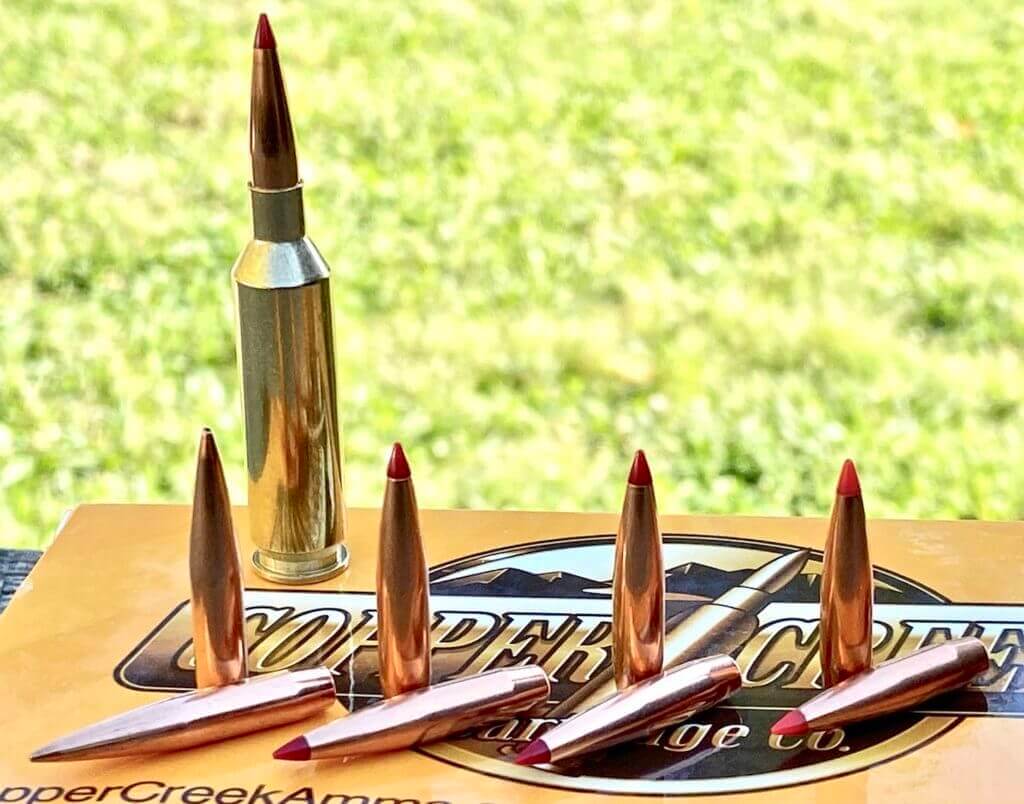

The 22 Creedmoor launches heavy .224 bullets fast, shoots brutally flat, bucks wind, and delivers almost no recoil. This former wildcat has become a serious option for predators, PRS competition, long-range steel, and even deer-sized game.
How the 22 Creedmoor Escaped Wildcat Status
As soon as any new cartridge hits the mainstream market, handloaders start tinkering with it and making wildcat variations. The now super popular Hornady 6.5 Creedmoor case is no exception to that rule. The first of those wildcats to make it to the big league was the 6mm CM, but there is another one that quickly gained widespread popularity: the 22 Creedmoor, aka 22 Creed.
I have rifles chambered in both 6.5 and 6mm Creedmoor, or CM, but the 22 CM captured my attention. I first heard of it from a friend who said the 22 CM came in the top 3 in a first-round hit capability study he had read.
Well, I am always a bit skeptical of studies and statistics since they can easily be swayed depending on what is included or excluded in the study, or how the study process is conducted. However, after running basic ballistic numbers on the 22 Creed, my interest was piqued.
The 22 CM has been making waves in predator and varmint hunting circles since before 2014, and its popularity has continued to climb. A rapid increase in interest led to widespread industry support, with brass, dies, and ammunition reaching the market.
22 Creedmoor Development: From Necked-Down Brass to SAAMI
The following is from the original report. Remember, this was written when the 22 Creed was still a wildcat cartridge.
Check out what SAAMI has to say about the 22 Creedmoor.
Based on the 6.5 CM cartridge case, the 22 CM runs in short-action rifles and feeds smoothly from SA magazines produced by many manufacturers. The only thing needed is a fast-twist barrel to stabilize the long, high BC bullets: 1 x 7 – 7.5 twist.
I had a rifle built by Meredith Rifles using a Defiance action, Bartlein barrel, Manners stock, and Nightforce scope. The first rounds I loaded were made by necking down readily available 6mm CM cases before 22 Creedmoor head-stamped brass was available.
22 Creedmoor Brass, Dies, and Factory Ammunition
The process for making that brass was easy enough, but still somewhat time-consuming. The good news is that Hornady, Peterson, Gunwerks, Atlas Development Group, or ADG, and Alpha Munitions are all selling factory brass now, so there is no more necking down the 6 CM for me.
Similarly, there were no big-name ammunition companies loading for the 22 CM as of this writing, but several smaller companies offered ammunition, so you did not have to reload at all. Cooper Creek, Gunwerks, and Spark Munitions had a variety of offerings depending on what purpose you had for the gun.
The available ammunition was priced in line with high-quality hunting and match ammunition. That pushed the 22 CM beyond the realm of a wildcat requiring handloading and brought it closer to being a true factory product.
22 Creedmoor Cartridge Specifications
| Specification | 22 Creedmoor |
|---|---|
| Bullet diameter | .224 |
| Shoulder angle | 30 degrees |
| Shoulder diameter | .462 |
| Rim diameter | .468 |
| Case length | 1.92 inches |
| Primer type | Large and small |
22 Creedmoor Ballistics: Flat, Fast, and Wind Defying
The performance of the 22 CM with 75 to 80 grain bullets makes it an outstanding varmint cartridge. I have seen claims of 80 grain Bergers at 3500 fps out of 26” barrels, which would be devastating on any varmint. Loaded ammunition is available with bullets in the 70-75 range leaving 24” barrels at velocities around 3400+ fps. That is a bit more conservative than personal handloading, but it still makes the 22 Creedmoor a very flat-shooting, low-recoiling round capable of delivering impressive results.
Part of the beauty of the 22 CM is that it shoots standard .224 caliber bullets, which are available almost everywhere for handloaders and cost less than larger caliber bullets. The heavier bullets used in the 22 CM range from 75 to 95 grains.
With a wide selection of bullets and factory brass available, all that is needed is a set of reloading dies to put everything together. With dies available from major sources such as RCBS, Hornady, Redding, and Whidden, the 22 CM’s future seems to be on the rise.
The cartridge stood out in the first-round hit study because its heavy-for-caliber bullets have relatively high ballistic coefficients. Those bullets can be launched at fast speeds, resulting in fewer wind and elevation corrections.
Almost No Recoil Makes the 22 CM Addictive
I have to say, the best part about shooting the Meredith 22 CM is that it is just fun to shoot. The gun has NO recoil and is downright easy to hit targets with thanks to its flat trajectory and outstanding wind-defeating bullets.
The lack of recoil resulting from the relatively light bullets makes it possible to watch your own impacts or misses if the terrain allows. This permits fast and accurate second-round corrections, which is a big advantage while hunting or competing.
One 22 Creedmoor Rifle Built for Three Jobs
I built the 22 CM to be a dual-purpose gun, or actually a 3-purpose gun. The first purpose was predator hunting and the varmints previously mentioned. The second was shooting PRS, or Precision Rifle Series, style matches on occasion. The third was hunting deer-sized game. As with any multi-purpose tool, there tend to be compromises.
For this project, my sacrifice was in the barrel length. It is a great-quality barrel, but the only profile available at the time was far heavier than I would have liked. To keep the overall weight of the gun down, I had the gunsmith make it a shorter barrel, giving up some velocity to gain mobility afield.
22 Creedmoor PRS Performance at 1,000 Yards
PRS matches typically limit bullet speeds to 3200 fps, which coincidentally works well since Copper Creek offers the 22 CM with a 95-grain SMK at 3160 fps based on a 24” barrel. This makes an outstanding round with only 7.1 mils of drop at 1000 yards and 1.7 mils of wind drift for a 10-mph wind at that distance. For PRS, you do not actually need all the speed the 22 CM can offer from longer barrels.
A quick ballistic comparison with several respected long-range cartridges shines a bright light on the 22 CM’s potential. Using 1000 yards as a distance benchmark, the 6mm CM drops 8.1 mils, and the 6.5 CM with the Hornady 147 ELD-M drops 8.7 mils. Both rounds are considered fantastic for long-range shooting.
Compared with the 7.1 mils of the 22 CM, it is easy to see why the 22 Creedmoor has a high hit probability. On unknown-distance targets, that flatter trajectory would result in more hits.
All of these Creedmoor cartridges are truly great long-range rounds when compared with the old military and police standard, the 308.
22 Creedmoor vs 308: A Brutal Long-Range Comparison
The industry-standard 308 load of a 168-grain Sierra MatchKing bullet at 2650 fps is no match for the more modern high BC cartridges. The old standard would have dropped in a rainbow-like curve of 12.6 mils at the 1000-yard mark.
Can the 22 Creedmoor Cleanly Take Deer?
For the third purpose, hunting deer-sized game, the 22 CM will certainly shoot far enough and flat enough to produce accurate hits. The long, slender bullets have good sectional density, so they will easily get the penetration needed to reach the vitals of thin-skinned medium game. However, the big hunting question is whether the small-diameter bullets have the energy needed to make clean kills.
So how much bullet energy is needed for medium-sized game? Well, opinions are mixed, and you know what they say about opinions. Research shows that recommendations range from 800 ft-lbs to 1300 ft-lbs. Some think energy is not the all-important factor and cite archery and sub-sonic hog hunting as examples. I really cannot argue with that either.
The good news is that the 22 CM seems to have all the energy needed for the task. The old deer-hunting go-to, a 30-30 caliber 150 grn bullet, drops below the 800 ft-lb mark at about 225 yards. The 22 CM drops below that 800 ft-lb threshold at between 600 to 775 yards, depending on the bullet and muzzle velocity of Copper Creek’s different offerings.
Leaning toward the more conservative number of 1300 ft-lbs, the same 22 CM bullet combinations are good out to 300- 400 yards. In reality, I think that number is way over what is needed with good shot placement.
22 Creedmoor Ballistics Compared at 1,000 Yards
| Caliber/ Bullet | Drop @ 1000 (mils) | 10 mph Drift @ 1000 | Energy @ 500 yds (ft-lbs) |
|---|---|---|---|
| 22 CM 75 ELD | 6.2 | 2.0 | 975 |
| 22CM 88 ELD | 6.2 | 1.9 | 1141 |
| 22 CM 95 SMK | 7.1 | 1.7 | 1028 |
| 6 CM 108 ELD | 8.1 | 2.2 | 1082 |
| 6.5 CM 147 ELD | 8.7 | 1.8 | 1409 |
| 308 168 SMK | 12.6 | 3.5 | 410 |
Why Energy Numbers Never Tell the Whole Story
I ran the numbers on the 45-70 I carried to Africa last year. The Hornady 250 grn FTX worked well on a large Black Wildebeest at 296 yards. The first shot took it down, and the second ensured it never got back to its feet.
The energy of the 250-grain 45-caliber bullet at that distance was only 630 ft-lbs. I have used the same round on whitetail deer, and inside 100 yards it takes them off their feet. They never know what hit them. It is definitely more than just the energy numbers that matter.
With all that being said, I do not think the 22 CM will have any problems making clean kills on deer-sized game out to 400-450 yards with solid shot placement. A highly accurate, easy-to-shoot rifle with a flat trajectory will make for confident hunting.
22 Creedmoor Barrel Life Is the Lingering Question
The only real issue that remains with the 22 CM rifle is just how long the barrel is going to last. I am running the heavier bullets, typically 88 or 95 grains. These bullets have higher energy levels, perform better in the wind, and should provide longer barrel life than the faster, lighter bullets.
Compounding the problem, though, is the fact that it is so fun to shoot. Its 22 caliber bullets also make it much cheaper to shoot than my larger calibers. I think the barrel will give me good life based on round count, but maybe not based on time because I really enjoy shooting it and letting others try it.
Pros and Cons of the 22 Creedmoor
- Pros: Flat trajectory, outstanding wind performance, almost no recoil, standard .224 bullets, strong long-range hit potential, easy impact spotting, and support for predator hunting, PRS competition, and deer-sized game.
- Cons: Barrel life remains a concern, fast-twist barrels are required for the longest bullets, and a multi-purpose rifle build can force compromises in barrel length and overall weight.
The Verdict: Was the 22 Creedmoor Build Worth It?
So, was the 22 CM worth the time and money it took to build? I think so. The 22 Creedmoor is a great-shooting cartridge, and the Meredith rifle shoots amazingly well. The cartridge and rifle perform with my handloads or the available factory ammunition. The fact that several vendors are manufacturing 22 CM brass certainly makes handloading simpler.
If I were to do it over again, I would build a lighter hunting-weight rifle. In reality, that would mean using a slimmer barrel and dropping down to a Nightforce NX8 2.5- 20x scope. Then the 22 CM would be right at home in the field where it belongs.
Check out the details, run the numbers yourself, and consider the 22 Creedmoor for your next rifle build.
Read the full article here
