



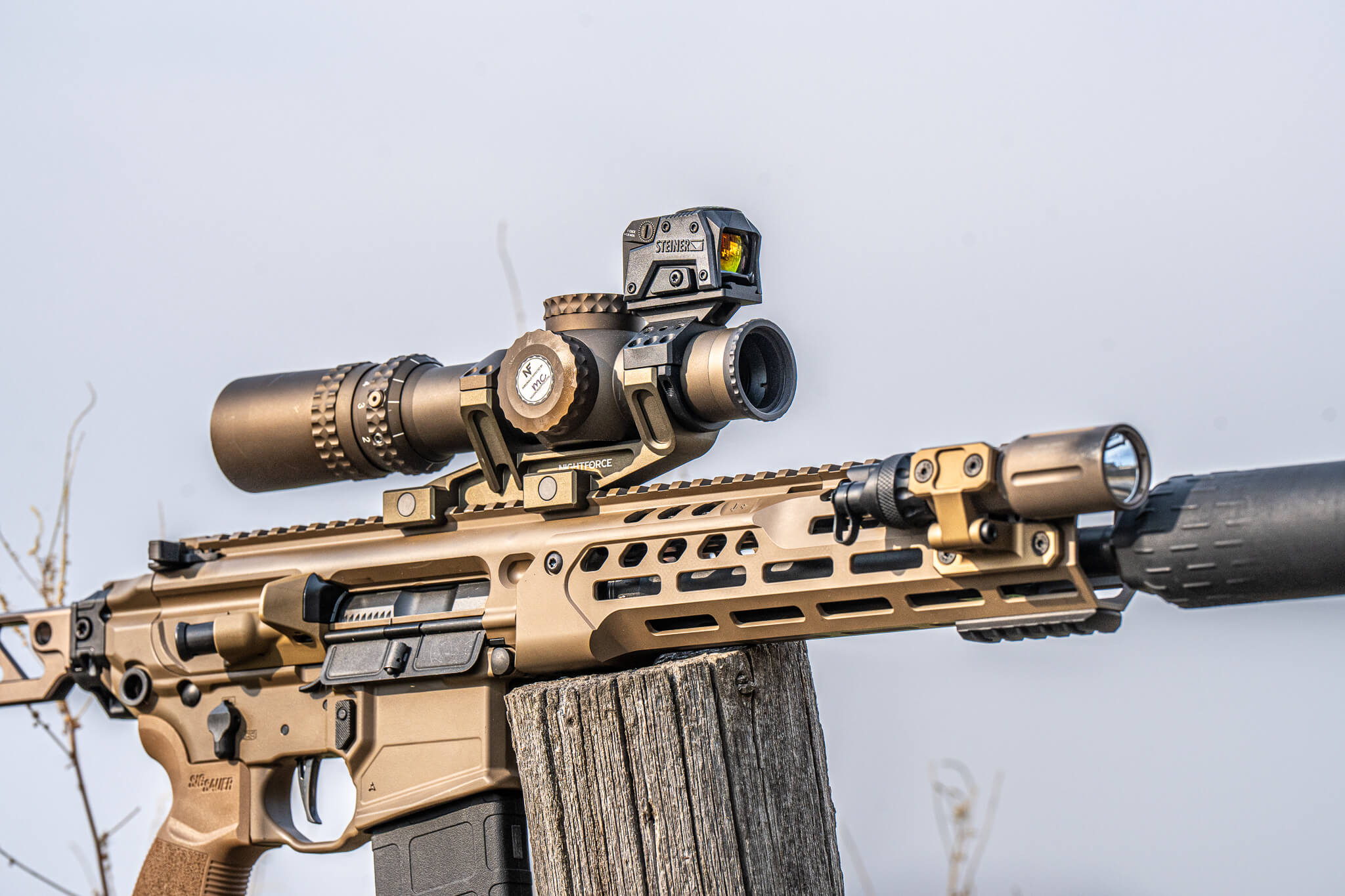

The Steiner MPS 2.0 keeps the original optic’s rugged enclosed-emitter design, then attacks its biggest weaknesses with up to 90,000 hours of battery life, larger controls, and a stronger mounting interface. It is not a reinvention, but the upgrades make this duty-grade red dot considerably easier to trust and run.
Steiner Upgrades Its Duty-Grade Enclosed Red Dot
The Steiner MPS 2.0 is not a ground-up redesign. It retains the enclosed-emitter construction, ACRO mounting footprint, large viewing window, and 3.3 MOA dot that made the original MPS a serious duty-grade optic. Instead, Steiner concentrated on several practical weaknesses in the first model, including battery life, mounting hardware, and control ergonomics.
I mounted the MPS 2.0 at the 12 o’clock position above a Nightforce ATACR 1-8x on a SIG MCX chambered in 5.56 NATO. Although Steiner calls it a Micro Pistol Sight, its size, weight, and durability make it equally appropriate for carbines and shotguns.
Steiner MPS 2.0 Specifications Versus the Original
| Specification | Steiner MPS 2.0 | Original Steiner MPS |
|---|---|---|
| Magnification | 1x | 1x |
| Dot | 3.3 MOA red dot | 3.3 MOA red dot |
| Optical window | 21 x 16 mm | 20 x 16 mm objective; 21 x 16 mm ocular |
| Emitter design | Fully enclosed | Fully enclosed |
| Mounting footprint | Aimpoint ACRO | Aimpoint ACRO |
| Battery | CR2032 | CR1632 |
| Battery life | Up to 90,000 hours at medium brightness; 27,000 hours at maximum | Up to 13,000 hours at medium brightness |
| Battery access | Top-accessible magnetic battery cover | Top-accessible battery compartment |
| Illumination settings | 8 total: 6 day/night and 2 night vision | 8 total: 6 day/night and 2 night vision |
| Brightness controls | Enlarged manual controls with button lock | Smaller manual controls |
| Automatic shutoff | Programmable 15-hour auto-off | Not listed on Steiner’s current product page |
| Adjustment value | 1 MOA per click | 1 MOA per click |
| Elevation range | 90 MOA | 90 MOA |
| Windage range | 90 MOA | 90 MOA |
| Parallax setting | Fixed at 25 meters | Listed as parallax-free from 10 to 150 meters |
| Waterproofing | Waterproof to 35 meters | Pressure-watertight; depth not listed |
| Operating temperature | -40°F to 140°F | Not listed on Steiner’s current product page |
| Dimensions | 45 x 31.6 x 31.9 mm | 1.89-inch length listed |
| Weight | 2.32 ounces | 2.05 ounces |
| Construction | Reinforced all-metal housing | All-metal housing |
| Current MSRP | $631.99 | $631.99 |
A CR2032 Battery Pushes Runtime to 90,000 Hours
The most important Steiner MPS 2.0 upgrade is the battery system, and the improvement is difficult to overstate.
The original MPS used a CR1632 battery and was rated for approximately 13,000 hours at medium brightness. The MPS 2.0 uses the much more common CR2032 and is rated for up to 90,000 hours at brightness level four. Steiner also rates it for 27,000 hours at maximum brightness.
That is a meaningful improvement for a defensive optic. CR2032 batteries are easier to find, provide substantially longer runtime, and are already used in many other optics and electronic accessories. Standardizing batteries also means one less specialized spare to keep in a range bag or armorer’s kit.
The top-accessible battery compartment still allows battery replacement without removing the optic or disturbing zero. Steiner also added a magnetic battery cover that helps retain the battery during installation. It is a small improvement, but anyone who has chased a coin battery across a workbench will appreciate it.
Bigger Controls Make the Steiner MPS 2.0 Easier to Run
The brightness buttons are substantially larger than those on the original MPS. They provide more surface area and are easier to locate by feel, particularly while working under night vision. The buttons still require deliberate pressure, reducing the likelihood of accidental adjustments.
There are eight brightness levels, including six conventional settings and two night vision-compatible settings. Pressing both buttons simultaneously locks the controls. Steiner’s manual also lists a programmable 15-hour automatic shutoff. The automatic shutoff can be disabled, although doing so also disables the highest brightness setting to conserve battery life.
The larger controls are especially useful on a carbine-mounted optic. With the MPS sitting above an LPVO, I could reach the buttons without searching for a small recessed control or significantly changing my firing grip.
A Stronger ACRO Clamp and Reinforced Housing Add Confidence
The MPS 2.0 retains the ACRO footprint and horizontal crossbolt mounting system, so it remains compatible with established ACRO-pattern plates and mounts. Steiner revised the clamping component to provide more contact area and a stronger interface with the mount. This addresses a known concern with the relatively small clamp used on the first-generation optic.
Steiner also describes the new housing as a reinforced all-metal design. The viewing window remains recessed behind an integrated protective hood, and the optic is rated waterproof to 35 meters.
The additional material comes with a small weight penalty. The original MPS weighed 2.05 ounces, while the MPS 2.0 weighs 2.32 ounces. That additional 0.27 ounce is unlikely to matter on a carbine or shotgun, though pistol shooters trying to minimize reciprocating slide mass may care more about it.
The Top-Mounted Emitter Frees More of the Window
One of the less obvious changes is the location of the emitter. The MPS 2.0 projects the dot from the top of the optical cavity rather than from the bottom.
This arrangement leaves more usable space toward the bottom of the viewing window. It does not guarantee co-witnessing with every pistol, plate, or iron-sight combination, but it improves the likelihood that properly selected backup sights will remain visible through the optic.
That design is also useful when mounting the MPS above a riflescope. The 12 o’clock position already creates a substantial height over bore, so preserving as much usable lower-window area as possible helps with rapid visual indexing.
Clean Glass and a 3.3 MOA Dot Keep the Sight Fast
The MPS 2.0 uses a 21x16mm viewing window and a 3.3 MOA red dot. Adjustments are one MOA per click, with 90 MOA of total windage and elevation travel.
The glass in my sample was clear and appeared largely free from optical distortion. Some miniature enclosed optics produce a noticeable magnification effect or curved, fishbowl-like image near the edges. I did not see that with the MPS 2.0.
There is a slight blue-green tint through the lens. It is visible when looking for it, particularly against light-colored backgrounds, but it is not severe enough to interfere with target identification or both-eyes-open shooting. Overall, the optical image is clean, flat, and easy to use.
The 3.3 MOA dot is a practical compromise. It is large enough to acquire quickly at close range without covering an excessive amount of the target at intermediate distances.
Night Vision Testing Shows Strong Passive-Aiming Performance
I tested the MPS 2.0 through night vision using its dedicated NV settings. It worked well for passive aiming, with enough adjustment to keep the dot visible without excessive blooming.
Mounted above the ATACR, the MPS provided an immediate passive aiming option without requiring me to look through the LPVO. The 12 o’clock position also works from either shoulder and avoids the directional limitations of a 45-degree offset mount.
The tradeoff is height over bore. At close distances, the shooter must account for the increased mechanical offset between the optic and the barrel. That is a mounting consideration rather than a fault with the MPS, but it needs to be understood and trained around. It’s not a big deal and only about an inch higher than the LPVO.
Steiner Fixed the Right Problems Without Reinventing the MPS
The Steiner MPS 2.0 is an evolutionary upgrade, but the changes are concentrated in the right places. The CR2032 battery and greatly extended runtime correct the original optic’s most significant weakness. The larger controls, magnetic battery cover, improved clamp, and top-mounted emitter make the optic easier to operate and integrate across different weapon platforms.
It is compact enough for a pistol, rugged enough for a shotgun, and light enough to serve as a secondary or primary sight on a carbine. On the MCX and ATACR combination, it provided a fast daytime aiming system and a capable passive night vision option without adding meaningful bulk.
Steiner MPS 2.0 Pros and Cons After Testing
- Pros: Up to 90,000 hours of battery life at medium brightness, common CR2032 battery, top-accessible magnetic battery cover, larger controls, button lock, reinforced all-metal housing, improved ACRO-pattern clamp, clear glass, dedicated night vision settings, and waterproofing to 35 meters.
- Cons: Slight blue-green lens tint, 2.32-ounce weight is 0.27 ounce heavier than the original MPS, pistol shooters may notice the additional slide mass, and a 12 o’clock rifle mount requires training around height over bore.
More Details From Steiner
Visit Steiner for more information about the MPS 2.0.
Read the full article here
