



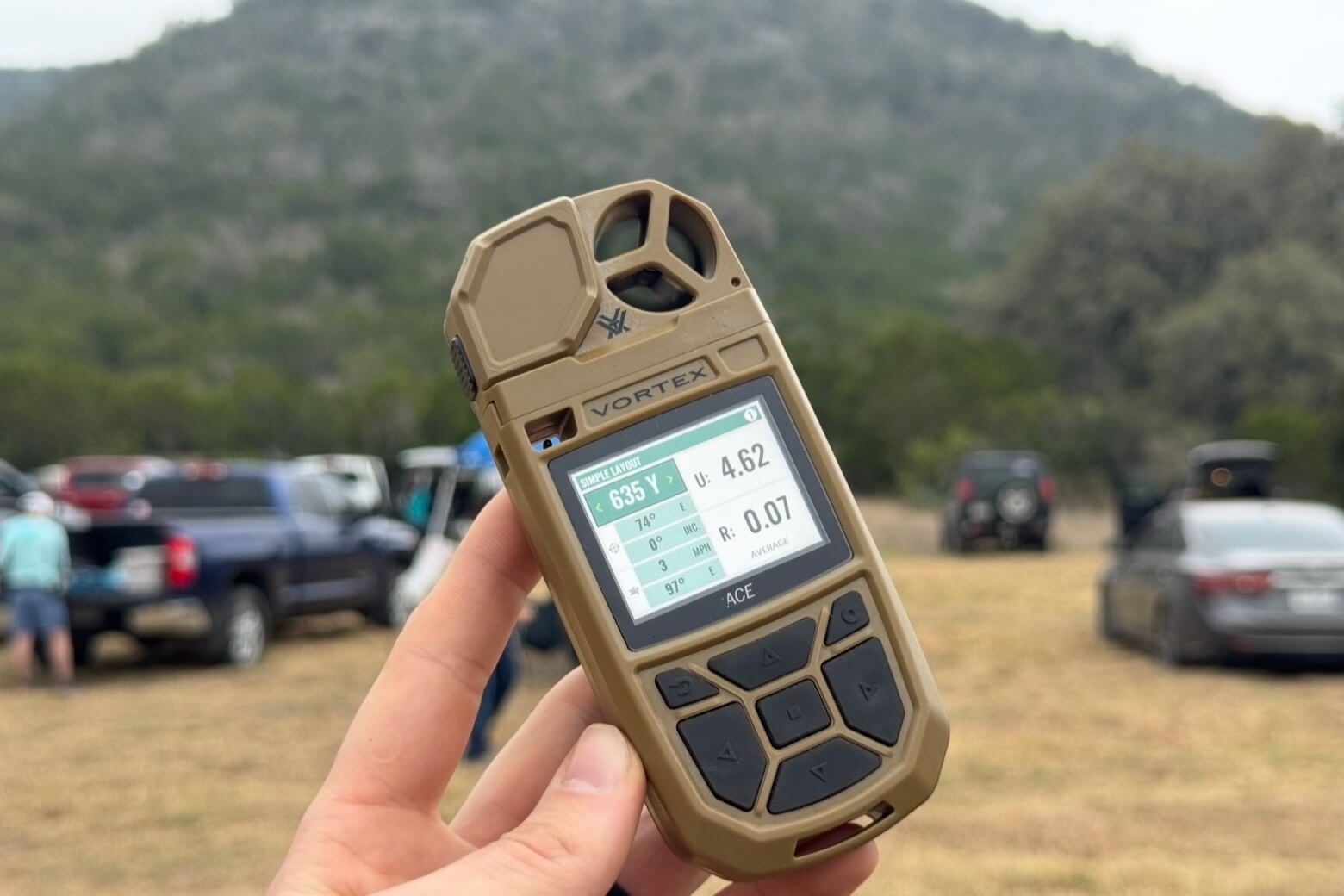

The Vortex ACE Ballistic Weather Meter put a first-round shot on target at 989 yards, then proved it could keep up through competition miles, changing wind angles, and real field work. Its big-screen usability and Vortex Relay integration make this more than another pocket weather meter.
The Vortex ACE Puts Weather, Wind, and Ballistics in One Hand
The Vortex ACE Ballistic Weather Meter combines onboard weather sensors, a GeoBallistics solver, and Relay connectivity in a single unit. The ACE is Vortex’s entry into a category long dominated by Kestrel-style weather meters. It blends real-time environmental data with an integrated ballistic solver and connected ecosystem support. It also emphasizes usability, which becomes obvious within minutes.
Out of the Box: Bigger Than a Kestrel, Easier to Run
Out of the box, the Vortex ACE Ballistic Weather Meter includes the unit itself, a lanyard, a drawstring storage bag, and a pre-installed screen protector. It also ships with two AA batteries, so it’s ready to use immediately.
Right away, the size stands out. The ACE is noticeably larger than a typical Kestrel 5700 Elite Weather Meter. It is 0.5” wider and 0.4” longer with a much larger screen. However, that added size directly improves usability. The 2.0-inch display is easy to read at a glance, and the larger buttons are clearly labeled and simple to operate. As a result, navigation is quick and effortless, even under pressure or while wearing gloves. The device itself feels durable, and the waterproof, shockproof construction is essential for real field use.
The interface is one of the ACE’s strongest features. It is as simple or as complex as the user wants it to be, which makes it approachable without limiting capability. The menu structure is intuitive, and the dedicated button symbols remove guesswork. Compared to Kestrel units, which may require a learning curve, the ACE was easier for me to pick up and run effectively. However, it still allows for deep customization through ballistic profiles and solver inputs. That balance between simplicity and depth is well executed.
First-Round Hit at 989 Yards: The Vortex ACE Does the Math
Ballistically, the ACE uses the GeoBallistics solver, while Kestrel units rely on Applied Ballistics. Applied Ballistics carries more brand recognition, but in practice, both systems produce nearly identical firing solutions. In real use, the ACE delivered me a first-round hit at 989 yards after only entering basic rifle data and muzzle velocity. I zeroed at 50 yards, then immediately went to shoot at 989 yards, trying to true my data, but it ended up being spot on. That level of performance eliminates unnecessary guesswork. Long-range shooting is fundamentally math and execution, and the ACE handles the math and weather inputs reliably.
Wind Calls and Weather Data: Where the ACE Earns Its Keep
The onboard environmental sensors track temperature, pressure, humidity, and wind, and overall performance was solid in testing. Under normal use, I didn’t run into any issues. However, temperature readings are not always instant when the unit is subjected to extreme changes. When I pulled it from the freezer, it took around ten minutes to stabilize at ambient temperature in still air. On the other hand, introducing airflow corrected the reading almost immediately. Blowing on the sensor or placing it in moving air quickly brought it in line. This delay only showed up when there was no wind after a rapid temperature swing of about 80 degrees. While noticeable, the limitation is situational and unlikely to matter in real-world shooting conditions where airflow is typically present.
The wind meter itself worked great for me. Users can capture a single instantaneous wind reading or hold the button to measure an average over time. An average helps account for gusts and lulls. The blades are also protected under a pivoting guard. Simply lock it over the blades to keep them safe when transporting, then fold it over whenever you need to get wind readings.
Additionally, the removable wind impeller is a clever design choice. It allows for easy replacement if damaged, and it also opens the door for future modular attachments. Vortex hinted at potential attachments that could be mounted to the ACE down the road. That forward-looking design adds long-term value.
Two AA Batteries Keep the Vortex ACE Field Practical
The ACE runs on two AA batteries, which is a practical choice. Battery life is solid in real use, and the ability to swap in common batteries is more convenient than relying on proprietary options. The battery compartment locks down tightly, which is a small detail that adds confidence during extreme weather and rough handling.
GeoBallistics and Vortex Relay Turn Data Into Fast Holds
The ACE becomes significantly more capable when paired with other devices through the GeoBallistics app and Vortex Relay system. Pairing is quick and reliable, and the app allows users to choose which connected device supplies specific data inputs. For example, you can assign one device for environmental data and another for distance. However, the ACE still requires a range input, so it does not replace a rangefinder. When paired with systems like the Impact 4000, the overall workflow becomes streamlined, combining environmental data, distance, and ballistic calculations into a single firing solution.
Pairing the ACE with connected devices like the Vortex Impact 4000 significantly expands its capability. Once a wind reading is captured, including both speed and direction, the ACE retains that wind bearing as a reference. As a result, every time a new target is ranged at a different angle, the system automatically accounts for the change in wind angle relative to the shooter. It also factors in barrel angle and updated distance, which allows the ballistic solver to continuously refine the firing solution without requiring manual updates. This creates a streamlined workflow where environmental data, orientation, and ranging inputs all work together. Instead of recalculating or second-guessing holds, the shooter gets near-instant, relevant corrections for each new target.
Run-and-Gun Proof: Fast Holds While the Miles Add Up
In competition use, that integration proved especially valuable. During a run-and-gun event, I was able to capture wind speed and direction with the ACE, then tuck it into a pocket when I started shooting. From there, I relied on the weapon-mounted Vortex Impact 4000 to range targets at varying distances and angles. Each time I ranged, the system delivered updated holds that already accounted for the original wind call, along with the new target angle and distance. This eliminated the need to stop and recheck environmental data, which saved time and kept me focused on execution. Over the course of multiple stages and several miles of movement, the setup remained efficient and consistent, making it easier to engage targets from roughly 200 to over 1,000 yards without wasting time.
Range Cards, Movers, and Wind Truing Add Real Capability
Beyond core functions, the ACE includes several advanced tools. It can generate range cards and ballistic charts directly on the device, which is useful for mapping stages or planning shots. It also supports mover calculations, which stand out in competition settings. Users can input known speeds or calculate unknown speeds using timing and reticle measurements, and the device provides a usable lead solution. Additionally, wind truing allows refinement based on actual shot impacts, which helps align theoretical data with real-world conditions.
Beyond the Range: The Vortex ACE Also Works the Farm
Weather meters are useful far beyond shooting applications, especially in agriculture, where they play a critical role in safe and effective spraying. Farmers rely on accurate wind speed and direction readings to prevent drift when applying herbicides, ensuring chemicals stay on target and don’t impact neighboring crops or property. We’ve used weather meters for years in this role, and they are essential for making informed decisions in the field. The Vortex ACE fits naturally into that use case, offering reliable environmental data with the added benefit of a modern interface and an outstanding warranty that reinforces long-term confidence.
Verdict: The Vortex ACE Is Built to Make Hits Simpler
Overall, the Vortex ACE is a well-rounded ballistic weather meter that focuses on practical performance. During my testing, it delivered accurate ballistic solutions out to 1100 yards, an intuitive interface, and strong ecosystem integration. The huge benefit is the direct pairing to other Vortex Relay devices. For shooters who value usability and connected systems, the ACE is a serious contender that performs where it counts. Street price runs around $599, and I would have no problem recommending this weather meter.
Vortex ACE Ballistic Weather Meter Quick Reference
| Product | Vortex ACE Ballistic Weather Meter |
|---|---|
| Ballistic Solver | GeoBallistics |
| Display | 2.0-inch display |
| Power | Two AA batteries |
| Field-Test Hit | First-round hit at 989 yards |
| Tested Ballistic Solutions | Out to 1100 yards |
| Street Price | Around $599 |
Vortex ACE Strengths and Limitations: Honest Field Takeaways
- Pros: Intuitive interface, large, readable screen, glove-friendly buttons, first-round hit at 989 yards, Relay pairing with compatible Vortex devices, removable impeller, and practical AA battery power.
- Cons: Larger than a typical Kestrel 5700 Elite Weather Meter, temperature stabilization can lag after an extreme, rapid temperature swing in still air, and the ACE still requires a separate range input.
Read the full article here
