



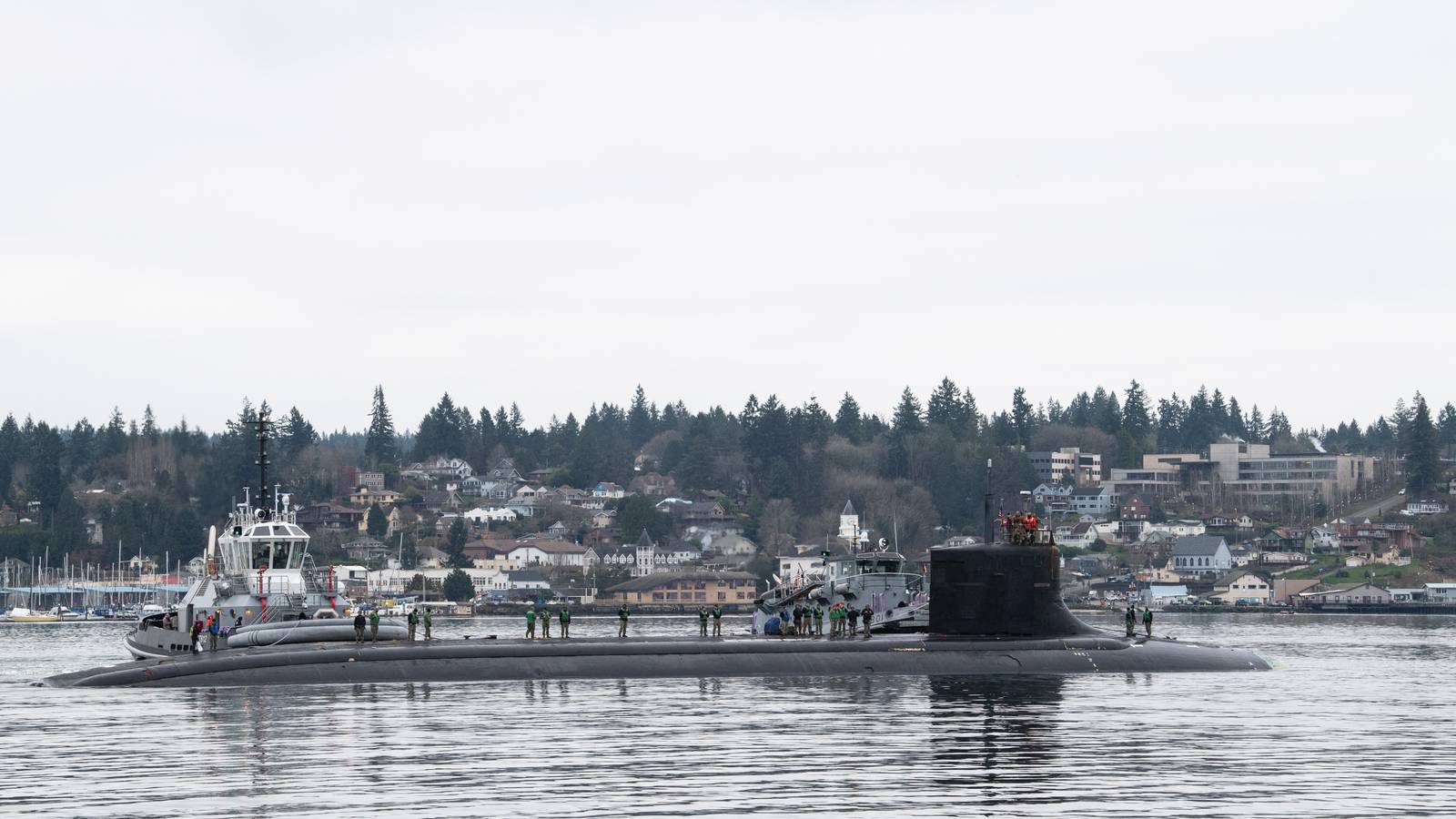

More than four years after the USS Connecticut slammed into an underwater mountain to force an emergency ascent off China’s southeast coast, the Seawolf-class submarine is nearing a return to service.
But not long after, retirement is now looming for a sub that became a lifeboat for the southeastern Connecticut economy as the Cold War drew to a close.
Designated SSN 22 in Navy shorthand, USS Connecticut was the second of three Seawolf-class attack submarines launched in Groton by General Dynamics Electric Boat in the 1990s, between USS Seawolf and USS Jimmy Carter.
A technological marvel then and now, the U.S. Navy originally envisioned a fleet of 29 Seawolf-class subs to counter the newest sub designs by the Soviet Union. But with the country disintegrating in 1991 during Mikhail Gorbachev’s final year as president, the Navy canceled the contract with plans to swap in what it intended to be a cheaper option in the Virginia-class subs that Electric Boat assembles today in Groton.
Facing a seven-year gap before Virginia-class sub construction would begin, Congress authorized a limited run of Seawolf subs to keep two active submarine construction shipyards viable during those years. As worded by Les Aspin, secretary of defense at the time, USS Jimmy Carter represented the final “bridge” sub in his words to keep dollars flowing to Groton and Quonset Point, Rhode Island, Electric Boat’s auxiliary shipyard that builds major components.
“When the Berlin Wall fell and Gorbachev really scaled back the size of the Soviet navy and military force, the cuts to the submarine program happened instantaneously,” said U.S. Rep. Joe Courtney, D-2nd. “You look at the size of the shipyard workforce, it went from about 30,000 to less than 10.000 in a really short period of time. … It was awful.”
USS Connecticut took five years to build, launching on Sept. 1, 1997, and commissioned for service in December 1998. This month, the Navy set a 2031 retirement date for USS Connecticut, even as planning proceeds for a new attack sub it currently calls SSN(X) — which given China’s current push for naval superiority, might end up a lot more like USS Connecticut than the Virginia-class subs that Electric Boat is building today.
“The Seawolf class is extremely capable — when you’re going against other submarines, you have this feeling that this just isn’t fair,” Michael Connor, former commander of USS Seawolf and Submarine Force Atlantic based at the Naval Submarine Base New London, told CT Insider. “It’s probably the best submarine class ever built.”
‘Sick to my stomach’
In the “silent service” where stealth is prized above all else, USS Connecticut has stood out from the pack for landing in headlines repeatedly in recent years.
By far the most serious incident occurred in October 2021, when the sub struck an underwater mountain in the South China Sea while on a classified “humanitarian evacuation” mission in the words of a Navy report after the accident. Hainan Island, China’s base for its most advance nuclear submarines, is located off the country’s southern coast in the South China Sea.
USS Connecticut was forced to surface with injuries to 11 sailors, one of whom had a fractured scapula, but no damage to the sub’s nuclear propulsion system. Still, the force of the impact was sufficient to risk fatalities or even “loss of ship” in the words of a Navy report led by C.J. Cavanaugh, today a rear admiral and commander of the U.S. sub fleet in the Pacific Ocean. The Cavanaugh report was declassified in 2022 with many elements redacted for national security purposes.
As detailed in the report, USS Connecticut struggled initially to make the surface amid issues with its system that generates high-pressurized air to expel seawater from tanks, giving subs the buoyancy to ascend. The crew quickly found a workaround using a trim pump, only for that device to overload to the point it “glowed red” and then ignited, but with the fire extinguished quickly.
At some point in the subsequent transit to Guam, USS Connecticut’s bow dome detached, making for a rough ride home, with YouTube video showing the sub in its stricken state after arriving in San Diego. A post-cruise examination also found rocks in the main ballast tanks.
Fifty crew members were recommended for mental-health counseling once back in port, according to the Cavanaugh report, another testament to the ordeal sailors suffered in the incident and aftermath.
Despite the Navy stating the underwater seamount did not appear at the time on its charts of the South China Sea, the Cavanaugh report termed the incident preventable and was the result of “an accumulation of errors and omissions in navigation planning, watchteam execution, and risk management that fell far below U.S. Navy standards.” The sub’s commander was relieved of duty.
Since arriving at Puget Sound Naval Shipyard in December 2021, USS Connecticut has been laid up in Dry Dock Five, one of six at the Navy yard used to lift vessels free of the water for repairs and maintenance. The extended layoff was driven by the need to custom-built a new bow dome, which required more than three years of work.
“When that crash took place in 2021, when I heard about it — I was sick to my stomach,” said U.S. Rep. Joe Courtney, D-2nd, an an interview with CT Insider. “You just knew what a loss it was to the Navy.”
The USS Connecticut is not alone on the list of Navy submarines to suffer severe incidents in peace time, with several other examples this century alone including the USS Hartford. The sub went aground in 2003 in a Sardinia harbor, and six years later collided in the Strait of Hormuz with the USS New Orleans, a large ship designed to launch shore assaults with amphibious landing craft and other equipment.
In 2001, USS Greeneville collided with a ship off Oahu carrying high school students from Japan on an educational research voyage, with nine people dying. The USS San Francisco struck an underground seamount while traveling at 25 knots, with a crewmember dying of injuries. Other submarines to collide with ships include the USS Jacksonville, USS Montpelier, USS Newport News, USS Oklahoma and USS Philadelphia.
But USS Connecticut had a few other incidents as well. In 2020 in what the Navy would term a “class A mishap”, the USS Connecticut smacked into a pier while attempting to moor at Naval Base Point Loma in San Diego. Class A accidents are the biggest red flags raised by Navy investigators, involving at least $2.5 million in damage, serious injury, or fatalities.
The previous year, a bedbug infestation broke out that, according to the independent publication Navy Times, resulted in some sailors sleeping on the floor or in chairs to avoid getting bitten. Navy Times reported one unidentified petty officer floating a scenario in which someone groggy at the helm after a night of little sleep could run the sub into an underwater mountain.
USS Connecticut has also made plenty of benign headlines — both those churned out by the U.S. Navy to promote its vessels and crews, as well as a break-the-Internet moment in April 2003 north of the Arctic circle.
After the sub punched through ice near a climate research station operated by the University of Washington, a polar bear ambled up to sniff the sub’s rudder as a meal candidate, with some trial bites before going on its way after about a half-hour. USS Connecticut crew members captured the moment in photos through the periscope,
“When you surface through the ice, polar bears are one of those things you need to always be ready for,” Connor told CT Insider. “People go out onto the ice and there’s a person assigned with a weapon to protect the humans. No one’s ever had to do that — but they’re always ready.”
The next SSN(X)
Puget Sound Naval Shipyard is now readying USS Connecticut’s return to the deep, with the sub at last report expected to resume service this September. In an updated shipbuilding plan published in May, the Navy set a 2031 retirement date for USS Connecticut, sticking with 33-year service life for attack submarines despite USS Connecticut losing more than four years while laid up in dry dock for repairs.
It is one of two Navy vessels today with names derived from Connecticut, along with the USS Hartford which is currently undergoing maintenance and upgrades at Electric Boat. A third will follow in the future USS Groton, a Columbia-class ballistic missile sub that will become the fourth Navy vessel named for the municipality home to Electric Boat and the Naval Submarine Base New London.
Notable among the ships next year slated to sail into the sunset: the USS Ohio, whose namesake class of ballistic missile subs will be replaced by the Columbia-class, starting with the USS District of Columbia now being assembled in Groton.
From where he sits as ranking member of the Seapower and Projection Forces Subcommittee of the House Armed Services Committee, Courtney thinks USS Connecticut might win a temporary reprieve from that 1931 retirement date, given its extended layoff for repairs.
“A lot of Los Angeles-class subs have definitely exceeded those initial retirement dates that have been in shipbuilding plans in the past,” Courtney said. “But they are obviously keeping an eye on hull safety and the reactor reserve — its basically running your gas tank down.
“It’s so valuable,” Courtney continued. “I think they are going to try to squeeze every deployment they possibly can for that sub.”
The same Navy shipbuilding plan devotes ample attention to the Columbia-class of ballistic missile submarines, and farther out, the SSN(X) class of attack subs.
“This submarine will be the first of its kind, engineered from the outset to accommodate and utilize unmanned systems and payloads,” the newest U.S. Navy Shipbuilding Plan states. “SSN(X) will benefit from a revitalized industrial base’s full capability and capacity. We cannot repeat the mistakes of the 1990s, when a false sense of security caused leaders to allow the [submarine industrial base] to atrophy.”
The document does not delve into whether SSN(X) would share Seawolf-class characteristics of being stealthier, faster and diving deeper than today’s Virginia-class subs — not to mention bigger, allowing it to carry more missiles, drones and torpedoes, and with improved sonar and other technologies.
“A lot of subs can be quiet if they’re not doing anything. Seawolf, you can be quiet and fast,” Connor said. “My first couple of weeks on [USS Seawolf], it was a little confusing because in the same place you’d see five sonar contacts on a Los Angeles-class, you might see 15 or 20.”
That all likely means a heftier price tag, even as Washington gauges how to pay for any number of new military platforms. Those range from hypersonic missiles to President Trump’s sought-after investments like a “golden dome” missile defense shield for the United States, and a proposed nuclear-powered battleship.
In a May hearing on Capitol Hill, Courtney voiced skepticism at being able to deliver on Trump’s timeline for a new battleship, in part on grounds just two U.S. shipbuilders today are certified to build nuclear-powered vessels: Electric Boat and HII’s Newport News Shipbuilding in Virginia that also builds submarines and aircraft carriers.
Courtney is not alone in wanting the U.S. to build on its sub capabilities, given the exposure of surface ships to hypersonic missile attacks and the threat subs represent to opposing navies.
“We have an overwhelming advantage against the Chinese in the undersea world,” said U.S. Rep. Mark Wittman, R- Virginia, speaking during a mid-May hearing of the Seapower and Projection Forces Subcommittee. “If you look at the pace that [Los Angeles-class subs] are coming out of the inventory and the pace at which Ohio-class are coming out of the inventory, that should be where the gas pedal is pressed.”
Iran and before that Ukraine have proven the capabilities of aerial or seagoing drones to pose threats to surface naval and commercial ships. After Connor retired as rear admiral, he started ThayerMahan in Groton which runs a maritime reconnaissance network using ocean buoys and autonomous surface drones to keep tabs on vessel traffic above and below the waves. In March, the company revealed it has developed a system to counter the threat of underwater autonomous drones to threaten ports, without disclosing the technology except to say it was a “non-kinetic” approach.
“It’s highly unlikely-to-impossible that we can produce submarines at the rate that China is currently producing them any time in the next 20 years,” Connor said. “That’s why we and other companies are focusing on large numbers of less expensive systems that have detection capabilities that are almost as good as a submarine — it’s not quite as good. We are looking to supplement the number of submarines we have with the ability to access a number of our remote systems, and make the submarine the linchpin in a network. That is the only way we outperform China.”
Includes prior reporting by staff writer Paul Schott.
© 2026 The Hour (Norwalk, Conn.). Visit www.thehour.com. Distributed by Tribune Content Agency, LLC.
Read the full article here
