



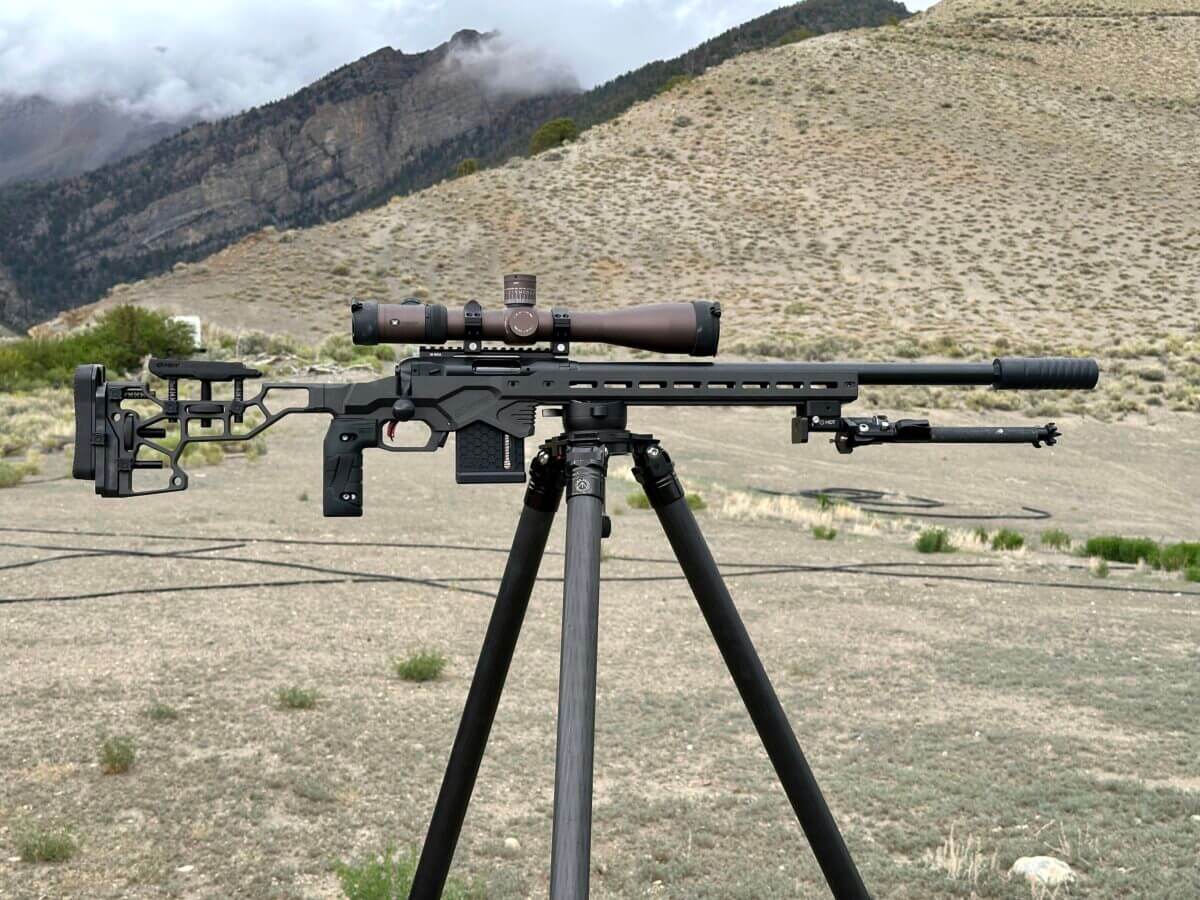

The Savage 110 RF Elite Precision takes the full-size Model 110 concept into.22 LR with serious competition hardware, a clever reversible bolt throw, and impressive accuracy. After two months of range work and varmint hunting, the bigger question is whether all that performance is enough to justify its $2,399.00 MSRP.
Savage’s new 110 RF product lineup aims to fill the niche market of precision .22 LR rifles. This market is typically pursued by demanding competitive shooters, and/or equally demanding range-therapy attendees like you. The 110 RF Elite Precision is the highest trim, and most expensive model currently available from Savage. Still, is this enough to allow it to compete with other premium rifle systems?
Savage 110 RF Elite Precision: A Full-Size .22 LR With a Serious Mission
Savage has released their new 110 RF rifle lineup, which is comprised of three different models that all share the 110 RF action. This is a full-sized action with a front-locking bolt head that can be changed between a .22 LR bolt throw or .308 Win bolt throw length, depending on the needs and desires of the shooter. The rifle that I tested is the highest trim model of these, called the 110 RF Elite Precision.
The 110 RF Elite Precision ($2,399 MSRP) is one of three different models available right now. The other two models are the 110 RF Core Tactical ($1,099 MSRP) and the 110 RF Magpul ($1,199 MSRP). The RF Elite Precision differs from these other two by its MDT Gen 2 ACC Premier chassis and a 22″ straight profile barrel. The other models have a heavy fluted 20″ barrel and different polymer stock options. This means that the 110 RF Elite Precision is a much heavier rifle system, weighing about 4 lbs more than the others.
Savage 110 RF Action Deep Dive: The Trick Behind Its Dual Bolt Throw
The 110 RF action this rifle uses shares the same footprint as Savage’s proven 110 action. This allows us to swap the 110 RF into any chassis or stock option that is already available with the Savage 110 action inlet. Another benefit of this is the ability to use any Savage 110-compatible aftermarket trigger. These are only a few of the aftermarket support options that are already available for this brand new gun from Savage.
One unique feature of the 110 RF action that is worthy of its own discussion is the bolt baffle. Alone, this part allows the bolt throw of the 110 RF to be easily changed between a short .22 LR length throw and the standard short action bolt throw. This is especially handy if you are using the 110 RF as a training rifle in lieu of your short action competition rifle that has a more expensive ammo diet.
The half-cylinder-shaped bolt baffle sits directly behind the bolt lugs. On one side of it, there is a long baffle that simply limits the bolt throw by lessening the space between it and the bolt stop. On the other side, this baffle is shorter and can be flipped around without the use of tools to increase the distance between it and the bolt stop. This baffle is held in place by a wave spring washer and it can be removed by twisting it approximately 90 degrees and popping it off the bolt while the bolt itself is removed from the gun.
Another unique feature of the 110 RF that I find noteworthy is the dual extractors found on the bolt face. The bolt is set up for a controlled round feed strategy. Controlled round feed means the bolt captures the cartridge before the cartridge enters the chamber and locks into battery. This design provides ultra-reliable feeding and extraction because the bolt holds the cartridge from the moment it leaves the magazine until the case is ejected.
Savage 110 RF Elite Precision Specifications: What $2,399 Buys
| Feature | Specification |
|---|---|
| Action | Model 110 full-sized action |
| Action and Bolt Finish | E-100 Blackout Cerakote on action and bolt |
| Chamber | Match chamber in 22 LR |
| Trigger | User adjustable Competition AccuTrigger |
| Trigger Adjustment | 1-4 lbs. |
| Bolt Head | Front locking bolthead |
| Bolt Knob | Threaded bolt knob |
| Bolt Knob Thread | 5/16″x28 TPI |
| Chassis | MDT Gen 2 ACC Premier chassis |
| Magazine | L3i detachable AICS style magazine |
| Magazine Capacity | 10 round capacity |
| Bolt Throw System | Interchangeable front baffle for bolt throw length |
| Bolt Throw Lengths | 308 WIN length or .22 LR length |
| Muzzle | Threaded muzzle |
| Muzzle Thread | 1/2″x28 TPI |
| Caliber | chambered in .22 LR |
| Configuration | available in right handed models (currently) |
| Barrel Length | 22″ barrel length |
| Weight | 12.5 lbs. |
| MSRP | $2,399.00 MSRP |
MDT Gen 2 ACC Premier Chassis: Where the Premium Price Starts Making Sense
The MDT Gen 2 ACC Premier chassis this model of 110 RF comes in is absolutely loaded with features and provides the ability to further customize the rifle system with add-ons. This chassis looks similar to MDT’s Elite chassis so I want to quickly point out that the Gen 2 ACC Premier is basically just shorter and slightly less adjustable ergonomically. Yes, there are other differences, but I could spend the rest of the review discussing these if I go into detail. Because it is shorter, the Gen 2 ACC Premier pairs very well with a rimfire rifle like this one that only has a 22″ barrel.
The premium price tag of the 110 RF Elite Precision is largely due to this chassis. The Gen 2 ACC Premier chassis has an MSRP of $1,099.99 alone. For this increase in cost, you get competition-ready features. Now I’ll breeze over a bunch of them from butt-to-forend. The buttpad has both vertical and length-of-pull (LOP) toolless adjustments. The cheek riser also allows fore-and-aft adjustment and toolless height adjustment. The rear of the buttstock features a short bag rider with an M-LOK slot that accepts rear monopods and other attachments. There is also a QD flush cup attachment point located here.
Moving forward, you’ll find an integral thumb shelf. Below this, there is an adjustable MDT vertical foregrip. If you do not like this grip, you can replace it with any AR-15-compatible grip. In front of the trigger guard, there is an ambidextrous paddle magazine release. The magwell is flared and has an integrated barricade stop that is quite aggressive.
Finally, the forend has a full-length ARCA rail plus M-LOK slots down the full length of both sides, plus three slots on the front of the bottom side. There are specific weight attachment points at the rear and front of the sides of the forend as well as on the inside of the barrel channel. Lastly, the forend accommodates NVG bridges and control-bridge accessories through its drilled and threaded mounting points.
MDT Gen 2 ACC Premier Chassis Specifications: Loaded for Competition
- Hard-anodized 6061 aluminum construction
- Cerakote finish
- 4.8 lbs with SRS-X Lite buttstock
- Weight varies depending on rifle model and added weights
- Length of Pull Adjustment
- Adjustable in ¼-inch increments via spacers
- 1 inch of total adjustment
- 12.32–13.32 inches with SRS-X Lite buttstock
- Compatible with AICS-pattern magazines
- XTN Buttstock interface
- 15 inch forend length
- Compatible with AR-15-style grips
- MDT Vertical Grip (Premier) included
- 1.250 inch maximum barrel diameter
- Accessory mounting points
- Integrated thumb shelf
- QD Sling cups
- Integrated barricade stop
- Attachment for NV and control bridges
- Compatible with interior forend weights
Savage 110 RF Elite Precision Accuracy: Real 50-Yard Groups
The way I chose to perform the accuracy test for the Savage 110 RF Elite Precision was to emulate the benchrest .22 LR competitions I shoot. This means that I shot the test at a distance of 50 yards off of a bench with a bipod in the front and a bag under the rear for support. I intentionally selected a day with a favorable wind forecast and conducted the test in the morning, when winds are typically at their calmest. With shooting .22 LR, you’ll find that switching ammunition will usually yield a few flyers. This is especially true if you go from a wax-coated lead bullet to a copper-jacketed projectile. To account for this phenomenon, I fired at least five rounds of the test ammunition before shooting the recorded five-shot group. Also, I shot this test with no muzzle devices attached.
The ammunition tested was provided by AmmunitionToGo and it included many match-quality offerings. This included Eley Tenex 40 grain, Eley Match 40 grain, Eley Club 40 grain, CCI Standard Velocity 40 grain, CCI Pistol Match 40 grain, CCI Green Tag 40 grain, SK Pistol Match 40 grain, and Fiocchi Range Dynamics 40 grain. I’ve linked all of these options that are currently available. Also, if you want to learn more about .22 LR ballistics, read about it here on the Lodge. As you’ll see detailed in the table below, most of the tested ammunition put down sub-one-inch groups while a couple (CCI Standard Velocity and Eley Tenex) shot sub-half-inch.
Range and Field Test: Where the Savage 110 RF Elite Precision Shines
I spent a ton of time behind Savage’s 110 RF Elite Precision and I used it for two very different applications: hunting and plinking. At the range, I accuracy tested many different ammunitions, plinked with friends, or punched paper for practice. I spent the remainder of my time in the field hunting varmints. In both use-cases, the 110 RF Elite Precision excelled.
This gun offers a lot of adjustability. Consequently, I dialed in the platform’s ergonomics by adjusting the length of pull, cheek-riser height, buttpad height, and grip angle to fit my body and shooting style. When everything fit me just right, I moved on to fine-tuning the reliability of the magazine.
The 10-round L3i Detachable AICS-style magazine that comes with this rifle has an adjustable magazine catch. To me, this is a positive and an annoyance simultaneously. First, it’s an annoyance because I had to spend a significant amount of time testing, adjusting, retesting, and readjusting the mag catch height to dial the mag in to feed smoothly and reliably. At the same time, this adjustability is also a positive from the perspective that I was able to fine-tune the magazine to reliably and smoothly feed the ammunition I was using. I guess the shooter could always buy a different magazine if they deemed this unnecessary, but I think the time spent was worth the benefit.
Trigger and Bolt Throw: Savage Got Both Right Out of the Box
Two notable aspects that I didn’t mess with were the trigger and bolt throw length. I left the 1-4 lb adjustable trigger alone because I measured the pull weight to be a crisp 1.25 lbs right out of the box. Also, I left the bolt throw length at the shorter .22 LR throw because it fit my application best. At the end of my testing, I did swap the bolt buffer around to yield the .308 Win bolt throw length and it felt fantastic. This would be a fantastic feature for the shooter who uses this rifle as a practice alternative to their centerfire rifle.
Suppressed Savage 110 RF: Quiet Meets Surgically Precise
I spent about 50% of my time behind the Savage 110 RF Elite Precision shooting unsuppressed. I chose to shoot the accuracy test and spent a lot of my range time unsuppressed just to avoid any accuracy-related issues that a suppressor may cause. All of my time shooting varmints was spent suppressed with an AB Suppressor F-4. It performed flawlessly and maintained the same level of accuracy achieved during unsuppressed shooting. Any suppressed bolt action rimfire is a pleasure to shoot because it is quiet, but this rifle system was both quiet and surgically precise, which really provided that “wow” factor.
Varmints at 200 Yards: The Savage 110 RF Leaves Little Room for Excuses
As a varmint rifle, the 110 RF Elite Precision excels. I placed this rifle on a sturdy tripod and posted up in a varmint-infested field. Once there, I shot in place for hours. I placed shot after shot on target. The real trouble was keeping magazines loaded. A miss was rare, and always due to a bad wind call or user error. I was able to accurately and comfortably take shots out to 200 yards. This is due to the capabilities of the rifle system. All I had to do was accurately range, dial the optic, and pull the trigger. Side note: I’ve experimentally tested the 40 grain CCI Standard bullet to yield a 0.120 G1 BC for those of you who might want to replicate this experience.
Savage 110 RF Elite Precision Verdict: Is It Worth $2,399?
Savage’s 110 RF Elite Precision is an incredible rifle. It’s accurate, highly user configurable, and purpose-built. This rifle would be a valuable training aid for long-range competition shooters. Especially if you have a Savage rifle that you use for this purpose. Potentially, a shooter could compete and train with two different rifles that feel exactly the same. This saves significantly on ammo expense by training with a .22 LR. On the flipside, this would be a fantastic rifle to use in .22 LR-specific competitions. Shooters can confidently use the 110 RF Elite Precision in both dynamic NRL22 and static benchrest competitions.
The biggest barrier to purchasing this rifle is the $2,399.00 MSRP. I don’t want to shy away from this. For the applications I just mentioned, this could be a justifiable expense. For you weekend warriors that are simply seeking a high-end rimfire rifle to enjoy, it’d be a good splurge if you’re able. If not, Savage recently released two other 110 RF models that cost more than $1,000 less, and I expect them to deliver the same reliability and accuracy that this rifle demonstrated. For all others, go ahead and express your thoughts in the comments if you haven’t already.
Two Months Later: Reliability, Accuracy, and the Final Word
After abusing this rifle for two months, I’ve had no failures to extract, failures to fire, or feeding issues (after fine-tuning the magazine height). The accuracy of this rifle system is impressive, and I found it to shoot the abundant and affordable 40 grain CCI Standard Velocity ammunition best. Overall fit and feel is excellent. And the MDT Gen 2 ACC Premier chassis adds a lot of features and adjustability that justify the increased cost of the 110 RF Elite Precision. Finally, the 110 RF action combines thoughtful engineering with features such as front locking lugs and a bolt bushing that simplifies switching the bolt throw between .22 LR and .308 Win lengths. I’ve thoroughly enjoyed this rifle and would be happy with this purchase if I were to buy it.
Read more about the Savage 110 RF Elite Precision here.
Savage 110 RF Elite Precision Pros & Cons: Premium Rimfire Reality
- Pros: Impressive .22 LR accuracy, highly adjustable MDT Gen 2 ACC Premier chassis, crisp 1.25 lbs measured trigger pull out of the box, reversible .22 LR and .308 Win bolt throw lengths, threaded muzzle, excellent suppressed performance, and no failures to extract or fire during two months of testing.
- Cons: $2,399.00 MSRP, 12.5 lbs. total weight, and the adjustable L3i magazine catch required repeated tuning before feeding was dialed in smoothly and reliably.
Read the full article here
