



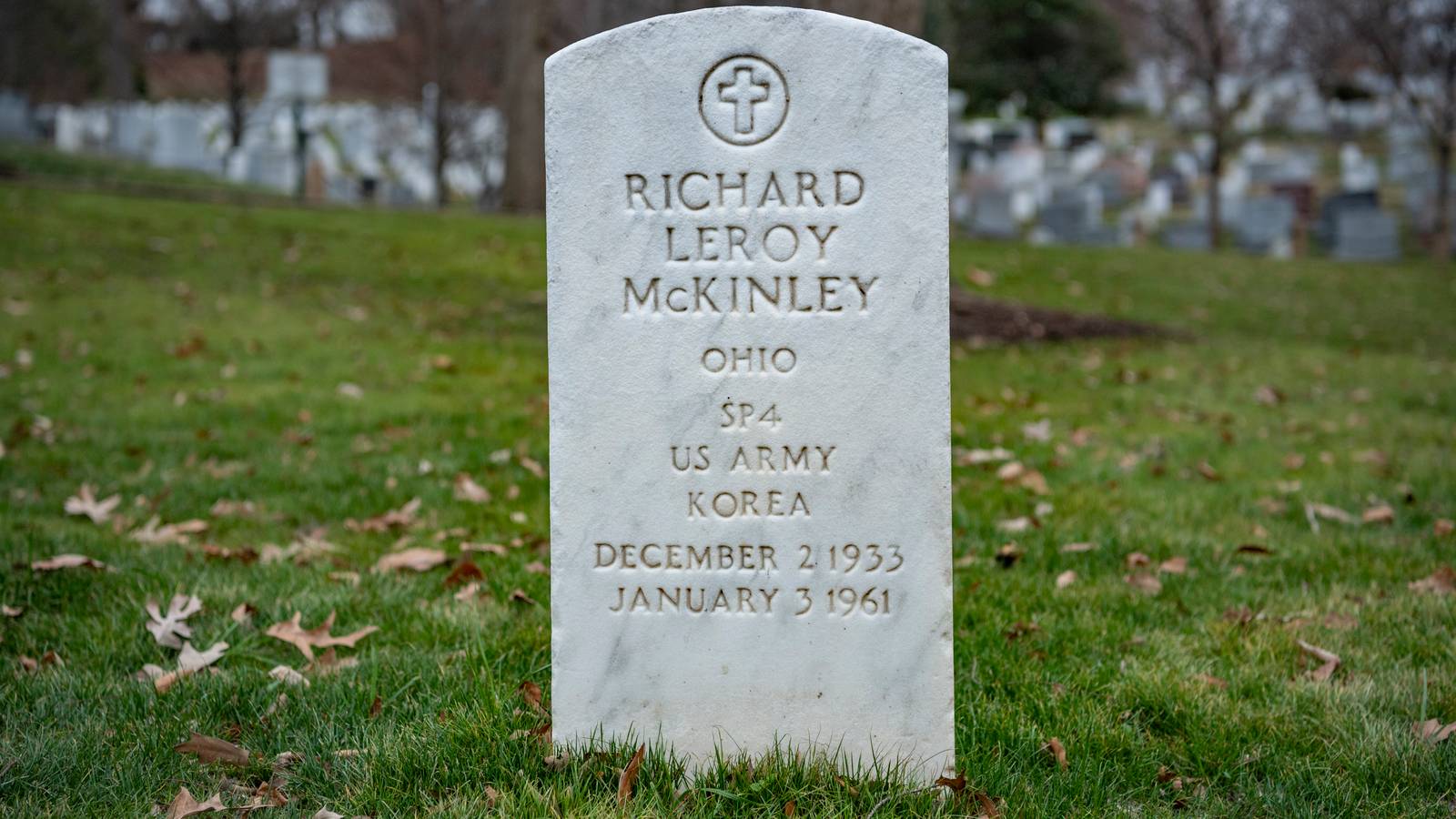

White marble, rounded top, a name and a pair of dates, one of thousands in the long rows of Arlington National Cemetery. Section 31, Grave 472. A visitor could walk past it a hundred times and never know.
Beneath it, a soldier is buried in a lead-lined casket, sealed in concrete, lowered into a metal vault, and covered with more concrete still. His body cannot be moved without the federal government’s permission. Sixty-five years after his death, it is still faintly radioactive.
His name was Richard Leroy McKinley, and he died running one of the first machines the U.S. military ever built to make nuclear power portable. The military is now building another.
A Reactor in the Desert
On the night of Jan. 3, 1961, McKinley and two other servicemen were at work inside a squat cylindrical building in the high desert of eastern Idaho, about 40 miles west of Idaho Falls, at what was then called the National Reactor Testing Station.
Their reactor was named SL-1, for Stationary Low-Power Reactor Number One. Experimental and small, but built to prove that a compact nuclear plant could generate electricity at remote military outposts, without the long fuel-supply lines that diesel generators required. It was the kind of idea that sounded like future tech.
The three men had come back from a holiday shutdown and were reassembling the reactor. That night’s job involved manually lifting a central control rod a few inches to reconnect it to its drive mechanism, but someone pulled it too far. In roughly four milliseconds, the reactor surged to thousands of times its normal power. The water inside flashed to steam, and the pressure hurled the entire 26,000-pound reactor vessel more than nine feet into the air before it dropped back into place.
Two of the men were killed instantly. McKinley, gravely injured, was still alive when rescuers finally reached the building more than an hour later, held back by radiation readings that pinned their needles. He would pass on the way to the hospital.
The other two were Army Specialist John Byrnes and Navy construction electrician Richard Legg. All three had absorbed radiation on a scale almost nothing in American life had produced before.
Most Dangerous Grave In Arlington
The problem did not end with their deaths, either; at this point, their bodies had become hazardous. McKinley’s remains were so contaminated that the ordinary rituals of death were impossible. He could not be safely embalmed; they couldn’t cremate him, which would have released radioactive material into the air.
He could not even be washed without endangering the people handling him.
So the government engineered a grave. McKinley was placed in a casket lined with lead, which was encased in concrete, then set inside a metal vault and buried beneath a further layer of concrete in Section 31 at Arlington.
His funeral, in the winter of 1961, was conducted with his family kept at a distance from the grave. Byrnes and Legg were buried with similar precautions in their hometowns, and some of the most radioactive tissue from all three men was disposed of separately as nuclear waste in the Idaho desert.
McKinley’s plot remains the only radioactive grave at Arlington. The cemetery’s own file on it is less an epitaph and more of a hazard placard, stating “Victim of nuclear accident. Body is contaminated with long-life radioactive isotopes. Under no circumstance will the body be removed from this location without prior approval of the Atomic Energy Commission in consultation with this headquarters.”
It is safe to visit; you can get in close enough to read the name. It simply cannot be disturbed for a very long time.
The Second Attempt
SL-1 was one piece of the Army Nuclear Power Program, not some experiment done on a whim. This was a mid-century effort to shrink the reactor down to something the military could carry. Pentagon officials wanted something that could power radar lines in the Arctic and bases at the ends of supply chains.
That accident helped to pause that dream for nearly seven decades. The SL-1 investigation reshaped how the country designed and regulated reactors, and its lessons are part of the reason the United States has never had another fatal reactor accident in the 65 years since.
Army higher-ups eventually wound down the program over the following decade. A testing station in Idaho grew into what is now the Idaho National Laboratory, and SL-1 receded into the memory of nuclear engineers or the occasional retelling online.
At the same Idaho laboratory, on the same high desert, the Pentagon is once again trying to build a nuclear reactor it can pick up and move. That program is called Project Pele and is run by the Defense Department’s Strategic Capabilities Office. Goals here are similar to when the SL-1 was developed, where a small, transportable reactor can power military operations far from any grid, delivered in standard shipping containers and switched on where needed.
In late 2025, the program reached a milestone when its specialized fuel arrived at the Idaho lab, and assembly and testing are expected to follow, with the reactor slated to run at the site. However, Pele is not SL-1. It is a high-temperature gas-cooled reactor, not a water-cooled one. This tech runs on what is known as TRISO fuel, uranium kernels wrapped in layers of carbon and ceramic engineered to hold their radioactive contents intact even under extreme heat.
Its designers describe it as meltdown-resistant by physics rather than by vigilance, the product of six decades of work aimed squarely at making sure the thing that happened to McKinley can never happen again.
That is the promise, and the engineers building it are staking their reputations on it. Whether a reactor can be both portable and perfectly safe is the question the program exists to answer, and it will be answered, as it was the first time, in the Idaho desert.
Read the full article here
