



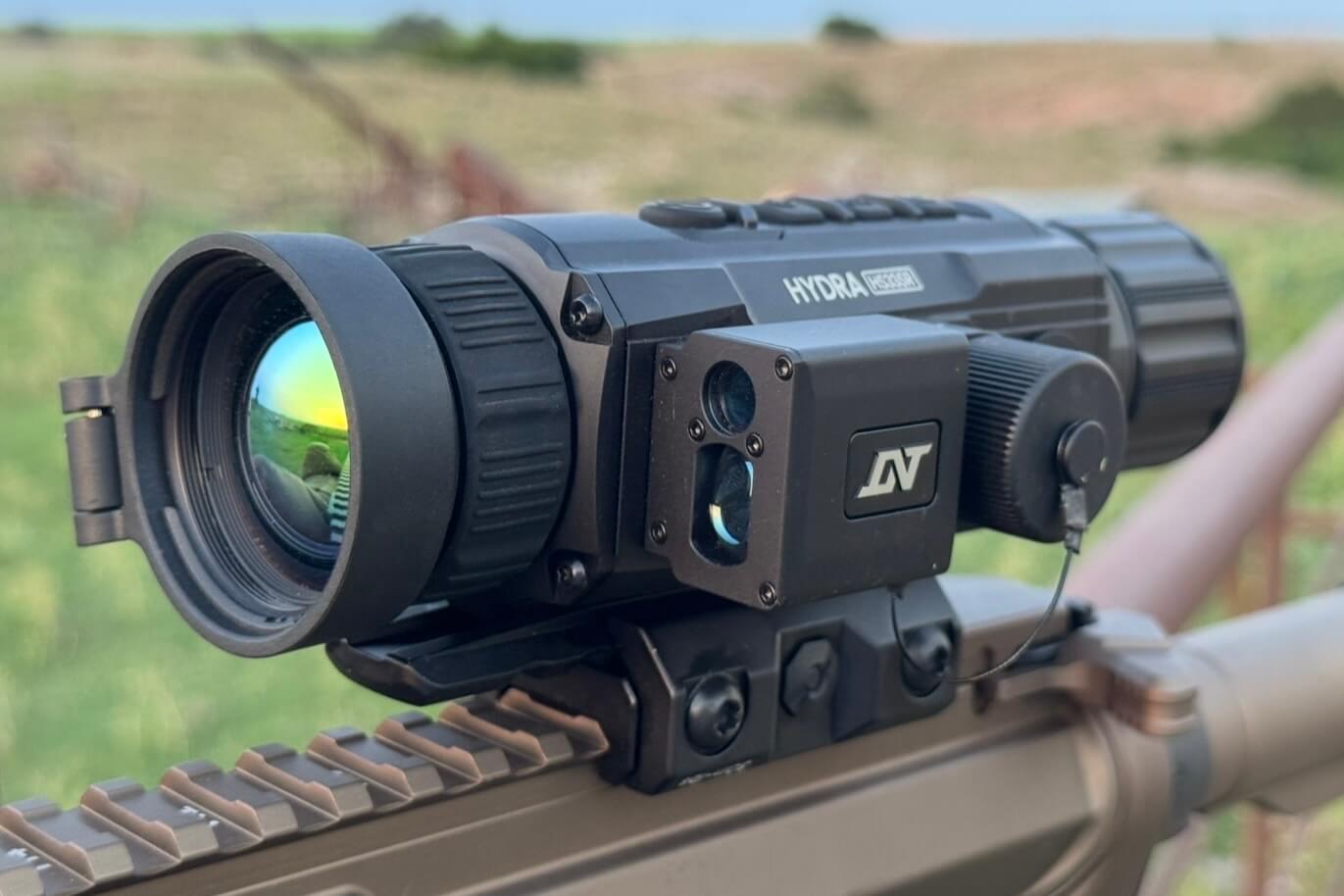

The DNT Hydra HS335R tries to pull off the night-hunting equivalent of a five-tool magic trick. It is a thermal scope, clip-on, scanner, laser rangefinder, and ballistic calculator packed into a 15-ounce unit selling for under $1,800.
The DNT Hydra HS335R combines a thermal scope, clip-on, scanner, laser rangefinder, and ballistic calculator for under $1,800.
Why the DNT Hydra HS335R Thermal Gets Your Attention Fast
Thermal optics continue to evolve, and manufacturers are packing more features into increasingly affordable packages. The DNT Hydra HS335R enters a unique segment of the market by offering multiple roles in a single device. It functions as a dedicated thermal scope, a handheld scanner, and a clip-on thermal while also integrating a laser rangefinder and onboard ballistic calculator. At its current sale price of $1,776.99, the Hydra promises capabilities that traditionally required several separate devices.
| Model | DNT Hydra HS335R |
|---|---|
| Thermal Sensor | 384×288, 12μm |
| NETD Rating | ≤18mK |
| Objective Lens | 35mm |
| Base Magnification | 3x |
| Digital Zoom | Up to 12x |
| Display | 1024×768 Micro-OLED |
| Refresh Rate | 50Hz |
| Weight | 15 ounces |
| Battery | Single flat-top 18650 battery |
| Recoil Rating | Up to .50 BMG |
| Waterproof Rating | IP67 |
| Laser Rangefinder | 5 to 1,300 yards |
| Current Sale Price | $1,776.99 |
The Hydra HS335R features a 384×288, 12μm thermal sensor with a claimed NETD rating of ≤18mK. DNT pairs that sensor with a 35mm objective lens, producing a 3x base magnification with up to 12x digital zoom. The display uses a 1024×768 Micro-OLED panel running at 50Hz.
The unit weighs just 15 ounces and runs on a single flat-top 18650 battery. DNT rates the Hydra for recoil up to .50 BMG and gives it an IP67 waterproof rating. The onboard laser rangefinder is capable of measuring targets from 5 to 1,300 yards, while the integrated ballistic engine provides holdover corrections based on the measured distance.
Included in the box are the Hydra HS335R, DNT’s QDM150 quick-detach mount, two 18650 batteries, a charger, cables, lens covers, and cleaning accessories.
First Look: Better Image Quality Than the Price Suggests
My first look surprised me. The image quality was noticeably better than I expected for a thermal at this price point. That does not mean the Hydra magically performs like a premium 640-resolution thermal. However, the image remains clean and natural-looking. Some budget thermals rely on aggressive image processing that can make targets appear artificial or overly sharpened.
Instead, the Hydra presents an image that looks honest to the sensor. The 384-resolution sensor remains the limiting factor, but the overall picture quality is quite respectable considering the cost. The compact size also stood out immediately. At only 15 ounces, the Hydra feels more like a handheld scanner than a traditional thermal scope.
One Compact Thermal, Three Real Field Roles
Many thermal manufacturers advertise their optics as both a scanner and a riflescope. The Hydra goes a step further. In addition to functioning as a dedicated thermal scope and handheld scanner, the HS335R can also serve as a clip-on thermal mounted in front of a traditional daytime optic. That versatility is what makes the Hydra particularly interesting.
During testing, I primarily used the Hydra on an AR-15 while hunting coyotes and hogs. When scanning fields, the compact design worked well as a handheld device. Then I could quickly attach it to the rifle when it was time to shoot.
The included QDM150 mount deserves some discussion. At first glance, it appears designed to remain attached to the rifle while the thermal itself gets removed. The engraved markings on the mount seem to support that arrangement.
However, the mount is reversible. I chose to permanently attach it to the Hydra instead. That setup allowed me to quickly move the thermal between rifles using compatible mounting positions. For my use, that approach made more sense.
Laser Rangefinder: The Hydra Feature That Punches Hard
The laser rangefinder is one of the Hydra’s strongest features. The ranging button sits in an excellent location when using the Hydra as a handheld scanner. Even when mounted on a rifle, it remains easy to access. I was able to range trees out to approximately 1,160 yards, which is very close to DNT’s advertised capability. However, sometimes the rangefinder timed out and couldn’t quite range that far. Ranges 650 yards and closer on grass read consistently, but past that would get spotty and often require ranging a few times before getting a reading.
For a thermal in this price range, that performance is impressive. There is one small caveat. Due to the compact size of the unit, it is possible to accidentally block the rangefinder with your support hand while scanning. I caught myself doing it a few times early on. Once I adjusted my grip, the issue went away.
DNT Ballistic Engine: Useful Holdovers With Room to Grow
The onboard DNT Ballistic Engine is also a welcome addition. During testing, I stretched the system to 627 yards using an AR-15 firing 55-grain PMC ammunition. Conditions included roughly 20 mph winds, so precision was already challenging.
The ballistic solution got me in the ballpark. My impacts were consistently a little low, although that could have been caused by a less-than-perfect zero. Still, I would like to see DNT add the ability to true ballistic profiles in future software updates.
More mature ballistic platforms, such as Applied Ballistics and GeoBallistics, offer additional tuning options. Nevertheless, the onboard system worked well enough to provide meaningful assistance at a distance.
One limitation stood out. When operating in clip-on mode, the rangefinder becomes disabled. As a result, you lose access to onboard ballistic calculations. Hopefully, DNT can address that in a future update because retaining ranging capability in clip-on mode would significantly increase the system’s usefulness.
Reticles and Color Palettes: Plenty of Ways to Tune the View
The Hydra HS335R offers a good amount of customization with nine reticle options, five reticle colors, and eight thermal color palettes. These options allow users to tailor the display to their preference and quickly adjust the optic for different hunting conditions.
The reticle selection provides everything from simple aiming points to more detailed options for longer shots. Likewise, the ability to change reticle colors helps keep the aiming point visible against different backgrounds and temperature environments.
The eight color palettes give hunters additional flexibility when scanning and identifying targets. While White Hot is my go-to, having additional options makes it easier to find a display setting that works best for everyone.
App Connectivity and One-Shot Zero: Clean, Simple, No Drama
DNT’s mobile app worked well for me. I never experienced connectivity problems throughout testing. Pairing was straightforward, software updates installed without issue, and adjusting ballistic profiles was simple. The app feels polished and easy to navigate.
Likewise, the one-shot zero process worked exactly as advertised. Most thermal optics now include some variation of this feature, but DNT’s implementation is quick and intuitive. After firing a shot at paper, simply freeze the image while aiming at the bullseye. Then move the reticle to the thermal signature of the bullet hole and save the adjustment. After confirming with a second shot, my rifle was properly zeroed.
Clip-On Performance: Real Capability With a 384 Sensor Ceiling
The Hydra occupies a unique position in today’s thermal market because it offers legitimate clip-on capability at an affordable price. Setting up clip-on mode requires its own calibration and dedicated zero. However, that process only needs to be completed once. Afterward, the included quick-detach mount consistently returned the unit to its established zero.
Image quality remained usable behind a daytime optic. Even at 10x magnification, the display resolution prevented the image from becoming excessively pixelated. However, the thermal sensor itself ultimately becomes the limiting factor.
While the display can support magnification up to 10X, the 384-resolution sensor simply does not provide enough detail to fully capitalize on that much zoom. For practical hunting purposes, lower magnification settings generally produce the best results.
The accompanying photos of cattle at 290 yards demonstrate this effect well. At 1x and 5x magnification, target recognition remains respectable. By 10x, however, sensor limitations become more apparent.
Ergonomics and Battery Life: Mostly Smart, One Pinchy Focus Ring
Overall, ergonomics are well thought out. The buttons are easy to locate, and the rangefinder placement feels natural. The compact housing also makes handheld scanning comfortable.
My primary complaint involves the focus ring. The ring is relatively small and somewhat awkward to adjust. Rather than grabbing it naturally, I found myself pinching it between two fingers to make fine adjustments. It works, but it is less comfortable than the larger focus rings found on many competing optics.
Battery life appeared adequate during my hunting trips. The included flat-top 18650 batteries easily lasted through several hours of nighttime hunting sessions. One thing to note is battery compatibility. The Hydra does not work with longer 18650 batteries. Users should stick with the supplied flat-top style batteries or verify compatibility before purchasing spares.
DNT Hydra HS335R Pros and Cons: Big Utility, Honest Limits
- Pros: Thermal scope, handheld scanner, and clip-on thermal in one compact unit; integrated laser rangefinder; onboard ballistic calculator; good image quality for the price; reliable app connectivity; quick one-shot zero; compact 15-ounce design; included QDM150 quick-detach mount; returned to zero during clip-on use.
- Cons: 384-resolution sensor limits detail at higher magnification; rangefinder is disabled in clip-on mode; ballistic profiles cannot currently be trued; focus ring is narrow and awkward to adjust; longer 18650 batteries are not compatible.
Final Verdict: The DNT Hydra HS335R Is a Serious Value Play
The DNT Hydra HS335R fills a niche that few thermal optics currently occupy. For less than $1,800, buyers get a thermal scope, handheld scanner, clip-on thermal, laser rangefinder, and ballistic calculator in a single package. That level of versatility is difficult to ignore.
The 384-resolution sensor naturally imposes limits on image detail. Likewise, I would like to see future updates add ballistic profile truing and enable rangefinder functionality while in clip-on mode. Even so, the Hydra delivers impressive capability for the money. The image quality exceeded my expectations, the rangefinder performed well, the app remained reliable, and the clip-on mode consistently returned to zero.
If you’re looking for maximum thermal clarity regardless of cost, there are higher-end options available. However, if you want a versatile thermal that can serve as a scope, scanner, and clip-on without breaking the bank, the DNT Hydra HS335R offers some of the best value I have seen.
Read the full article here
