



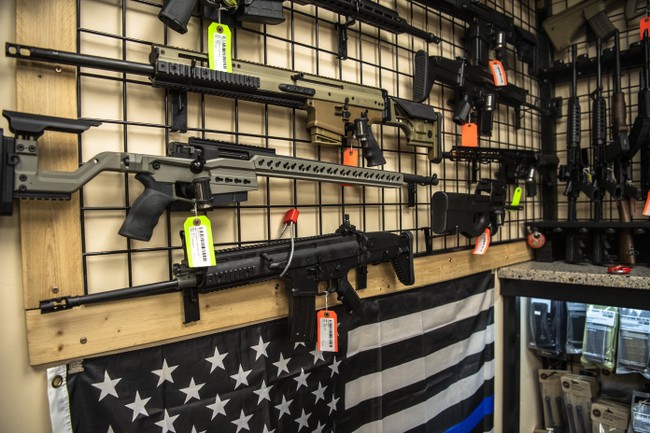

In a long-awaited opinion, the Third Circuit Court of Appeals has released its en banc decision in a trio of cases challenging New Jersey’s ban on so-called assault weapons and large capacity magazines, holding that the ban violates the Second Amendment’s protections for the right to keep and bear arms.
Besides the majority opinion, there are five opinions concurring either in whole or in part, along with three dissenting opinions, so Second Amendment attorneys and amateur law nerds like myself will have a lot of reading to do this weekend. Here’s the most important part of the majority opinion as an appetizer.
Applying the framework announced in New York State Rifle & Pistol Association v. Bruen, we agree with the District Court that New Jersey’s ban on Colt AR-15s violates the Second Amendment. However, because the record supports the same result for all semi-automatic rifles—not only Colt AR-15s—we will MODIFY the District Court’s order so that it deems the Assault Firearm Provisions unconstitutional with respect to the full class of semi-automatic rifles. We will AFFIRM that part of the order as modified.
The LCM Provisions also violate the Second Amendment, so we will REVERSE the District Court’s order with respect to those. Because the LCM Provisions violate the Second Amendment, we need not address the Takings Clause challenge.
While other circuit courts have upheld “assault weapon” bans by claiming they’re “dangerous and unusual” (or “unusually dangerous”), are not commonly-used for self-defense, and so close to machine guns that they’re not even protected by the Second Amendment, the Third Circuit rejected each and every one of those claims.
On the “common use” test, the Third Circuit correctly noted that “although the Court sometimes uses only the three-word phrase ‘in common use,’ that phrase means in common use for lawful purposes at the time of the modern restriction.” And self-defense isn’t the only lawful purpose for keeping and bearing arms.
While self-defense is “central” to the Second Amendment, other lawful purposes also bring a commonly used weapon within the ambit of the Second Amendment. After all, Founding-era Americans commonly used weapons for hunting in addition to self-defense. See id. at 599 (noting that most Founding-era Americans “undoubtedly thought [the SecondAmendment right] even more important for self-defense and hunting” than for securing the citizen militia). So weapons commonly used for hunting fall under the protection of the Second Amendment. Whatever the purpose of using a given arm, the lawfulness of that purpose is a necessary condition of Second Amendment coverage.
The majority held that the AR-15 and other semi-automatic rifles in the AWB are in common use for lawful purposes, which means they cannot, in the court’s view, be “dangerous and unusual.”
The District Court found that there are around 24 million AR-l5s and similar sports weapons in circulation—a figure that is surpassed only by the number of registered handgun owners within the United States. New Jersey does not provide any data or statistics of its own to contradict the sheer number of semi-automatic rifles in common use for lawful purposes. Instead, New Jersey argues that the features of semi-automatic rifles are a legacy of their military heritage and are designed for combat.
But the record tells another story. The District Court found that these weapons are used for lawful purposes including self-defense, target shooting, hunting, and pest control, and that their build and design features, such as their mild recoil, ergonomics, and accuracy make them “a good choice for self-defense.”
There’s been a lot of speculation about how the Supreme Court might address features-based prohibitions, and the Third Circuit may have given us a preview.
In a different case, we might need to qualitatively examine a weapon’s features to determine whether a weapon is in common use for lawful purposes. Indeed, the Supreme Court has suggested the features of “certain categories of guns . . . including the machine guns, sawed-off shotguns, and artillery pieces that Congress has subjected to regulation” are different from other categories of guns that “traditionally have been widely accepted as lawful possessions.” But on the record before us today, we need not precisely define the quantity or qualities that make a weapon in common use for lawful purposes. Regardless of where those lines may be drawn, the many millions of semi-automatic rifles in circulation for lawful purposes are plainly in common use.
Once that has been established, finding that these arms are indeed protected by the Second Amendment is pretty straightforward.
Together, Heller and Bruen teach that bans or broad prohibitions on possessing or carrying of a class of weapons in common use for lawful purposes fail to find support in our Nation’s tradition of firearm regulation. That is so even when the regulations are passed with the intention of reducing gun violence.
That principle led the Third Circuit to the inescapable conclusion that, just like with Heller, there is no historical basis for a broad prohibition on an entire class of weapons used for lawful purposes.
What about 19th century regulations on Bowie knives, slungshots, and other weapons? The majority says those laws “have the same ‘why’ as the Assault Firearm Provisions: They were intended to ‘bar people from misusing weapons to harm or menace others.'”
The Third Circuit held, however, that those regulations are “too late in time, and none enacted an outright ban on a class of weapons in common use for lawful purposes.”
What about the “large capacity” magazines that New Jersey bans?
The text of the Second Amendment covers all magazines, not just magazines that New Jersey considers “standard capacity.” Standard capacity magazines and LCMs are subsets of the broader category of “magazines,” separate categories of arms. The determination that magazines are arms, then, necessarily means that LCMs are arms as well.
The majority also points out the fact that “large capacity” has no fixed meaning.
New Jersey’s use of the term “large capacity magazine” further supports this conclusion. The LCM label is not objective: what is considered an LCM is statutorily defined. In New Jersey, that definition has changed over time. Today, a magazine capable of holding 15 rounds of ammunition is an LCM. But until 2018, that same magazine was not an LCM. It would defy reason for a label devised by New Jersey’s legislature to govern the reach of the Second Amendment’s text.
Indeed.
New Jersey argued that magazines aren’t “arms,” but mere accessories. The Third Circuit, however, notes that in some cases a magazine is required for a firearm to function as intended, and in any case a magazine “facilitates the arm user’s ability ‘to cast at or strike another,’” which means they’re arms.
Second, nothing in text of the Second Amendment suggests that the capacity of a magazine bears on whether it receives constitutional protection. So it cannot be that a magazine that can hold ten rounds is an “Arm[]” covered by the plain text of the Second Amendment but a magazine that can hold eleven rounds is not. Although magazines of different capacities may implicate different public policy concerns, “the enshrinement of constitutional rights necessarily takes certain policy choices off the table.”
At least at Bruen’s first step, policy choices have no bearing on whether magazines of any size are covered by the text of the Second Amendment.
Likewise, we are unpersuaded by the State’s argument that LCMs are not “Arms” covered by the Second Amendmen tbecause they are not necessary to operate a firearm. The State reasons that firearms can operate with smaller capacity magazines. But the text of the Second Amendment does not limit “Arms” to the minimum equipment necessary to operate a weapon. And nowhere in Heller or Bruen’s textual analyses did the Supreme Court suggest that the availability of alternative equipment changes the definition of an arm unde rthe Second Amendment. Thus, Bruen’s textual step is not the correct place for such an inquiry.
If magazines are presumptively protected by the Second Amendment, it’s up to New Jersey to show where restrictions on magazine capacity are part of the national tradition of gun ownership and history of gun regulation. Since these laws are thoroughly modern creations, they cannot. The Third Circuit also found that 10 or more round magazines are most certainly in common use for lawful purposes, and therefore these items are protected by the Second Amendment as well.
The majority opinion doesn’t address the pistols and shotguns that are included in New Jersey’s ban, but it does instruct the district court to do its own analysis on those arms based on the rationale the judges used to shoot down the rifle ban.
I’ve only had time for a quick read of the majority opinion, but it seems pretty strong to me. I wish the majority had at least mentioned the defense against tyranny as one of the lawful purposes for owning AR-15s, but that’s a fairly minor complaint, all things considered.
We’ll have a look at the concurrences and dissents in the coming days, but you can read each and every opinion here. Congratulations to NRA, FPC, SAF, and the other Second Amendment organizations and activists who brought these legal challenges forward, and I’m looking forward to seeing some of our Second Amendment rights restored in the Garden State in the near future.
Read the full article here
