



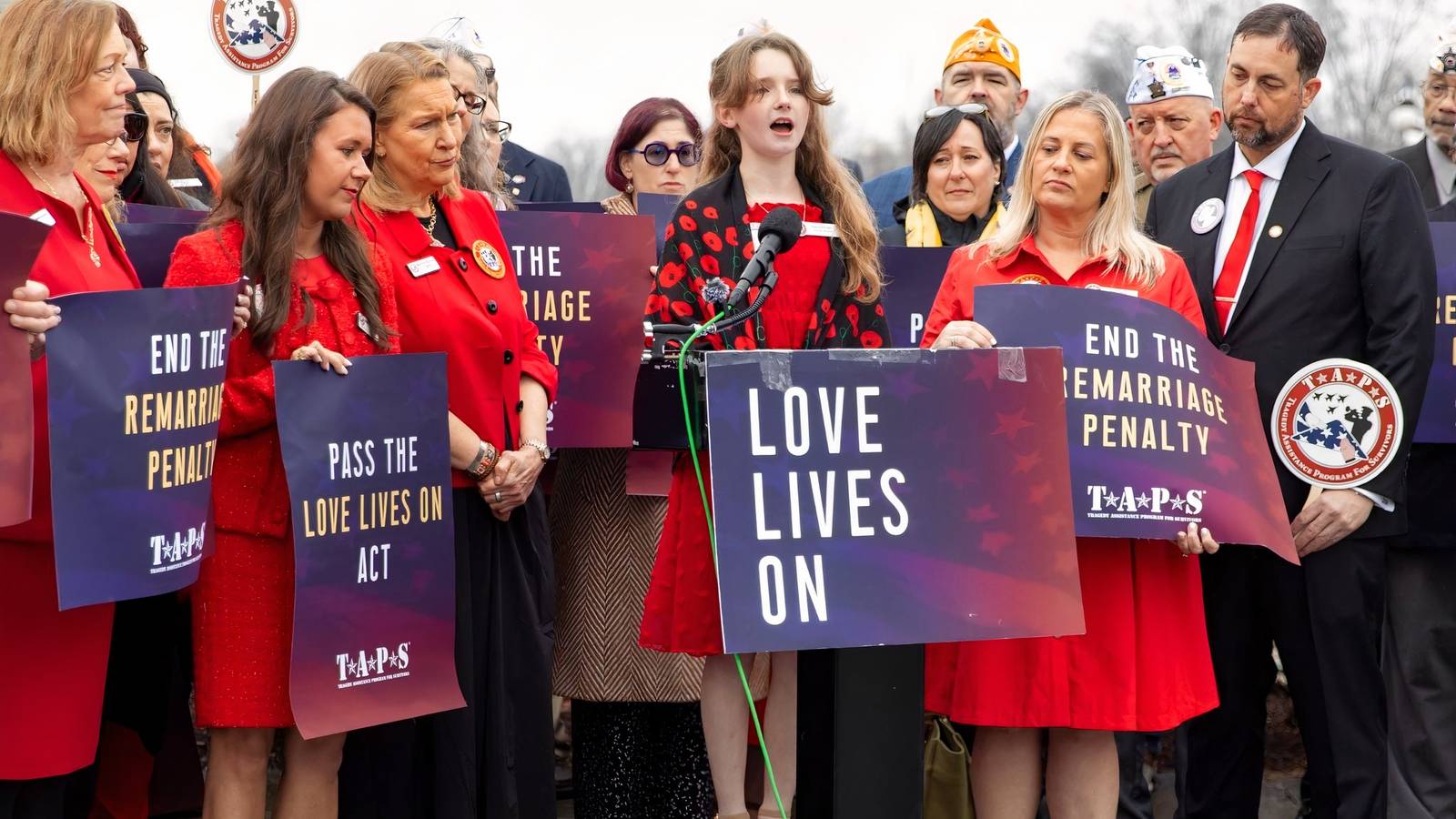

For some surviving military spouses, getting married again can come with a price few Americans likely realize exists: losing benefits tied to the service and death of their first spouse.
A proposal before Congress could change that for tens of thousands of military survivors.
Approximately 50,000 surviving spouses under age 55 currently receive Department of Veterans Affairs Dependency and Indemnity Compensation and could retain those benefits if they remarry under the Love Lives On Act, according to the Tragedy Assistance Program for Survivors, or TAPS.
And the legislation wouldn’t only protect benefits going forward.
The Congressional Budget Office estimates 4,750 surviving spouses who previously lost DIC eligibility because they remarried would begin receiving the benefit again within two years if the legislation becomes law. Another 1,350 surviving spouses who lost eligibility for the military’s Survivor Benefit Plan because of remarriage would begin receiving those payments again within one year.
Together, the numbers put a new dimension on a policy military survivor advocates have spent decades trying to change: Under current law, surviving spouses can lose certain benefits when they remarry before age 55.
Bonnie Carroll, president and founder of TAPS, told Military.com in an interview that military families have been fighting to eliminate what advocates call the “remarriage penalty” for decades.
We have been pushing Love Lives On and the removal of the marriage penalty for decades, literally decades, and this is the closest that we have come, Carroll said.
The Love Lives On Act would allow eligible surviving spouses to retain certain benefits regardless of whether they choose to marry again. The legislation is also included in the broader Take Care of America’s Veterans Act, or TCAVA, a package containing dozens of veterans-related proposals.
For Carroll, however, the issue is considerably more personal than the legislative maneuvering surrounding the larger package.
It’s whether benefits earned through a service member’s sacrifice should depend on what the person they left behind chooses to do with the rest of his or her life.
50,000 Survivors Could Keep DIC After Remarrying
Dependency and Indemnity Compensation, or DIC, is a tax-free VA benefit paid to eligible survivors of veterans who died from service-connected conditions or, in some cases, were rated totally disabled for a specified period before death.
Under current law, a surviving spouse who remarries before age 55 generally becomes ineligible for DIC, although the benefit can be restored if that subsequent marriage ends through annulment, divorce or death.
Love Lives On would remove remarriage before age 55 as a barrier to receiving DIC.
TAPS estimates approximately 50,000 surviving spouses under 55 currently receive DIC, meaning they are the population that could potentially be protected from losing that benefit if they choose to remarry.
That doesn’t mean 50,000 people are expected to remarry. Instead, the number illustrates how many current DIC recipients under 55 potentially face the existing restriction.
The legislation would also reach survivors who have already lost their benefits.
Using historical data on spouses who became ineligible because of remarriage, CBO estimates 4,750 people who lost DIC eligibility before the legislation’s enactment would begin receiving benefits again within two years.
CBO also estimates about 250 surviving spouses each year would otherwise lose DIC because they remarry before 55. Under Love Lives On, they would keep it.
By 2036, CBO projects approximately 7,100 additional surviving spouses would be receiving DIC, with annual benefits averaging about $29,000 at that time.
Another 1,350 Could Get Military Survivor Benefits Back
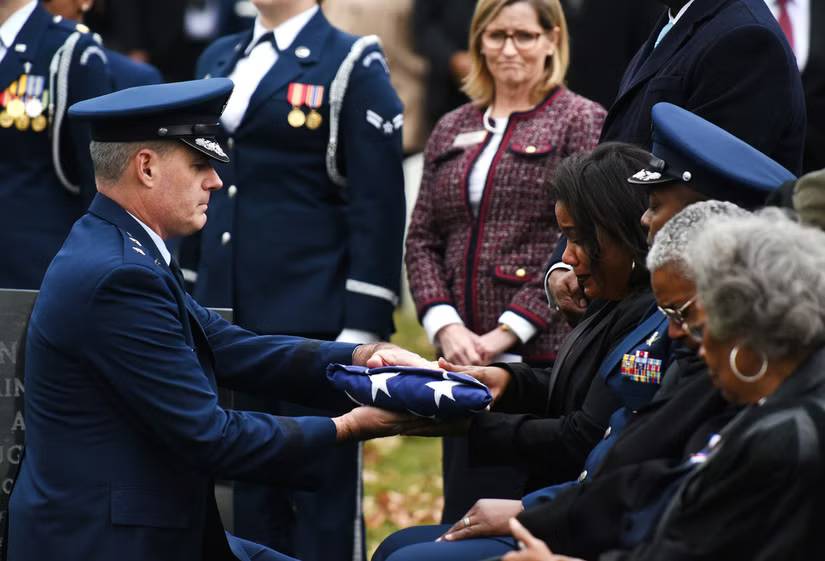
The legislation separately addresses the Defense Department’s Survivor Benefit Plan, or SBP, which provides monthly payments to eligible survivors of military retirees and service members who die on active duty.
Under current law, surviving spouses who remarry before age 55 can lose eligibility for SBP payments.
Love Lives On would allow surviving spouses of service members who die on active duty to retain the benefit regardless of their age when they remarry.
CBO estimates approximately 1,350 surviving spouses who already lost SBP eligibility because they remarried would begin receiving the benefit again within one year of enactment.
Another roughly 50 surviving spouses lose eligibility each year under current law because they remarry, according to CBO. Those survivors would retain the benefit under the proposed change.
By 2036, CBO estimates approximately 1,800 additional people would receive SBP payments averaging $31,000 annually.
‘These Are Earned Survivor Benefits’
For Carroll and other survivor advocates, the fundamental question isn’t simply how many people would receive benefits or what the legislation would cost.
It’s why getting married again should affect the benefits in the first place.
Military spouses can spend years moving between duty stations, raising families through deployments and sacrificing career opportunities to support a service member’s career.
When that service member dies, Carroll said, the benefits passed to their survivors reflect that service and sacrifice.
“These are earned survivor benefits,” Carroll said in describing the argument TAPS has made.
TAPS has publicly argued that surviving spouses shouldn’t have to choose among another chance at marriage, financial security and creating a stable home for their children.

‘We’re Not Just Talking About Money’
The consequences can also extend to Gold Star children.
Carroll recalled an 8-year-old boy who spoke to members of Congress about what changing the remarriage rules would mean for his family. His biological father, who died while serving in the military, would always be his father, Carroll said.
But the boy wanted his mother to have the opportunity to remarry. He wanted to live in a two-parent household and be able to call the man in his mother’s life his stepfather without his family facing the financial consequences created by the existing system.
Carroll said the child’s remarks moved congressional staff and survivor advocates in the room to tears.
“We’re not just talking about money,” Carroll said. “We’re talking about … a child.”
For TAPS, that gets at why the term “remarriage penalty” can understate the issue.
The policy can put a federal benefit calculation into decisions about whether someone marries, how a family moves forward after loss and what financial security looks like years after a service member dies.
TAPS isn’t alone in arguing that surviving spouses shouldn’t have to make that choice. In a separate interview with Military.com, Mario Marquez, executive director of government affairs for The American Legion, pointed to the Love Lives On Act as one of the important survivor provisions included in TCAVA. The American Legion has separately urged Congress to eliminate the remarriage penalty, arguing that surviving spouses should not have to choose between rebuilding their lives and retaining benefits earned through their deceased spouse’s military service.
TAPS Says the U.S. Stands Apart
Carroll also pointed to how the United States treats military survivors compared with other countries.
TAPS works with partners in 57 countries, Carroll told Military.com, and she said the United States is the only country among those partners that she knows of that still terminates the survivor benefits at issue when a widow or widower remarries.
Carroll said counterparts in other countries have expressed surprise when she explained the American policy.
It reflects the broader argument TAPS has made for years: A survivor’s decision to rebuild his or her personal life shouldn’t erase a benefit connected to the service of someone who died.
The families of our nation’s fallen deserve all of our support, Carroll said.

A Change Decades in the Making
The Love Lives On Act has been pursued through multiple Congresses. The current proposal would change DIC and SBP remarriage rules and also restore certain Defense Department health benefits for remarried surviving spouses whose subsequent marriages end.
CBO estimates the legislation would increase direct federal spending by about $2 billion between 2026 and 2036.
The bill is now part of TCAVA, which has become controversial because of its proposed funding mechanism tied to potential changes in future VA disability ratings.
But for survivor advocates, Love Lives On represents something much older than the current TCAVA debate.
TAPS has advocated for comprehensive remarriage legislation for years, repeatedly asking Congress to eliminate the age-55 restriction on DIC and SBP. Now the potential reach of that change is becoming clearer.
TAPS estimates roughly 50,000 current DIC recipients under 55 could potentially be protected from losing those benefits because of remarriage.
CBO estimates 4,750 people who already lost DIC could begin receiving it again. Another 1,350 surviving spouses could regain SBP payments.
For TAPS, those aren’t new benefits created because someone decided to marry again.
They are benefits the organization argues should never have disappeared because of marriage in the first place.
Asked by Military.com what she would want members of Congress to understand before voting on the legislation, Carroll returned to the people those benefits were designed to support.
“Honor those who were sacrificed by their nation by taking care of the families who they loved and left behind,” Carroll said, “and giving that family every possible resource and benefit to live a full life.”
Read the full article here
