



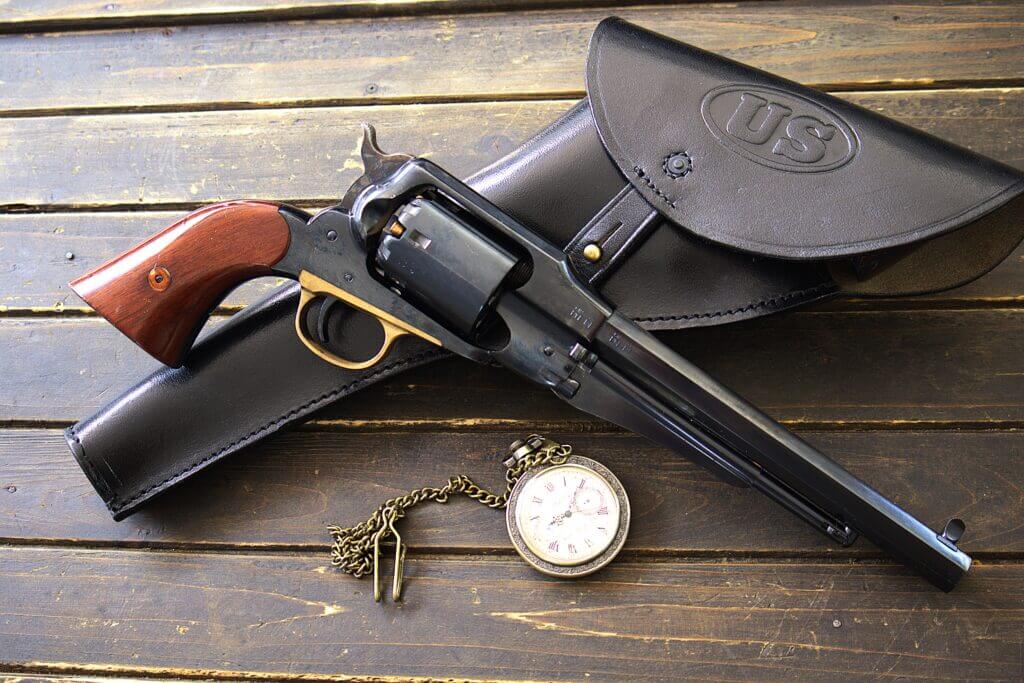

The 1858 Remington revolver brought solid-frame confidence, serious accuracy, and black powder attitude to the handgun world. More than a century later, its smoke, steel, and cartridge-conversion potential still make it one of the most appealing replica revolvers you can shoot.
The 1858 Remington revolver was one of the most popular handguns of the 19th century, and today it is perhaps the most appealing replica handgun out there, thanks to its surprisingly modern lines. Today, you have your pick of an original percussion cap model, cartridge conversions, and the purpose-built Model 1875 revolver. Here is a look at the iconic 1858 Remington revolver lineup, from percussion smoke to cartridge-era practicality:
How the 1858 Remington Revolver Built Its Solid-Frame Legend
Remington of Ilion, New York, is one of the oldest gunmakers in American history. It got its start with Elijah Remington in 1816, producing musket parts, but its first standalone products came into being as Colt’s patent on the revolver was expiring in 1856.
In short order, Remington began producing a modern solid-frame design in four frame sizes: pocket, police, Navy, and Army. Remington even went a step further with its pocket model by outfitting it with a double-action trigger mechanism, which was almost unheard of at the time. The line was improved in 1858 with the addition of the Fordyce Beals patent. The patent protected a cylinder pin design that is retained by a web-like loading lever.
War, Price Pressure, and the Rise of the Remington Army Revolver
Due to this patent date, the Remington revolvers that use this redesigned loading lever are erroneously called 1858 Remingtons. But the models we know as 1858s only went into production in 1861 as the Remington Army and Navy revolvers. In 1863, the New Model Army and Navy revolvers with improved cylinder pin and forcing cone were introduced.
These revolvers were introduced as the Union government called for arms. Remington claimed its revolver was superior to the Colt and was willing to sell to the government for a lower price of $13.50. This forced Colt to drop its own prices. While the Remington models were purchased, their quantity was low until a mysterious fire burned down the Colt factory in February 1864. By the end of the war, approximately 150,000 Remingtons were purchased for the war effort.
🛒 Check Current Price for 1858 Remington on GunsAmerica
From Cap and Ball to Cartridges: The Remington Evolves
With the war’s end, so many Remington New Model Army revolvers were on the surplus market that the company could not hope to sell any on the civilian market. As it happened, metallic cartridges were the wave of the future, and Remington was stuck with a muzzleloading handgun. Remington temporarily licensed Smith & Wesson’s Rollin White patent to produce cartridge conversions in .46 Remington. But most cartridge conversions of the New Model Army were one-off gunsmith jobs.
Remington weathered the storm thanks to its long gun sales and produced a proper cartridge gun in the Remington Model 1875. It retained the characteristic solid frame and webbed cylinder pin. Originals were chambered in .44 Remington, and a few were chambered in the .44-40. Modern replicas of the 1875 are available in .44-40 or .45 Colt.
The Model 1875 was a modest success, selling upwards of 30,000 units. However, it could not compete with the popularity of the Colt Peacemaker. Remington made one last attempt to compete with Colt with its Model 1870. This model is essentially a Model 1875 sans webbed cylinder pin. This Colt look-alike came at the wrong time as the gun market gravitated toward faster-firing double-action revolvers. The Model 1890 chambered in .44-40 persisted until the line was dropped completely in 1896. Less than 2,500 units were made. Uberti continues to produce the Model 1890 in .44-40 or .45 Colt, alongside the Model 1875. Uberti, Pietta, and Pedersoli produce variants of the original New Model Army and Navy models.
Loading the 1858 Remington: Round Ball, Conicals, and .45 Colt
The New Model Army is a nominally .44 caliber revolver that takes an oversized bullet seated from the front of the cylinder. A .451-inch diameter bullet can work, but a .454-inch projectile covers all the bases when getting around the tolerances of Italian quality control.
Originally, these revolvers were loaded with combustible paper cartridges. Depending on the luck of the draw, some Remingtons will work just fine. Others will require the rammer and bullet port to be relieved with a Dremel to allow for the bullet to swing under the loading lever. Working with loose powder and balls requires no modification, and you can easily tailor the load. The Remington New Model Army has a generous six-shot cylinder that can readily take 35 grains of black powder or substitute and still have enough room for a 143-grain ball or a 200-grain conical bullet. A 200-grain Lee bullet backed by 30 grains of FFFg is not far ahead of the standard service load.
Conversion cylinders for the 1858 Remington are available in .45 Colt. This allows for the safe use of standard pressure .45 Colt ammunition with a simple switch of the cap and ball cylinder. The Howell type conversion is the most commonly found and has six firing pins. One chamber should be left empty for safety, whereas the cap and ball cylinder is equipped with safety notches and can be carried fully loaded.
Shooting the Remington New Model Army: Modern Feel, Old-School Smoke
The Remington New Model Army is a robust modern design that is familiar to modern shooters, though that same modernity can lead to moments of frustration. The revolver is available from Uberti, Pietta, or Pedersoli. Pedersoli produces a high-end target version of the revolver, while the former makers produce the Remington closer to its stock configuration. The only appreciable difference is that the Uberti guns hide their modern markings, and the Pietta’s loading ports tend to run small.
Accuracy Advantage: Why the 1858 Remington Still Hits Hard
The New Model Army is well balanced, and the combination of a thin front blade and fixed rear notch for sights makes for more precise target shooting compared to a typical Colt. As with all cap and ball revolvers, Remingtons tend to shoot high out to twenty-five yards, though closer to the point of aim with lighter round ball ammunition.
Solid-Frame Strength Comes With a Black Powder Catch
The grip placement was the common failing of the Remington design, as the grip provides for a longer reach for the trigger and hammer over the typical Colt. The Remington’s solid frame is both a blessing and a curse. In its cap and ball configuration, the Remington is less prone to spent caps jamming the action. But black powder fouling, with nowhere to go, accumulates in the cylinder frame and on the small cylinder pin. After just eighteen rounds, the revolver will start to bind up, and it can be impossible to get the cylinder out without a soft hammer. The Colt’s dated open-top action and big, greased arbor powers through fouling with ease.
Although it was not common in the period, today’s Remington revolvers have the advantage of interchangeable cylinders that can be readily swapped out, provided that the handgun is not completely fouled. This is of little consequence for cartridge conversions firing mild smokeless loads.
Final Verdict: The 1858 Remington Was Born Ahead of Its Time
On the whole, there is plenty of myth surrounding the Remington New Model Army, ranging from the date it was introduced to how it was reloaded. What is undeniable is that it was a modern revolver that belongs in the smokeless era but was born a few decades too early. Thanks to modern steels, the Remington is perhaps more popular than ever, as we can now enjoy the best of both eras.
1858 Remington Specifications and Load Reference
| Revolver | Remington New Model Army |
|---|---|
| Nominal Caliber | .44 caliber |
| Round Ball Diameter Options | .451 inch or .454 inch |
| Cylinder Capacity | Six-shot |
| Black Powder Capacity Stated | 35 grains |
| Round Ball Weight Stated | 143 grain |
| Conical Bullet Weight Stated | 200 grain |
| Lee Bullet Load Stated | 200 grain Lee bullet backed by 30 grains of FFFg |
| Conversion Cylinder Chambering | .45 Colt |
| Model 1875 Replica Chamberings | .44-40 or .45 Colt |
| Model 1890 Replica Chamberings | .44-40 or .45 Colt |
1858 Remington Pros and Cons: Accuracy Meets Black Powder Grime
- Pros: Modern, readable sights, generous cylinder capacity, fixed barrel for best accuracy.
- Cons: Solid frame invites fouling, and grip frame length makes one-handed shooting tricky.
Read the full article here
