




It’s no wonder that so many people are asking what is prepping and how it can help them to navigate life’s uncertainties with confidence and resilience. After all, in our ever-changing world filled with unexpected challenges, being prepared is an obvious and essential priority.
The bottom line up front is that beyond the misconceptions and stereotypes, prepping is a lifestyle that embraces self-reliance, essential skills, and maximizing our chances of survival and success. Join us in this comprehensive guide, “What is Prepping,” as we delve into its goals, fundamentals, and purpose, equipping you with valuable insights and practical advice to proactively prepare yourself for whatever comes your way.
Quick Look at What You’ll Learn
The Definition of Preparedness
To begin with, let’s first nail down the definition of preparedness: I define preparedness as:
All the efforts taken to ensure survival, minimize unwanted struggle, and live your best possible life.
In other words, preparedness includes all the proactive measures taken not only to survive and thrive but also to live your life to the fullest potential. As such, contrary to what many in our modern society believe, preparedness is NOT only for Doomsday Preppers.
Rather prepping is for everyone who, no matter their circumstances, wants to live their life possible. The challenge is, how do we get there? How do we succeed in living our best possible life despite what the universe may throw at us?
The Goals of Preparedness
In preparedness, there are three goals: survival, minimizing unwanted struggle, and living your best life possible.
Survival
Survival is the first goal because, without it, there is no chance to do anything else. Survival has two basic aspects: avoiding massive trauma and maintaining homeostasis. Massive trauma instantly ends survival, so it must be avoided. Maintaining homeostasis involves keeping the body in balance and functioning optimally. The body is always adjusting to maintain equilibrium, but it cannot always compensate for problems it experiences. Once survival is taken care of, the next goal of preparedness is to minimize unwanted struggle in our lives.
Minimize Unwanted Struggle
The second goal of preparedness is to minimize unwanted struggle in our lives. Unwanted struggle can come in many forms, including health problems, financial difficulties, disasters, personal loss, relationship issues, addiction, and anything that prevents us from surviving, struggling less, and living our best life possible. On the other hand, wanted struggle is intentional, and we engage in it to improve our lives, grow, and be rewarded for our effort. Prepping can be a wanted struggle, and once we accomplish our goals, we are rewarded with a sense of success and confidence. Although growth can come from unwanted struggle, we prefer to avoid it, and that’s why we prepare.
Live Your Best Possible Life
The third goal of preparedness is to, after surviving and minimizing unwanted struggle, lead as satisfying a life as possible. By achieving the first two goals, we put ourselves in a position to focus on living our best possible lives, experiencing love and belonging, and proactively pursuing personal growth and happiness. In essence, prepping can provide the foundation for leading the most personally meaningful of lives—lives worth living.
Factors of Success
The key to achieving the goals of preparedness is to maximize the controllable factors of success, which are mindset and ability. Simultaneously, we must work to minimize our reliance on the uncontrollable factor of success, luck. By focusing on mindset and ability, you can eliminate the need for good luck while also preparing yourself to overcome bad luck when it arrives. Because luck is uncertain, it should never be counted on as part of your preparedness plan. Instead, focus on what you know and can control—your mindset and ability.
Mindset
When it comes to Mindset, I write in my book, Mind4Sruvival, that…
“I define mindset as our mental readiness and awareness, which shapes how we make sense of and interpret ourselves, the world around us, and our situation within that world. Are we upbeat and happy, or do we view things through a veil of despair? Mindset also influences how people think and act in response to a situation, and for those who want to prepare, sets us on our path to becoming better prepared.”
When it comes to mindset, mindset is controllable and can be improved. However, in order to improve your mindset, you must first be willing to step out of your comfort zone and critically evaluate your capabilities and knowledge. It’s only by being personally honest and critical with yourself that you’ll put yourself in the best position to avoid the overconfidence and bias that can lead to catastrophe when disaster strikes.
Ability
The ability to prepare for unforeseen events is essential for success. Ability, as a factor of success, includes having the knowledge, skill, and resources to do something. Knowledge and skill are internal components that determine how well we can do something. Resources, on the other hand, are the external components that we use to succeed and include books, tools, materials, finances, air, water, food, etc., that we use as part of our preparedness. In the end, while we may have limitations, we can improve our abilities by, over time, increasing our knowledge and skill, along with the availability and quality of our resources.
Luck
Luck, which is unpredictable and uncontrollable, is the third factor of success. While luck can be helpful, it can also cause problems and, as such, cannot be relied upon as a factor of success, especially when it comes to our preparedness. To effectively achieve the goals of preparedness, survival, minimizing unwanted struggle, and living our best life, it’s important to focus on the factors of success that can be controlled. In other words, we should focus on our mindset and ability so that we’re always about to deal with unexpected and harmful situations that luck may bring.
What is the Purpose of Prepping?
The primary purpose of prepping is to succeed at the goals of preparedness. By succeeding at the goals of preparedness, we position ourselves to, regardless of the circumstances, live our best possible life. That’s the goal everyone should strive to achieve for themselves and their loved ones.
Prepping allows preparedness-minded people to be in a position to minimize our problems and maximize our opportunities. Many believe the purpose of prepping is solely to deal with the negative, as with Doomsday Preppers. However, the truth is that modern preppers ready themselves to be in the best position possible to seize upon the opportunities to make the best out of their situation.
For example, a prepared person who has an emergency fund set aside, along with a stockpile of food, is in a position to weather a job search should they lose their current job. They will be in a much better position than someone who wasn’t prepared and had no funds to fall back on.
Prepping is ultimately about being ready for the unexpected. It’s not, as some may believe, only about preparing for catastrophic events or taking extreme measures. What it really boils down to is having the knowledge, skills, and
How to Prepare: The Fundamentals of Preparedness
The question of “how do I get prepared” is often, and rightfully so, front and center in a person’s mind—especially someone new to preparedness. While the detailed answer can, at times, be complex, the overarching strategy of preparedness is simple and contained in the fundamentals of preparedness. It’s through effectively managing our relationship with the fundamentals of preparedness that we best set ourselves up for preparedness success, which is also known as successfully meeting the goals of preparedness.
The Fundamentals of Preparedness
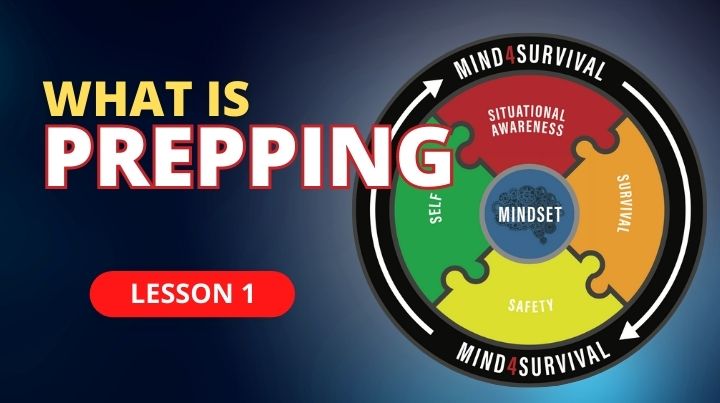
The Fundamentals of Preparedness are:
- Mindset
- Situational Awareness
- Survival
- Safety
- Self

Mindset
Mindset is the first fundamental of preparedness. As such, it is the foundation of effective preparedness and the starting point for everything we do. It determines how we approach life and shapes our understanding of reality. Our mindset is influenced by biases, beliefs, and fears, and it plays a significant role in decision-making, motivation, and resilience in difficult times. As it’s our understanding of reality, it influences our overall perspective and perception of life and the situations we encounter within it.
It’s our subjective perception of objective reality that is influenced by our biases, judgments and lived experiences. As such, it is crucial to understand that our perception is, in part or total, wrong to some degree. Whether that is one degree of error or a complete meltdown of inaccuracy, the true reality is that our understanding of a situation is incorrect.
Acknowledging that we don’t fully understand reality helps us consider what we’re getting wrong, which is a good mindset to have. A good mindset leads to better decisions, more positive outcomes, and personal growth. On the other hand, a bad mindset leads to poor decision-making, less positive outcomes, and stagnant personal growth.
In the end, the mindset you use to face what the world throws at you is a choice. Good mindset or bad, it’s your choice.
Situational Awareness
Situational awareness is our ability to perceive and comprehend the elements within our personal environments. The elements in our personal environments include such things as people, objects, events, and environmental factors.
Situational awareness not only requires the ability to observe the elements but also understanding the relationships, dynamics, patterns, and trends between them. It’s our situational awareness that not only helps us gain insights into the present situation but also affords us the ability and opportunity to project the potential impact of those elements in the future.
In the context of prepping, situational awareness plays a crucial role in preparing for potential emergencies or disasters. By assessing their environment, identifying risks or threats, and anticipating how situations might evolve, situationally aware individuals can make informed decisions and take effective actions on behalf of themselves, their families, and loved ones.
Survival
Survival is where we address all of the things that can kill us. Continuing from our discussion on the first goal of preparedness, this is where we take those actions that satisfy our need to remain alive—avoiding massive trauma and maintaining effective homeostasis.
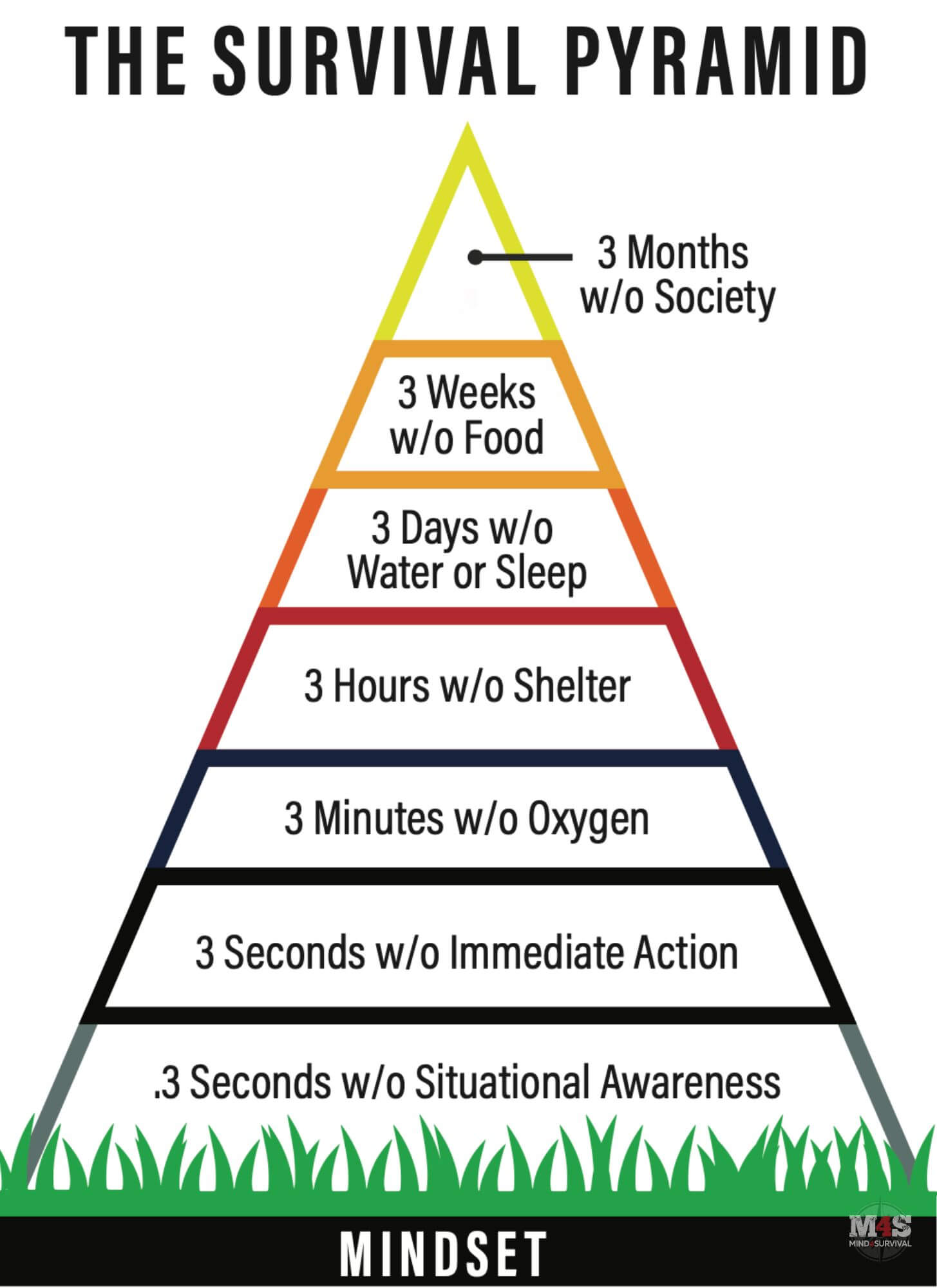
When it comes to survival, I use my The Survival Pyramid as a roadmap to help me know what my survival needs are, along with their order of precedence and the time I have to satisfy each need. The survival pyramid is an expanded and more logical option to the Survival Rule of Threes.
The Survival Pyramid is:
- Situational Awareness: one-third of a second
- Immediate Action: three seconds
- Oxygen: three minutes
- Environment: three hours
- Hydration and Sleep: three days
- Nutrition: three weeks
- Society: three months
Safety
We can now, with our survival needs met, focus on the fourth fundamental, safety. Safety is when most of our preparedness happens. Safety is when we can focus on managing our risk and, in turn, make our everyday life safer, more secure, and more comfortable. Safety is also where we establish and manage our risk profile.
As I wrote in my Mind4Survival book:
“Our risk profile is an objective view of everything we have to protect, everything we’re protecting it from, and everything we’re protecting it with.”
With that, we address our risk profile by identifying what we have to protect (our assets) and the impact of having harm should we fail to protect it, what we have to protect our assets from (threats), and what we have to protect our assets with (vulnerabilities). Proactively and objectively managing our risk profile helps us to categorize our risks and address each one based on impact, threat, and vulnerability.
Risk management provides us with a roadmap for dealing with our risk. It tells us where we should invest our time and effort. Risk management is what helps us avoid overreacting in a haphazard, knee-jerk, and wasteful manner to our preparedness. Instead, it paints the picture for us to evolve our preparedness in the most effective and efficient manner possible.
Safety is where we learn whether we should prepare for a family emergency, major disaster, or apocalyptic event. Safety is also where we determine whether we should spend money on first aid supplies, stockpiling food, toilet paper, or other supplies.
Self
The final fundamental of preparedness is self. Self is the fundamental of preparedness that makes all of our efforts with the other fundamentals really worthwhile. It provides us with a greater purpose to prepare and a reason to persist even during challenging times.
Self is where we move past the basic preparedness of survival and safety that many preppers focus on. Instead, self is where we focus and strive to live lives that have meaning.
In my opinion, self is the fundamental that all the other fundamentals strive to support and make happen. Self is the opportunity to not just simply survive and experience less unwanted struggle. Self sets us up to live our best possible lives—the ultimate goal of preparedness.
The Bottom Line About What Prepping Means
The bottom line about prepping is that it is a proactive lifestyle that aims to increase self-reliance and personal readiness. It is not limited to extreme measures, conspiracy theorists, or preparing solely for natural disasters and catastrophic events. Instead, preppers work to achieve the goals of preparedness, which include survival, minimizing unwanted struggle, and living one’s best possible life.
Preppers are normal people who start prepping by investing in the necessary skills, knowledge, and tools to be prepared for potential risks and challenges. They prioritize self-sufficiency and self-reliance, with the ultimate goal of being able to thrive in any situation.
The purpose of prepping is to position oneself to minimize problems and maximize opportunities. It allows individuals to be ready for the unexpected and increases their chances of success and well-being. Prepping is about being prepared for both negative and positive circumstances, enabling individuals to seize upon opportunities and make the best out of their situation.
The fundamentals of preparedness include mindset, situational awareness, survival, safety, and self. These fundamentals provide a roadmap for effective preparedness and help individuals meet their goals. By focusing on these fundamentals, preppers can cultivate a positive mindset, understand their environment, address survival needs, manage risks, and ultimately lead a meaningful life.
In short, prepping is a comprehensive approach to life that emphasizes preparedness, self-reliance, and personal readiness. It is about being proactive, acquiring the necessary skills and knowledge, and being prepared for a wide range of situations. By embracing the prepper lifestyle, like-minded individuals can take the steps to prepare and, in so doing, increase their chances of survival, minimize unwanted struggle, and ultimately live their best possible lives.
What does prepping mean to you? Tell us your thoughts on prepping in the comments below.
Read the full article here
