



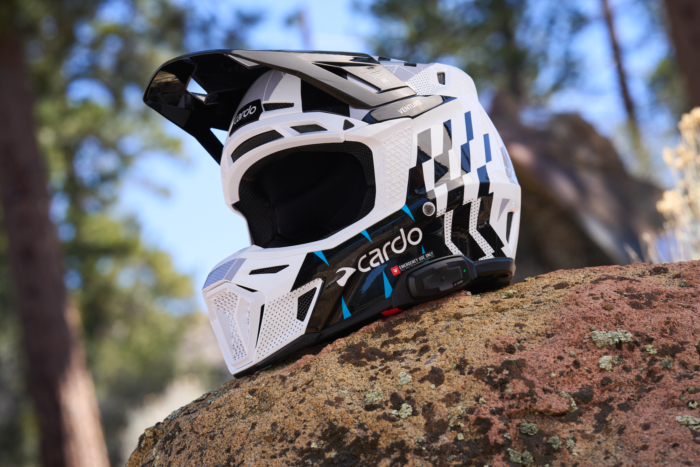

Riding a dirt bike is one of those activities that is often both very social and yet very isolating. They’re social in that you often go out riding with your buddies, and that camaraderie is one of the draws. On the other hand, you’re inevitably stuck in your helmet, which makes communication kind of tough. Until now, that is, because Cardo is introducing its Venture helmet, and spoiler alert: it’s awesome.
The Helmet
If you’re thinking, “Wait, Cardo? Isn’t that the company that makes those communicators that clip on the side of your street helmet?” then you’re already getting to the exciting thing about this helmet. It’s got a built-in Cardo Packtalk Edge system with an integrated battery, an IP67-weather-sealed microphone, and 40mm JBL earphones. At the time of publication, it’s the first dirt helmet with integrated communications, and for a first effort, Cardo knocked it out of the park.
In short: Cardo’s first off-road helmet brings the world of dynamic mesh communications to the trails and completely upends the social experience of riding a dirt bike or driving a UTV by providing clear, easy-to-use inter-rider comms. The helmet also manages to be comfortable, stylish, and well-ventilated. Overall, it’s a home run for the brand.
ECE R22.06 and DOT homologated
Carbon/Kevlar/fiberglass shell
Turbine 360 rotation mitigation system
Built-in Dynamic Mesh communications
Pros
- Carbon/Kevlar shell is lightweight
- Excellent ventilation
- Flawless integration of the Cardo comms unit
- All-day comfortable
Cons
- Not Snell-rated
- Headphones aren’t IP67-rated
Because this is a helmet, we’ll get through the helmet-y stuff first. This lid is based on the Leatt Moto 8.5, which is a high-quality carbon/Kevlar/fiberglass composite helmet that comes with both DOT and ECE safety certifications, making it legal pretty much anywhere, though we’d like to see the Snell M2025 rating.
Safety Features
The Cardo Venture differs from the Leatt helmet in a few ways (other than the communications), but mostly, it uses less carbon and more Kevlar in its construction because carbon fiber is an RF insulator, meaning it blocks the communicator signals. Despite that, the Venture is still a very light helmet, coming in at under 1,500 g for a medium-sized shell, which is extremely competitive for the class.
The Venture, like the Leatt, has a bunch of high-end safety features. The expanded polystyrene (EPS) layer, aka the part of the helmet that protects your brain by deforming and absorbing crash energy, is made of four layers of foam. This is a good thing because it lets your brain slow down more gradually in the event of a crash.
This helmet also has what Leatt (and subsequently Cardo) call Turbine 360, but which is essentially the same thing as the MIPS (Multi-Directional Impact Protection System) used in other brands of helmets. Turbine 360 uses little elastomer nubbins that slightly decouple the liner of the helmet from the shell, which helps reduce the rotational forces your head experiences in a crash, and possibly mitigates neck injury.
Also notable is the inclusion of an emergency cheekpad removal system. This is great because the last thing you want after a crash is an emergency medical technician yanking your helmet off.
With this system, there are a couple of very clearly labeled loops of fabric that the EMT can pull on, which will quickly and easily remove the cheekpads in your helmet without jostling your skull too much. It’s pretty common these days on a variety of on- and off-road helmets, but it’s a very nice thing to see.
The helmet has 10 forward-facing vents, which is awesome and keeps your head nice and cool (as long as you’re moving). This makes for a noisier ride, but that’s par for the course with dirt helmets. The helmet peak visor is a breakaway unit, and there’s an extension for it in the box, which helps cut light further if you need it. The buckle system is the classic double D-ring, which is our favorite, as opposed to the micro-ratchet system that many European brands like to use because it’s simpler.
Communication
Like Cardo’s other products, the Venture helmet’s headline feature is its Dynamic Mesh Communications capability, aka DMC. This is the communications protocol that allows up to 15 people to create a group and chat with each other.
Unlike cellular or Wi-Fi, mesh communication uses multiple units connected to one another to create a web-like network. The more devices, the stronger the network. Because it’s based on well-established tech, the user experience is pretty seamless and bug-free. Voices are clear and easy to understand, and because Cardo limits the number of speakers to five at a time, you don’t have an unintelligible free-for-all to muddy things up.
The Cardo system uses what’s called a self-healing network. This means that if one of your group members drops out of range and then re-enters, the network automatically allows them back in without having to manually re-add them to the group. It’s a fantastic way to keep in touch with fellow riders when you’re out in the middle of nowhere.
Cardo also connects your helmet to your phone via Bluetooth, allowing you to stream music or make phone calls. It responds to natural voice commands, too, meaning it can be a totally hands-free experience. Just say “Hey Cardo, stop music,” for example, and it’ll do just that. The system works well, too, because Cardo has been working on this for years with its Packtalk communicators.
Packtalk or Venture?
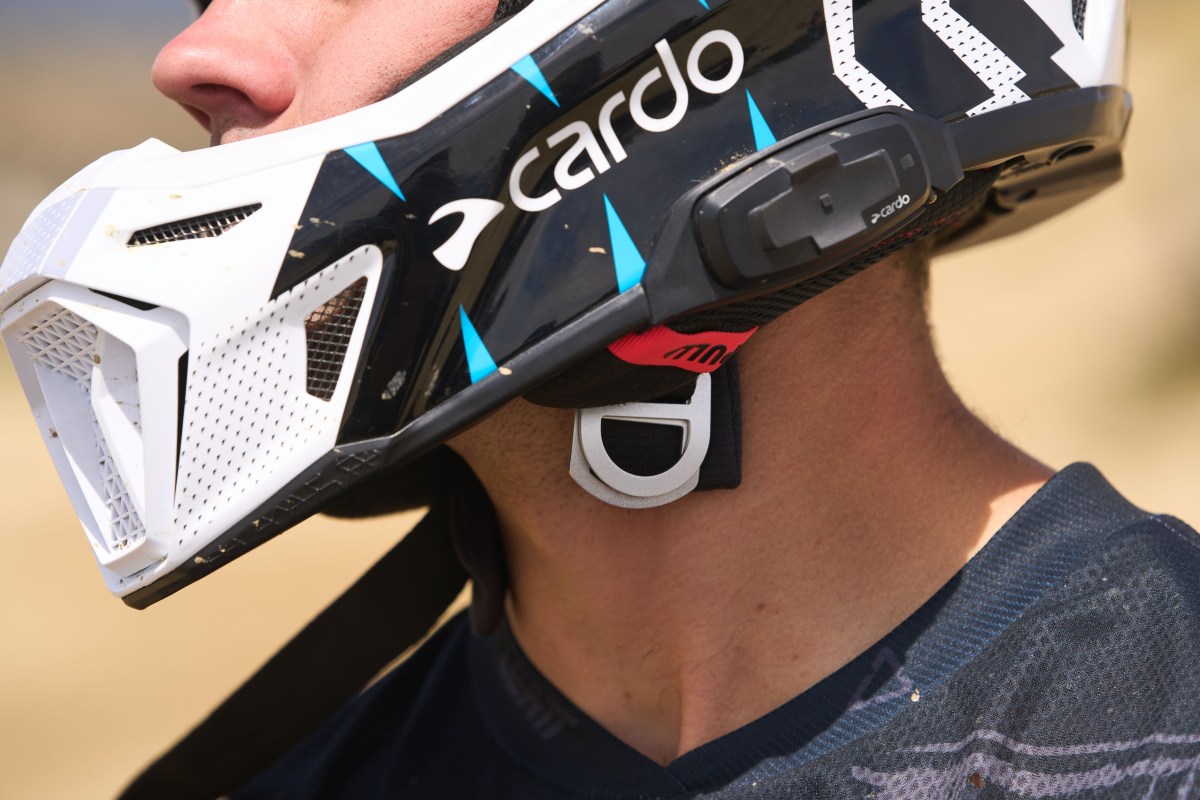
The Venture helmet has the guts of the latest Packtalk Edge communicator integrated into its shell. The battery and brains live in the back of the helmet around the neckline. The controls are on the left side of the helmet, and also around the neckline. The microphone and earphones are all pre-wired in. It’s a really elegant setup, with a claimed 13 hours of talk time, but not without its flaws.
The separate Packtalk units use a little scroll wheel as part of their control layout, but the Venture helmet eschews that for buttons, presumably to aid durability and water resistance. This makes it a little more fiddly to change volume, for example.
Many of the helmet’s features are operated through the Cardo Connect app, which is pretty easy to use, thankfully. Through the app, you can change things like microphone sensitivity, make new groups, set up private chats, etc. If you want a totally phone-free experience while you’re riding, you can have it, but your ability to tweak things will be limited.
Just a Gimmick?
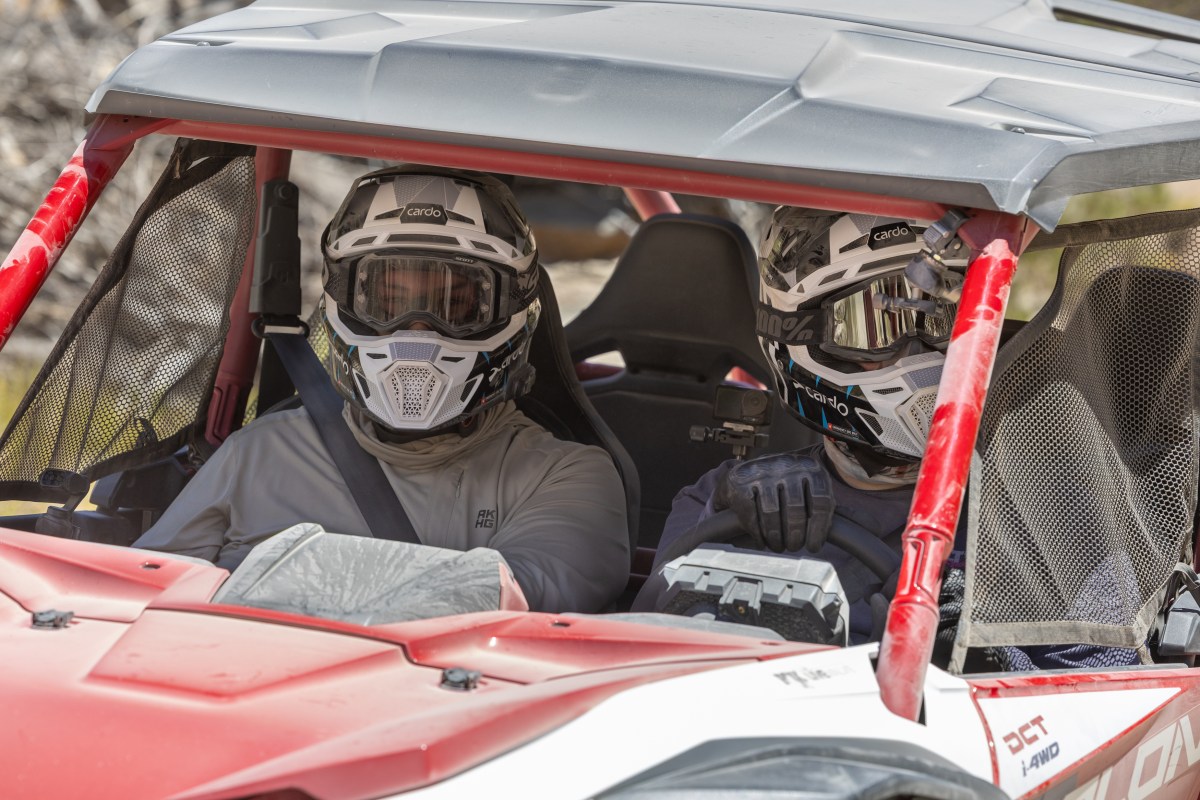
If all this communication stuff sounds like a gimmick, we get it. The truth is, though, that communicating with your friends or family while riding is a total game-changer and makes the entire experience even more enjoyable. Whether it’s a group ride with you and your buddies talking trash and having a laugh, or you’re a parent trying to coach a kid who is new to riding without having to shout across a field, the Cardo system makes it all work better.
As a total package, the Venture is hard to beat. This comes down to Cardo nailing the basics. It leaned on industry experts and picked a great helmet to base its designs on. It uses quality materials for the shell and lining, and has stellar ventilation that will keep your noggin cool even during a day of thrashing a UTV in the Southern California summer sun.
Comfort is not only highly subjective but also highly dependent on head shape. That said, I found the Venture to be all-day comfortable despite my oddball long-oval skull, which was a genuine surprise given that the Venture is modeled on an intermediate oval. Intermediate oval, for all you playing at home, is the most common head shape in North America.
I wasn’t surprised at all that Cardo excelled at its core competency of building great communications gear. I’ve used Cardo products for most of the last decade and have had an overall great experience. I was pleasantly surprised that its first effort at a space as challenging as helmets has been such a resounding success. The Venture is a genuinely good helmet.
Pricing and Availability
If you’re sold on getting the Venture helmet (and you should be, it’s awesome), you’re probably wondering how much it costs and when you can get your grubby little hands on one. The answer to the first question is $799 MSRP. That sounds like a lot of money, and it is, but it’s not out of line with other premium helmets.
The Leatt helmet on which the Venture is based retails for $549 without any of the comms gear, and the Cardo Packtalk Edge ORV sells for $440, so you’re actually seeing a net savings by going with the Venture.
The Venture also comes with a pretty comprehensive warranty. You get a 5-year warranty on the helmet, three years on the comms, and one year on the battery (or 2 years on the battery if you live in the EU).
As for the second question of when it’s going to be available, Cardo plans to have it in stores by the end of this summer.
Read the full article here
