



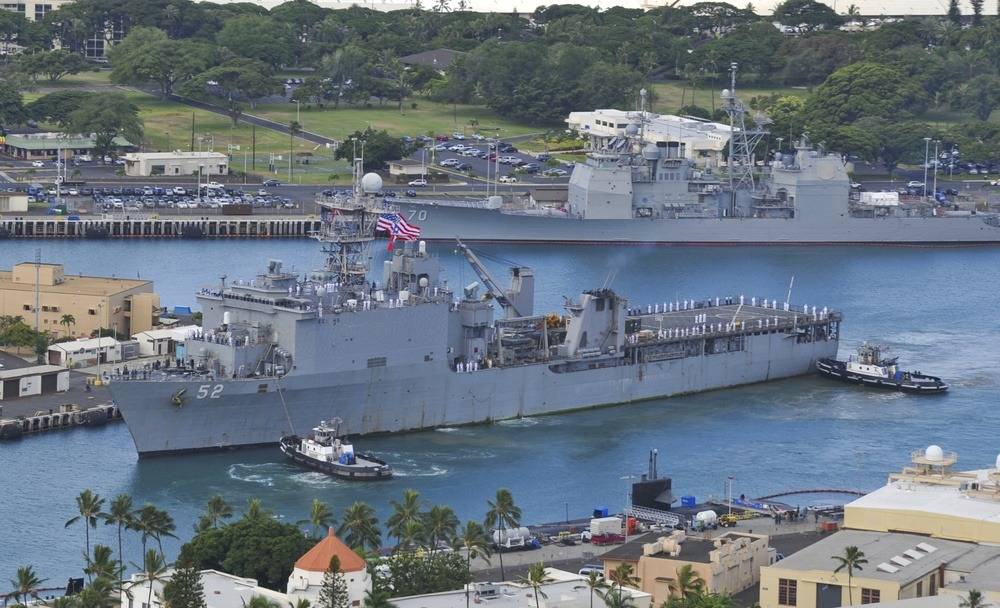

This week, senior military leaders from around the world are gathering in Waikiki to discuss potential conflict and crisis around the world’s coastlines.
About 300 service members from 25 countries are meeting at the Asia Pacific Center for Security Studies for the 12th Pacific Amphibious Leaders Symposium, a gathering organized by U.S. Marine Corps Forces Pacific that each year takes place in different locations around the region. Last year it took place in the Philippines.
On Tuesday, Lt. Gen. James Glynn welcomed participants, telling them that “trying to get to Hawaii’s a long way from everywhere, which … puts it right in the middle of everything at a time when it’s needed most.”
Hawaii is the nerve center of all U.S. military operations across the region. Glynn, the top U.S. Marine in the Pacific, leads his forces from Camp Smith as they have been restructuring themselves for a potential Pacific conflict, with a major focus on the “littorals” — the shallow waters and reefs between land and the open ocean.
“Ancient Hawaiian warriors gathered on these shores and looked out from where the land met the sea to look for approaching boats paddled by Polynesian cultures from across the area, wondering whether they came to trade and to exchange ideas, or if they came to impose their will,” said Glynn. “Those that stood where the sea intersected the land also looked landward and saw the promise of what could be: what agriculture could bring, what these intersections of waterways could bring in terms of trade and the exchange of both goods and ideas — but sometimes they brought conflict, they brought competition.”
The U.S. military has been working to bolster alliances as commanders in Hawaii eye China amid tensions along critical ocean trade routes in the Western Pacific, particularly in the South China Sea and around Taiwan.
The symposium began Tuesday and concludes today, though many of the participants arrived in Hawaii days earlier and have been engaged in other talks and meetings on Oahu.
“The value of relationships that are established in advance of any training exercise (or) crisis — be they be they natural or manmade — is priceless,” Glynn told reporters Tuesday morning on the sidelines of the symposium. “And so this (gathering) provides us a reliable forum year after year for these like-minded capabilities.”
During his opening remarks, Glynn highlighted the recent Exercise Balikatan in the Philippines, telling attendees “I personally witnessed personnel from the Philippines, Australia, Canada, France, Japan, New Zealand and the United States operating side by side in various locations of consequence.”
He said the training sites were “consequential because they represented that place where land met sea and overlooked locations — many of them out to sea — that are contested by folks in the region, adversaries who have their own views of what a piece of land, an outcropping, a reef, whatever it may be (represents).”
China has been embroiled in a series of bitter disputes with its neighbors — especially the Philippines — over territorial and navigation rights in the South China Sea. Beijing regards almost the entirety of the South China Sea as its exclusive sovereign territory over the objections of its neighbors.
In 2016 an international court ruled in favor of the Philippines and declared that China’s claims have “no legal basis.” Beijing has dismissed the ruling and the Chinese military has built bases on disputed reefs and islands and frequently harassed Filipino and Vietnamese fishermen that they say are intruding on their territory.
During Balikatan, members of the Kaneohe-based 3rd Marine Littoral Regiment trained with Philippine troops in the Batanes islands — just 100 miles south of Taiwan — and brought their new NMESIS anti-ship missile system with them.
But during his remarks Tuesday, Glynn did not mention China by name. Last month President Donald Trump traveled to China and met with leader Xi Jinping in an effort to thaw relations and jumpstart trade and investment between the world’s two largest economies. Weeks later, a Chinese military delegation traveled to Oahu to meet with U.S. military leaders here on the island.
Conflict has rocked the global economy, especially this year after U.S. and Israeli forces launched a massive bombing campaign against Iran. Those strikes sparked a wider regional conflict as Iranian forces retaliated with sprawling missile and drone strikes on oil infrastructure, ports, ships and other targets across the Middle East, essentially shutting down the flow of oil and fertilizers from the Strait of Hormuz for months.
Observations on that conflict, as well as of fighting in Ukraine and the Black Sea, were among the topics of discussion in Waikiki this week.
“When a missile has a range longer than a traditional piece of cannon artillery, much like a boxer who has a longer reach, it makes it a more challenging contest,” Glynn told the Star-Advertiser. “Longer range requires deeper sensing, deeper sensing requires different sensors, right? And it extends … into space and cyber and everywhere else.”
The Marine Corps has been in the midst of a controversial reorganizing called Force Design 2030, which began with the establishment of the 3rd Marine Littoral Regiment on Oahu.
The plan, which several retired Marine officers have harshly criticized as being based on unproven tech and tactics, has seen the Corps move to divest from all of its tanks and traditional cannon artillery to form units around anti-ship missile batteries that would operate from islands and coastlines.
Marine leaders have pitched it as a 21st century twist on the island fighting campaigns that defined its World War II Pacific service and a return to the service’s roots as a naval service focused on coastal operations.
Glynn said that looking at the fighting in the Strait of Hormuz, “the proliferation of long-range, cheap, destructive means has, I think, demonstrated the utility of the Force Design concept, and the fact that sensors and ranges and logistics and things have to be more sustainable, more resilient (and) able to be repaired.”
© 2026 The Honolulu Star-Advertiser. Visit www.staradvertiser.com. Distributed by Tribune Content Agency, LLC.
Read the full article here
