



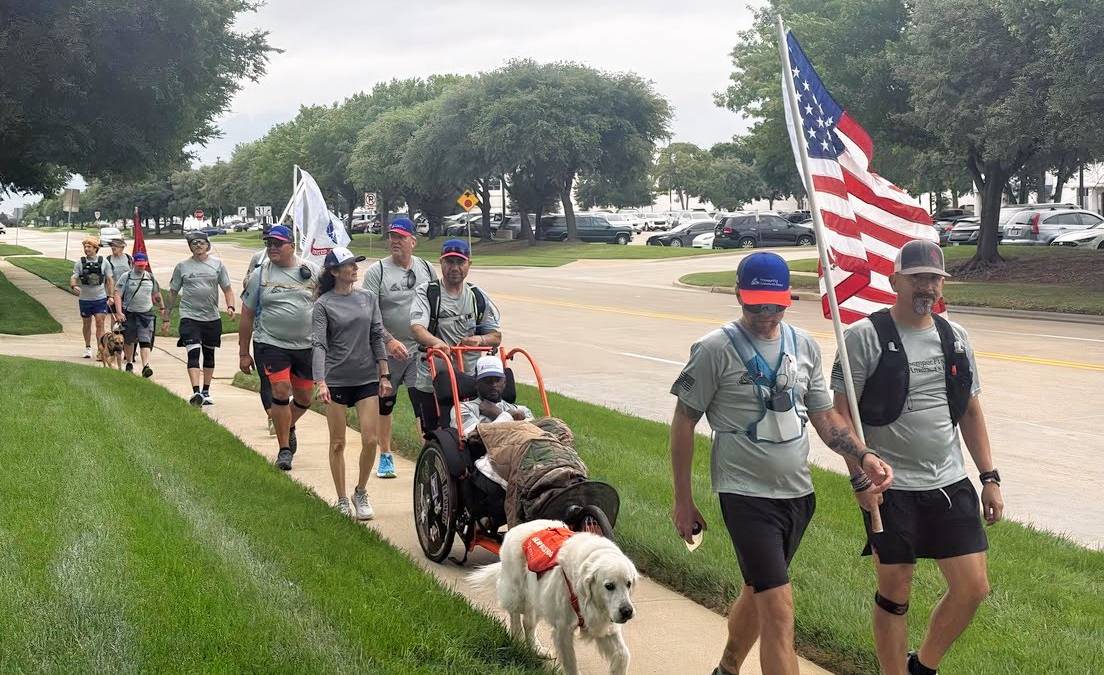

There was a time when completing a 100-mile hike would have been unfathomable for Army veteran John Filipkowski.
After all, it took years to recover from the blast.
Filipkowski, a Special Forces soldier, was serving in Afghanistan when an IED tore through his vehicle, flinging his body airborne and causing a traumatic brain injury (TBI). Physically, his body was so damaged that he was confined to a wheelchair, eventually using a cane for mobility. Mentally, the post-traumatic stress the former sergeant first class suffered from 11 deployments handcuffed him with anxiety and depression.
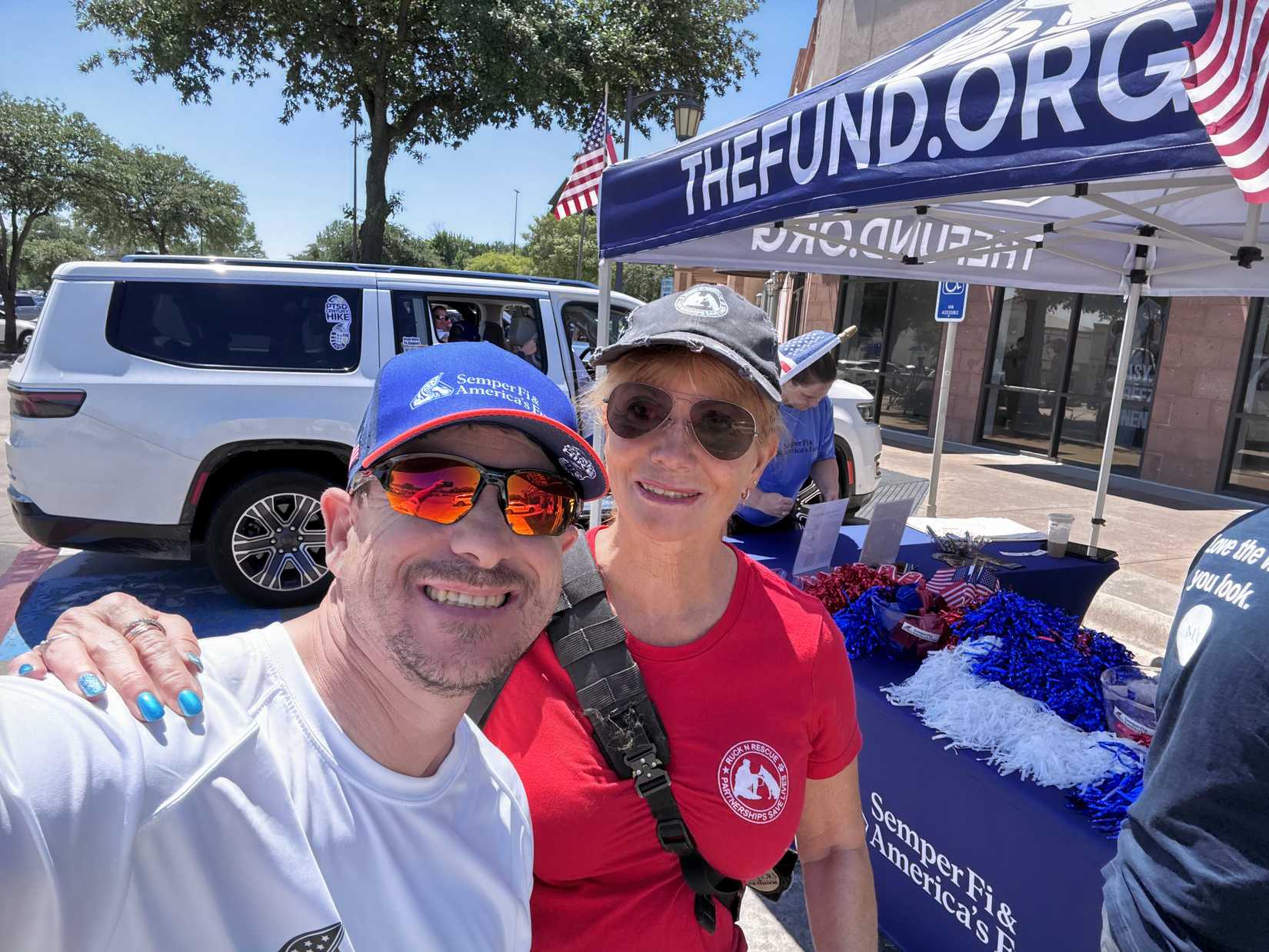
Yet, there he was, along with a group of other veterans and his loyal service dog, grinding through a five-day trek across the vast Dallas-Fort Worth metroplex from April 29 to May 3 to spread awareness of the 15 percent of veterans diagnosed with post-traumatic stress disorder (PTSD). Veterans also hiked to support Semper Fi & America’s Fund, an organization that helps combat-wounded veterans and their families.
Joining Filipkowski was fellow Army veteran Nekita Hunter, who fought her own battles with PRSD, born from 12 debilitating years as a trauma nurse, caring for critically wounded soldiers in combat. Hunter walked those 100 miles to share the message that people who medically treat severely injured service members are not immune to mental health struggles.
Fund Provides Sense of Purpose
During the five-day hike, the team logged about 20 miles per day, beginning at AT&T Stadium, home of the Dallas Cowboys and ending at Texas Motor Speedway. They started hiking from a new location every day, and a group of 13 veterans hiked all five days, with several others joining throughout the week.
“And we also had a few members from (Semper Fi & America’s Fund) walk with us in short periods of time, kind of motivating us and helping us through the race itself,” Filipowski told Military.com.
Hunter, who served as a nurse in the burn unit at Brooke Army Medical Center in San Antonio, Texas, has been involved with Semper Fi & America’s Fund for more a decade, saying the organization has “helped tremendously.”
“They gave me a new sense of purpose, right? They introduced me to endurance sports,” Hunter said. “I cycled before, but with them, it was a different experience. And then I got into running, so now I run marathons and ultras (marathons) versus cycling. And it connects me with the community of veterans who truly understand the journey of recovery.”
For Hunter, running is like medicine for the brain.
“It helps me stay off of those PTSD medications, it helps me stay off of anxiety meds, stay off antidepressants,” Hunter said, “so that is my medication, running, cycling and hitting the gym.”
Filipkowski has worked with the organization since 2022.
“I was in rec therapy, learning how to walk again and the nurses and caregivers recommended the team from Semper Fi & America’s Fund to help my recovery process and I’ve gone from being in a wheelchair or a cane to walking a 100-mile hike, which I never thought I could ever do,” he said.
Trauma Nurse Anxiety
Hunter, hailing from a family of military veterans, became an Army reservist while in college during Operation Desert Storm in the early 1990s.

She transitioned to active duty and the Army helped fund her nursing degree from Howard University in Washington, D.C., through the Enlisted Commissioning Program. Upon graduating, she was commissioned as a second lieutenant.
Hunter began her career at Brooke Army Medical Center shortly before Sept. 11, 2001, when the world suddenly changed.
“From there, I left the trauma unit and ended up in the burn unit and became a flight nurse, so we used to fly back and forth to Germany to pick up the large burn patients that the Air Force did not transport for us. We had a complete burn team,” Hunter said.
She retired as a major, serving for 25 years, including a deployment to the war in Iraq as a trauma nurse. Hunter saw the devastation of combat up close, witnessing horrors most people never see. But, unlike many veterans, Hunter knew something was off mentally.
“When it comes to PTSD, you know, they call that the silent disease, right? A lot of people are in denial. I was never in denial. I just did not realize that was what was happening to me. My coworkers noticed the change in me. And people are like, ‘Oh, you know, everyone goes through that,’” Hunter said. “Well, it wasn’t until my memory started affecting me because if I get anxious, I have no short-term memory and I would forget where I was going, even driving to work. My co-workers were like, ‘Hey, you’re never late, where are you?’ And I’m like, ‘Oh, that’s where I was going?’ I started writing everything down because I couldn’t remember anything.”
The tipping point came when Hunter lost a patient who was in the hospital for elective surgery. She suffered an anxiety attack and was diagnosed with PTSD.
“My blood pressure was at stroke level, and the ER (emergency room) could not get it to break. They brought in a cardiologist; he put everyone out of the room. He knew me personally from working in the ICU (intensive care unit),” Hunter said. “He says, ‘There’s nothing wrong with your heart, you’re suffering from PTSD.’”
The scary incident spelled the end of her career as a military trauma nurse, but at least Hunter received the help she needed before it was too late.
Multiple Deployments Take Toll
Like Hunter, Filipkowski has strong military ties going back generations.
Poised to follow his cousin and best friend into the Marine Corps, he was disappointed when a recruiter told him he couldn’t be an airborne soldier. So, Filipkowski pivoted and joined the Army.
“And I said, ‘I don’t care what you make me do, I’m gonna go airborne.’ And they were like, ‘Alright, we’ll take care of you,’” Filipkowski recalled.
However, due to medical complications, his dream to jump out of planes was curtailed. The Army sent Filipkowski to Ranger school, opening the door to Special Operations.
“I got to serve with those guys and loved every minute of it, especially going to work wearing shorts, T-shirts and a little facial hair. So, a little bit different than most active-duty soldiers,” Filipkowski said.
But for Filipkowski, who served from 1994 to 2017, the battle scars started to drain him mentally and physically. After he was medevacked a third time from a combat zone, his days in the Army were numbered.
“I went from maxing the PT test and being kind of a stellar soldier to barely passing the PT test. And because I was with the Special Forces Unit, they went, “Hey, this isn’t right, let’s see what we can do,’ instead of treating me like a bad soldier,” Filipkowski said. “They took extra care of me; they looked at all the details of what was going on with previous medical issues and getting hurt in combat.”
Left with few options, doctors told him it was best to medically retire from the Army. It was a blow, but it led Filipkowski to Veterans Affairs, where he worked with a recreational therapist who suggested reaching out to Semper Fi & America’s Fund for additional help.
“I still wasn’t doing well. Cognitive memory was affecting me, and I was having a hard time walking,” Filipkowski said.
He started working with a case manager, and within three months, he was accepted into the fund.
“The fund has given me the opportunity and the courage to step out of that role of being kind of a victim into being self-sufficient and striving to get better on a day-to-day basis,” Filipkowski said. “Quite literally, when the fund got hold of me, I was in a wheelchair using a cane, and now I’m a level one certified alpine instructor for skiing, with my next goal becoming a level one snowboarding instructor.”
Filipkowski volunteers his time teaching other veterans how to ski.
“There’s no better feeling than seeing them smile and accomplish those goals,” Filipkowski said. “Even though there are a few setbacks, they’re still accomplishing their goals.”
During the 100-mile hike, he had a few setbacks, but his fellow veterans encouraged him to keep going.
“I love that camaraderie that has brought a sense of purpose in my life, and to take that and give back to other veterans who are struggling at the place that I used to be is an incredible feeling and opportunity that the fund has given me to share with other veterans,” he said. “Doing this 100-mile hike with all 13 veterans that were there, they’ve become family now. I talk to these guys more than I do my blood family.”
While both Hunter and Filiipowski are avid athletes, they admitted hiking 100 miles in five days was grueling. But they’re willing to grit their teeth through the pain to bring a voice for veterans struggling with PTSD.
“I would love to do this event again,” Filipkowski said. “I’d like to challenge myself even more than what I did this year. I had a lot of support from the veterans and the staff from the fund that helped me push further than I thought I would.”
Read the full article here
