



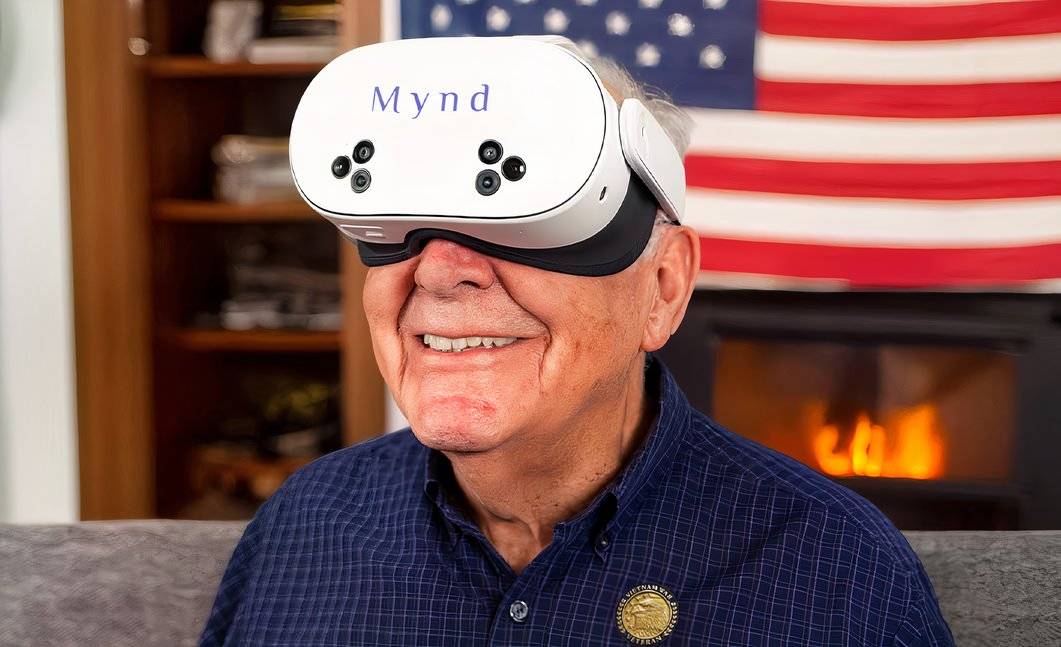

The Department of Veterans Affairs is significantly expanding its use of virtual reality as a therapeutic tool, partnering with Mynd Immersive to bring immersive experiences to 45 additional VA medical centers nationwide. The initiative reflects a broader institutional shift toward non-pharmacological care, particularly for chronic pain, anxiety, and post-traumatic stress.
A Shift Toward Immersive Healthcare
Chris Brickler, CEO and co-founder of Mynd Immersive, describes this shift as part of a larger technological convergence. “I define immersive healthcare by a combination…of AI and spatial computing that can deliver an entirely new genre of healthcare products and applications,” he said in an interview with Military.com.
The VA’s move aligns with its existing Pain Management, Opioid Safety, and Prescription Drug Monitoring Program, which emphasizes alternatives to opioids. According to the VA, these efforts are part of a long-term strategy to reduce dependence on prescription painkillers while improving patient outcomes.
Brickler framed immersive therapy as particularly suited to the needs of aging veterans, who often face overlapping conditions such as chronic pain, anxiety, isolation, and cognitive decline. These categories, he explained, form the core targets of Mynd’s platform.
Addressing Gaps in Veteran Care
The expansion comes at a moment when the VA is actively searching for scalable ways to address persistent care gaps. Chronic pain affects a substantial portion of veterans, with estimates suggesting that more than half of VA patients experience some form of it.
At the same time, mental health challenges remain widespread. Many veterans experience PTSD, anxiety, or depression, often in combination with physical conditions.
Brickler sees immersive technology as uniquely positioned to intervene across these overlapping issues. “We can lift them out of their four walls . . . and take them into a different level of existence,” he said, describing how virtual environments reconnect patients with sensory and emotional experiences that may otherwise be inaccessible.
He emphasized that Mynd does not present itself as a medical device company making clinical claims. Instead, the VA conducts and validates research on outcomes. That research has shown measurable improvements, including reductions in pain intensity and anxiety, reinforcing the technology’s potential as a complementary tool.
What Makes Immersive Therapy Different
Unlike traditional digital health tools, immersive platforms operate on a fundamentally different premise: they replace passive interaction with fully simulated environments. Brickler argues that this distinction allows for deeper engagement across multiple therapeutic domains.
“Virtual reality is an unbelievable tool…that no other digital health product can replicate,” he said, particularly when it comes to memory recall, physical rehabilitation, and cognitive retraining.
In practice, the system combines a VR headset with a clinician-controlled interface. Providers can select from hundreds of experiences tailored to specific goals, ranging from relaxation exercises to physical therapy simulations.
One example involves patients performing rehabilitation exercises while immersed in a virtual landscape. A patient recovering from shoulder mobility might “catch butterflies” in a simulated meadow, unknowingly completing structured therapeutic movements. “By the time they’re done…they’ve probably done two to three times more exercise work than they would have done without VR,” Brickler explained.
This approach reflects a broader trend in healthcare toward gamification and behavioral engagement, where adherence improves when therapy feels less clinical and more interactive.
From Clinics to Living Rooms
A central feature of the VA’s expansion is its emphasis on home-based care. While VR headsets will be deployed in clinical settings, physicians can also prescribe them for at-home use.
Under this model, devices are shipped directly to veterans, often within days of a prescription.
The current model relies less on remote monitoring technology and more on traditional clinical oversight. The VR headsets are prescribed by VA clinicians and used by veterans at home, but the devices themselves are not yet transmitting patient data back to providers. Instead, clinicians track progress through standard care interactions like follow-up appointments, patient feedback, and in-clinic observation when applicable.
“Every device is prescribed to a veteran who lives at home . . . so they have a relationship with their clinician, and that feedback back and forth between the patient and clinician is what’s happening in this phase,” Brickler said.
In practical terms, that means the system currently operates as a clinician-guided tool rather than a remote monitoring platform. Veterans use the technology independently, but any assessment of its effectiveness comes from conversations with providers rather than real-time performance data.
The shift toward home-based care also aligns with broader federal healthcare priorities. The VA has increasingly focused on reducing reliance on facility-based treatment and expanding telehealth access, particularly for rural veterans.
Rural access remains a persistent challenge. Veterans in remote areas often face long travel times to reach VA facilities, a barrier that immersive technology could help mitigate. Brickler noted that VR may allow providers to rethink telehealth entirely, offering interactive experiences rather than traditional video consultations.
Partnerships and Platform Development
The rollout relies on a collaboration between Mynd Immersive and Meta, which provides the underlying hardware. The partnership reflects a growing intersection between consumer technology firms and healthcare systems.
Brickler explained that adapting VR for clinical use required significant modifications. “It’s not a video game headset—it’s a headset that has to adapt to healthcare standards,” he said, pointing to considerations like comfort, durability, and sanitization.
In addition to hardware, Mynd has developed a content ecosystem that includes therapeutic experiences designed specifically for veterans. These range from relaxation modules to more emotionally complex programs.
One notable project, still in development, is “Virtual Vietnam: A Path to Peace,” which uses immersive footage of historical sites to help veterans process memories and find closure. Brickler described it as a “transformative example” of how immersive media can support emotional healing.

Security, Data, and the Next Phase
Despite the technological sophistication, the current phase of the rollout intentionally limits data collection. Brickler emphasized that no patient data is being gathered at this stage, a decision aimed at ensuring a controlled deployment.
“The health record and personal data are part of phase two,” he said, noting that future iterations may incorporate performance tracking and remote monitoring.
In later stages, aggregated data could allow clinicians to track progress remotely, potentially reducing the need for in-person visits and improving care coordination.
Overcoming Skepticism and Scaling Up
One of the biggest challenges, according to Brickler, has been cultural rather than technical. “Convincing healthcare that VR is not just a tool for gaming” has been a persistent hurdle, he said.
That perception has gradually shifted as clinical evidence has accumulated. Early pilots, including a 2025 program in Biloxi, Mississippi, demonstrated strong patient engagement and promising outcomes, helping justify the broader expansion.
For Brickler, the long-term vision extends beyond the VA. He sees immersive therapy as part of a larger transformation toward value-based care, where outcomes improve while costs decline.
“We’re going to make home care more efficient…and have a much healthier relationship with those veterans that live at home,” he said.
Read the full article here
