



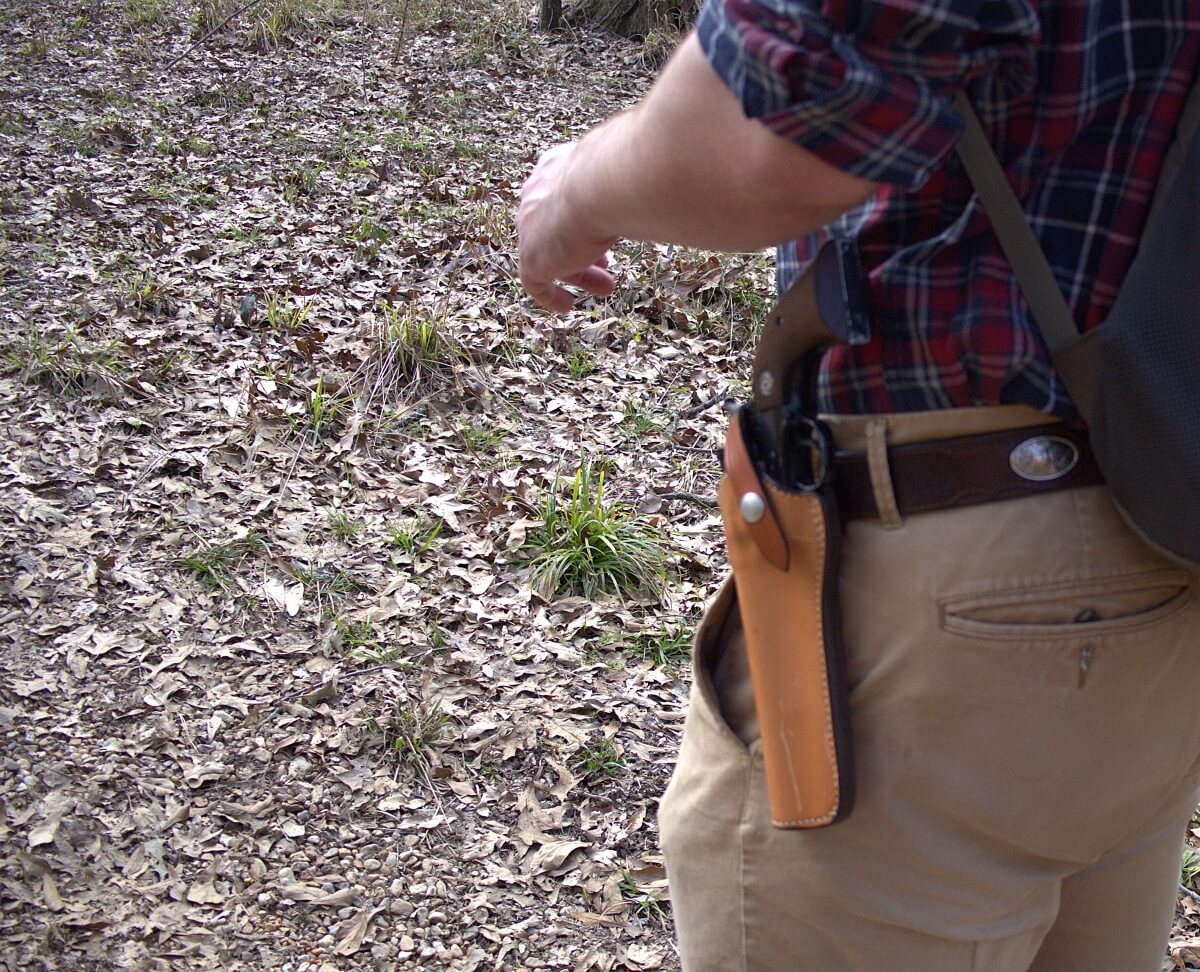

A .22 LR handgun is easy to dismiss until you carry one all day, shoot it well, and watch it punch deeper than expected. For hunters, trappers, and everyday carriers in the woods, the humble rimfire sidearm still has teeth.
Why the .22 LR Handgun Still Earns a Spot in the Hunting Kit
Hunters carry handguns for a number of reasons. Some of us like the challenge of handgun hunting in particular. For those of us who live the concealed carry lifestyle day in and day out, the handgun goes with us no matter what the activity. Others still want a backup to a long gun, whether it is there in case of malfunction or for taking game you otherwise can’t get. No matter the reason, caliber selection is going to be an important factor that will define the handgun’s role in the hunting kit. Among the most common platforms are .22 handguns.
A handgun in .22 LR is not going to fit all roles well, but it is all too often discounted. Follow along as we discuss the capabilities and power of .22 LR handguns in their role as hunting and defensive sidearms.
Caliber Selection: Pick the Handgun That Actually Does the Job
Handguns can serve as a primary hunting weapon or a backup. To be worth the weight on your next adventure, the handgun must do what you need. In bear country, a magnum revolver or 10mm pistol works well, if you can shoot it accurately. These handguns might be ideal for big game hunting but poor for small game. Still, they leave enough meat to eat.
The .22 Handgun Tradeoff: Light, Cheap, Useful, and Limited
.22 rimfire handguns lie at the low end of the power spectrum. Both the handguns and ammunition tend to be lighter and less expensive than centerfire options. This makes them easy to pack. However, the small size and low power of the ammunition make it less ideal for personal protection. On the other hand, a .22 works well for dispatching wounded game, signaling, and taking small critters with minimal meat damage.
Know the Law Before You Pack a .22 LR Sidearm
Caliber selection is also dictated by your state, local, and WMA regulations while hunting. Currently, some states disallow certain calibers, while others have extended concealed carry laws to public lands. In my particular state, constitutional carry prevails, but that was relatively recent. Until a few years ago, the only allowable sidearm was a .22 pistol loaded with rat shot.
Whether the .22 draws your interest or the law requires you to have one, you should know what it can do before you take a shot.
.22 LR Handgun Platforms: Pistols, Revolvers, and Derringers Compared
You can roughly divide .22 handguns into three categories: semi-automatic pistols, revolvers, and derringers. Each has particular advantages and drawbacks, and all are worth some consideration.
Semi-Auto .22 Pistols: Capacity, Familiar Controls, and Easy Shooting
Semi-auto handguns in .22 LR vary from heavy-barreled target pistols like the Ruger Mk. IV to small tip-up pocket pistols like the Beretta 21A and 20X.
One advantage of the semi-auto .22 is general familiarity. Modern shooters understand the semi-auto pistol, how its slide or bolt operates, and how to reload with detachable magazines.
Another advantage is ammunition capacity and shootability. Semi-automatic pistols generally offer a few more rounds than comparable revolvers. They may have light, consistent trigger pulls for potentially better accuracy.
A more recent advantage, particularly with compact and full-sized .22 handguns, is the inclusion of small optics and polymer frames. This makes shooting ability and portability that much easier over traditional models. See exhibit Sig P322 and Taurus X22, among a few others. On the other hand, aluminum and all-steel handguns may be steadier in the hand but are a little harder to pack. Despite all the advances, the Ruger Mk. IV and Browning Buckmark continue to sell.
The main disadvantage of .22 pistols is reliability. The pistols themselves usually perform well, but .22 rimfire ammunition can include underpowered or dud rounds. Bulk pack ammo causes more problems than smaller batches, and some pistols prefer certain brands over others. Neglect also affects reliability since .22 handguns fail more often when dirty from elements or repeated shooting. They tolerate dirt less than centerfire pistols.
.22 Revolvers and Derringers: Simple, Stubborn, and Pocket Friendly
The inverse of the semi-auto pistol holds for revolvers and derringers. Both do not rely on gas or recoil pressure, so they can generally shoot any ammunition that is run through them. Although dud rounds are still possible, they are generally less prevalent and can be remedied by going to the next round that is loaded without the need to manipulate a slide or magazine.
Like pocket autos, derringers and snubnosed revolvers excel for pocket carry and dispatching animals at very close range. However, their shorter barrels and coarse sights make it harder to shoot at distances where you are more likely to surprise a critter.
Longer-Barreled .22 Revolvers: Heavier to Pack, Easier to Hit With
Longer-barreled revolvers, like larger semi-autos, are harder to pack but easier to shoot. A good pair of adjustable sights is also helpful, as not all .22 LR loads will hit in the same place. If you find an accurate .22 load, it is easier to simply shift the sights than to remember where to hold with fixed sights.
Double-action .22 revolvers like the Ruger LCR and S&W Model 43C are light to carry, but their lack of a hammer spur and short barrel limits their usefulness. Going up to a full-sized handgun like the Ruger SP101 or Smith & Wesson 617 gives the shooter more weight on the belt, but a single-action capability for a short, crisp trigger pull that might make the difference when the time comes to hit small targets. But, being double-action guns, they can be fired quickly by simply pressing the trigger when the need arises.
Single-action revolvers in .22 are more common. Handguns like the Ruger Wrangler, Heritage Rough Rider, and Chiappa 1873 are competitively priced and enjoy the benefit of a crisp single-action trigger pull. They also have fewer parts overall compared to a double-action gun. Unfortunately, revolvers like these are functionally clones of the Colt Peacemaker. They are gate-loaded revolvers that usually wear fixed sights, although revolvers like the Super Wrangler and the Single Six ship with good adjustable sights.
🛒 Check Current Price for .22 LR on GunsAmerica
.22 LR Handgun Field Snapshot: What Matters in the Woods
| Category | .22 LR handguns for hunting, backup carry, dispatching game, signaling, and small critter control |
|---|---|
| Common Platforms | Semi-automatic pistols, revolvers, and derringers |
| Strengths | Light weight, lower ammunition cost, easy packing, low meat damage, useful penetration with the right load |
| Limitations | Lower power, rimfire ammunition reliability concerns, reduced hollow-point expansion in short barrels |
| Tested Handguns Mentioned | Bond Arms Stinger RS with a 3-inch barrel and Ruger Single Six with a 5.5-inch barrel |
| Test Load Mentioned | CCI Blaser 40-grain lead round-nosed ammunition rated at 1,280 feet per second |
| Chronograph Results | 942 feet per second from the Stinger and 1,187 feet per second from the Single Six |
| Gelatin Test Distance | Ten feet |
The Real Power of .22 LR Handguns: Small Bullet, Deep Surprise
There are many different types of .22 rimfire handguns to choose from. Some qualify as small game hunting tools in their own right. Others might be best used on the trap line or to give the coup de grâce to wounded game. The most important part of choosing a .22 handgun is that it is both reliable and accurate enough in your hands to serve its intended purpose. If a handgun is problematic and your groups are measured in feet rather than inches, it is time to reevaluate. But once you have a .22 you like, it is worth selecting quality ammunition and knowing its capabilities.
.22 LR Ammo From Handguns: Barrel Length Changes Everything
Handguns have shorter barrels than rifles, and any given ammunition will lose some velocity because of that. Some handguns in the 5+ inch barrel category can approach rifle velocities, while pocket pistols can cost you a few hundred feet per second off what is advertised on the box.
If you prefer hollow-point ammunition, choose a longer barrel to achieve good expansion. However, expect less penetration than a solid bullet. On the other hand, when you use a pocket pistol, hollow points may behave like solid bullets because they don’t reach the needed velocity.
The Punch of the Humble .22 Handgun Is Not a Joke
No matter what bullet type you choose, it is worth knowing its capabilities so you don’t employ it to do a job that it cannot do. That brings up the question: how much damage can a bullet fired from a .22 handgun do? The answer is probably more than most folks want to admit.
In my testing using pocket pistols with barrel lengths of 3 inches or less, hollow-point expansion in ballistic gelatin is almost nonexistent. But any high velocity loading can get 10-12 inches of this muscle tissue simulant, tumbling along the way. Longer-barreled handguns generally do better with solid bullets for penetration, achieving an extra 2-4 inches, but at velocities high enough where tumbling is not as pronounced.
I shot this load over my Caldwell chronograph and achieved an average five-shot velocity of 942 feet per second using the Stinger and 1,187 feet per second with the Single Six. Barrel length can and does matter in calibers this small!
.22 LR Gel Test Notes: Tumbling, Penetration, and Real Woods Use
I initially fired two rounds from each handgun, but ultimately needed a third from each as two rounds escaped the blocks. The Stinger put these pills at a lower velocity, so they did not go as far. One round yawed and exited the second block at the 13-inch block. The two remaining bullets were captured at the 12-13 inch mark, respectively. The 1-inch stretch cavities in the first block and the recovery of the bullets with their bases facing forward indicate instability and tumbling after impact. But on the whole, a pocket .22 with a solid bullet gives good penetration and should not be written off.
Two rounds fired from the Ruger Single Six left icepick wounds, and each round stopped at 16 1/2 inches. Despite their higher velocity, there is less damage in the wound track but better penetration. That is good to know if this setup is used for hunting small game or potentially taking out the errant coyote. In the former case, lack of meat damage is a plus, while in the latter case, penetration for an ethical kill is beneficial. The Single Six and CCI Blaser is my preferred woods setup and was used to down a 36 lb. coyote. The bullet hit just behind the shoulder and hit the rib bone, but was still able to traverse sideways out the other side.
Pros and Cons: Where the .22 LR Handgun Wins and Where It Doesn’t
- Pros: Light to carry, cheaper to feed, useful for small game, practical for dispatching wounded game, capable of surprising penetration with solid bullets, and easy to shoot well when the handgun and ammunition agree.
- Cons: Limited power for personal protection, rimfire ammunition can produce duds or underpowered rounds, dirty guns become less reliable, short barrels reduce velocity, and hollow-point expansion from pocket pistols may be almost nonexistent.
The Bottom Line: A .22 LR Woods Gun Is Small, Useful, and Too Easy to Underestimate
A good .22 rimfire rifle or handgun belongs in the woods like a brook running through the rocks. Neither is a be-all and end-all when it comes to taking game or acting as a defensive tool, but neither are they a waste of space. A good .22 handgun that is both loaded right and shot well can deliver the game you were not intent on hunting that day and, as our little gel test has shown, can strike deep if need be.
Read the full article here
