



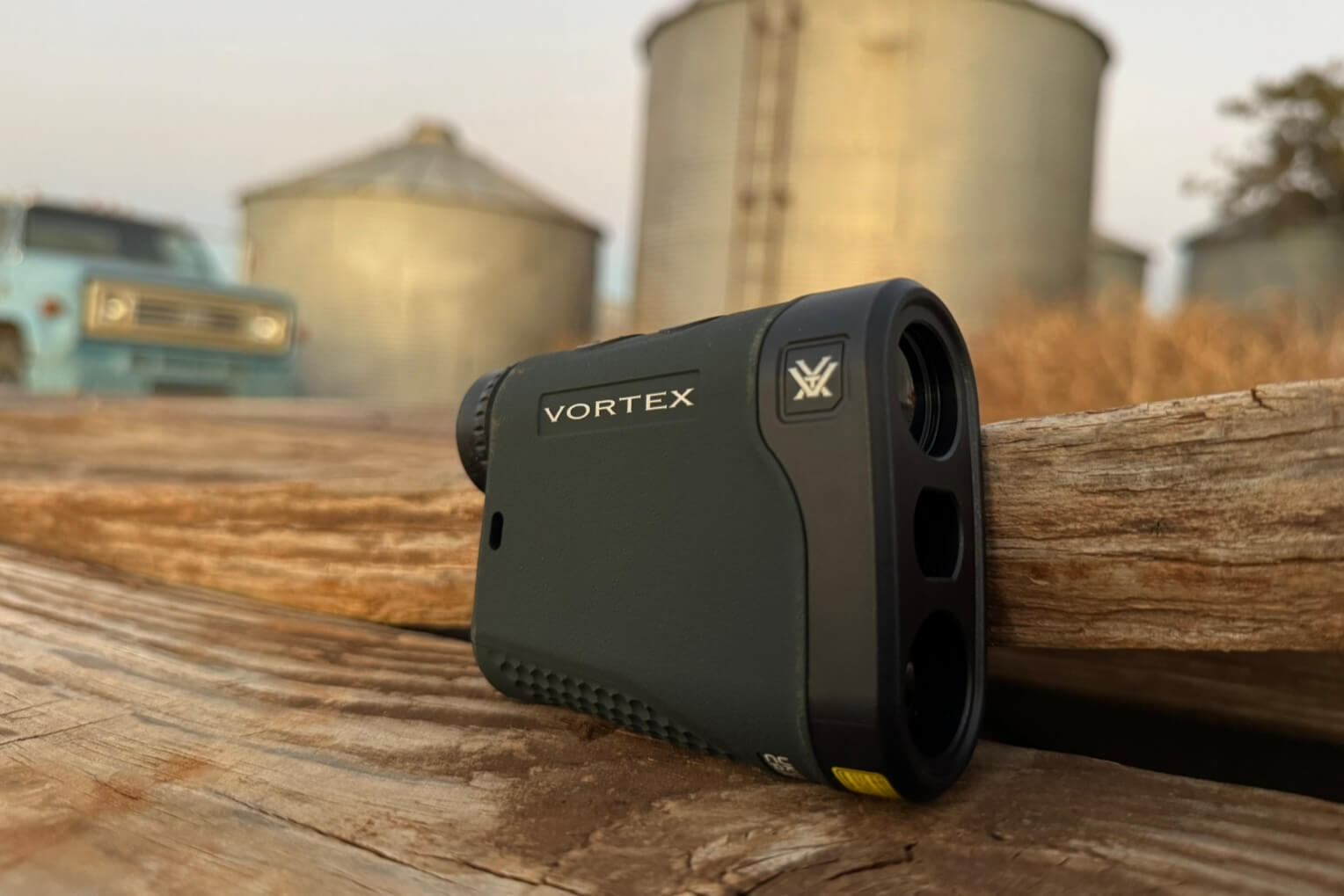

The Vortex Triumph HD 850 is one of those budget rangefinders that has no business being this useful for the money. It ranges farther than its size suggests, weighs almost nothing, and reads fast, but a slightly off reticle keeps it from being an easy slam dunk.
The Vortex Triumph HD 850 is a compact laser rangefinder designed for hunters who want fast, reliable ranging without the extra bulk. Built with hunters in mind but versatile enough for general shooting use, the Triumph HD 850 focuses on simplicity, lightweight construction, and practical ranging performance at an approachable price point. With an MSRP of $149.99 and a typical street price closer to $100, it sits squarely in the budget-friendly category while still offering angle-compensated ranging and multiple target modes.
What You Get With the Vortex Triumph HD 850 Out of the Box
The Triumph HD 850 comes with a soft carry case, wrist lanyard, lens cloth, and a CR2 battery. Everything needed to get started is included, and the case is adequate for protecting the unit in a pack or pocket.
Optical Clarity and Display Performance That Beat the Price
The Triumph HD 850 uses a 5x magnification paired with a 21mm objective lens, delivering a fairly clear and usable image for its intended ranges. The HD optical system does a good job controlling chromatic aberration and maintaining near-edge-to-edge sharpness, especially considering the price of the unit. Color fidelity is solid, and contrast is adequate for picking targets out of mixed backgrounds like grass, tree lines, or shaded timber. Light transmission is slightly degraded compared to what I see with my own eyes, so last light ranging can prove difficult.
The black LCD display is easy to read in bright daylight and doesn’t wash out when set against lighter backgrounds. Readings are crisp and quick to interpret, which helps when scanning terrain or ranging multiple targets in succession.
Real Field Ranging Performance Past What the Box Suggests
In real-world use, the Triumph HD 850 consistently delivers fast readings. On grass, trees, and natural terrain, it can reliably range out to around 750 yards. Beyond that distance, readings become more difficult to obtain, which aligns with expectations for a compact unit rated for 850 yards on reflective targets. I was honestly surprised I could easily range grass hills and trees out to around 750 yards.
One limitation worth noting is beam divergence. When attempting to range a target just beyond a closer object, such as a hillside behind brush or grass, the unit will often pick up the nearer object instead. This is most noticeable when the closer object occupies a significant portion of the beam path. Using First or Last Target Mode can help in some situations, but this behavior is something users should be aware of when ranging in cluttered environments.
Also, when ranging with the Triumph HD 850 vertically, I would get a different reading than when ranging upside down. I did this to check if the crosshairs were actually on what the device was ranging. It appears the laser is actually hitting below the reticle. I also verified using night vision that the laser was a little below the reticle. This wasn’t great to find. However, once you figure out the proper hold, you can sort of get used to it.
Accuracy is rated at 0.5 yards at 100 yards, and performance in that regard feels consistent during target shooting. Ranges update quickly and don’t lag when panning across terrain using the scan feature.
Ranging Modes That Cover Real Hunting and Range Use
The Triumph HD 850 includes a useful selection of ranging and target modes that cover most hunting and shooting scenarios.
Horizontal Component Distance (HCD) mode is the primary mode and is especially useful for both rifle and archery applications. It automatically compensates for steep angles and displays the corrected horizontal distance. This allows shooters to use their standard ballistic or sight references without additional calculations.
Line of Sight (LOS) mode provides true line-of-sight distance, which can be useful for general ranging or non-shooting applications. Target modes include Normal, First, and Last. Normal Mode works well for most situations. First Mode, on the other hand, helps isolate closer targets in front of brush or other reflective objects. Last Mode is useful when ranging targets beyond foreground clutter, though beam divergence can still limit effectiveness in some scenarios.
Featherweight Ergonomics and Better-Than-Expected Handling
One of the standout characteristics of the Triumph HD 850 is its weight. At just 4.6 ounces, it feels noticeably lighter than many rangefinders in this category. If you’re used to more robust, heavier units, the weight can be surprising at first. However, it quickly becomes an advantage when carried in a pocket or bino harness.
The overall size is compact without feeling cramped. Button placement is intuitive, and the two-button layout makes it easy to operate without looking. The “soft-touch” exterior provides a secure grip. Also, the more aggressive texture on the bottom of the housing offers excellent control. It remains secure when ranging one-handed or trying to hold steady at longer distances.
The ocular diopter adjustment is firm enough to stay in place once set, though a slightly stiffer adjustment would be preferred. Once adjusted, the image remains consistent and sharp.
The battery cap design is well thought out. The flip-up half-cap design Vortex has been using works smoothly and feels secure, making battery changes quick without feeling fragile. This device is powered by a single CR2 battery.
Built for Hunting Weather, Even if the Housing Feels Light
The unit is waterproof and shockproof, designed to handle typical hunting conditions without issue. Maybe it is due to the lightweight design, but the sides do feel thinner and more flexible than other beefier housings. While it’s not intended for extreme abuse, it held up without issue throughout my testing.
Final Verdict: A Budget Rangefinder That Overdelivers, With Caveats
At a street price hovering around $100, the Vortex Triumph HD 850 offers strong value. It delivers quick readings, practical ranging distances for real hunting scenarios, and a lightweight, easy-to-use design. While beam divergence is worth noting, and the reticle being off, I was still able to get readings out to 750 yards on non-reflective targets, which is well past the advertised 500.
For mixed-use shooters who want a compact rangefinder for target shooting, hunting, or general field use, the Triumph HD 850 is a solid budget option. While it doesn’t range as far as some or offer onboard ballistics, it ranges further than its size suggests, handles well, and keeps the feature set focused on what actually matters in the field, all at a killer price.
Vortex Triumph HD 850 Specifications That Matter
| Model | Vortex Triumph HD 850 |
|---|---|
| Magnification | 5x |
| Objective Lens Diameter | 21 mm |
| Eye Relief | 13mm |
| Range Reflective (yards) | Up to 850 yds. |
| Range Tree (yards) | Up to 500 yds. |
| Range Deer (yards) | Up to 350 yds. |
| Min Range | 6 yds. |
| Accuracy | .5 yds @ 100 yds. |
| Length | 3.8″ |
| Height | 3.1″ |
| Width | 1.4″ |
| Weight | 4.6 oz. |
| Max Angle Reading | ± 89° |
| Battery | CR2 |
| MSRP | $149.99 |
Pros and Cons of the Vortex Triumph HD 850
- Pros: Very light at 4.6 ounces, fast readings, useful HCD and target modes, easy two-button controls, strong value, and ranges natural targets farther than expected.
- Cons: Beam divergence shows up in clutter, last-light performance is limited, housing feels a bit thin, and reticle and laser alignment issue is not ideal.
Read the full article here
