





A German mine tore open the Navy transport USS Susan B. Anthony off Utah Beach on the morning of June 7, 1944. The ship lost power and went down within a few hours of the blast, the only large troop ship sunk in the entire invasion. Everyone aboard got off alive, including thousands of soldiers from the 90th Infantry Division who came ashore carrying their rifles but stripped of the heavier weapons that went down with the ship.
The men of the 90th landed in a supporting role on D-Day and never drew the attention paid to the other divisions. Five American divisions made the assault on the Normandy beaches and drop zones that morning.
The 90th was the sixth American division to put men ashore that same day, overshadowed from the start by the assault forces and by legendary figures like Brig. Gen. Theodore Roosevelt Jr., son of the late president and 4th Infantry Division’s assistant commander, who earned the Medal of Honor during the assault.
The division’s first weeks in combat went so badly that senior commanders considered breaking it up and transferring its men out as replacements. Within a few months, the same division had become one Gen. George S. Patton counted among the best he ever commanded.
The Division’s WWI Roots
The Army raised the 90th at Camp Travis outside San Antonio on Aug. 25, 1917, under Maj. Gen. Henry T. Allen, the year the United States entered World War I. Texas and Oklahoma provided its first soldiers who gave the division its early identity.
The men wore a red T and O patch on the shoulder, a monogram for their two home states. They adopted it in France in 1918 and later reread it as a nickname, the Tough ‘Ombres. Other soldiers knew the outfit as Texas’ Own or the Alamo Division.
The 90th shipped to France in the summer of 1918 and went onto the line in Lorraine. That September it fought in the St. Mihiel offensive, the first great American attack of the war. It pushed on into the Meuse-Argonne, the campaign that helped break Germany’s last line of defense before the armistice in November.
The 90th came out of that war having lost more than 1,300 men killed, with thousands more wounded or gassed. It conducted occupation duty in Germany and came home in 1919 for demobilization.
The Army held the 90th in the reserves through the 1920s and 1930s and called it back into active service on March 25, 1942, at Camp Barkeley, Texas, under Maj. Gen. Henry Terrell Jr. Its ranks were no longer only filled with men from Texas and Oklahoma, but from across the entire country.
The division trained for close to two years in the United States before crossing to England in the spring of 1944. It spent the final weeks before the invasion of Normandy rehearsing drills and training for heavy combat.
On June 6, the 90th joined the Utah Beach landings. The beach sat at the foot of the Cotentin Peninsula on the western end of the invasion front. Once the 4th Infantry Division had punched inland and opened the beachhead, the 90th was to widen the foothold, link up with the 82nd Airborne and join the drive north to the port of Cherbourg.
The first of the 90th to land were the 1st and 3rd Battalions of the 359th Infantry Regiment, attached under the 4th Infantry Division for the assault. They came in behind the lead regiments once those troops had cleared the way, then gathered in the rear and became the 4th Division’s reserve.
Most of the division was still at sea off Utah Beach on the night of June 6. The Susan B. Anthony, loaded with the remainder of the 359th and other 90th units, struck the mine the next morning while trying to bring the men ashore.
Heavy Losses in the Hedgerows
The full division needed three days to gather off the beach. On June 9, the 82nd Airborne, fighting to cross the Merderet River, turned to the 90th’s 345th Field Artillery Battalion for fire support after losing its own guns in the airdrop. The battalion had just four guns ready and could not bring its full weight to bear for another two hours. Rather than send his paratroopers across without it, Maj. Gen. Matthew Ridgway pushed the attack back.
The division’s own attack jumped off on June 10 and pushed into the hedgerows, the high earthen banks that walled off every Norman field and gave the German defenders cover on every side. The 357th Infantry made little progress and lost 99 men in one day.
On the left, the 358th stalled after its commander chose to dig in rather than press the attack, costing its lead battalion 129 casualties before nightfall. The division did not reach its first objectives until June 13.
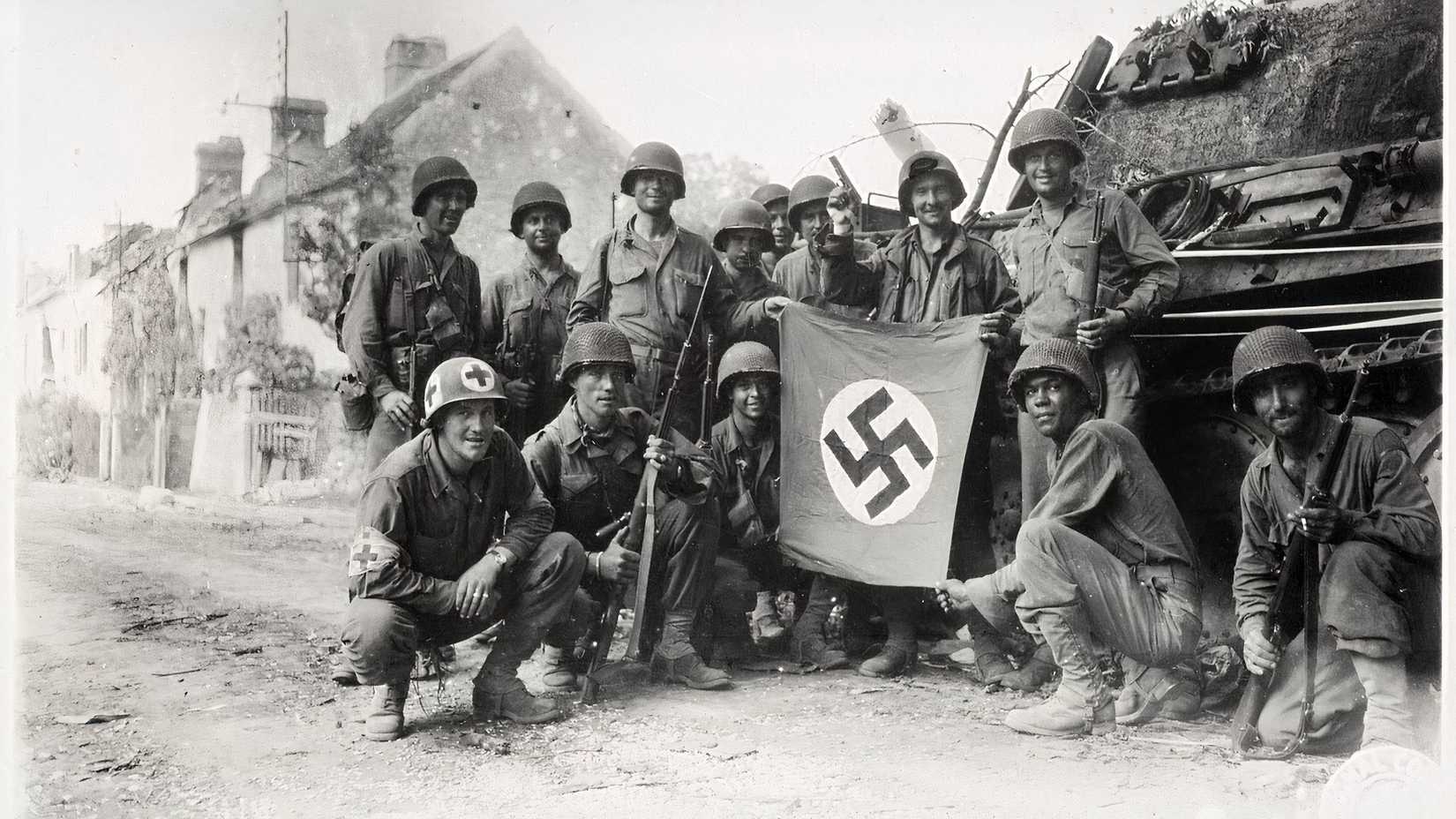
In early July the division attacked into the Forêt de Mont Castre, a wooded ridge the Germans held in the center of the Cotentin. The fight for the high ground lasted for days against heavy resistance. The 90th finally cleared it by July 11 in some of the costliest combat of the Normandy campaign.
Within days of the first attack, the Army had relieved the division commander, Brig. Gen. Jay W. MacKelvie, along with the commanders of the 357th and 358th. Command of the 90th would change hands again over the weeks that followed.
Theodore Roosevelt Jr. was in line to take control of the 90th, but he suffered a fatal heart attack on July 12, before he could assume command.
By midsummer, the headquarters of Lt. Gen. Omar Bradley had begun to weigh dissolving the 90th outright and transferring its troopers into other divisions as replacements.
The 90th Advances Into Germany
Maj. Gen. Raymond S. McLain took over the 90th in August. The men who had lived through June and July were hardened veterans by then, with fresh replacements filling the ranks.
Fighting alongside the French 2nd Armored Division, the 90th helped close the Falaise Pocket around the German 7th Army. On Aug. 19, 1944, its men met Polish forces at Chambois, sealing tens of thousands of enemy troops inside the pocket.
As part of Patton’s Third Army, the 90th drove east into Lorraine. Its hard-fought crossing of the Moselle River that November earned a nomination for the Presidential Unit Citation, which Gen. Dwight D. Eisenhower turned down under a standing policy against awarding the honor to a full division.
When the Germans struck in the Ardennes that December, the 90th turned north into the Battle of the Bulge. From there it broke through Germany’s western border defenses, crossed the Rhine in March and drove on toward Czechoslovakia.
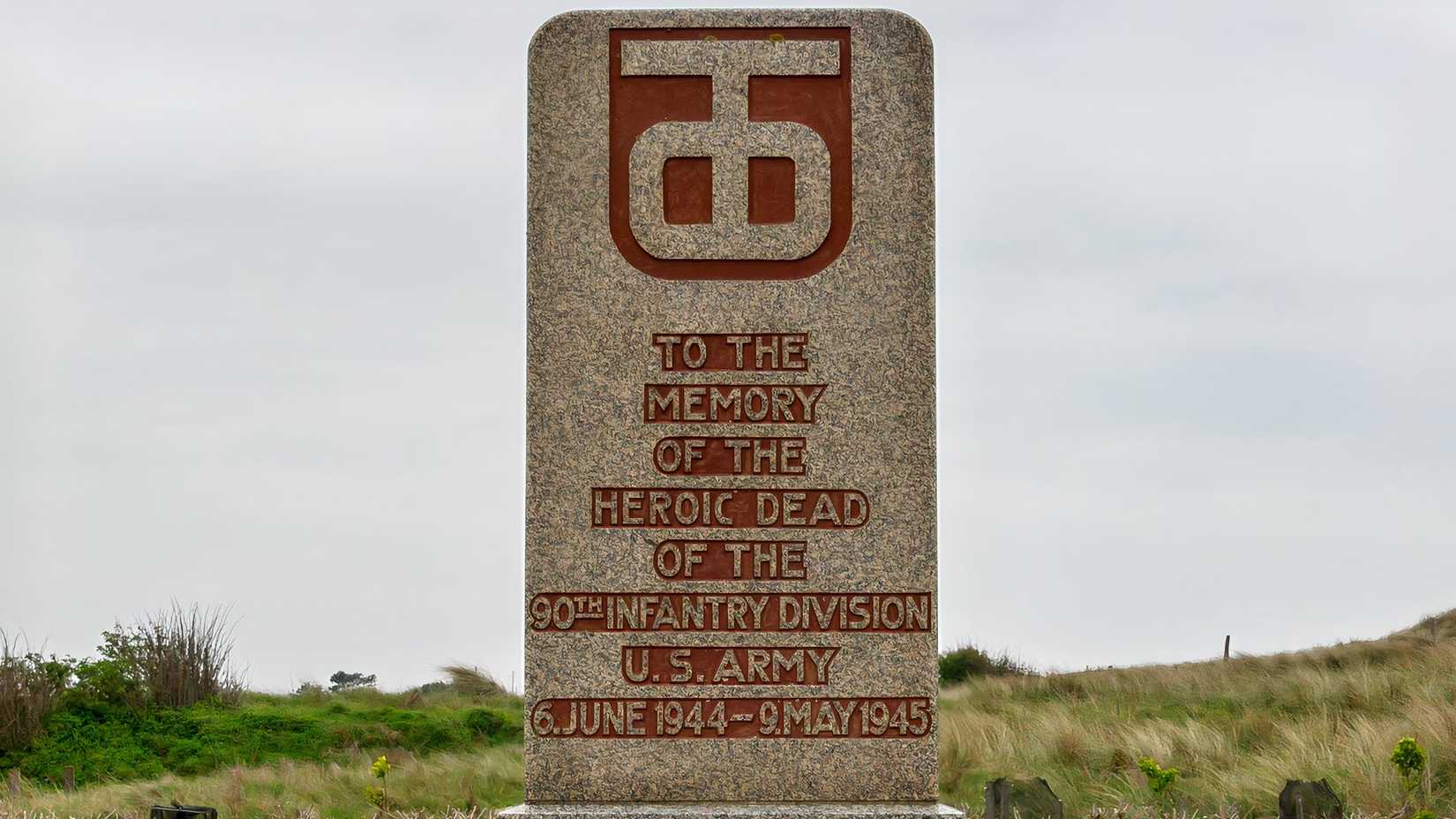
In early April, the division took the town of Merkers. Inside a salt mine nearby, its soldiers found Germany’s hidden gold reserve along with a hoard of looted art the Nazis had shipped out of Berlin.
Later that month, the 90th overran the concentration camp at Flossenbürg, where the SS had left roughly 1,500 prisoners behind after leading the rest away on a death march.
By the time the fighting ended, the 90th had lost close to 4,000 men killed and many thousands more wounded, a toll among the heaviest any American division paid in the conflict. The division had advanced all the way from Utah Beach in Normandy to the other side of Germany, much further than many other Army units in the theater.
Bradley later counted the 90th among the best combat divisions on the Western Front, a complete reversal from his previous thoughts about disbanding the unit. Patton, whose Third Army it had fought under for most of the war, left its soldiers a written certificate of tribute from Weiden, Germany, on July 13, 1945.
“Sometimes I think you don’t know how good you are,” he wrote. “You are the best soldiers in the world. It was a great honor to command you.”
The Army inactivated the 90th after the war. However, its lineage carries on today in the 90th Sustainment Brigade, an Army Reserve unit whose soldiers are still known as the Tough ‘Ombres.
Read the full article here
