



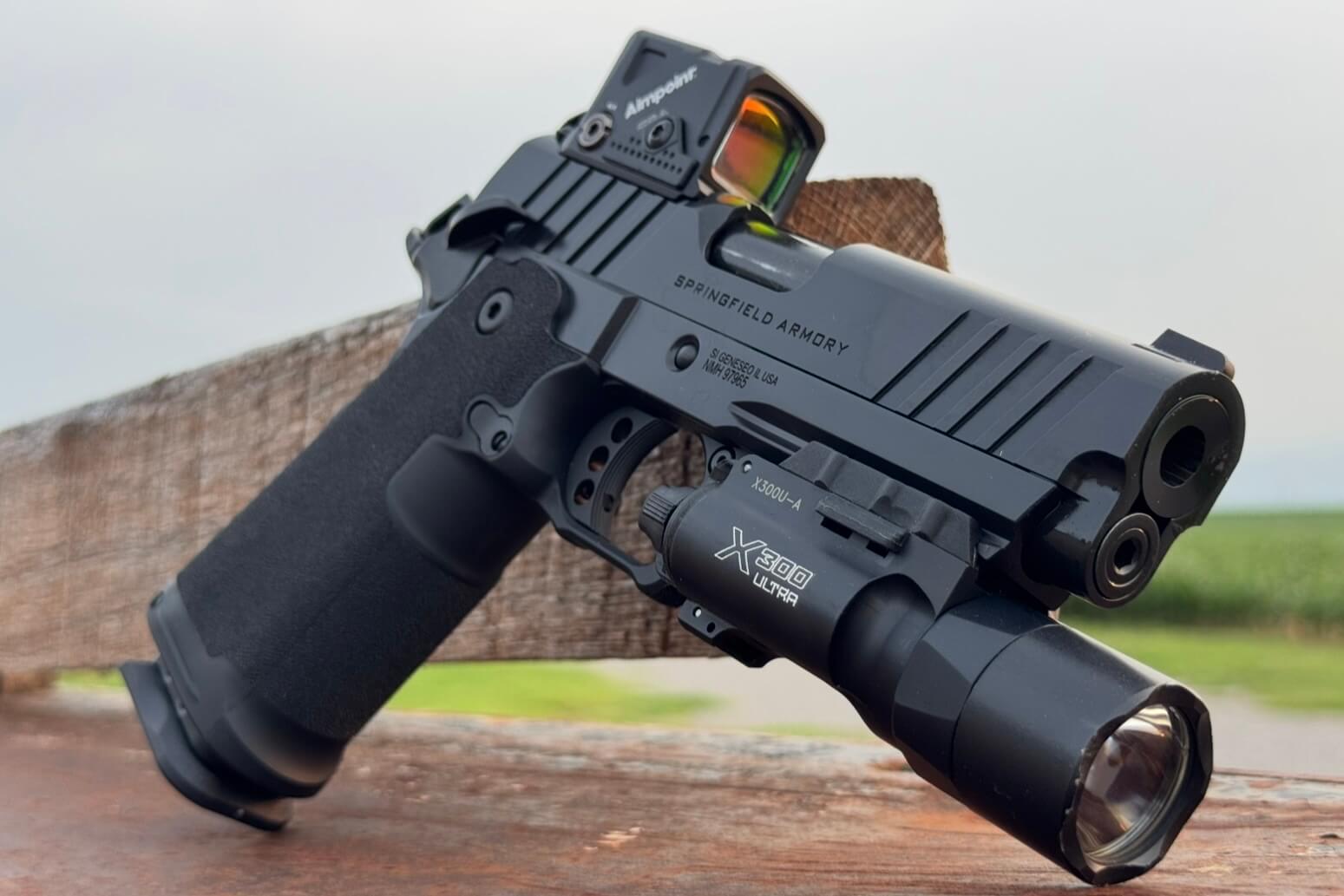

The Springfield Prodigy COA pairs double-stack 1911 performance with an Aimpoint optic that sits remarkably low and stayed locked on zero. After several hundred rounds, +P loads, mag dumps, quick-draw drills, and hits at 100 yards, the pistol finished with zero malfunctions.
Springfield Prodigy COA Review: More Than an Optic Cut
The Springfield Prodigy COA combines a double-stack 1911 platform with an Aimpoint COA red dot and A-CUT mounting system. While the Prodigy itself is not a new pistol, the COA configuration represents an expansion of Springfield’s factory optic-ready lineup. The A-CUT interface and Aimpoint COA combination are now available across several Springfield platforms, including the Echelon, Prodigy, and select 1911 models.
However, this Springfield Prodigy COA review is not simply about the optic cut. While I have handled and shot Prodigies before, this was my first opportunity to test one as a complete package. After several hundred rounds, I came away impressed with what Springfield built. The Prodigy COA is a solid mid-range double-stack 1911-style pistol that brings premium features without reaching the price point of some higher-end options.
🛒 Check Current Price for Springfield Prodigy COA on GunsAmerica
Springfield Prodigy COA Specifications and MSRP
| Manufacturer | Springfield Armory |
|---|---|
| Model | 1911 DS Prodigy 4.25″ COA |
| Caliber | 9mm |
| Capacity | 18+1 rounds |
| Barrel | 4.25″ forged stainless steel, match-grade bull barrel, 1:16 twist |
| Slide | Forged carbon steel, black Cerakote, Aimpoint A-CUT interface |
| Frame | Forged carbon steel with polymer grip module |
| Optic | Aimpoint COA 3.5 MOA enclosed-emitter red dot |
| Sights | Black front and rear sights with lower co-witness capability |
| Recoil System | Two-piece full-length guide rod |
| Magazines | Two 18-round Mec-Gar magazines |
| Weight | 32.5 ounces |
| Length | 7.8 inches |
| Height | 5.75 inches |
| MSRP | $1,955 |
Out of the Box: Aimpoint COA Installed and Nearly Zeroed
The Prodigy COA arrives in Springfield’s standard soft-sided handgun case. The case has a double-zipper design and enough room to protect the pistol and store an additional magazine or accessories. Inside the case, the biggest thing that stands out is the factory-installed Aimpoint COA. This is not a pistol where the customer needs to purchase an optic, find a mounting plate, and hope everything works together. Springfield ships the complete system ready to go.
My first step with any optic-equipped firearm is confirming the zero. Factory-mounted optics are convenient, but I never assume they are perfectly aligned. The Aimpoint COA surprised me. I first checked that the dot lined up with the iron sights, and then I moved to paper. The optic was essentially dead on from the factory.
That is not always the case. I have tested plenty of factory optic packages where the optic needed significant adjustment before shooting groups. While you should always confirm zero yourself, having the COA arrive properly aligned was a great first impression.
The included iron sights are also worth mentioning. Springfield got the height exactly right. They sit just above the bottom edge of the Aimpoint window, providing a lower co-witness without unnecessarily blocking the sight picture.
A-CUT Mounting System Locks the Optic Into the Slide
The A-CUT mounting system is one of the biggest reasons this Prodigy configuration stands out. Traditional handgun optics typically rely on adapter plates secured by screws. While that system works, it adds another interface between the optic and firearm where movement can potentially occur.
The Aimpoint A-CUT interface integrates directly into the slide using a full-length dovetail secured by a front hook and rear wedge. From an engineering standpoint, this changes how recoil forces are managed. Instead of relying on mounting screws to absorb the repeated shear forces generated during slide cycling, the A-CUT system mechanically captures the optic and transfers those forces directly into the slide. The screws become a retention component rather than the primary structural element.
The result is an extremely low mounting height, improved rigidity, and excellent zero retention. The optic feels like it was designed into the pistol from the beginning rather than added afterward. Additionally, the lower profile allows Springfield to use properly proportioned iron sights that remain visible in the bottom of the optic window without unnecessarily obstructing the sight picture.
When Aimpoint first introduced the COA and A-CUT system, I spoke with some Aimpoint representatives at the SHOT Show 2025 Range Day booth. They told me their testing had exceeded one million rounds. Obviously, I do not have the budget or resources to independently verify that claim, but I appreciate the depth of testing behind the design.
More importantly, my experience matched the intended purpose of the system. After several hundred rounds, the optic remained exactly where it started. Also, when removing the optic and reattaching it, the zero did not appear to shift at all. However, always confirm on paper before moving on after removing an optic.
Aimpoint COA Brings Enclosed-Emitter Protection
The Aimpoint COA deserves a section of its own because it is arguably the biggest upgrade to this package. The COA is a compact enclosed-emitter red dot designed for hard-use applications. The 3.5 MOA dot provides a good balance between precision and speed, while the enclosed design protects the emitter from rain, snow, dust, and debris. For defensive or duty applications, that matters.
Open-emitter handgun optics have improved dramatically, but an enclosed emitter removes one of the biggest concerns. There is simply less opportunity for the optic to become obstructed. The battery compartment is also designed for easy access. Users can replace the battery without removing the optic, which helps maintain zero over the life of the sight.
During testing, the COA performed exactly as expected. The dot was crisp, the glass was clear, and the optic never lost zero. The combination of the optic window size and the lower co-witness iron sights creates a very natural sight picture. The shooter gets the benefit of a red dot while still having a reliable backup sighting system.
Steel-Frame Prodigy Ergonomics Feel Planted Under Recoil
The Prodigy takes the traditional 1911 design and updates it with modern capacity. Instead of a single-stack magazine, Springfield uses a double-stack design paired with a polymer grip module mounted to a forged steel frame. The steel frame is one of my favorite aspects of the pistol. Yes, it adds weight. However, that weight comes with benefits.
The Prodigy feels incredibly solid in the hand. The rigid steel frame provides an excellent shooting platform and creates a stable mounting surface for accessories. This matters especially for shooters who run lasers. Polymer frames can flex under recoil, potentially causing laser shift. The Prodigy’s steel frame eliminates much of that concern. While this matters less with a weapon light, it is still a nice advantage.
While the added weight is nice for competition shooting and recoil control, at 32.5 ounces unloaded, this is not a lightweight carry pistol. The 4.25-inch barrel length makes the Prodigy reasonably compact, but the overall package is heavier than what I personally want for daily concealed carry.
Prodigy Controls Work, but the Ambi Safety Bites Back
The controls on the Prodigy are mostly well executed, but there are a few areas where I would make changes. The slide release is positioned farther forward than I prefer. With my normal grip, I cannot reach it easily without slightly adjusting my hand position.
The ambidextrous safety is also not my favorite feature. With a high and tight grip, the right-side safety lever presses into my dominant hand. That said, the left-side safety works very well. In fact, I found myself using it almost like a gas pedal or thumb rest during shooting.
The grip texture is another area where Springfield found a good balance. It is aggressive enough to provide excellent control but not so aggressive that it becomes uncomfortable. Shooters who use this pistol for competition will appreciate the traction, while those who carry it will not have to worry about it grabbing clothing or rubbing their skin raw.
Crisp Prodigy Trigger Makes Fast Follow-Up Shots Easy
The Prodigy trigger is one of the strongest features of the pistol. The trigger has a short take-up before reaching a clearly defined wall. From there, the break is crisp and predictable. The reset is also excellent. It is short, positive, and quickly returns the shooter right back to the wall for rapid follow-up shots.
This is exactly what I expect from a performance-oriented 1911-style pistol. The trigger allows the shooter to take advantage of the platform’s accuracy potential while still being forgiving during fast shooting.
Prodigy COA Accuracy and Velocity Results at 10 Yards
Accuracy testing was performed at 10 yards using a Garmin Xero C1 Pro chronograph to gather velocity data and Hornady defensive ammunition to see what this pistol could do. The table below shows my 5-round groups with each type of ammunition:
The Prodigy showed respectable accuracy across the ammunition tested. While the 5-round groups opened up, most shots were within about 3/4″, subtracting one flier. Every load performed comparably, and the pistol consistently produced groups suitable for both defensive use and competition.
Zero Malfunctions Through Mag Dumps, +P Loads, and 100 Yards
For those interested in the ammunition used in this review, AmmunitionToGo.com is the official ammunition sponsor for this article. I ordered ammunition for testing, and it was on my doorstep within the week. They offer a wide selection of competitively priced ammunition, an easy-to-use website, and quick shipping.
During testing, I primarily shot 124-grain Blazer Brass for general practice. I also ran Hornady defensive ammunition ranging from 115 grains to 147 grains, including +P loads. The Prodigy experienced zero malfunctions throughout testing.
I pushed the pistol beyond simple accuracy testing. I ran close-range mag dumps, general target shooting, and stretched it out to 100 yards on a C-zone steel silhouette. The Prodigy handled everything well, and the Aimpoint COA made precise shots quite easy.
For additional testing, I mounted a SureFire X300U and ran quick-draw drills from a Safariland holster. The combination of the low-mounted Aimpoint COA, excellent trigger, and solid frame made the pistol extremely enjoyable to shoot.
Watch the Springfield Prodigy COA in Action
For those interested in seeing the Prodigy COA in action, I also posted a short video review on my Instagram page. The video shows the pistol running on the range and provides another look at the low-mounted Aimpoint COA setup.
Springfield Prodigy COA Pros and Cons
- Pros: Factory-installed Aimpoint COA, extremely low A-CUT mounting height, enclosed-emitter protection, lower co-witness iron sights, crisp trigger, solid steel frame, 18+1 capacity, respectable accuracy, and zero malfunctions throughout testing.
- Cons: The 32.5-ounce unloaded weight is heavier than I prefer for daily concealed carry, the slide release sits farther forward than I like, and the right-side ambidextrous safety presses into my hand with a high grip.
Final Verdict: A Factory Optic Package That Earns Its Price
The Springfield Prodigy COA is an impressive factory package. The Prodigy itself is a solid mid-range double-stack 1911-style pistol, but adding the Aimpoint COA and A-CUT mounting system significantly increases the value.
With an MSRP of $1,955, the pistol includes a premium enclosed-emitter optic that costs around $600 on its own. More importantly, Springfield eliminates the hassle of aftermarket milling, mounting plates, and compatibility concerns.
For competition shooters, this pistol makes a lot of sense. It offers capacity, accuracy, a great trigger, and a factory-installed optic system built for serious use. For concealed carry, the weight is my biggest limitation. It can absolutely be carried, but it is heavier than what I personally prefer.
Overall, the Springfield Prodigy COA is a well-executed combination of a proven platform and modern optic integration. For shooters who want a high-performance handgun without stepping into the highest price tiers, it is a compelling option.
Read the full article here
