



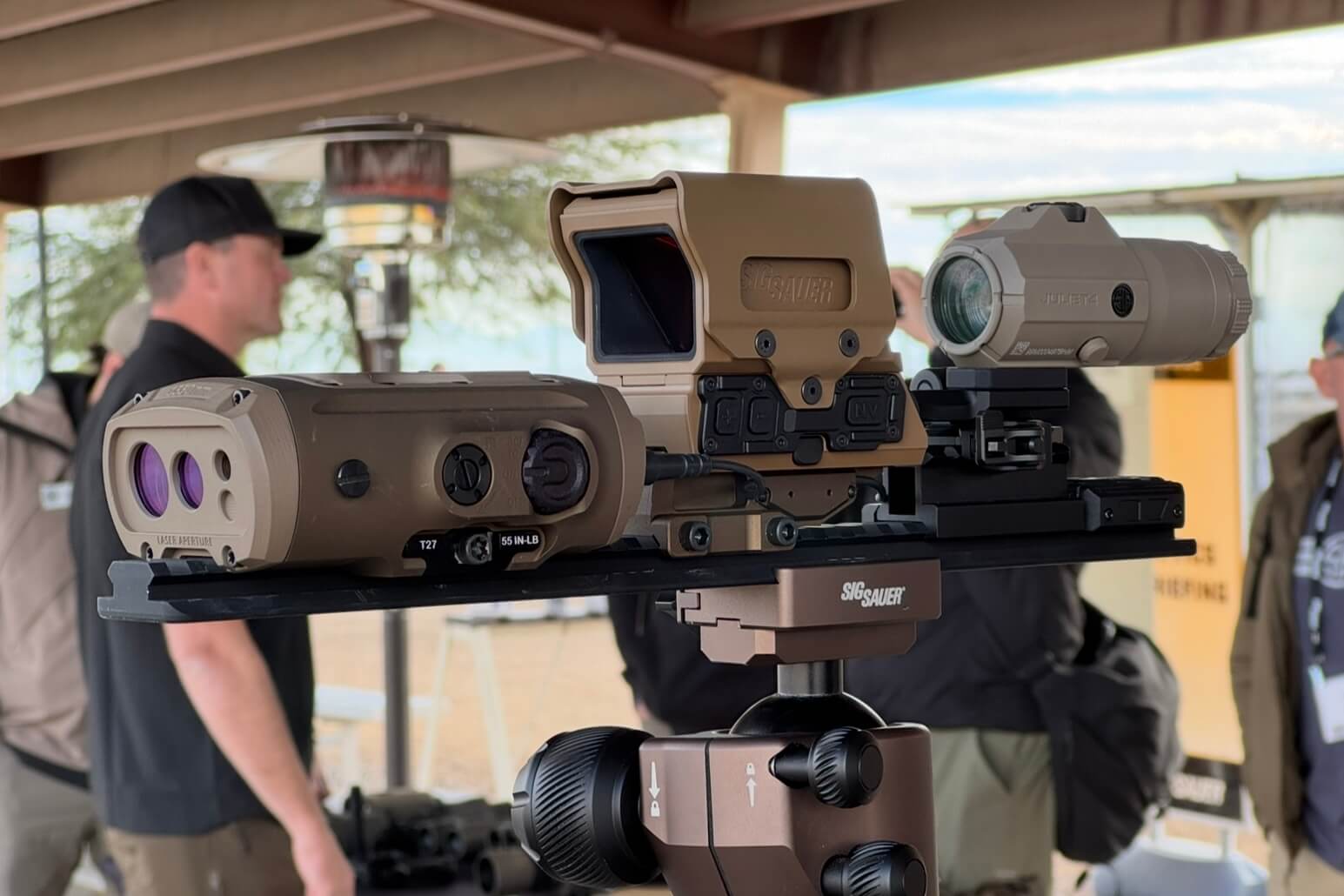

SIG Sauer’s XRAY7-CO red dot totally redefines what red dots can be, utilizing zero moving parts, and onboard ballistics capabilities.
This red dot uses a distortion-free digital display and zero moving components to deliver a rugged, data-driven combat optic designed for belt-fed machine guns.
A Different Approach to Red Dot Design
The SIG XRAY7-CO doesn’t follow the traditional red dot formula. Instead of reflecting an emitter off a curved lens, it uses a roof-mounted digital display paired with flat plate glass. That design choice removes the spherical lenses that often introduce distortion in conventional optics.
SEE ALSO: Seekins SIC: SF-Bred Modular Precision Rifle
The result is a clear, parallax-free sight picture with unlimited eye relief. The shooter looks through plate glass, while the reticle image reflects down from the roof. SIG says this layout eliminates common visual artifacts found in standard red dots.
At the core is an active-matrix LED display with tens of thousands of pixels. That pixel density lets SIG create virtually any reticle shape. Circle dots, chevrons, text, or data overlays are all possible. Because it’s a display, reticle changes are handled through firmware rather than physical components.
No Moving Parts, Built for Abuse
One of the XRAY7-CO’s defining traits is what it doesn’t have. There are no springs, screws, or internal adjustment mechanisms for windage and elevation. Zero changes happen digitally.
That design makes the optic extremely resistant to shock. SIG built the XRAY7-CO specifically to survive belt-fed machine gun use, including heavy recoil and sustained fire. During testing, SIG mounted the optic on machine guns and dropped it onto concrete from eight feet.
According to SIG, other components fail before the optic does. That durability focus explains the XRAY7-CO’s size, which is closer to an M250-class weapon than an M4. However, they hinted that smaller sizes may be available down the road.
Integrated Ballistics and Rangefinder Connectivity
The XRAY7-CO connects directly to the SIG Kilo WARP laser rangefinders. With the 905 LRF, it links via Bluetooth. With the WARP 1550, wired connections are available.
Once paired, ranging a target triggers automatic reticle adjustment. The point of aim shifts to match the calculated hold. There’s no mental math required. The optic moves the reticle for you.
SIG also built in compatibility with magnifiers. The XRAY7-CO uses the same AMR technology found in the ROMEO8T series. Reticle scaling changes with magnification, and the optic automatically adjusts brightness when you flip a magnifier into place.
Multiple Zeros and Custom Reticles
The XRAY7-CO includes a ZeroSwitch system that stores multiple zero profiles. This was designed for belt-fed barrel swaps, where each barrel may require its own zero. Users can quickly select between profiles without re-zeroing.
That same feature applies to other use cases. Different ammo types, suppressed versus unsuppressed setups, or mission-specific configurations can all have dedicated zeros. Because the reticle is display-based, custom reticles are also possible. SIG can tailor reticles, features, or data displays through firmware to meet specific end-user needs.
Availability and Future Plans
SIG says the XRAY7-CO is headed to defense customers this year. Commercial versions are in development but will likely be scaled down for M4-sized platforms.
For now, the XRAY7-CO stands as a purpose-built advanced combat optic focused on durability, modularity, and real-time ballistic integration rather than traditional red dot simplicity. I for one, am excited to see SIG pushing the envelope with this new design. Learn more HERE.
*** Buy and Sell on GunsAmerica! ***
Read the full article here
