



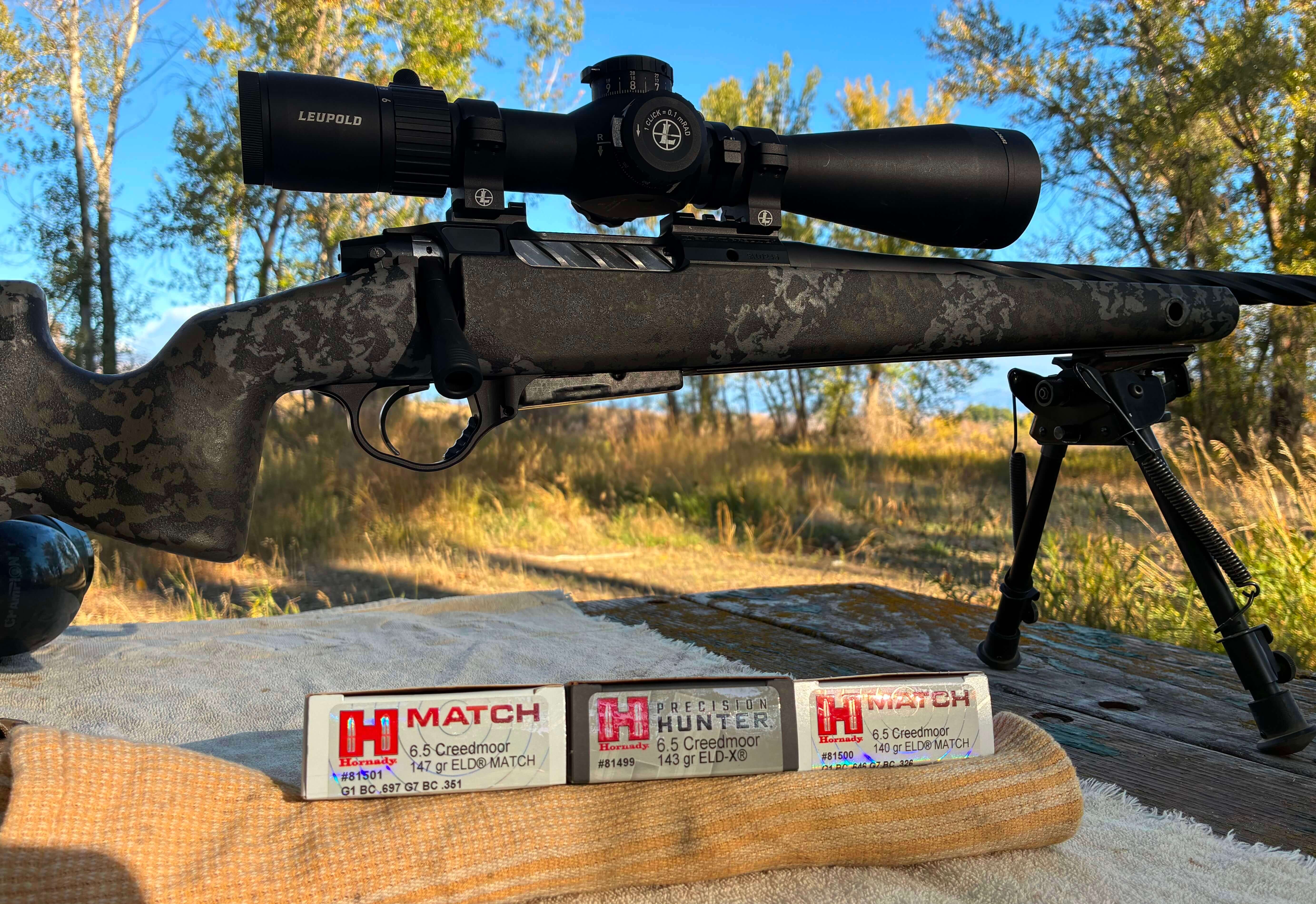

My Seekins PH3 in 6.5 Creedmoor didn’t just print one pretty group. After a quick factory tune, it drilled repeatable sub half-inch clusters and held that precision to 775 yards.
Seekins PH3 6.5 Creedmoor: Predator Rifle Goals Met
I recently purchased a Seekins PH3 in 6.5 Creedmoor. While all of the new features on this rifle are exciting and fun to talk about, I wanted to do a review on what matters most on a high-end rifle. How accurate is it? All the new features are worthless to me if a gun is not accurate enough for my shooting demands.
This rifle was purchased as my predator rifle, mainly for coyotes, with occasional big-game hunts. Anyone who has hunted coyotes knows how small a target they are. After the skin is peeled away, you’re looking at approximately a 4-inch target from the top of the back to the bottom of the chest.
Over the years, I found that if I don’t have a gun that will consistently produce a half-inch group at 100 yards, then I will consistently miss coyotes, and it’s not accurate enough for predator hunting. I shoot a long way at predators, and inconsistencies in accuracy add up quickly.
My calibers for this endeavor have been ever evolving. I started with a 22-250, then a 25-06, then a .223 in an AR platform, and then, by accident, on to 6.5 Creedmoor. I purchased a 6.5 Creedmoor in 2012 with the idea that it would be my deer gun. But it quickly became my favorite caliber from rock chucks to elk.
I originally wanted the PH3 rifle chambered in 22 ARC, but barrels for the 22 ARC were not available yet, so I went with the trusted 6.5 Creedmoor, knowing that I could swap in a 22 ARC barrel when it becomes available with the quick-change barrel system on the PH3.
Will It Shoot Sub Half Inch With Factory Ammo?
I have owned and shot many 6.5 Creedmoor rifles over the years, and most of them shoot Hornady ammunition well. I decided to stick with Hornady for the PH3. I began with the 143 ELDX and the 147 ELDM. I was able to get under a half-inch group with each of these factory loads, but I couldn’t repeat them from group to group.
For example, I would shoot a .4-inch group with either load, I would zero the rifle and go hunting. Then I would miss a shot that I knew I was capable of making, go back to the 100-yard target, and shoot a 1-inch group or larger with the same ammo, and the zero would shift as well.
This drove me absolutely crazy. I even shot some Nosler and Berger ammo with the same results. I shot multiple suppressors and scopes to rule them out as a problem; the result was the same. Then I would shoot the same scope and suppressor on a different rifle. They would shoot great, so it wasn’t a scope or suppressor issue.
Next, I would shoot the ammo through a different rifle that I knew shot well. The ammo would shoot great, every group was consistently the same size, and the zero didn’t change. Hmmm. This was maddening, as every time it shot a good group (½ inch or under), I thought the rifle was good to go, but it wouldn’t do it every time.
🛒 Check Current Price for The Seekins PH3 on GunsAmerica
Beyond MOA: Seekins Makes It Right
There was only one option left: the rifle. Normally, I would have never attempted to send back a rifle to the manufacturer that had shot multiple sub-half-inch groups with factory ammunition. But Seekins has a customer satisfaction guarantee, not an MOA guarantee. I had complete confidence that they would make the rifle shoot to my standards, as they had fixed a rifle for me in the past.
I am fortunate in that I get to shoot a lot of rifles, and people will hire me to either work on their rifles or set them up to shoot for them. I had one person bring me a Seekins Element in 6.5 PRC that he had bought used; it was the old model, and he had gotten a very good deal on it. When I went to set it up for him, I couldn’t get it to group under an inch with any factory ammunition. Some of the groups were closer to 2 inches, probably why he had gotten such a great deal on the rifle.
I emailed Seekins to explain the situation, and they responded with an RMA form and a shipping label. No questions asked, even though he was not the original owner of the firearm. I got a phone call from them a few weeks later, asking if a .6-inch group with Precision Hunter 143 ELDX factory ammunition was satisfactory. I told them it was, and they shipped the rifle back to me. The entire process took less than a month.
When I received the customer’s 6.5 PRC rifle, I shot the Hornady Precision Hunter 143 ELDX through it and got a .6-inch group! I was very pleased as I couldn’t get under an inch with any ammunition before. The customer had several different boxes of factory ammo to test, and the next box I tried was Federal 130 gr. Ascent. They shot a .298-inch group. I zeroed the rifle for the 130’s and showed the customer his group. He was ecstatic to say the least.
When I received the RMA form and shipping label for my rifle, I made sure to include everything I had done for the guys at Seekins who would be working on the rifle. I included pictures of a dozen different groups, both good and bad, along with a statement detailing everything I had done to rule out anything other than the rifle. As well as explaining, it would shoot a sub half-inch group, but not every time.
After a few weeks, a representative from Seekins called me to say that the rifle was driving tacks. I asked him how many groups he had shot with it, and he told me three different groups, and the biggest group was under a half inch. I asked which ammo he was using, and he stated they like to shoot the Hornady 140 gr. ELDM, as it was the most consistent lot-to-lot. I thanked him, and he said the rifle would be on its way back to me. Seekins included a receipt of what had been done to the rifle:
Cleaned and bumped the barrel
De-burred and trued bolt head
Trued mating surfaces
Accuracy tested
Test fired
Customer Satisfaction You Can Bank On
I then bought a box of Hornady 140 ELDM to test alongside the 143 ELDX and the 147 ELDM. I shot the 140s first and shot a .439-inch group.
Next, I shot the 147 ELDMs and got a .416-inch group. I had several boxes of the 147s, so I shot another group with them. The second group was .476 inches.
I had to wait for the next day to shoot the 143’s, and after lining out some suppressor issues (I had installed a new end cap and experienced baffle strikes), the PH3 shot a .380-inch group.
The PH3 was now shooting three different factory loads at under a half an inch. No more groups going from small to big and everywhere in between, no more shifting zeros, it flat shoots. I have never shot a rifle that shoots three different factory loads under a half inch, including custom guns with aftermarket barrels. If I had more time, I’d reload for this rifle, and I’m positive I would get to a one-hole group.
But with a rifle that shoots factory loads this well, why reload? I have shot each of the above-mentioned loads in the .3’s. They all shoot close to the same zero. I can load all three into my Sig Kilo 10k’s and choose between them without issue. While I prefer the 147’s, they have the best BC at a G1 of .697, they all fly amazingly, and are capable of hitting coyotes well past 1000 yards. While I can get my SDs into single digits when I reload, it takes a lot of time and effort compared to shooting factory. I will post the FPS and SDs for each load below. (20-inch barrel)
- Hornady 140 gr. ELDM: AVG FPS-2635. STD-12.5 FPS
- Hornady 143 gr. ELDX: AVG FPS-2596. STD-12.1 FPS
- Hornady 147 gr. ELDM: AVG FPS-2612. STD- 11.3 FPS
I’m very happy with the results, and very thankful that a company like Seekins Precision exists. I don’t know of another company with this kind of commitment to its customers, at least not for the price point.
Proven At 775 Yards: Real World Drops And Wind
After I was convinced the gun was shooting the way I wanted it to at 100 yards, I decided to take it out to distance. I was shooting consistently high at 1000 yards and knew I needed to true up my B.C. to get my holdovers correct. I made a quick target, painted a line across its center, and set it up at 775 yards. After adjusting my B.C to hit the line, I shot this group.
Best Bang For Your Buck: Why PH3 Wins On Value
The PH3 retails for $1850; it’s a lot of gun for the money. The new 60 degree action is buttery smooth and fast to cycle, the Trigger Tech trigger is crisp and easily adjustable (I got mine down to 1.9 lbs.), the stock is comfortable and well thought out, the toolless adjustable cheek piece is perfect, and the quick change barrel is ridiculously easy to use, your scope doesn’t have to come off, no gun vise or barrel wrench required. These are only some of the improvements over the old model (which is still great), but even with all the innovative changes that the new Seekins bolt rifle offers, the number one reason to buy one is the customer service.
Glenn Seekins is completely changing the rifle industry; not only are his rifles more innovative than the competition, but his customer service is also unmatched. The only question with Seekins Precision Rifles is whether they can keep up with demand. I certainly hope they do!
Seekins PH3 6.5 Creedmoor Specifications
| Model | Seekins Precision PH3 |
|---|---|
| Caliber | 6.5 Creedmoor |
| Barrel Length | 20 in |
| Overall Length | N/A |
| Weight | N/A |
| Capacity | N/A |
| MSRP | $1850 |
Pros And Cons: What Stands Out
- Pros: Repeatable sub-half-inch groups with multiple factory loads, smooth 60-degree action, crisp TriggerTech trigger, toolless adjustable cheek piece, quick-change barrel, standout customer service.
- Cons: Initial inconsistency required a return trip, some specs depend on configuration, reloading gains may be marginal given factory performance.
Read the full article here
