




Tired of staring at shelves of optics and guessing at the buzzwords? This quick glossary breaks down real red dot sight terms so your next pick is simple and smart.
Master Red Dot Sight Basics In Minutes
It seems like everyone has a red dot sight (RDS), to the point it wouldn’t be a surprise to discover your dog got their paws on one for their collar. And although the tech surrounding the RDS has slowed down a bit, it’s by no means halted. Red dots aren’t going away, and that means it’s a good idea to educate yourself on the related terminology. If you’ve ever stared at a website or shelf lined with red dots and tried to figure out what the random words mean, we’re here to help. RDS terminology will be word soup no longer.
But First, What Is A Red Dot Sight
A red dot sight is a smaller optic designed for closer-range target engagement, unlike scopes. Red dots aren’t magnified but instead rely on a glowing dot of varying size to guide your aim. Many shooters are talking about their handguns when they reference red dots, but these sights are also used for rifles and shotguns. If you need magnification on a long gun with a red dot sight, you can add a magnifier.
A Is For Adjustment Range And Astigmatism
Adjustment range: Refers to how much the reticle or dot can be moved when zeroing. For example, 45 MOA gives the user 45 MOA of movement possible.
Astigmatism: An eye condition involving an odd curvature of the cornea or lens that can cause distortion of images. This is relevant because people with astigmatism often struggle with red dots, experiencing a halo effect that renders the dot largely useless. Many shooters with astigmatism cannot use a red dot easily, but can use the RDS design with a green or blue dot.
B Is For Battery Life
Battery life: How long the battery in the RDS should last, depending on the brightness setting it’s on.
C Is For Closed Emitter And CR2032
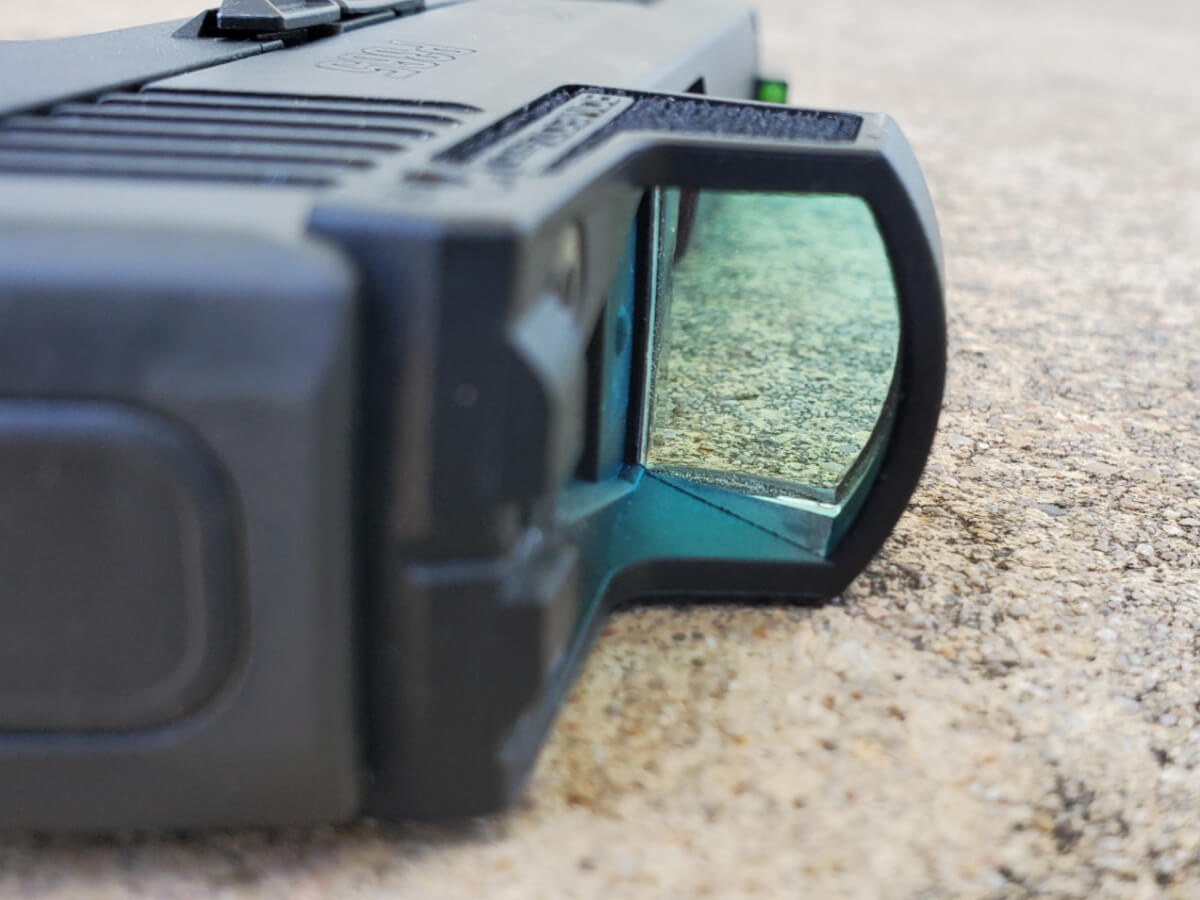
Closed emitter: This type of sight is designed with the emitter enclosed between two lenses and protected by the housing. Closed emitters are more durable, easier to clean and maintain, and offer great protection from the elements.
CR2032: A type of lithium coin cell battery commonly used to power RDS. Other sizes used in some models include CR1632, LR44, and CR1/3N.
D Is For Direct Mount
Direct mount: The practice of mounting an RDS directly to the handgun’s slide without additional mounting accessories or parts. This requires the optics cut on the slide to match the RDS being used; the shooter must change to using an adapter plate or mount.
E Is For Elevation And Eye Relief
Elevation: When shooting and zeroing a red dot sight, elevation refers to the vertical adjustment of the dot. Elevation is adjusted by moving the dot up or down.
Eye relief: The distance between the shooter’s eye and the sight that allows the shooter to maintain a good view of the reticle as well as a solid field of view.
Field of view: Red dot sights have basically unlimited field of view due to their design and use. When using a riflescope, the field of view refers to how much the shooter can see when looking through the eyepiece.
Footprint: The size and shape of the base of an RDS. Footprint being used in relation to the slide of the gun refers to which size RDS is compatible with the optics cut. FOV: Acronym for field of view.
H Is For Holographic Sight
Holographic sight: This type of sight is often lumped in with red dots, although it’s technically different. A holographic sight utilizes a laser to project the reticle onto the glass. These sights tend to be more complex than basic RDS.
I Is For Illumination Setting
Illumination setting: This is the feature that allows the user to adjust the brightness of the dot as needed for the environment. Some models have automatic adjustment, so the dot automatically changes according to available light.
M Is For Magnifier And MOA
Magnifier: A product that’s mounted in front of the sight for the purpose of providing magnification. Magnifiers are typically used on rifles and allow the shooter greater precision at longer distances. They’re often designed to rotate out of the way to shift between closer and further engagements.
Minute of angle: A measurement used with optics, including red dot sights. Minute of angle (MOA) is 1/60 of a degree, with 1 MOA translating to one inch (technically, it’s 1.047 inches). In shooting, this means a one-inch spread at 100 yards. Understanding MOA is important with red dots so you can properly zero your sight. Most red dot sights are zeroed by adjusting windage and elevation at 1/4 MOA per click. Always check the manual or with the manufacturer to find out the MOA on your specific red dot sight. All red dot sights must be zeroed; the impact won’t match your point of aim.
MOA: Acronym for Minute of Angle. The acronym is used regularly, and you won’t see it spelled out often.
O Is For Occlusion And Open Emitter
Occlusion: Occlusion of, or occluding, a red dot sight is used in training to teach target focus. This involves covering the forward-facing end of the red dot with something like a piece of tape so the shooter can temporarily not look through the glass. With iron sights, front sight focus is necessary, but with a red dot sight, target focus is needed. In fact, the way red dots allow target focus is one reason many shooters prefer them for defensive use.
Open emitter: This type of RDS leaves the emitter open on the back of the sight, reducing weight and overall size. Open emitter RDS are also often more affordably priced. These sights are prone to obstruction due to the emitter being expose,d and that can result in the dot disappearing until it’s cleaned.
Optics cut: A slide with an optics cut is milled and ready to accept an RDS, provided the footprint of the RDS matches that of the slide. Most optics-ready slides come with an optics plate insert that remains in place until the shooter chooses to remove it and mount an RDS to the gun.
Optics adapter plate: A typically aftermarket plate that’s mounted to the slide of the handgun to facilitate the addition of a specific RDS. This gives the shooter the ability to choose to mount RDS with different footprints on one gun.
P Is For Parallax And Parallax Free
Parallax: Refers to a perceived shift in the reticle’s position as it relates to the target. This is a significant issue with riflescopes and long-range shooting, but not much of a problem with RDS.
Parallax-free: The sight is designed so the dot placement on the target is accurate regardless of where the shooter’s eyes are positioned. From a physics standpoint, there’s no such thing as a parallax free sight, but because RDS aren’t magnified, they function as parallax-free within a certain distance.
R Is For RDS Recoil Rating Reflex Sight
RDS: Acronym for red dot sight.
Recoil rating: Refers to how much recoil the sight in question can tolerate without being damaged. This directly correlates to what caliber gun the sight can or should be used on.
Red Dot Sight: A general term for non-magnified optics designed with smaller dimensions and used for aiming at closer ranges. Despite the name, these sights can have red, green, or blue aiming dots. There are subcategories within the red dot sight category.
Reflex sight: A type of RDS that utilizes an LED emitter to reflect light onto glass that’s then redirected to the shooter’s eye with the reticle or aiming dot visible. A person standing on the other side isn’t going to see the aiming dot that the shooter can see.
S Is For Shake Awake
Shake awake: A feature of some models that turns the RDS on when the handgun it’s mounted to is moved, typically drawn from the holster.
W Is For Windage
Windage: When shooting and zeroing a red dot sight, windage refers to the horizontal adjustment. Windage is adjusted right or left, not up and down.
Z Is For Zero
Zero: The practice of adjusting the position of the red dot on the glass so point of aim matches the point of impact.
Check out Holosun and their full line of red dots here.
Read the full article here
