



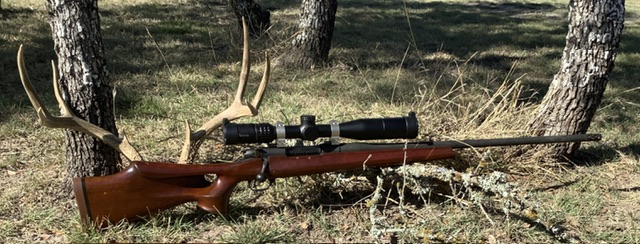

This old Weatherby story starts with a gifted .257 Weatherby Magnum and ends with a hard-hitting custom .300 Win. Mag. that still shoots sub-MOA and carries decades of hunting memories. It is part rifle review, part field journal, and all old-school cool with a little extra thunder.
Old School Cool – Part 1
Old School Cool – Part 2
Old School Cool – Part 3
Old School Cool – Part 4
Table of Contents
🛒 Check Current Price for Weatherby Mark V on GunsAmerica
In 1982, I went into the US Air Force. When I came out of basic training, an old family friend of my father gifted me a Weatherby Mark V, in 257 Weatherby Magnum, 1976 vintage. He had acquired it from someone years prior as partial payment for work that he had done. It had a shortened stock, much too short for me, but a fabricated 1.5” spacer made it work for a few years. I regret never getting a picture of that original gun, as it was quite a sight.
The Original Old School Weatherby Mark V That Started It All
The beautiful Weatherby mesquite wood stock with Rosewood forend tip, and that 1.5” plexiglass spacer between the recoil pad and butt made an ugly rifle. It wore a Redfield 6x wide field scope. I picked up a box of factory ammo; $20.00 a box was expensive back then. When I went to the range, I discovered the rifle would sometimes not fire. This was aggravating for those moments when you ”need” the gun to work as it is supposed to. One day, while perusing some old gun periodicals, I found an exploded drawing of a Weatherby bolt, and I took it apart. It turned out someone had not pre-tensioned the firing pin spring inside the bolt. Turning the cocking piece a few turns and tensioning the spring before reassembling the bolt solved the misfire issue.
The rifle made a few hunts, but I still only had the original 20 cases, so a set of RCBS dies was purchased, and I would reload those 20 over and over again. One day, I walked into a gunsmith’s shop and found a thumbhole stock of unknown wood type, but showing some fiddleback. I asked the shop owner if it could be made to fit a Weatherby, and his reply was affirmative. A deal to restock my gun was made, as well as change the caliber to something less similar to my 25-06. The Weatherby would become my first custom rifle, and a 300 win.mag.
A Custom Weatherby Mark V Is Born in .300 Win. Mag.
A Douglas #5 air gauged supreme barrel, 26” long. Back then, that was unobtainable in any factory gun. Also, a KDF brake was added, making recoil feel like a 243win. The entire steel surface was black parkerized, making for a tough, weather-resistant finish. What I had built was the predecessor of what is today a commonly found rifle, a Beanfield or Sendero rifle. The accuracy provided was MOA to 550 yards, and velocity “seemed” to be very close to what the reloading manuals claimed. I say “seemed” because access to a chronograph was nowhere near as commonplace as it is today. Comparing trajectory impacts at every 50 yards out to 550 yards, by way of a silhouette range, provided my estimate of velocity.
The load I eventually settled on was a 165gr. Nosler partition and H4831 powder. The original load has been confirmed to be moving along at 3180fps. The rifle was built in a time when laser range finders for the general public were nonexistent. So we compensated for miscalculations in range judgement with fast bullets and flat trajectories. The rifle is not one you would want to carry up and down mountains or make long treks cross country. I began to refer to it as my Anti-stalking rifle. It is a pleasure to shoot from an overlook, field edge, or South Texas tower blind. The combination of the stock configuration, barrel length, and weight all conspired to limit its general-purpose hunting use.
Texas Mule Deer Hunt No. 1: A Foggy Last-Day Win
My most memorable Weatherby hunts were for West Texas mule deer. The ridgelines and canyon rims are where the rifle shines, and the Texas desert is a perfect habitat. When the last day of my first Texas mule deer hunt arrived, I’d not seen anything beyond small fork-horned bucks. The last day was a drizzly, slightly foggy day. Not ideal for sitting on a ridge line with a wood-stocked rifle. So I carried the rifle cradled in my arms under my poncho. The weather conditions made it easy to sneak up on deer, with the damp ground and fog. As I walked by a power line, a group of does stood up and lingered. Amongst them was a buck, his antlers were as wide as his ears, a good last-day buck. The buck was 75-80 yards away, so I shouldered the rifle and acquired him in the scope.
I wasn’t sure how long he would stand there. He was behind a small bush. I could make out the top of his vital area. I could hold on him easily enough, so I placed the crosshairs right at the top of the brush. When I pulled the trigger, the recoil and the slowly drifting fog obscured what happened to the buck. I didn’t see him run off, but given the fog, it would have been easy not to see anything.
I walked to where the buck had been standing, and he was there, dead. It was ironic, I’d traveled all that way and carried the big rifle, for a shot I could have made with an iron-sighted 30-30. The buck would be the largest taken on the ranch that season. My next Muley would be the following year, on the same ranch, taken within a quarter mile of my first.
Texas Mule Deer Hunt No. 2: When the Weatherby Earned Its Keep
My second Texas mule deer, the following year, was more suited to the rifle’s purpose. I again hadn’t seen anything worthy of shooting and was on the last day of my hunt. Sitting below the crest of a hill, overlooking a small waterhole and valley. I watched the dawn approach as I sat on a big flat rock. Below me was a wide-open little valley with a 15×30 foot waterhole. My Bronco was parked below the crest of the hill on the other side of where I sat. Coyotes, turkeys, and cottontails were scurrying across the valley floor when I heard a rock scuff another rock. I glanced to my right, and walking down a finger of hillside was a nice mule deer buck. I only had his profile to see, but I could tell he was a nice 4×4. He was about 150 to 180 yards away.
Swinging around to get settled in, I grabbed the rifle and solidified my position. He now turned, and I only had his butt to shoot at, as he walked away from me. Placing the crosshairs on the base of his tail, I pulled the trigger. At the shot, he turned slightly and started walking more quartering from me. I racked another round into the gun and placed the crosshairs on his shoulder and fired. He went down and rolled up against a small agave. When I walked up, I noticed a shaved groove in the hair on his butt. Apparently, my first round impacted higher than I expected and simply shaved hair like a razor, never breaking the skin. Luckily, my second shot was quick and true, and I had another fine trophy. I have the 165gr. Partition, expanded just like it should, and a memento of a good memory.
A New Beginning for the Old School Weatherby Workhorse
The Weatherby has since been used for South Texas whitetails, feral hogs, and coyotes. It has been a culling rifle with a premium European optic designed for nighttime shooting. It has taken full moon pigs before the advent of affordable night vision. Sadly, I cannot recall the last time I had the rifle out, much less its last blooding. It has been a safe queen since the early 90’s, and without an optic mounted. Technology has altered my medium game guns. Easily available mono-metal bullets, laser range finders, and accuracy-enhancing benefits have all eliminated the need for big guns and fast bullets. I like my bigger guns, but they are now used on bigger game.
I recently took a nice Burris Veracity 2-10x and mounted it up. Taking advantage of our newer modern powders and the long-throated, long-action. I tried MagPro powder, the same powder I use in my old school 300 win mag competition long-range gun. It has allowed me to gain another 100 or so fps from my original load using H4831. So now I am able to send 165gr. Nosler Partitions at 3300+ fps. Accuracy is still sub-MOA, and everything looks promising for continued occasional use. It may just barely meet the old school cool requirements, but it does it with pizzazz. The Weatherby, while a specialized rifle that fills a very specific niche, will be seeing more game time in the near future.
Custom Weatherby Mark V Specifications
| Rifle | Weatherby Mark V |
|---|---|
| Original Chambering | 257 Weatherby Magnum |
| Custom Chambering | 300 win.mag. |
| Vintage | 1976 |
| Barrel | Douglas #5 air gauged supreme barrel |
| Barrel Length | 26” |
| Muzzle Device | KDF brake |
| Finish | Black parkerized |
| Primary Load | 165gr. Nosler partition and H4831 powder |
| Confirmed Velocity | 3180fps |
| Current Velocity | 3300+ fps |
| Optic | Burris Veracity 2-10x |
| Accuracy | MOA to 550 yards, sub-MOA with current setup |
Pros & Cons of This Custom Weatherby Mark V
- Pros: Flat-shooting performance, proven sub-MOA accuracy, excellent recoil reduction with the KDF brake, strong hunting history, and plenty of old-school character.
- Cons: Heavy and specialized, not ideal for mountain carry or long cross-country treks, and built more for overlooks, field edges, and tower blinds than all-around hunting use.
Related Reads from GunsAmerica Digest
Read the full article here
