



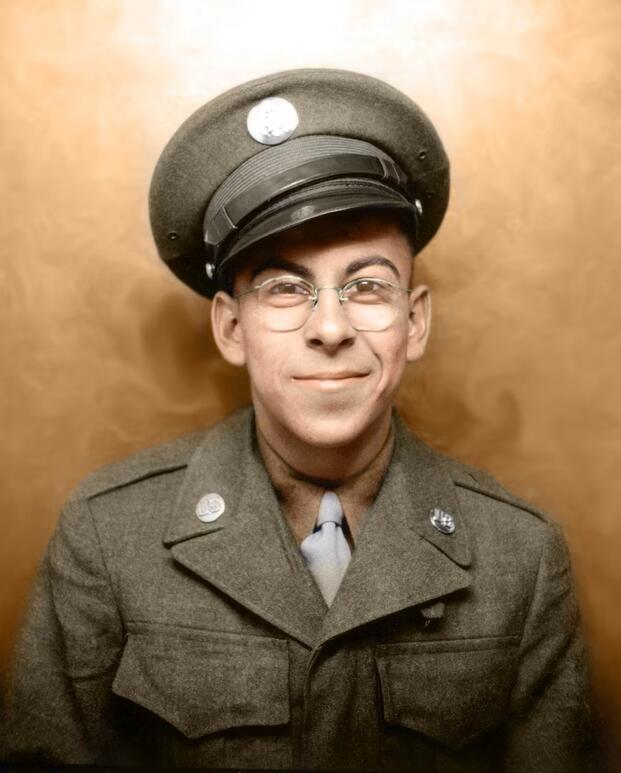

There is closure for the family of a young Korean War soldier who went missing in action some 75 years ago. The remains of U.S. Army Sgt. Celestino Chavez, just 19 years old at the time, was returned to his family and buried with full military honors in his hometown of Gallup, New Mexico, on Wednesday, April 15, 2026.
“Chavez’s family recently received their full briefing on his identification,” read a statement from the U.S Defense POW/MIA Accounting Agency (DPMAA), and obtained by Military.com. “Therefore, additional details on his identification can be shared.”
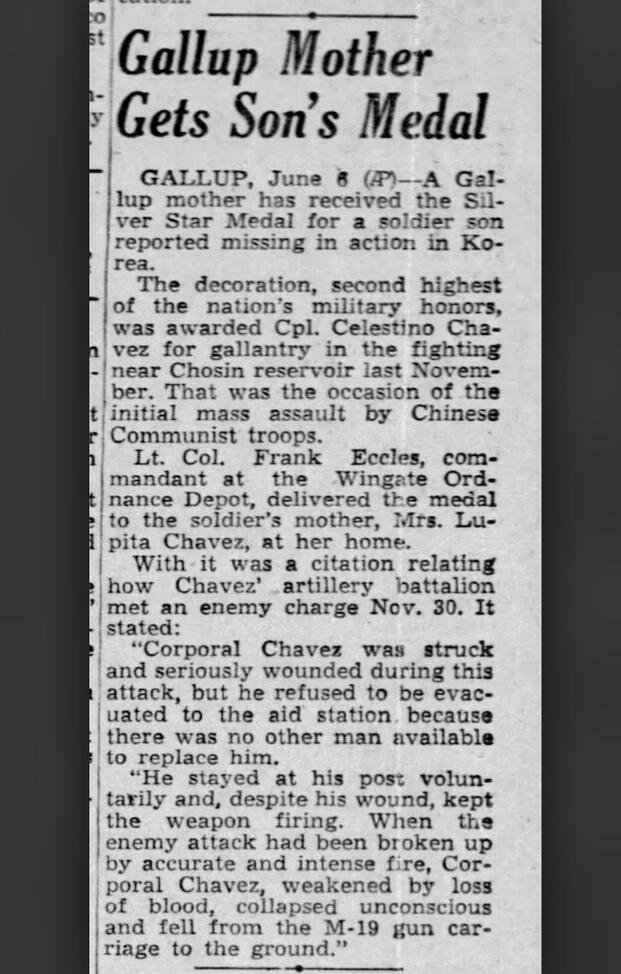
The story of Chavez’s loss dates back to 1950. Newspaper clippings shared by the DPMAA and released to Military.com, quotes the 19-year-old’s mother, Lupita Chavez, as saying she last heard from her son on November 27, 1950, when she received a letter in which he told her: “If anything happens to me, please mother, no tears.”
Assigned to the 15th Anti-Aircraft Artillery, Automatic Weapons Battalion, 7th Infantry Division, the statement from the DPMAA says Chavez was wounded while defending his position in the Democratic People’s Republic of Korea. He was evacuated to an aid station on November 30, 1950, and reported missing in action on December 2, after his convoy was ambushed by opposing forces.

“The U.S. Army did not receive any indication that he was ever held as a prisoner of war and with no evidence of his continued survival, issued a presumptive finding of death on December 31, 1953,” read the statement. “He was posthumously awarded the Silver Star for continuing to man his position despite his wounds during the November 30 attack.”
Remains Among Dozens Given to U.S. in 2018
In July 2018, following a summit between President Donald Trump and North Korean Supreme Leader Kim Jong-un, North Korea turned over 55 boxes containing the remains of American service members killed during the Korean War.
DPAA scientists used a combination of anthropology, as well as circumstantial and material evidence, to identify Chavez’s remains. Additionally, scientists from the Armed
On a Facebook page reviewed by Military.com, Chavez’s surviving nephew Ben Baca, offered additional details of his uncle’s fate in the war during heavy fighting.
“Roadblocks and constant enemy fire made the withdrawal extremely dangerous,” Baca wrote on Facebook. “Chavez was manning his gun vehicle and engaging the enemy when he was killed in action. The following morning, his body was placed at a first aid station, but during the withdrawal on December 1, his remains had to be left behind and were not recovered.”
Chavez was positively identified in April of 2025. One year later, on April 15, 2026, he was buried in Gallup, NM.
“Celestino Chavez is my mother’s little brother,” wrote Baca in his Facebook post. “He is home now, after 76 years MIA.”
Federal Agency Tracks POW/MIA Soldiers
The Defense POW/MIA Accounting Agency prides itself on “fulfilling our nation’s promise” to never leave a soldier behind.
“A world-class workforce fulfills our nation’s obligation by maximizing the number of missing personnel accounted for while ensuring timely, accurate information is provided to their families,” reads the agency’s mission statement, shared with Military.com. “We provide the fullest possible accounting for our missing personnel to their families and the nation.”
According to the DPMAA, Chavez is memorialized on the Courts of the Missing at the National Memorial Cemetery of the Pacific. His name is also inscribed on the Korean War Veterans Memorial Wall in Washington, D.C., which was updated in 2022 to include the names of the fallen.
Since 1982, the remains of more than 450 Americans killed in the Korean War have been identified and returned to their families for burial with full military honors. That’s in addition to the roughly 2,000 Americans whose remains were identified in the years following the end of hostilities, when the North Korean government returned over 3,000 sets of remains to U.S. custody.
Read the full article here
