




MOA gets tossed around constantly, but a lot of shooters still treat it like voodoo. This guide breaks down minute of angle, scope clicks, reticles, and real-world rifle accuracy in plain English so the math finally stops feeling slippery.
This article is an updated version of a piece originally written by the author and published on WesternShooter. It has been revised and expanded for GunsAmerica. The author is also working on a companion piece covering Mils, so stay tuned.
MOA Starts Here: Angles, Degrees, and Why Tiny Errors Matter
Before we talk about Minutes of Angle, let’s back up even further to basic geometry. Don’t worry, this won’t take long.
Imagine standing in the middle of a field and turning all the way around in a complete circle. That full rotation is divided into 360 degrees. You’ve probably seen degrees used to describe turns or compass headings, but in geometry, a degree is simply a unit for measuring how wide an angle is.
One degree is actually a pretty large unit when you’re talking about aiming a rifle. A one-degree error at 100 yards would put your shot roughly 5 feet off target, so shooters needed a much smaller unit.
That’s where minutes come in. Just like an hour is divided into 60 minutes of time, each degree is divided into 60 minutes of angle. So a full circle contains 360 degrees multiplied by 60 minutes, which equals 21,600 Minutes of Angle in total.
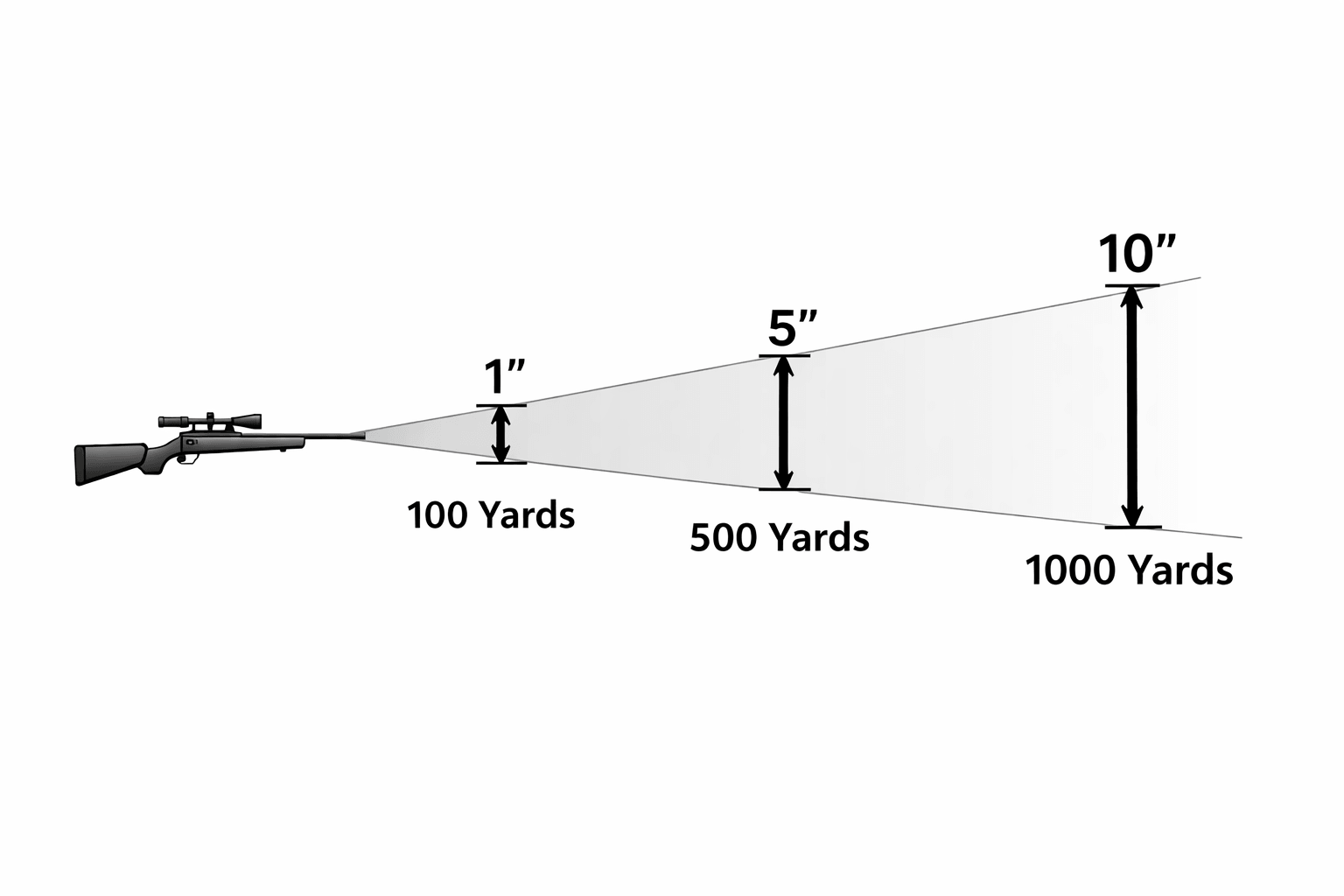
One Minute of Angle is therefore an extremely small slice of a circle, but it has a very useful property: at 100 yards, 1 MOA works out to almost exactly 1 inch. That happy coincidence is what makes MOA so practical for shooters. The further your target, the bigger that slice gets. Two inches at 200 yards, 3 inches at 300 yards, and so on. With that foundation, the rest of this article will make a lot more sense.
Already Know the Basics? Jump Into the Minute of Angle Quiz
You should understand that an English inch and a Minute of Angle (MOA) are not the same thing. They are units of measurement that happen to be extremely close in value. However, they are close enough together that for the rest of this explanation, please simply round down to an inch.
Exact Minute of Angle (MOA):
1 MOA = 1.0471996 inches @ 100 yards
1 MOA = 5.24 inches @ 500 yards
1 MOA = 10.47 inches @ 1000 yards
Rounding MOA: The Simple Version Most Shooters Actually Use
| Distance | 1 MOA (exact) | 1 MOA (rounded) | 2 MOA | 3 MOA |
|---|---|---|---|---|
| 100 yards | 1.047″ | 1″ | 2″ | 3″ |
| 200 yards | 2.094″ | 2″ | 4″ | 6″ |
| 300 yards | 3.141″ | 3″ | 6″ | 9″ |
| 400 yards | 4.188″ | 4″ | 8″ | 12″ |
| 500 yards | 5.236″ | 5″ | 10″ | 15″ |
| 600 yards | 6.283″ | 6″ | 12″ | 18″ |
| 700 yards | 7.330″ | 7″ | 14″ | 21″ |
| 800 yards | 8.377″ | 8″ | 16″ | 24″ |
| 900 yards | 9.425″ | 9″ | 18″ | 27″ |
| 1000 yards | 10.472″ | 10″ | 20″ | 30″ |
How Minute of Angle Applies to Group Size, Precision, and Bullet Drop
MOA is used to measure group sizes. A 1-inch group at 100 yards is referred to as a 1 MOA group. A 2-inch group at 100 yards is a 2 MOA group.
At 100 yards, it seems simple enough to understand. However, it can get confusing if you’re not used to the terminology when you move beyond 100 yards. For example, a 3-inch group shot at 300 yards is also a 1 MOA group. A 6-inch group shot at 300 yards is a 2 MOA group. A 1 1/2 inch group shot at 300 yards is a .5 MOA group.
Another way to look at it is like this:
1/2 MOA @ 700 yards is 3.5 inches
1 MOA @ 700 yards is 7 inches
2 MOA @ 700 yards is 14 inches
3 MOA @ 700 yards is 21 inches
And working it the other direction:
3.5 inches @ 700 yards is 1/2 MOA
7 inches @ 700 yards is 1 MOA
14 inches @ 700 yards is 2 MOA
21 inches @ 700 yards is 3 MOA
MOA Calculations That Make the Whole Thing Click
How many inches equal 4 MOA at 700 yards?
(MOA x yards) / 100 = inches
(4 MOA x 700 yards) / 100 = 28 inches
How many MOA equal 21 inches at 700 yards?
(inches/yards) x 100 = MOA
(21 inches / 700 yards) x 100 = 3 MOA
5 inches = 1 MOA — how many yards away is the target?
(inches x MOA) x 100 = yards
(5 inches x 1 MOA) x 100 = 500 yards
You can drop the last step and make the calculations easier by moving the decimal on the yards two places to the left.
How many inches equal 4 MOA at 700 yards?
(4 MOA x 7.00) = 28 inches
How many MOA equal 21 inches at 700 yards?
(21 inches / 7.00) = 3 MOA
MOA Scope Adjustments Explained Without the Usual Confusion
Most hunting and target scopes adjust in Minutes of Angle (MOA). The most common adjustment is 1/4 MOA, or 0.25 MOA, per click. Although not as common, some scopes adjust in 1/8, 1/6, 1/5, 1/3, 1/2, and 1 MOA.
1/4 MOA at 100 yards literally means that each time the scope turret is clicked, the bullet impact will move 1/4 or .25 inches.
To move the bullet impact 1 inch, you would need 4 clicks (.25 x 4 = 1).
Example: When sighting in a rifle, the bullet needs to move up 5 inches to hit the center of the target. 5 in / .25 in = 20 clicks. Or you could think of it like this: need to move 5 inches, 4 clicks per inch, 5 in x 4 clicks per inch = 20 clicks.
Another application for understanding MOA and scope or sight adjustment is when shooting longer distances. The rifle is sighted in at 100 yards. Your ballistic program tells you that you need to come up 20 MOA to shoot at 600 yards. 20 MOA / .25 = 80 clicks. Or: 20 MOA x 4 clicks per MOA = 80 clicks.
Scope Clicks Reference: 1/4 MOA Per Click
| Desired correction | Clicks required | Inches moved @ 100 yds | Inches moved @ 500 yds | Inches moved @ 1000 yds |
|---|---|---|---|---|
| 1 MOA | 4 clicks | 1″ | 5″ | 10″ |
| 5 MOA | 20 clicks | 5″ | 25″ | 50″ |
| 10 MOA | 40 clicks | 10″ | 50″ | 100″ |
| 20 MOA | 80 clicks | 20″ | 100″ | 200″ |
| 28 MOA | 112 clicks | 28″ | 140″ | 280″ |
Clicks are always the same regardless of distance. MOA is an angular unit, so 4 clicks always move 1 MOA. What changes is how many inches MOA represents at each distance.
MOA Reticles Explained: Read Your Scope Like a Built-In Ruler
Most shooters are familiar with adjusting their scope turrets in MOA clicks, but many modern scopes take things a step further by building MOA measurements directly into the reticle itself. These are commonly called MOA reticles or MOA-based reticles, and once you understand how they work, they become one of the most powerful tools in a long-range shooter’s kit.
In a MOA reticle, the crosshair is marked with small hash marks, dots, or lines at precise MOA intervals, typically every 1 or 2 MOA. Because you already know that 1 MOA equals roughly 1 inch at 100 yards and scales proportionally from there, those marks give you an instant ruler built right into your optic.
Here’s where it gets practical. Say you’re shooting at 500 yards and your first shot lands 2 MOA low. You can see exactly where the bullet hit relative to your hash marks without doing any math in your head. Each mark represents 5 inches at that distance (1 MOA x 5.00 = 5 inches), so 2 MOA low means your shot hit 10 inches below your point of aim. You can either dial your turrets 2 MOA up, or if you’re shooting quickly, you can simply hold over by 2 MOA using the reticle marks themselves without touching the turrets at all. This technique is called holdover, and it is extremely common in competition and hunting situations where dialing between shots is too slow.
MOA reticles also let you estimate the size of a target and use that to confirm or calculate your distance. If you know a deer’s chest cavity is approximately 18 inches deep and it spans 3 MOA marks in your reticle, you can work backwards. At 600 yards, 1 MOA equals 6 inches, so 3 MOA would be 18 inches. That match tells you your range estimate is on. This kind of ranging is less precise than a laser rangefinder, but it is a genuine field skill that experienced hunters and long-range shooters use regularly.
One important thing to understand is that some scopes have a reticle in the first focal plane (FFP) and others have it in the second focal plane (SFP). In a first focal plane scope, the reticle grows and shrinks as you change magnification, which means the MOA measurements on the reticle remain accurate at any power setting. In a second focal plane scope, the reticle stays the same apparent size regardless of magnification, which means the MOA hash marks are only accurate at one specific magnification level, usually the highest. This is a critical distinction. If you are using an SFP scope and trying to use your reticle marks for holdover or ranging, make sure you know what power your marks are calibrated for, or your calculations will be off.
For most shooters getting started with MOA reticles, the practical takeaway is straightforward: those marks in your scope are not just decoration. They are a measurement system that works on the same math you have been learning in this article. Once that clicks, your optic transforms from a simple aiming device into a genuine ballistic tool.
Test Yourself: The Minute of Angle Quiz
Below are some quiz questions that will help you think and talk in Minutes of Angle. Answers are at the bottom of the page.
Question 1. If you’re sighting in your rifle at 200 yards and your groups hit the target 6 inches low, how many 1/4 MOA clicks do you need to turn your scope turret to hit the center of the target?
Question 2. How many inches equal a minute of angle at 625 yards?
- A. 1
- B. 3.75
- C. 5.5
- D. 6.25
Question 3. If I brag about my shooting and tell you I shot a 1/2 MOA group at 300 yards, what size group did I shoot?
- A. 1/2 inch
- B. 1 1/2 inch
- C. 3 inch
- D. 1 inch
Question 4. If I can consistently get my rifle to shoot under 2 MOA, in theory, what is the smallest size steel plate I should be able to always hit at 700 yards?
- A. 10 inches
- B. 15 inches
- C. 18 inches
- D. 24 inches
Question 5. My group size is 4 inches, and my rifle shot 1 MOA. How far away is my target?
- A. 40 yards
- B. 400 yards
- C. 444 yards
- D. 800 yards
Question 6. Many gun writers maintain that a gun that will shoot 2 Minutes of Angle is adequate to hunt with. What is the maximum distance such a gun will consistently shoot 10-inch groups?
- A. 250 yards
- B. 750 yards
- C. 500 yards
- D. 100 yards
Question 7. In standard Mil-Dot Reticles, from the center of one mil-dot to the center of the next mil-dot is 3.6 MOA at 100 yards. If you are sighting in your rifle at 100 yards and your groups are approximately the space between two mil-dots above the center, how many 1/4 MOA clicks do you need to turn your turret down to center your group?
- A. 14 clicks
- B. 3.6 clicks
- C. 10 clicks
- D. 24 clicks
Question 8. If you shoot a .25-inch group at 25 yards, what MOA did you shoot?
- A. .25 MOA
- B. .5 MOA
- C. .75 MOA
- D. 1 MOA
Question 9. If your buddy tells you he can shoot 1 MOA at 1760 yards or 1 mile, approximately how big is his group?
- A. 100 inches
- B. 17.6 inches
- C. 20 inches
- D. 176 inches
Question 10. In 1000-yard F-Class matches, the X ring is 5 inches. If you were to place all your shots in the X ring, what MOA would you have shot?
- A. 1 MOA
- B. 10 MOA
- C. .5 MOA
- D. 5 MOA
Question 11. You’re going to shoot your rifle at 1000 yards. Your rifle is sighted dead on at 100 yards. The ballistics program says you need to dial in 28 MOA to reach 1000 yards. How many 1/4 MOA clicks do you need to turn your scope turret?
- A. 28 clicks
- B. 280 clicks
- C. 112 clicks
- D. 64 clicks
Question 12. You and a buddy are out shooting balloons in the desert at 600 yards. The wind is blowing, and your buddy is spotting your shots. After your last shot, he tells you that your elevation was dead on, but your wind was off 2 MOA to the left. How many inches off to the left was your shot, and how many 1/4 MOA clicks to the right will it take to correct?
- A. 6 inches, 8 clicks
- B. 12 inches, 8 clicks
- C. 12 inches, 16 clicks
- D. 24 inches, 24 clicks
Question 13. Assume a 100-yard zero. If you have to adjust your scope up 28 MOA to shoot 1000 yards, how many feet is your bullet dropping?
- A. 28
- B. 10
- C. 55.7
- D. 23.3
Question 14. In theory, if you can shoot a 1-inch group at 100 yards, what size group should you be able to shoot at 400 yards?
Minute of Angle Quiz Answers
Answer 1 — B. (6 in / 2.00 yards) = 3 MOA, then 3 MOA x 4 clicks per MOA = 12 clicks
Answer 2 — D. (1 MOA x 6.25 yards) = 6.25 inches
Answer 3 — B. (.5 MOA x 3.00 yards) = 1.5 inch group
Answer 4 — B. 2 MOA = 14 inches @ 700 yards
Answer 5 — B. (4 inches x 1 MOA) x 100 = 400 yards
Answer 6 — C.
Answer 7 — A.
Answer 8 — D.
Answer 9 — B.
Answer 10 — C.
Answer 11 — C.
Answer 12 — B.
Answer 13 — D. (28 MOA x 10.00) = 280 inches, then 280 in / 12 in = 23.3 feet
Answer 14 — A.
Read the full article here
