



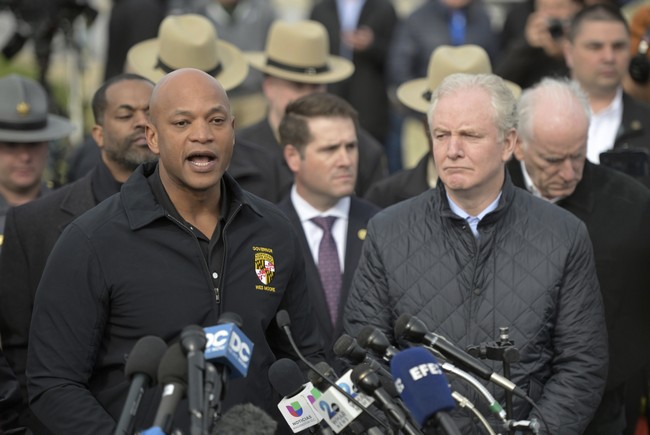

Maryland Gov. Wes Moore is cheering the Fourth Circuit Court of Appeals decision on Tuesday that upheld the vast majority of the “gun-free zones” put in place after the Supreme Court ruled that “may issue” carry permitting regimes violate the Second Amendment.
Maryland was one of several “may issue” states that responded to the ruling by making it impossible for those with permits to carry to legally do so in most publicly accessible places. Before Bruen, Maryland didn’t have nearly as many “gun-free zones,” but after losing the ability to block average citizens from getting a concealed carry permit, Democrats responded by blocking those with permits from carrying in a variety of places, including all government buildings, public transit, and even state parks.
𝗠𝗔𝗝𝗢𝗥 𝗪𝗜𝗡 𝗙𝗢𝗥 𝗣𝗨𝗕𝗟𝗜𝗖 𝗦𝗔𝗙𝗘𝗧𝗬
My statement after the Fourth Circuit upheld Maryland’s 2023 law banning concealed carry from sensitive locations like government buildings, schools, and health care facilities: pic.twitter.com/BxohjhpBZH
— Governor Wes Moore (@GovWesMoore) January 21, 2026
Moore says that the state will “respect the rights of responsible gun owners” even as he cheers on the decision that criminalizes bearing arms in scores of publicly accessible places. By itself that’s a laughable statement, but when you add in other gun laws like the bans on so-called assault weapons and large capacity magazines, the permit-to-purchase a handgun, and 7-day waiting period for handguns, Moore’s comment becomes utterly absurd and unmoored from reality.
If Moore honestly wanted to respect Marylanders’ Second Amendment rights he would have vetoed the Bruen response bill that was approved by the Democrat-controlled legislature, and he definitely wouldn’t be cheering on a court decision that upheld virtually every one of the “gun-free zones” adopted by lawmakers during their legislative hissy fit.
As Judge G. Steven Agee wrote in his well-reasoned dissent to the majority opinion (or at least most of it):
At bottom, the Supreme Court has made clear that the historical analogues from which courts discern the principles on which the how and why of firearms regulations are compared originate in the Founding Era, not later. The district court’s decision and the majority opinion grossly misread Bruen to treat Reconstruction-era and later firearms regulations as relevant historical analogues to assess whether the modern challenged laws are constitutional.
More troubling still, for many of the challenged Maryland provisions, a smattering of mid-to-late 19th century and later laws serve as the only historical analogues on which the majority opinion pins its analysis. That diversion only further attenuates its conclusions from Bruen’s mandate to understand the Second Amendment’s scope based on its widespread meaning at the Founding.
Agee (along with the majority) gives too much deference to the Supreme Court’s broad statement in Heller that “nothing in our opinion should be taken to cast doubt on longstanding prohibitions on the possession of firearms by felons and the mentally ill, or laws forbidding the carrying of firearms in sensitive places such as schools and government buildings,” given that the Bruen decision specifically referenced “legislative assemblies” and “courthouses” as places that are presumptively sensitive enough where guns can be banned. That suggests that not all goverment buildings can be off-limits to lawful carry, particularly if there is no historical tradition of those prohibitions.
But Agee is correct in noting that the majority opinion upheld the majority of Maryland’s “gun-free zones” by claiming that a handful of laws adopted long after the ratification of the Second Amendment suffice to demonstrate a “national tradition”, even when those statutes did not directly implicate the places deemed “sensitive” by Maryland lawmakers.
Why, for instance, should an 18th century law prohibiting selling alcoholic beverages to a militia member who’s on duty be analogous to a ban on lawful carrying in any place where alcohol is served? Couldn’t those 18th century lawmakers have imposed a ban on guns in taverns if that was their intent? A modern analogue might prohibit consuming alcohol in a public establishment while lawfully carrying, but a blanket prohibition on carrying where alcohol is available for sale doesn’t suffice.
Moore is cheering now, but Maryland gun owners may get the last laugh. Depending on what SCOTUS says in Wolford v. Lopez about the level of generality for historical analogues, the Fourth Circuit’s decision could very well be vacated by the Supreme Court and remanded back down to the lower courts for a do-over; this time taking a real look at the national tradition of gun ownership instead of looking for any possible reason to uphold the state’s restrictive gun laws that make bearing arms a criminal offense in many publicly accessible places.
Editor’s Note: President Trump and Republicans across the country are doing everything they can to protect our Second Amendment rights and right to self-defense.
Help us continue to report on their efforts and legislative successes. Join Bearing Arms VIP and use promo code FIGHT to get 60% off your VIP membership.
Read the full article here
