



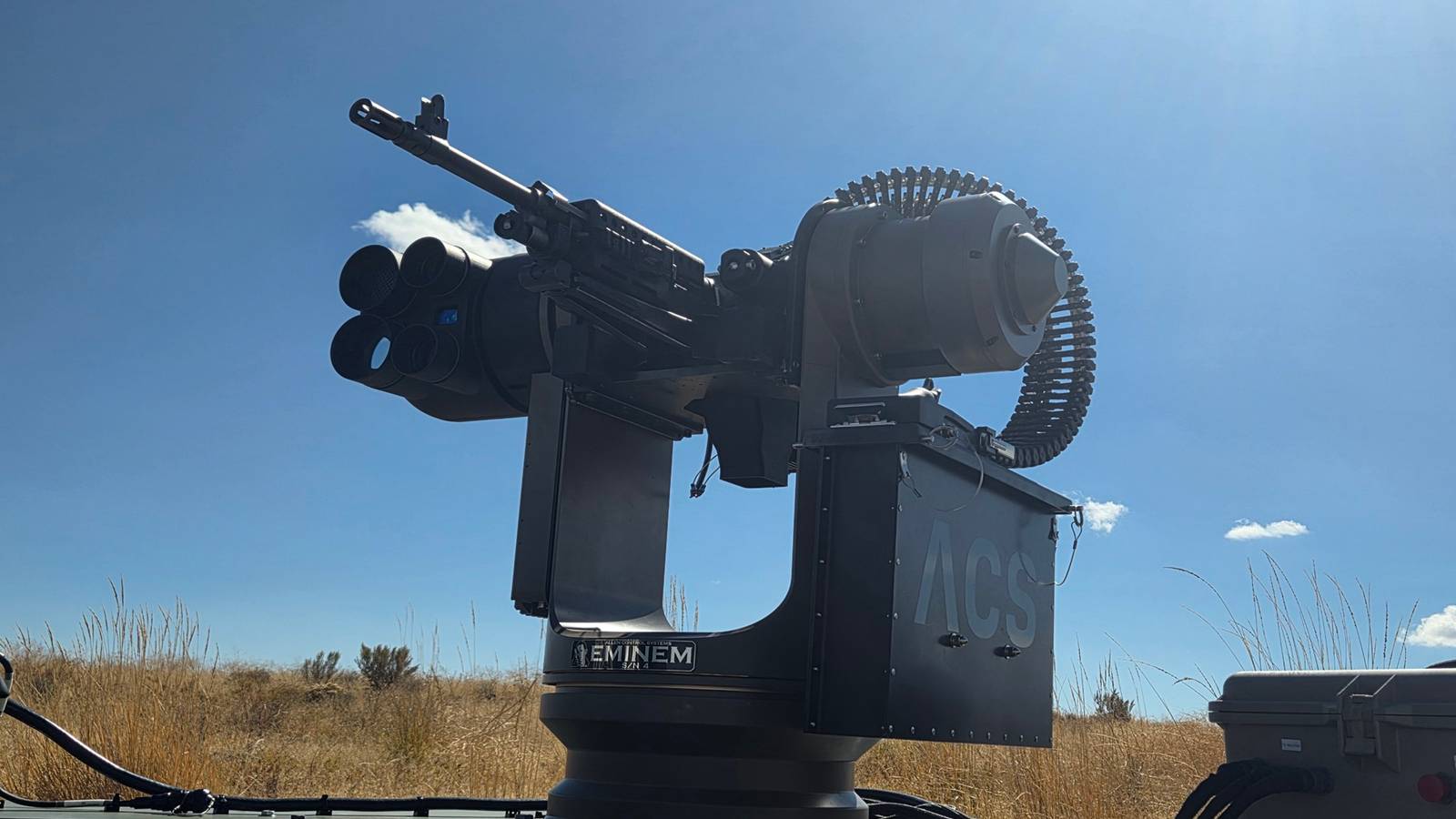

The Marine Corps has selected Allen Control Systems’ Bullfrog autonomous weapon station for integration into its Light Marine Air Defense Integrated System (L-MADIS) under the Ground-Based Air Defense (GBAD) program, according to a company announcement this week.
The move pairs the AI-powered robotic mount with the M240 machine gun already familiar to Marines, giving the service’s most expeditionary counter-drone platform a kinetic option that can detect, track and engage Group 1 through Group 3 unmanned aircraft systems at a fraction of the cost of missile interceptors.
“The Marine Corps requires the most sophisticated and accurate possible capabilities to carry out its critical missions,” said Mike Wior, co-founder and CEO of Allen Control Systems, in a press release provided to Military.com.
We are honored to support Marines with fast, scalable, and cost-effective counter-drone solutions that integrate seamlessly into existing platforms.
How Bullfrog Works
Bullfrog is not a new gun. It is a robotic weapon station that uses artificial intelligence, computer vision and precision robotics to transform legacy or modern firearms into systems capable of autonomous detection, tracking and engagement of aerial threats. The version selected for the Marine Corps is built around the M240 7.62mm machine gun.
According to specs provided to Military.com, the system relies on passive sensing rather than radar, which helps keep the host platform’s signature low. Pointing accuracy is listed at less than one minute of angle.
In the M240 configuration, the cyclic rate is 850 rounds per minute, and the company has repeatedly highlighted a cost per kill measured in the low tens of dollars, driven largely by the price of the ammunition itself.
Regarding autonomy concerns: Operators retain the final authority. The system can handle the detect-track-identify sequence and present firing solutions, but a human authorizes the engagement. That human-in-the-loop design keeps the capability inside existing rules of engagement while removing much of the cognitive load of manually tracking fast, small drones.
Fitting Into L-MADIS and GBAD
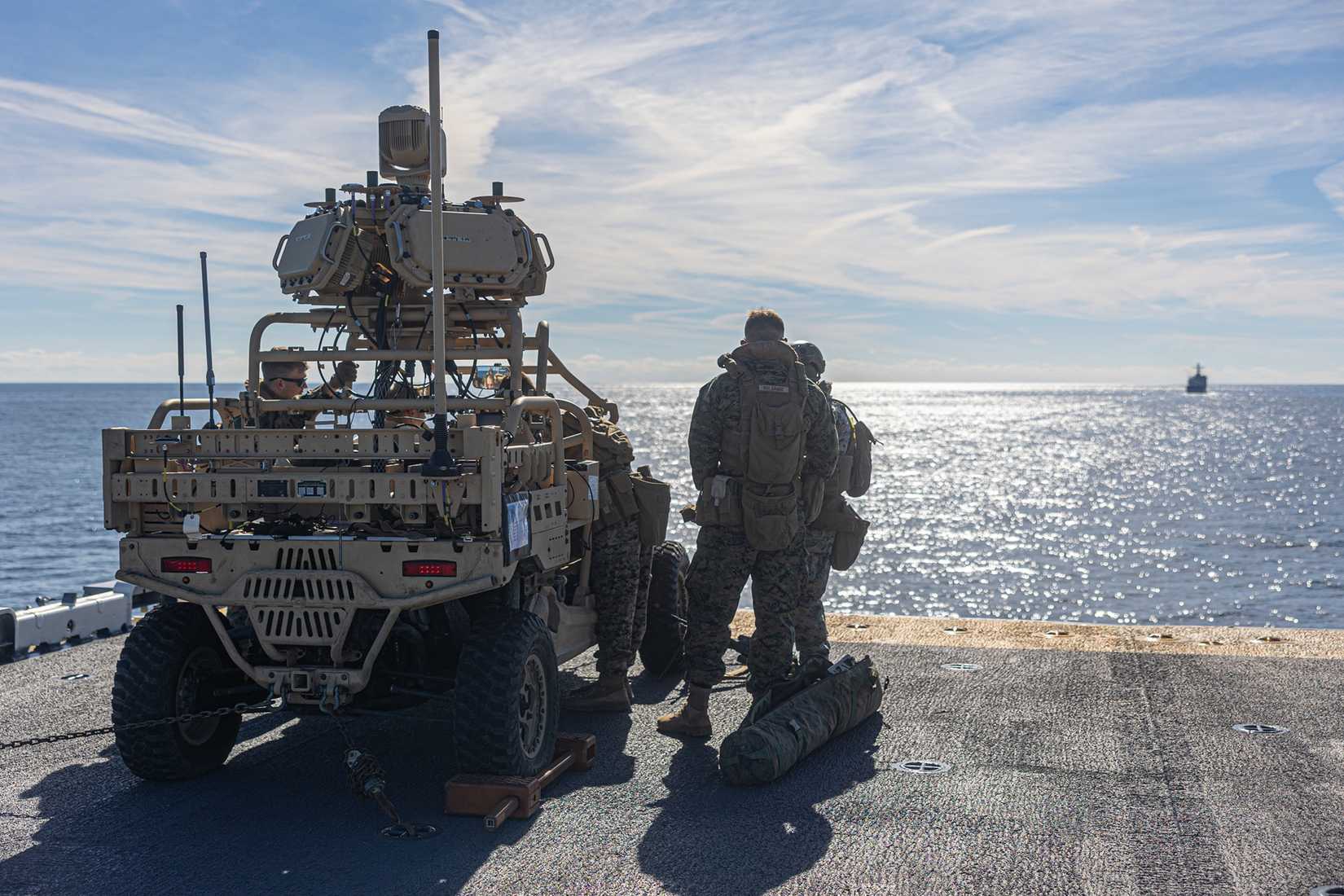
L-MADIS is the Marine Corps’ lightest and most mobile counter-drone system. It typically consists of a pair of Polaris MRZR all-terrain vehicles: one focused on command and control, the other carrying electronic warfare gear to detect and jam hostile drones.
The addition of Bullfrog supplies a kinetic layer that can finish targets when electronic attack is ineffective, especially against autonomous drones that no longer rely on continuous radio links.
The work is proceeding under a prototype Other Transaction Agreement as part of the broader Ground-Based Air Defense portfolio. GBAD is the service’s effort to give Marine formations organic, mobile air defense against drones, cruise missiles and low-flying aircraft.
The larger MADIS family, built around Joint Light Tactical Vehicles (JLTV), already fields Stinger missiles, 30mm cannons, and electronic warfare suites. L-MADIS was designed as the more expeditionary counterpart that can deploy by air and operate with smaller units.
Company materials and Breaking Defense place the initial prototype effort in the low single-digit millions. The Marine Corps has requested more than $1 billion for the overall GBAD effort in the fiscal 2027 budget request, reflecting how seriously the service is taking the drone problem.
Why the Cost Asymmetry Matters
Conflicts in Ukraine and the Middle East have driven home a simple arithmetic problem: low-cost commercial and military drones can force expensive interceptors or high-risk close-range engagements. A single Shahed-style one-way attack drone can cost tens of thousands of dollars or less. Traditional kinetic interceptors often cost hundreds of thousands to millions.
Bullfrog’s pitch is that a well-aimed burst of 7.62mm ammunition can solve the same problem for the price of the rounds. The system is already fielded or under contract with the Army, Navy, U.S. Special Operations Command maritime units, and allied forces including South Korea and the United Arab Emirates. It has also been validated through Joint Interagency Task Force 401 work.
For Marine units that must stay mobile, disperse, and fight under constant aerial observation, a low-signature, low-cost kinetic option that rides on existing machine guns restores freedom of action. It reduces the need to hold still while waiting for higher-echelon air defense or to burn expensive munitions on cheap threats.
What Comes Next
Allen Control Systems, based in Austin, Texas, closed a $200 million Series B round in June that valued the company at roughly $2.2 billion. The capital is intended to expand manufacturing and field more systems.
The company has also pursued co-production arrangements and additional variants that can carry heavier weapons such as the M2 .50-caliber machine gun or the M230 30mm cannon.
For the Marine Corps, the immediate task is integration onto the L-MADIS vehicles and validation under operational conditions. If the prototype phase succeeds, the same architecture could expand across other platforms that already carry M240s or similar weapons.
Junior Marines and veterans who have spent years watching the drone threat evolve will recognize the practical value.
The system does not invent a new logistics chain. It takes a weapon every Marine already knows how to feed and maintain, mounts it on a robotic station that never gets tired of staring at the sky, and lets a human decide when to pull the trigger.
That combination of autonomy, familiarity, and cost control is exactly the kind of capability that keeps a maneuver force moving when the air is full of cheap threats.
Read the full article here
