



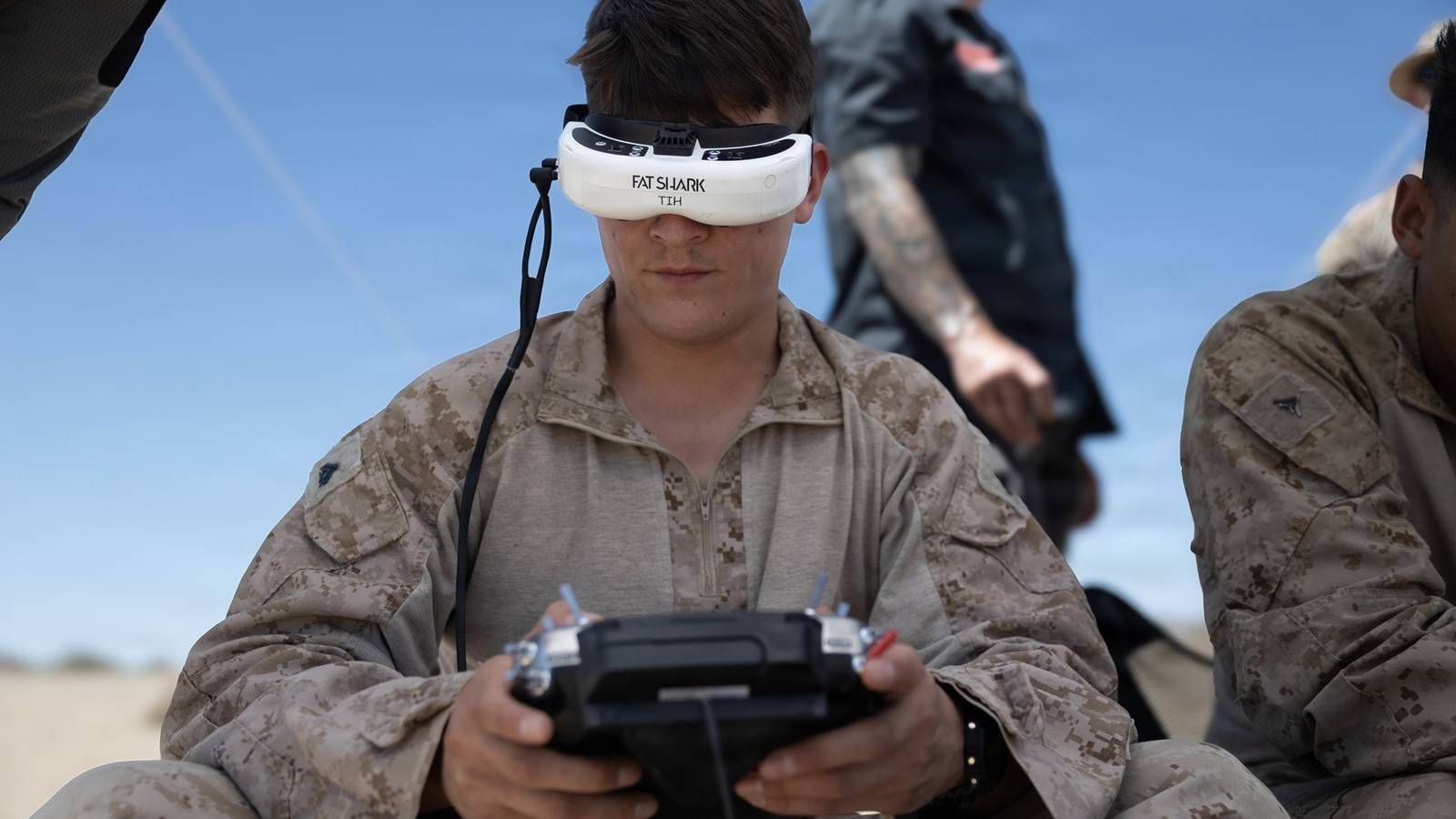

The Marine Corps has established a new service-level organization to standardize training and integration for small unmanned aircraft systems and counter-drone capabilities, marking the latest evolution in its push to dominate the low-altitude fight.
Marine Corps Training and Education Command stood up the Marine Corps Robotics Integration Group (MCRIG) on July 8, 2026, as the focal point for Group 1 and Group 2 small Unmanned Aircraft Systems (sUAS) and counter-small unmanned aircraft systems training across the Total Force.
Assigned to the Marine Air Ground Task Force Training Command (MAGTFTC) at Marine Corps Air Ground Combat Center (MCAGCC) Twentynine Palms, California, the group will develop curriculum, instructor certifications, and enduring training products from validated tactics, techniques, and procedures.
This step institutionalizes capabilities that have moved from experimental to essential in recent years, creating a bridge between rapid tactical innovation and service-wide standards.
Building Directly on the Attack Drone Team
The new group works hand in glove with the Marine Corps Attack Drone Team, which the service established in January 2025 at Quantico under the Weapons Training Battalion to advance first-person view (FPV) drone employment, experimentation, and competitions.
The attack drone team has focused on turning lessons from conflicts like those in Eastern Europe into practical training and requirements for the Fleet Marine Force. It has represented the Corps in events testing hunter-killer tactics and informed rapid fielding of affordable strike drones that extend squad reach dramatically compared to traditional systems costing orders of magnitude more.
MCRIG now provides the mechanism to scale those insights service-wide through standardized programs of instruction delivered via designated regional hubs that execute training across the Fleet Marine Force while feeding operational observations back for continuous refinement.
Adding the Counter-Drone Side
Complementing the attack-focused team, the Marine Corps also stood up a Marine Corps Counter Drone Team (MCCDT) as an organic element of the Weapons Training Battalion at Quantico.
This cell identifies emerging threats, tests solutions, validates tactics for defeating adversary sUAS, and feeds findings to MCRIG for institutionalization. The paired structure allows the service to study both sides of the unmanned flight simultaneously.
Colonel Charles Anklam III, commanding officer of Weapons Training Battalion, emphasized the paired approach. “The Marine Corps Attack Drone Team and the Marine Corps Counter Drone Team are designed to move at the speed of technology. Through the analysis of exercises, operations, and purposely designed events, we gain critical information about how systems should be employed or defeated.” He added:
Our responsibility is to rigorously test ideas, validate capabilities, and rapidly transition those findings to MCRIG, where they become standardized training that benefits every Marine. This partnership allows us to remain agile to the constantly changing threat, innovate quickly, and provide the fleet with consistently reliable, credible, and operationally relevant information to increase lethality and survivability.
Institutionalizing Lessons from a Transformed Battlefield
The establishment reflects hard-won recognition that inexpensive, commercially available unmanned aircraft have fundamentally altered modern combat. Small drones now serve as primary tools for reconnaissance, precision engagement, and force protection, while also posing acute threats that demand robust countermeasures.
In ongoing conflicts, low-cost FPV drones have repeatedly demonstrated the ability to achieve high hit rates against armored vehicles and fortifications at ranges extending several miles, forcing militaries worldwide to rethink force protection and maneuver.
Major General Mark H. Clingan, commanding general of MAGTFTC and MCAGCC, addressed the shift: “The battlefield continues to demonstrate that small unmanned aircraft systems are no longer niche capabilities; they are indispensable tools for reconnaissance, precision strike, force protection and survivability.”
The Marine Corps Robotics Integration Group provides the institutional framework necessary to rapidly integrate validated capabilities into standardized training, ensuring Marines across the Total Force are prepared to employ and defeat these systems in future conflicts.
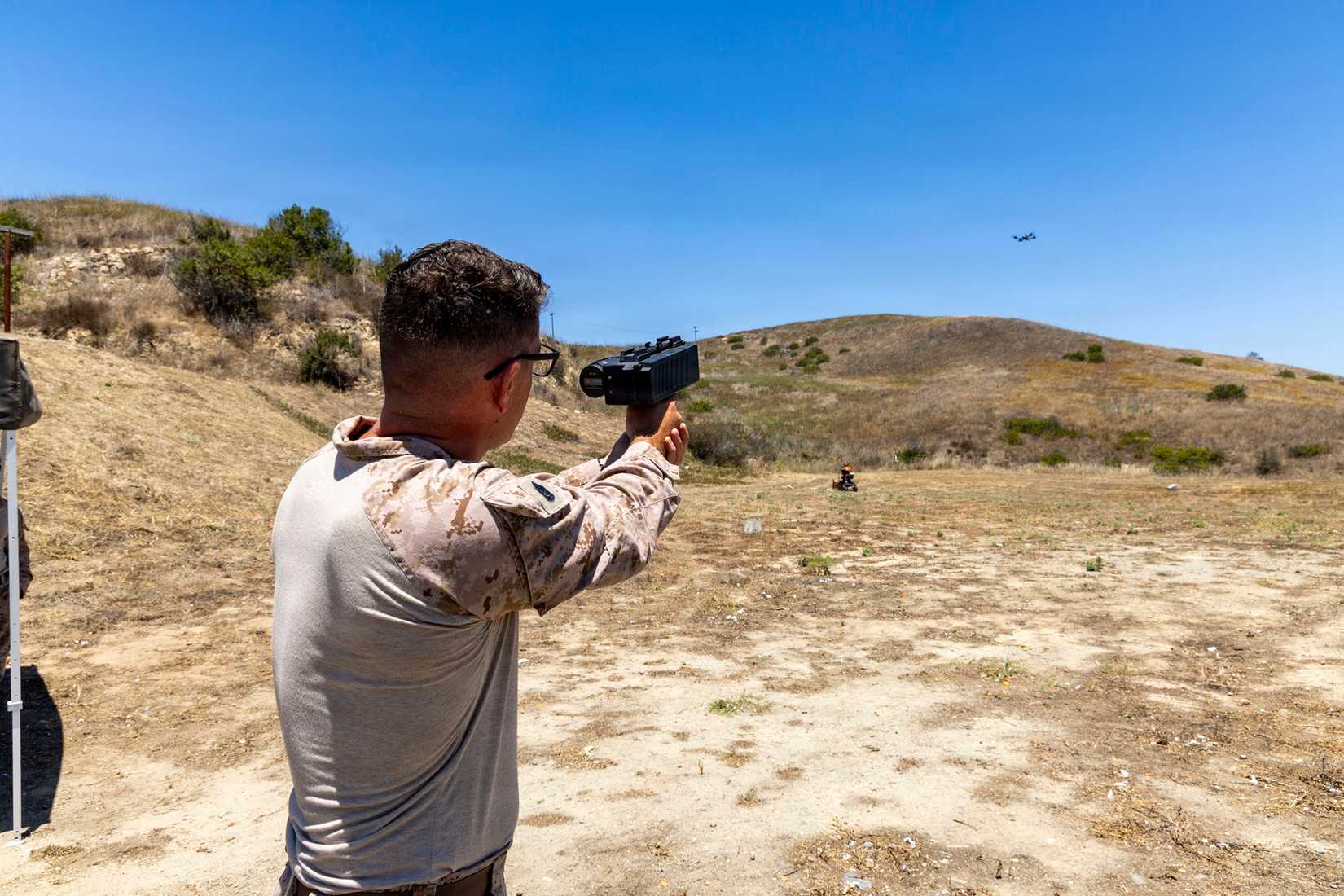
By creating a deliberate pathway from battlefield observation and unit experimentation through validation to service-wide training standards, the Marine Corps aims to outpace adversaries who have already demonstrated mass drone employment.
The goal is not simply to field more drones but to ensure every Marine who might employ or face them operates from a common, current baseline of knowledge.
Alignment with Force Design Efforts
This training infrastructure directly supports the Marine Corps’ Force Design modernization, which has reoriented the service for distributed operations in contested maritime environments. Infantry squads have returned to a 13-Marine structure that includes a dedicated drone operator.
Battalions now feature Fires and Recon companies equipped for unmanned systems and precision fires. Counter-drone systems such as the Marine Air Defense Integrated System (MADIS) and lighter variants continue to be fielded, alongside portable anti-drone kits reaching every unit.
These structural changes pair new weapons, sensors, and unmanned resupply systems to enable small units to persist and strike inside adversary weapon engagement zones.
MCRIG ensures that as new systems like organic precision fires and loitering munitions arrive in volume, and as experiments with helicopter-launched drones or autonomous logistics continue, the resulting knowledge translates into repeatable training rather than remaining the province of specialists or ad hoc unit initiatives.
Recent plans to grow the force by up to 5 percent by 2032 explicitly tie additional manpower to expanding attack drone capabilities and pushing tactics, techniques, and procedures into every infantry battalion and the broader training establishment. The new organization helps close the loop between that growth and actual readiness.
A Disciplined Cycle of Innovation and Standardization
The model deliberately separates rapid tactical development from enduring institutionalization. The Attack Drone Team and Counter Drone Team operate at the metaphorical tip of the spear by analyzing real-world data from exercises and operations, conducting force-on-force evaluations, and testing emerging commercial and program-of-record systems.
Validated packages, including pilot courses and recommended training requirements, flow to MCRIG. There, they become programs of instruction, training support packages, and certification standards before distribution to regional hubs for consistent delivery.
This cycle mitigates a persistent challenge in military innovation: the gap between promising experiments and force-wide competence. It ensures Marines receive current, relevant instruction regardless of duty station while preserving agility to incorporate new lessons without rewriting doctrine from scratch each time technology shifts. In an era where drone tactics evolve monthly on active battlefields, disciplined speed matters.
Marines interested in serving in this emerging capability can apply for select billets within the Robotics Integration Group, including team chief positions, staff noncommissioned officer roles, an intelligence officer billet, and an electronic warfare specialist slot. Details and eligibility appear in Marine Administrative Message (MARADMIN) 307/26.
MCRIG is not just an administrative headquarters element. It codifies a commitment to treating unmanned systems as core war fighting competencies on par with marksmanship or combined arms maneuver.
By bridging the speed of tactical innovation with the permanence of standardized training, the Marine Corps positions its total force to employ and counter these systems effectively in the conflicts most likely to define the coming decades.
The character of war continues to evolve with each technological leap, yet the requirement for disciplined, realistic preparation remains constant. This latest organizational step advances both.
Read the full article here
