




Troops calling for fire depend on it. So does the pilot navigating to a target, or a ship coordinating its movements with a carrier group. Each of them, in moments that matter most, relies on systems roughly 22,000 miles overhead. Complex systems they will likely never see and may never once stop to think about.
For most of the space age, that dependence was safe to take for granted; not any longer. Space has stopped being a sanctuary and has become a domain the U.S. military now has to plan to fight in.
This paradigm shift is forcing an overhaul of how the country builds, defends, and trusts what it puts in orbit.
Space, Another Frontier
Contested space is not new or groundbreaking in itself. It has been a strategic concern since Sputnik went up in 1957. Military planners quickly understood that whoever controlled information from space would gain an advantage.
What has changed, according to Jeff Hanke, president of L3Harris Space Systems, is the pace and the sophistication of the threat.
Competitors have demonstrated anti-satellite weapons, electronic warfare, cyberattacks, and on-orbit surveillance systems, as well as the ability to field new capabilities quickly. “Space is no longer a sanctuary,” Hanke said. “It’s an operational domain where military advantage can be challenged every day.”
One clear institutional marker of that shift came in December 2019, when the U.S. Space Force stood up as the first new military service in more than 70 years. The service’s leaders have been blunt about why. Gen. B. Chance Saltzman, the chief of space operations, has said “the peaceful use of space may no longer be assumed,” even as the nation depends on space every day.
For industry, Hanke said, that changes the assignment. The job is no longer simply to build systems that operate in space, but systems that can survive. Systems that keep supporting troops while an adversary actively tries to shut them down.
Hard to Defend
A satellite is a uniquely difficult thing to protect. Unlike a base, a ship, or an aircraft, it cannot be reinforced, pulled behind cover, or reached by a repair crew once something goes wrong. Whatever resilience it has must be built in before leaving the ground.
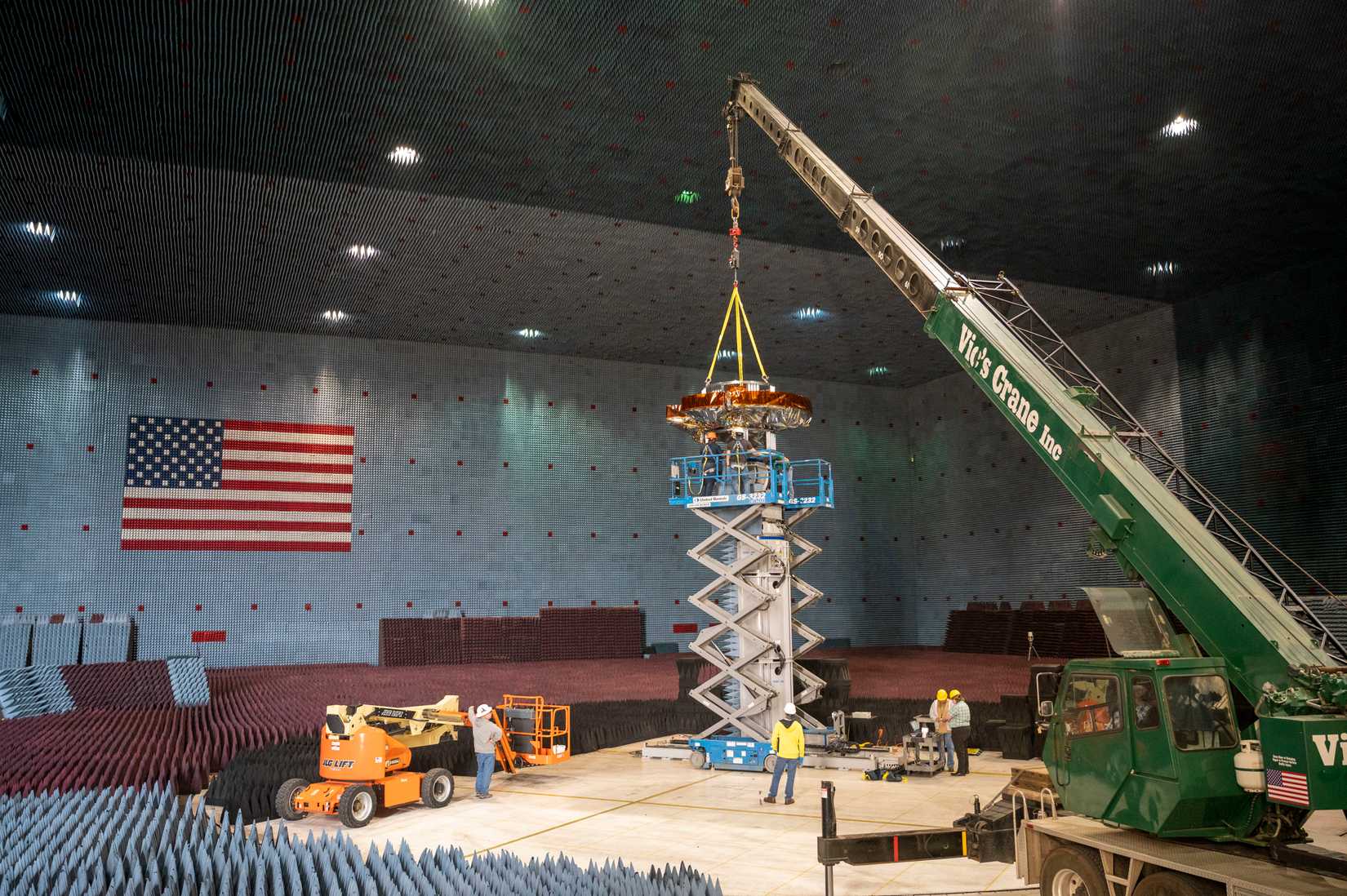
This all starts with the punishing physics of getting into orbit and staying there. Every satellite goes through months, sometimes years, of environmental testing, Hanke said, including vibration testing that replicates launch forces and thermal vacuum testing that recreates the airlessness and temperature extremes of space. But surviving the trip is only the beginning.
“Modern satellites must also be resilient against deliberate threats,” Hanke said. That means spacecraft that can maneuver when needed, operate on their own, resist jamming and cyber intrusion, and keep delivering data even when part of the surrounding network has been degraded.
Signal vs Noise
Nowhere is this dependence deeper than in positioning, navigation, and timing. These capabilities guide munitions and troop movement, while also synchronizing communications. Timing across systems beyond the battlefield becomes possible. However, it’s precisely this concentration of need that makes it a valuable target.
When a near-peer adversary contests those signals, the effects can cascade quickly. They’ll eventually land hardest on the person at the bottom of the chain. A service member who has never given a satellite a second thought is the one who suddenly cannot trust a location or a targeting solution.
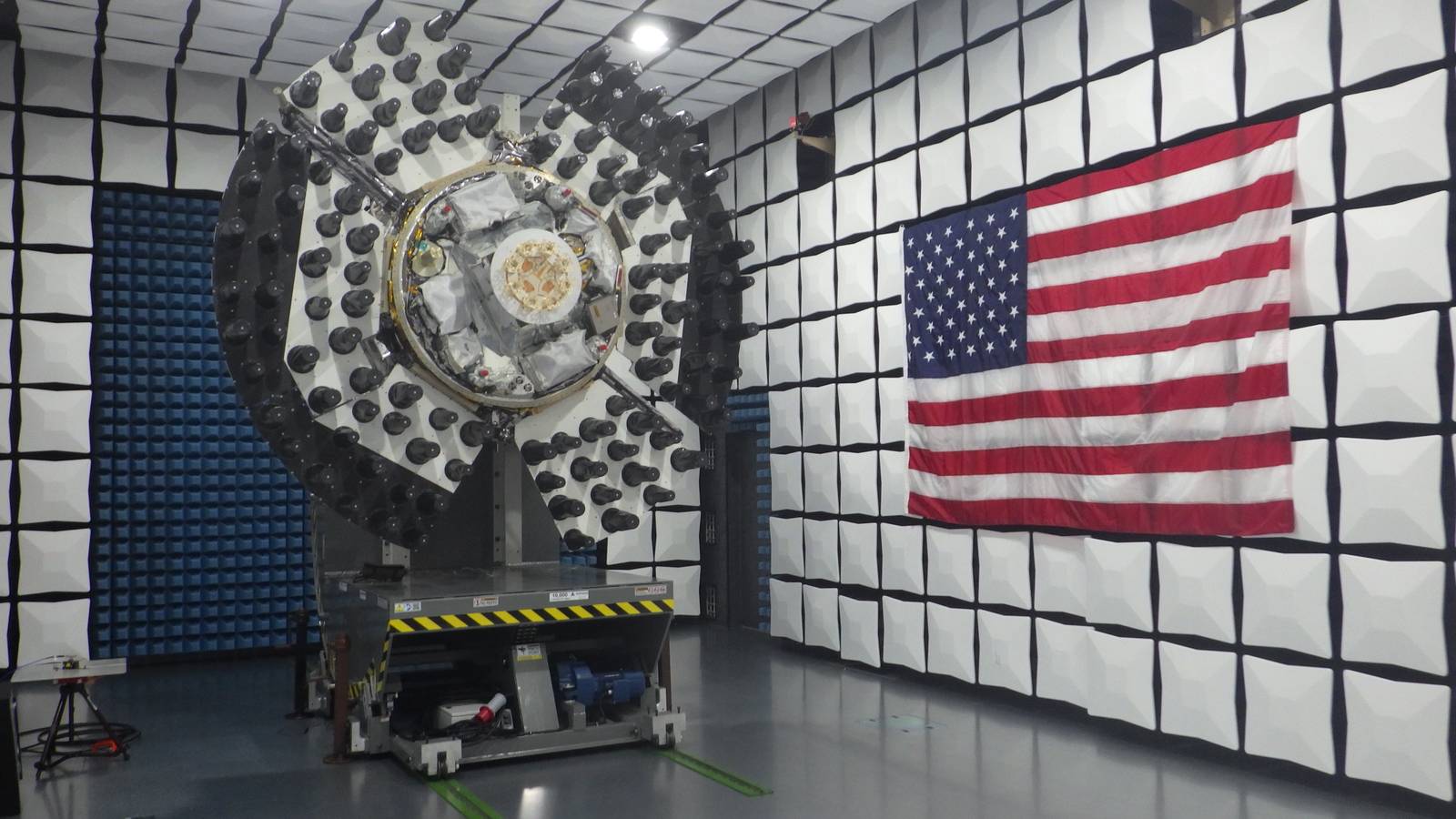
L3Harris built its answer to that problem around a satellite called NTS-3. Launched in August 2025, it was the Department of War’s first experimental navigation satellite in nearly 50 years, and the first fully reprogrammable one.
“NTS-3 has a reprogrammable space architecture, which provides a robust infrastructure against interference and threats to deny, jam, or spoof GPS signals,” Hanke said, adding that the technology has been tested with direct input from the war fighters who would rely on it.
Strength in Numbers
The military is also changing the shape of what it puts in orbit. For decades, national security space rested on a few extremely capable satellites.
Those systems still matter, Hanke said, but they also make attractive targets, and the current strategy leans toward resilience through proliferation, trading a handful of exquisite spacecraft for hundreds of smaller ones so that losing any single satellite does not break the mission.
Hanke pointed to the Space Development Agency’s satellite architecture as the model. A layered network meant to provide communications, missile tracking, and continuous overwatch against threats, including hypersonic and ballistic missiles.
L3Harris is helping build it, he said, with missile-tracking satellites already in orbit and dozens more in development, along with a July contract to build 18 more missile-defense satellites for the constellation.
He was candid about how hard the approach is. Building hundreds of satellites, rather than one exquisite spacecraft every few years, demands industrial-scale manufacturing, faster production cycles and constant networking across the constellation. It is, he said, a fundamentally different model.

Space Debris is Already a Problem
None of it works without knowing what is in orbit in the first place. Space Domain Awareness involves detecting, tracking, and identifying objects overhead.
Anticipating what they might do has become more critical as satellites grow more maneuverable and adversaries’ capabilities continue to advance.
Hanke said L3Harris supports that mission through its MOSSAIC ground sensors, which detect objects in space, and its ATLAS system, which catalogs them. Destroying a satellite scatters debris, threatening everyone’s spacecraft, including the attacker’s, for decades.
He called it responsible counterspace. He put the scale of the tracking task in blunt terms, pointing to more than 50,000 objects larger than a softball and over 400,000 larger than a golf ball already being followed in orbit.
That shared risk, Hanke said, is why L3Harris has emphasized non-destructive options, electronic warfare that can deny an adversary the use of its systems without wrecking the orbital environment in the process.
The Human Cost
The effects of a contested space environment, Hanke said, can “cascade quickly and personally.” A warfighter who has never given a satellite a second thought can suddenly find themselves operating without the trusted location, timing, communications, or targeting information needed to make a life-or-death decision.
That is the human cost beneath every design decision, every launch, and every contract. And it is why the traditional line between industry and the military is disappearing.
Industry is no longer simply a supplier that delivers a system and steps away. It is an operational partner, embedded in the fight from design through deployment. It provides real-time support, rapidly updating capabilities as the threat evolves, and delivering the surge capacity needed when the stakes are highest. They’re not building satellites; they’re building combat capability.
For Hanke, that means designing systems with a simple reality in mind: an adversary will not wait for the next upgrade cycle, and the troops on the ground cannot afford to wait for help to arrive.
“Warfighters must have constant, real-time situational awareness of activities taking place across the domain in order to keep ahead of the threat,” Hanke said. “That’s what we’re building toward, making sure the support they depend on is there, even when an adversary is doing everything possible to take it away.”
Space may be invisible to the people who depend on it most. But the consequences of losing it are not.
Every satellite, sensor, and capability ultimately has a human being on the other end; someone making a decision, executing a mission, or, potentially, counting on that capability to come home.
Read the full article here
