



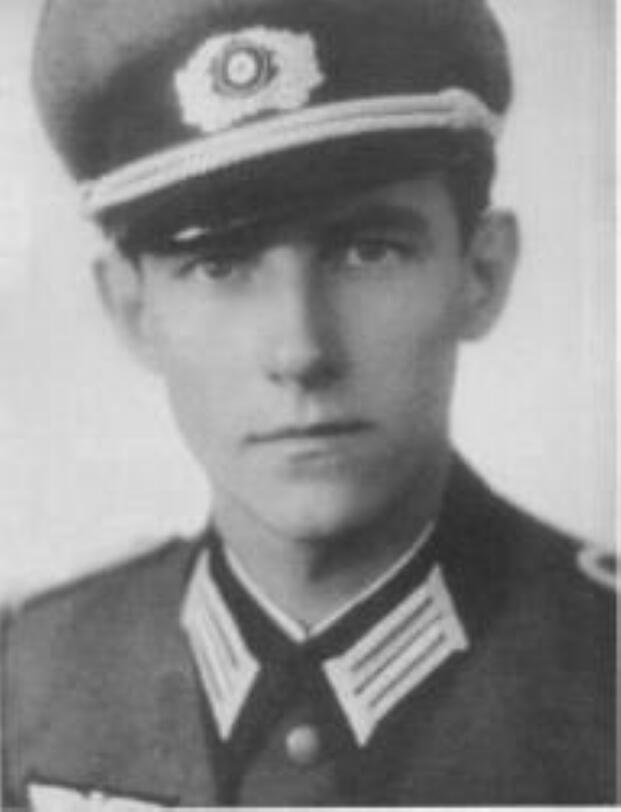

During the bloody battle for Hurtgen Forest in late 1944, a 23-year-old German lieutenant heard a wounded American soldier crying for help in a minefield. Lt. Friedrich Lengfeld ordered his men not to shoot any American medics who might try to rescue the man. When no help came after hours of listening to the man’s cries, Lengfeld led his own medics into the minefield to save him.
The decision would lead to Lengfeld’s death. The American soldier’s identity remains unknown. Fifty years later, American veterans erected what may be the only U.S. monument honoring a German soldier from World War II.
The Battle of Hurtgen Forest
The Battle of Hurtgen Forest lasted from September 1944 to February 1945. The U.S. First Army tried to push through 200 square miles of dense forest, steep terrain and German fortifications along the Siegfried Line. American forces needed to reach the Rur River dams, which controlled flooding toward the Rhine. After this, the Americans could breach into the German interior.
The Americans failed to breakthrough. Weeks later, the Germans used the area as a staging ground for their last ditch Ardennes Offensive. The battle ultimately cost at least 33,000 American casualties, with some estimates reaching 55,000 when including non-combat losses from trench foot, frostbite and combat fatigue. German forces suffered approximately 28,000 casualties.
On both sides, soldiers went through hell in one of the most infamous battles of the Western Front.
The thick forest eliminated American air superiority. Highlighting the formidable terrain and enemy defenses, the 9th Infantry Division took 3,000 yards in 10 days at a cost of 4,500 casualties.
The German 275th Infantry Division had dug into prepared positions with minefields, barbed wire and concrete pillboxes. Forester’s lodges, bunkers, hills, ridges, and trenches throughout the forest changed hands repeatedly in close combat.

Lengfeld Takes Command
Lt. Lengfeld arrived in Hurtgen Forest and took command of 2nd Company, Fusilier Battalion, 275th Infantry Division in early October 1944. His two predecessors had become casualties within days of each other.
Born Sept. 29, 1921, in Grunfelde, East Prussia, Lengfeld had been wounded repeatedly during combat on the Eastern Front and received several awards for his service. His communications runner, Hubert Gees, later recalled that Lengfeld never told his men “Go and check” but always said “Follow me” when leading patrols into certain danger.
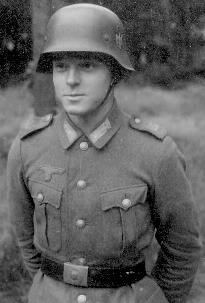
By November 1944, his company was engaged against U.S. troops near Vossenack between Schmidt and Hurtgen alongside the 116th Panzer Division. The divisions were sapped and exhausted after months of nonstop combat against superior American firepower.
His soldiers had not bathed in days. They suffered from lice, hunger, malnutrition and severe cold. But they held the line, hoping to stall the American advance into Germany.
They eventually fought over a forester’s lodge south of what is now Hurtgen War Cemetery. The lodge was guarded on one side by the Wilde Sau minefield. On Nov. 11, the U.S. 12th Infantry Regiment captured the lodge before German forces retook it the following morning. American troops fell back in disarray.

The Rescue Attempt and Lengfeld’s Sacrifice
During the American withdrawal on the morning of Nov. 12, an unfortunate U.S. soldier ran into the Wilde Sau minefield and triggered a mine. He was severely wounded and began calling for help from no man’s land.
Lengfeld ordered Gees to run a message to one of his machine gunners, ordering them not to fire on any American medics who might try to rescue the soldier. Hours passed and no rescue attempt was made. The American continued to scream in agony as the Germans listened. Around 10:30 a.m., Lengfeld realized no help was coming. He assembled a rescue team of medics with Red Cross vests and flags and set out to save the man.
Lengfeld knew where his company had placed anti-tank mines along the road, but several anti-personnel mines were hidden throughout the minefield. He led his team along the road toward the American soldier. When Lengfeld moved across the road to reach the soldier’s position, he stepped on one of the anti-personnel mines.
The explosion tore two deep holes in Lengfeld’s back and caused severe internal injuries. His men, including one of his NCOs who was also wounded, carried him to the aid station at Lucas Mill, then to the medical facility in Froitzheim. Lengfeld died that evening.
German soldiers who returned to the area later did not find the body of the enemy combatant. The American soldier’s identity and fate remain unknown. The Wilde Sau minefield would claim another German soldier just five days after Lengfeld’s death. On Nov. 17, a soldier named Alfons Bösl stepped on a landmine near the site of Lengfeld’s death.
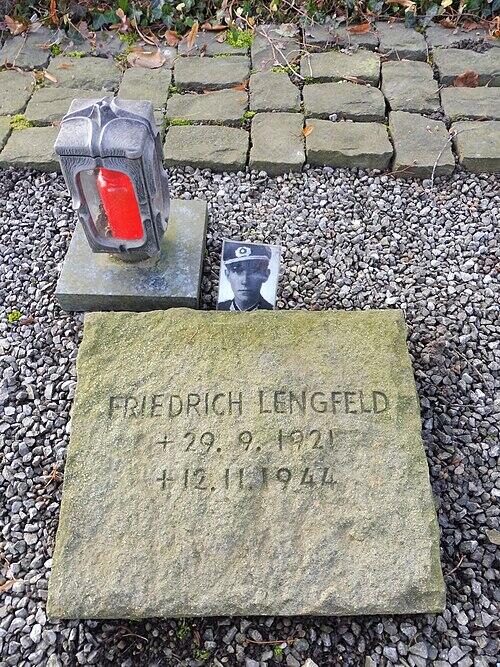
American Veterans Honor German Enemy
Gees witnessed the rescue attempt and Lengfeld’s death. Decades later, he recalled, “With Leutnant Lengfeld, I lost the best superior I ever had. In the previous hard weeks he meant much to me and gave me a lot of inner strength. He was an exemplary company leader and he claimed never more from us as he was willing to give by himself.”
On Oct. 7, 1994, retired Maj. Gen. John Ruggles led American veterans to Hurtgen War Cemetery to dedicate a monument to Lengfeld. Ruggles had served as a lieutenant colonel with the 22nd Infantry Regiment during the battle. The 22nd sustained some of the highest casualties of any single regiment in the Hurtgen campaign.
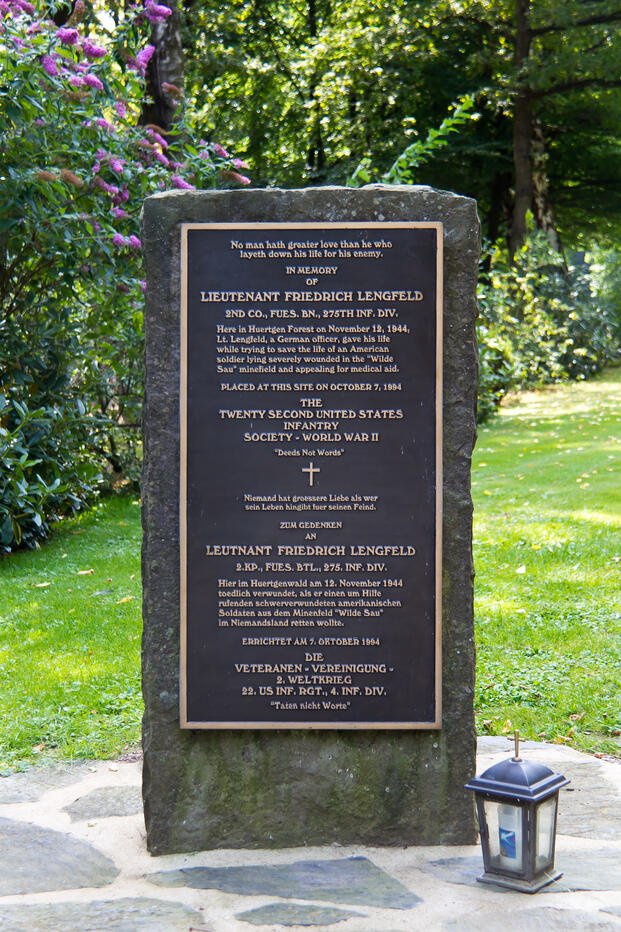
The monument stands near the cemetery entrance among over 3,000 German war dead, including Lt. Lengfeld. The bronze plaque reads, “No man hath greater love than he who layeth down his life for his enemy.” The inscription also includes “Deeds Not Words,” the 22nd Infantry Regiment’s motto.
Ruggles later said, “You can’t go to any greater extreme than to give your life trying to rescue someone you are fighting as your enemy in war.”
Lengfeld is buried at Duren-Rolsdorf war cemetery. The monument dedicated to him is thought to be the only memorial placed by American soldiers in a German war cemetery to honor an enemy soldier from WWII.
Story Continues
Read the full article here
