



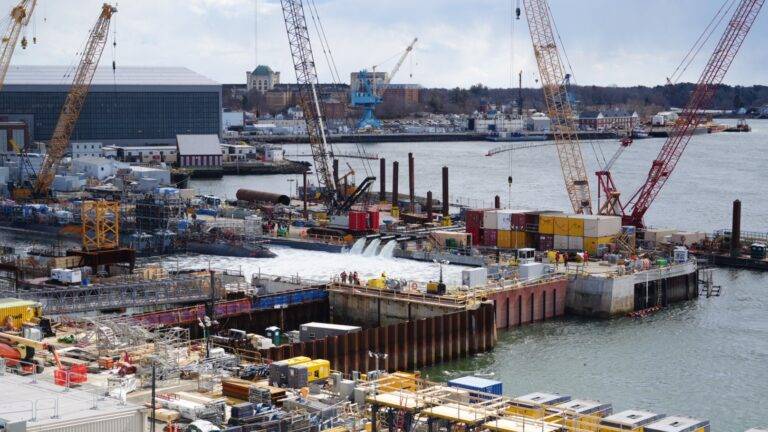

It’s been more than 80 years since the last naval shipyard was built in the United States. It may be “too little, too late,” a security expert told Military.com.
Earlier this month, President Trump signed a national security presidential memorandum green lighting a plan to establish the first naval shipyard to be built in the United States in more than 80 years. It remains unknown where the shipyard will be constructed, or how much it will ultimately cost.
Retired Marine intelligence officer Hal Kempfer, an expert in global security, strategic risk and intelligence operations, said a new naval shipyard is long overdue. The U.S. is lagging behind its main adversaries as the military-defense race heats up.
“We’re way, way behind,” Kempfer told Military.com. “We’re going [in] the right direction, but we’re so far behind. We’re talking about the possibility of going to war with China within a few years.
“It’s going to take 10 to 20 years to get our shipyards up to where they’re good to go. So, it’s the right direction, but it’s too little, too late. We’ll have to fast track this and get it moving fast.”
In addition to announcing the shipyard plan on Aug. 13, Trump’s order creates a dedicated submarine repair center and directs a comprehensive reorganization of Naval Sea Systems Command to address chronic delays and cost overruns.
“As a country, we haven’t incentivized shipbuilding, unlike other countries around the world,” said Kempfer, CEO of Global Risk Intelligence & Planning (GRIP) and Knowledge and Intelligence Program Professionals Inc. “We used to be the shipbuilders for the world, but of all that work went overseas at the end of the Cold War. We closed a bunch of naval shipyards all over, and we’re really paying for it now.”
Trump Plan Calls for Fifth Shipyard
Currently, the Navy’s youngest of four public shipyards is more than 100 years old.
Trump’s order allows plans for a fifth shipyard to move forward, which would expand repair capacity for nuclear-powered aircraft carriers and submarines. It also instructs Defense Secretary Pete Hegseth to submit a proposal within 120 days to bolster submarine and aircraft carrier readiness.
The president’s memo said the plan should address the following:
- Sufficient dry dock capacity to service the planned growth of the fast attack submarine fleet over the next two decades.
- Locations proximate to the United States Pacific Fleet, including in the continental United States, Alaska, Hawaii, and the United States territories.
- Site options that include up to three new dry docks designed and built to hold the ranges of every current and projected class of submarine.
- Innovative financing mechanisms such as public-private partnerships.
- Timelines and resourcing requirements.
Analysts said the price tag for a new shipyard depends on several factors, including location. The Navy has previously operated multiple other shipyards, including the Philadelphia Naval Shipyard, the Charleston Naval Shipyard, Mare Island Naval Shipyard in Vallejo, Calif., and the Long Beach Naval Shipyard in California.
All were closed in the 1990s, after Congress passed the Base Realignment and Closure Act (BRAC) in 1988. The Navy’s current four shipyards are in Hawaii, Maine, Virginia and Washington.
“When you look at a map of naval shipyards, they’re needed in the Pacific—which is a pretty important body of water, especially when you consider our main pure adversary is across the Pacific,” Kempfer, who is based in Long Beach, Calif., said. “But when you look at where the remaining naval shipyards are distributed, they’re all on the East Coast, which means if we have a big naval war in the Pacific, our shipyards are all in the wrong place.”
Shipyard Plan Could Be Stalled in Congress
Congress will have a say in the matter.
The administration will need majority support from lawmakers to move forward. If approved, experts believe the funding will be given incrementally, and not all at once.
Kempfer said the political climate could stall or even kill the project, which is not uncommon in Washington.
“Here in California, there was a big push politically to keep the naval shipyard going here in Long Beach,” he said. “It just couldn’t get any political traction.
“What it boiled down to was the Department of Defense was really tired of dealing with the California politicians. They looked at military facilities as gift horses.”
A new naval shipyard could cost more than $1 trillion, he added, with a time frame of a decade or more for construction.
“You don’t snap your fingers and open a new shipyard,” he said. “That’s a long-term construction project, and long-term dredging.
“There’s just a lot that goes with that. But we need it, and we need it on the West Coast.”
Read the full article here
