



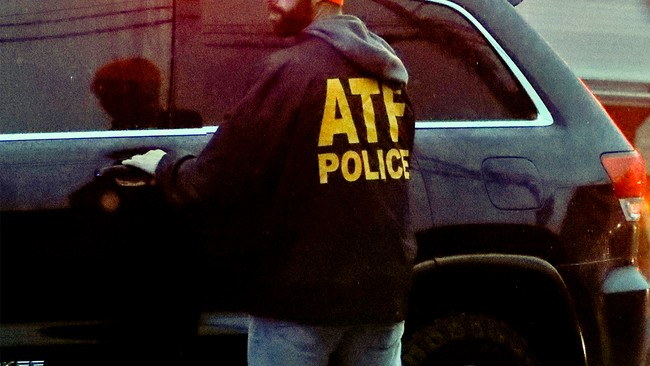

Which makes me like most of them even more, to be honest. We’re still waiting to see the actual text of these rules published in the Federal Register, but based on the summaries provided on the ATF’s website, we still have a pretty good idea of what DOJ and ATF are trying to put in place.
Everytown’s “Senior Firearms Analyst” and editor of the group’s Smoking Gun website Greg Lickenbrock claims the proposed rules “are clearly designed to benefit the gun industry,” which is a big problem for a group intent on destroying that same industry.
Lickenbrock also claims that “several of the proposed and final rules will make it easier for guns to fall into the hands of people who are legally prohibited from having them.” Specifically, he objects to the repeal of the Biden-era “engaged in the business rule” that treated almost every gun owner who offered a firearm for sale as an “unlicensed dealer” who needed to put buyers through a background check.
That rule simply helped implement the Bipartisan Safer Communities Act, enacted in 2022, which updated the longstanding statutory standard for which gun sellers need to obtain a dealer license and, in turn, keep sales and inventory records, conduct background checks on customers, and meet additional requirements under federal law. But gun groups railed against the rule since it was first proposed in September 2023, calling it a “backdoor scheme” to require background checks on all gun sales. The NSSF even claimed it “create[d] criminal law through executive fiat.”
What Lickenbrock fails to tell his readers is that a federal judge has already determined that the rule implemented under Biden and then-ATF Director Steve Dettelbach went beyond the ATF’s regulatory authority. The language that Congress adopted in the BSCA defined a dealer as “[A] person who devotes time, attention, and labor to dealing infirearms as a regular course of trade or business to predominantly earn a profit through the repetitive purchase and resale of firearms,” but added that “such term shall not include a person who makes occasional sales, exchanges, or purchases of firearms for the enhancement of a personal collection or for a hobby, or who sells all or part of his personal collection of firearms.”
The ATF’s final rule contained some truly bizarre interpretations of that language. It maintained that “there is no minimum threshold number of firearms purchased or sold that triggers the licensing requirement” or “determines whether a person is ‘engaged in the business’ of dealing in firearms.” Even a single firearm transaction or a mere offer to engage in a transaction could require a license, even though the statute clearly stated that a person who makes occasional sales, exchanges, or purchases does not need a dealers license.
You can read the judge’s entire ruling here, but here’s one critically important passage:
To sum up, Congress decided that a person is not engaged in the business of dealing in firearms unless he deals firearms “as a regular course of trade or business.” See 18 U.S.C. § 921(a)(21)(C). Regular means repeated or often. So regular business requires more than one firearm transaction involving a single firearm. Because the Final Rule says single transactions involving one firearm may be prohibited in some cases, it exceeds ATF’s statutory authority.
Lickenbrock also takes issue with a proposed rule dealing with “non-over-the-counter” (NOTC) transactions. Again, we need to see the actual text, but according to ATF the intent of the rule is to “allow FFLs to comply with the requirements of NOTC transactions originally implemented by the Gun Control Act of 1968 and the requirements of the Brady Handgun Violence Prevention Act of 1994 more efficiently to include identification verification.” Buyers would still have to go through a background check, but once they’ve done so the firearm could be shipped directly to their home, so long as they’re purchasing the gun in the same state where they live.
So what’s Lickenbrock’s problem with the rule?
The rule could allow gun dealers to simply mail guns to people’s doors, removing the need to visit a brick-and-mortar store — and creating a new gun trafficking channel. The system is already in use with silencers, and the U.S. Postal Service recently proposed a rule to undo the 99-year-old ban on mailing handguns in response to a memorandum opinion issued by the DOJ that declared that same ban to be unconstitutional.
As FPC’s Rob Romano noted on X, silencers are rarely used in crime and are already shipped directly to buyers’ homes, so this shouldn’t (and won’t) be a new channel for gun trafficking.
Lickenbrock also frets that the ATF’s plan to shorten and modernize the Form 4473 “may make it harder to prove that the buyer is illegally straw-purchasing the gun for someone else, for example — and provide cover for gun dealers who complete the sales.” I don’t know he came to that conclusion, given that the ATF says the new form is meant to “streamline identity and residency verification requirements for transferees,” but the bottom line is that Lickenbrock’s “will” turned into a “may”, and he’s offering up nothing more than his theory… not facts.
Some of Lickenbrock’s objections are downright laughable, like his whining about the ATF hoping to redefine “willfully” to only apply in situations where gun dealers “know their conduct is unlawful.” The gun control lobby, of course, would like for unknowing and unintentional errors to be defined as “willful violations”, even if that completely redefines what that word means.
The ATF’s proposed rule allowing dealers to destroy records after “20 to 30 years” is another sticking point for Lickenbrock, who complains that it would be “destroying any chance law enforcement has of tracing older guns.” Here’s a question for Lickenbrock: how many firearms purchased 20 to 30 years ago are used in a crime by the person who originally bought it? Better yet, how many of those guns are recovered at the scene of a crime that is not connected to the buyer’s business or place of residence?
Just for funsies, I looked up the 2023 ATF trace data for New York, and learned that the average age of a traced firearm was about 10 years. The national average is closer to 7. We are talking about a handful of firearms that would be impacted by this change, but it would be of huge benefit to FFLs if they didn’t have to maintain reams of decades-old paperwork on the off chance that the ATF might need to look at a document one day.
Lickenbrock has issues with some of the other rules as well, but this post is already getting pretty lengthy. I’ll probably do a Part II (that’s two, not eleven, if Rep. Ilhan Omar is reading this) tomorrow or over the weekend to debunk the rest of his bad arguments against the ATF’s “new era of reform,” because some of them are truly awful takes.
Editor’s Note: President Trump and Republicans across the country are doing everything they can to protect our Second Amendment rights and right to self-defense.
Help us continue to report on their efforts and legislative successes. Join Bearing Arms VIP and use promo code FIGHT to receive 60% off your membership.
Read the full article here
