



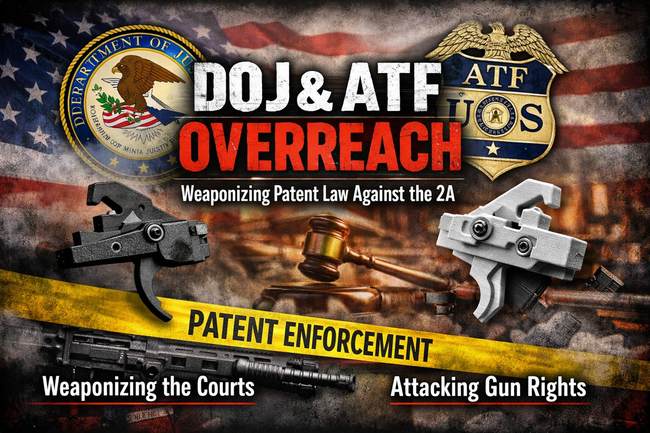

It’s no surprise to see the federal government trample on gun rights time and again. But the latest stunt from the Department of Justice (DOJ) and the Bureau of Alcohol, Tobacco, Firearms and Explosives (ATF) takes the cake. On January 26, 2026, the ATF filed a “Statement of Interest” in a purely civil patent infringement lawsuit between Rare Breed Triggers and Hoffman Tactical. This isn’t about crime or national security; it’s a business dispute over intellectual property. Yet here comes Uncle Sam, sticking his nose where it doesn’t belong, all in the name of “public safety.” If this doesn’t scream anti-2A overreach, I don’t know what does.
Let’s back up and break this down for those who might not be knee-deep in the gun world. Forced reset triggers, or FRTs, are engineered triggers that allow for faster semi-automatic firing by mechanically resetting the trigger after each shot. They’re not machine gunssince they require a separate trigger pull for every round, as affirmed by multiple courts. Rare Breed Triggers pioneered the FRT-15, a popular model that lets law-abiding citizens like you and me shoot fasterwithout converting semi-automatic firearms into fully-automatics. Hoffman Tactical, run by inventor Timothy Hoffman out of Tennessee, developed his own version called the Super Safety. It’s similar in concept but differs in design details. Notably, his design has been promulgated via open-source 3D-printable files that empower DIY enthusiasts to make their own.
The beef started when Rare Breed sued Hoffman in late 2025, claiming patent infringement. Rare Breed argues Hoffman’s design copies their tech too closely, while Hoffman counters that his is distinct enough and that no one owns the broad idea of forced resets. This should be a straightforward intellectual property/patent fight in the U.S. District Court for the Eastern District of Tennessee (case number 1:25-cv-00389-CLC-CHS); No criminals, no threats to society, just two companies hashing out who gets to profit from a clever invention.
Enter the ATF, stage left. In their Statement of Interest, they declare a “strong interest in promoting the safe use of firearms by the public, and in this particular case, in discouraging unregulated manufacture of forced reset triggers that allegedly infringe Rare Breed’s patents.” They’re urging the judge to grant Rare Breed a preliminary injunction against Hoffman, effectively shutting him down. Why? Because in the DOJ’s rationale, fewer FRTs mean less “danger.” This isn’t neutral advice; it’s a blatant push to limit access to these triggers through the backdoor of patent enforcement.
To understand this meddling, we need to rewind to the ATF’s long war on FRTs. Back in 2021, the agency sent a cease-and-desist to Rare Breed, classifying the FRT-15 as a machine gun under the National Firearms Act. Rare Breed fought back, and in a landmark 2024 Supreme Court ruling in Cargill v. Garland, the justices struck down the ATF’s bump stock ban, setting a precedent that devices like FRTs aren’t machine guns. By July 2024, a Texas district court applied this to FRTs, ruling they require multiple functions per shot—not the single pull that defines a machine gun.
Undeterred, the ATF kept up the pressure, seizing triggers and dragging Rare Breed through lawsuits. But in May 2025, under the self-described “most pro-2A administration in history,” the DOJ settled. The feds dropped their cases, agreed to return seized FRTs (including those from Wide Open Triggers, a similar product), and Rare Breed resumed sales. Sounds like a win, right? Not so fast. The settlement had strings attached: Rare Breed promised not to develop FRTs for pistols and, crucially, to “enforce its patents to prevent infringement that could threaten public safety.” In other words, the ATF outsourced its infringement agenda to a private company.
Now, Rare Breed is suing not just Hoffman but several manufacturers of Super Safety designs. YouTube creators and gun forums are buzzing—some call it a betrayal, with Rare Breed torching community goodwill to appease the feds. Hoffman himself received a cease-and-desist in February 2025, pulling his files offline. And the ATF’s intervention? It’s the cherry on top, admitting in essence they’re using this civil suit to curb “unregulated manufacture.”
The ATF has no statutory authority to regulate firearm accessories like triggers in this way. They were created to enforce existing laws, not invent new ones via proxy. Patent law is for protecting innovation, not as a tool for disarmament. Whether Republicans or Democrats are in charge, the bureaucracy finds ways to chip away at our rights. Remember, this “pro-2A” admin settled with conditions that force Rare Breed to police the market, effectively creating a monopoly that limits options for Americans.
The implications are chilling. If the government can hijack private lawsuits to advance gun control, what’s next? Banning aftermarket parts through intellectual property? Ignoring the First Amendment and stifling 3D printing innovations that empower self-reliance? Hoffman’s open-source approach democratizes gun tech, putting power in the hands of the people, not corporations or the state. By backing Rare Breed, the ATF is signaling they want fewer triggers out there, period, regardless of legality. We can’t let bureaucrats weaponize the courts. Support organizations like Gun Owners of America who broke this story, contact your reps, boycott companies that cave to government pressure, and stay vigilant. The Second Amendment isn’t negotiable; it’s our birthright.
Editor’s Note: Second Amendment orgs like GOA are hard at work across the country doing everything they can to protect our right to keep and bear arms
Help us continue to report on their efforts and successes. Join Bearing Arms VIP and use promo code FIGHT to get 60% off your VIP membership.
Read the full article here
