





The newly announced suspension of multiple large-scale offshore wind projects by the Trump administration is being criticized by some military members as a “gift” to the fossil fuel industry.
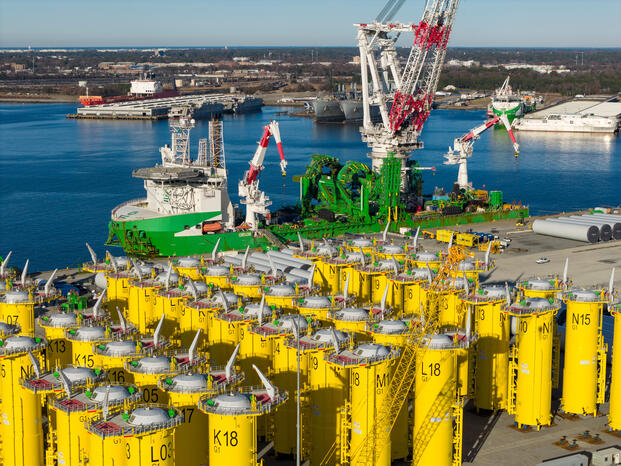
The pause, announced Monday by the U.S. Department of the Interior (DOI), went into effect immediately and impacts five leases currently under construction off the Atlantic coast. DOI said the project suspensions were tied to national security threats purportedly identified by the Department of Defense as referenced in recently completed classified reports.
“The prime duty of the United States government is to protect the American people,” DOI Secretary Doug Burgum said in a statement. “Today’s action addresses emerging national security risks, including the rapid evolution of the relevant adversary technologies, and the vulnerabilities created by large-scale offshore wind projects with proximity near our east coast population centers. The Trump administration will always prioritize the security of the American people.”
Military.com reached out to the Pentagon for comment.
A White House spokesperson declined to comment, deferring to DOI. A DOI spokesperson told Military.com that they have no additional remarks.
US Energy Reliance ‘Real Security Threat’
The five projects being suspended indefinitely are as follows:
-
Vineyard Wind 1, off Massachusetts.
-
Revolution Wind, off Connecticut and Rhode Island.
-
Coastal Virginia Offshore Wind.
-
Offshore projects off New York known as Empire Wind and Sunrise Wind.
Vet Voice Foundation, a national nonprofit that mobilizes and encourages veterans to be present in the civic arena, was one of the groups scrutinizing the Trump administration’s decision—saying in part that the move not only negatively impacts the United States’ ability to add domestic energy but that it has broader national security implications by playing a vital role in strengthening the maritime industry.
“It’s a political gift to fossil fuel donors that will raise electricity bills for U.S. households and increase our risk of blackouts.”
“This isn’t about national security; it’s a political gift to fossil fuel donors that will raise electricity bills for U.S. households and increase our risk of blackouts this winter,” Janessa Goldbeck, a U.S. Marine Corps veteran and CEO of Vet Voice Foundation, said in a statement provided to Military.com. “The real security threat is a grid that is vulnerable to blackouts and reliant on foreign energy.”

“Developing American offshore wind helps protect our nation against blackouts, strengthens America’s energy independence, and creates jobs across our maritime industry that benefit naval security and keep our workforce prepared for potential conflicts. The Trump administration’s actions to hinder the U.S. offshore wind industry have undoubtedly made our nation less safe,” Goldbeck added.
Military.com reached out to the nonprofit for additional remarks.
The Trump administration’s decision was met with applause from Robin Shaffer, president of Protect Our Coast New Jersey, who said in a statement: “This is an incredible Christmas gift for our thousands of supporters—hard-working fishermen, small business owners, and families who value reliable, affordable energy over climate virtue signaling.”
‘Rigorous Framework’
National Ocean Industries Association (NOIA) President Erik Milito said in a statement that the DOD regulatory process already involves a “rigorous framework” for assessing national security implications—saying that the projects in question, plus all others under construction, have already undergone review by the Department of Defense without any objection.
“The process, as required by law, provides a timely, transparent and repeatable process to evaluate potential impacts and mitigation options related to offshore energy compatibility,” Milito said. “The Department of Defense coordinates at every stage of planning, permitting, and development.”
Others admonishing the pause, including Washington lawmakers, cited the DOD’s own past unclassified reports showing that the offshore projects in question are up to national standards.

In a December 2024 letter to Pentagon officials about the construction of the Revolution Wind project, officials said that the project “with no more than 65 wind turbines, up to 873 feet above sea level, and no more than two offshore substations up to 228 feet above sea level, would not have adverse impacts to DoD missions in the area.”
A report from August 2023 cited similar findings.
NOIA relayed their views on the matter to the Trump administration earlier this year. Military.com reached out to NOIA for additional remarks.
“Offshore wind improves our national security by shifting economic, infrastructure and geopolitical advantages to the U.S. through increased shipbuilding, enhancements to our ports, greater energy security to power surging electricity demand, more manufacturing and good-paying jobs, additional business for the oil and gas supply chain, and collaborative opportunities for our military,” Milito added. “In short, offshore wind helps the U.S. achieve its energy dominance goals.”
Energy Wars and China
Retired Army Gen. James “Spider” Marks, senior intelligence officer for the 2003 liberation of Iraq and the former commanding general of the U.S. Army Intelligence Center, said in a statement that the federal government’s decision only provides China with a leg up in the energy wars.
“America needs a strong offshore wind energy industry in order to compete with China,” Marks said, citing data showing China currently operates 129 offshore wind farms—the most of any country, and much more than the four wind farms currently operating in the U.S.
“By dwarfing our domestic energy projects, China is well positioned to withstand global supply shocks and power its military growth and modernization—which will only grow unless our country makes the necessary investments,” Marks added.
Retired U.S. Navy Cmdr. Kirk Lippold, the commanding officer of the USS Cole when it was attacked by al Qaeda terrorists, wrote in August 2025 that “American energy dominance and the nation’s maritime power are inexorably linked together.”
“The precipitous decline in our shipbuilding capability has eroded our national security just as rising demand for power is magnifying our need to maintain multiple energy sources simultaneously,” Lippold wrote in The National Interest.
He praised the Trump administration at the time for making strides in simultaneously addressing national security threats and the energy crisis.
President Donald Trump signed an executive order on Jan. 20, 2025, “unleashing American energy.” The order called for “affordable and reliable energy and natural resources” and for the nation to be a leading producer and processor of non-fuel minerals, such as rare earth minerals.
Federal officials said the offshore wind projects’ pause will give DOI and DOD, as well as other government agencies, more time to work with leaseholders and state partners to assess the possibility of mitigating the observed threats.
Story Continues
Read the full article here
