



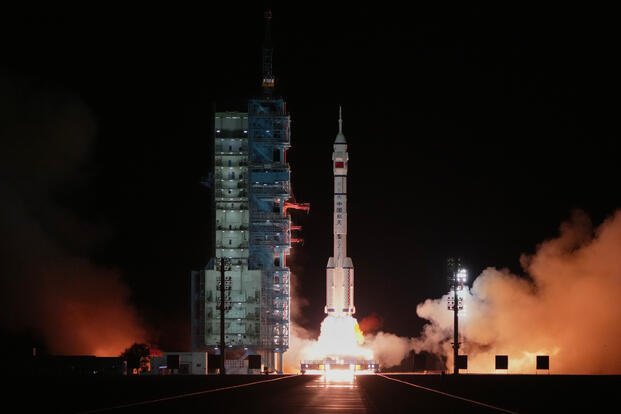

China’s explosive climb in space is jolting America’s intelligence agencies, triggering new warnings about how fast Beijing is moving and how much the United States risks losing in the race above Earth.
U.S. House lawmakers held a hearing last Thursday to assess how China is rapidly expanding its imaging, reconnaissance and deep space programs, wondering why U.S. intelligence agencies are scrambling to keep pace. Members part of the Space and Aeronautics Subcommittee examined how those capabilities could reshape surveillance, targeting and global power projection as Beijing closes in on advantages the United States has held for decades.
The hearing included input from industry experts such as Dean Cheng, senior fellow at the Potomac Institute for Policy Studies; Clayton Swope, deputy director of the Aerospace Security Project at the Center for Strategic and International Studies; Patrick Besha, founder of Global Space Group; and Michael Griffin, co-president of LogiQ, Inc.
Military.com reached out to the White House, the Department of Defense, NASA and commercial satellite operators for comment. Multiple federal agencies and industry leaders were also reached out to for comment.
A Rapidly Shifting Threat Environment
China is investing heavily in high resolution satellites and military directed systems that could alter how nations monitor forces or target weapons. China’s accelerating capabilities have added pressure to U.S. intelligence agencies already working to modernize systems and move faster, according to remarks from the National Reconnaissance Office to Military.com.
An NRO source said the agency is facing “once-in-a-generation changes” driven by new technology, rising threats and expanding demands. The NRO said it is modernizing its architecture in space and on the ground and is focused on delivering more capability with greater resilience. A growing mix of large and small satellites in multiple orbits will deliver far more signals and images than are available today.
NRO officials pointed to remarks made by Maj. Gen. Chris Povak, the agency’s deputy director, who told industry leaders that the NRO is “at the precipice of a major transformation” as it adapts to a congested and contested space environment. His comments and a recording of the hearing were posted publicly on the agency’s website.
Bipartisan Concerns
Both Republican and Democratic lawmakers expressed wariness over China’s continued ascendance in the space race, and how the nation’s ambitions are driving technological advancements that put the United States’ position in a state of flux.
“We are at the start of the next age of exploration, one where humanity is not just observing the cosmos but acting on its observations and beginning to inhabit it,” said Rep. Mike Haridopolos, (R-FL), chairman of the subcommittee, in his opening statement. “For those new to this issue, the question we should be asking as we explore beyond our planet is: Will humanity carry forward the American values of economic and political freedom or those of the Chinese Communist Party?
“For generations, the United States led humanity into space with unmatched ingenuity and without a true rival. However, that situation is changing as China moves methodically, relentlessly and ruthlessly to tighten its grip on space capabilities and seek the strategic advantages it confers by any means possible.”
“Will humanity carry forward the American values of economic and political freedom or those of the Chinese Communist Party?”
Concern was shared by Rep. Brian Babin (R-TX), chairman of the House Committee on Science, Space and Technology, who in his opening remarks said that strengthening U.S. competitiveness in research and development, science, and technology involves “acknowledging the growing challenges posed by the Chinese Communist Party.”
“The CCP has made no secret about its ambition to emerge as the world’s foremost leader in space exploration and innovation,” Babin said. “Since the election of President Xi [Jinping] in 2013, the CCP has deepened the connection between its space program and its broader national goals of domestic and military modernization.
“This increased focus has led to greater attention and resources for its space program, resulting in several recent accomplishments that cannot be overlooked.”
Rep. Valerie Foushee, (D-NC), the subcommittee’s ranking member, called the current period “a pivotal moment” and pledged not to “hand the keys” to China for lunar exploration.
Rep. Zoe Lofgren, (D-CA), ranking member of the full committee, said “it’s critical that we redouble our commitment to supporting and stewarding a strong, robust space program.”
Critical Agencies Stay Tight-Lipped
The National Geospatial Intelligence Agency told Military.com it had no comment on the subject, while the State Department’s Bureau of East Asian and Pacific Affairs also declined to weigh in on China’s ambitions and strategy in the region. The American Institute of Aeronautics and Astronautics said it was unable to offer input.
The Federal Aviation Administration did not address specific questions about Chinese launch capabilities. An FAA spokesperson directed Military.com to a presidential executive order on commercial space competition issued in August 2025. The order aims to accelerate U.S. commercial space development by streamlining launch and reentry licensing, easing environmental reviews and expanding federal support for new spaceports and novel space activities; it also directs agencies to create faster regulatory pathways to increase launch capacity by 2030 as the United States faces growing competition from China.

Military.com reached out to multiple additional agencies and commercial satellite firms for comment.
Commercial Stakes Growing
China’s push is creating new pressure on American satellite companies that once dominated global markets.
Its state-supported commercial Earth observation programs can offer lower prices and wider access, or strategic partnerships that appeal to countries looking for alternatives to U.S. providers.
Analysts drawing on open-source assessments, including the Pentagon’s annual report on China’s military power, have warned that Beijing’s imagery programs could strengthen targeting systems, improve artificial intelligence models, and support operations in contested regions including the South China Sea.
China has also expanded partnerships with nations in Africa, the Middle East and Latin America by offering satellite data and launch services through its international agreements.
China’s long-term strategy has been detailed in congressional reviews of global threats, which warn of rising integration between the country’s military and civilian space infrastructure.
Washington Tries to Keep Pace
U.S. intelligence officials say the coming decade may decide whether American dominance in space continues. Agencies like the NRO are moving to acquire hardware faster and to rely more on commercial providers, building systems that can survive attacks or disruption.
China’s approach centers on speed. An aggressive launch rate, expanding constellations and rapid manufacturing cycles allow Beijing to deploy new capabilities in months rather than years. Experts warn that this pace could give China a critical edge in a crisis.
Committees studying the issue during Thursday’s hearing discussed options that include deeper partnerships with commercial firms and procurement reforms. The hearing underlined how much pressure the United States faces to match China’s momentum.
Story Continues
Read the full article here
