





U.S. Central Command (CENTCOM) on Wednesday announced a new task force for the U.S. military’s first one-way-attack drone squadron based in the Middle East, as part of the Defense Department’s wide-ranging push to accelerate domestic drone acquisition and implementation.
The launch of the Task Force Scorpion Strike (TFSS) is designed to attain low-cost and effective drones and field them to warfighters, following Defense Secretary Pete Hegseth’s directive earlier this year to boost affordable drone technology. A squadron of Low-cost Unmanned Combat Attack System (LUCAS) drones are already based in the Middle East.
“This new task force sets the conditions for using innovation as a deterrent,” Adm. Brad Cooper, CENTCOM commander, said in a statement. “Equipping our skilled warfighters faster with cutting-edge drone capabilities showcases U.S. military innovation and strength, which deters bad actors.”
A CENTCOM spokesperson referred Military.com to their press release. Military.com reached out to the Pentagon for comment.
Challenging Iran
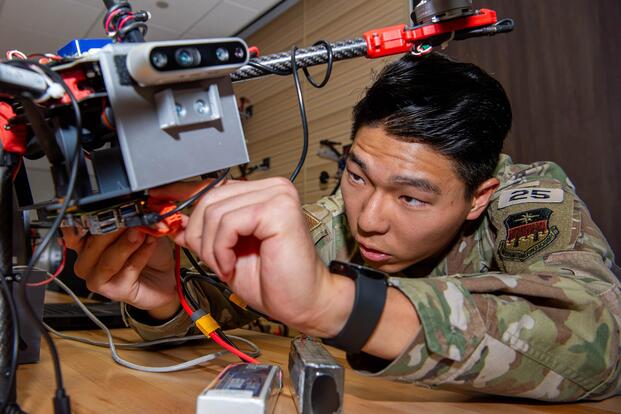
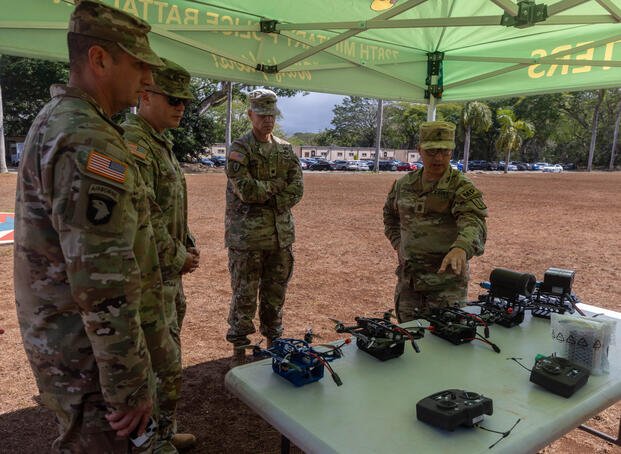
CENTCOM-deployed LUCAS drones are designed to operate anonymously and can be launched by multiple mechanisms including catapults, rocket-assisted takeoff, and mobile ground and vehicle systems. They are designed to operate autonomously and cost roughly $35,000 per platform.
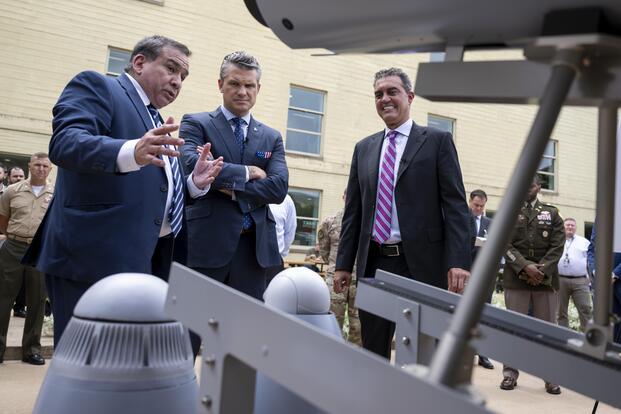
In June, Hegseth was present when 18 American-made drone prototypes were on display at the Pentagon. The LUCAS kamikaze drones are designed to be a cheaper but formidable alternative to Iran’s Shahed-136 drones.
Today’s announcement comes more than two months after CENTCOM announced the Rapid Employment Joint Task Force (REJTF), led by CENTCOM’s chief technology officer to fast-track processes for outfitting deployed forces with cutting-edge capabilities.
U.S. Special Operations Command Central (SOCCENT) oversees TFSS.
Billion-Dollar Plans
The CENTCOM announcement comes one day after Hegseth and the Defense Department outlined their long-term “Drone Dominance” program that will purchase hundreds of thousands of drones in the next few years to boost American military superiority.
The plan will begin early next year and take place over four phases or “gauntlets,” per Hegseth, with the federal government offering $1 billion to build roughly 340,000 small unmanned aerial systems capable of conducting one-way attack missions.
He said the first of those four gauntlets runs from February-July 2026 when 12 vendors will be asked to collectively produce 30,000 drones at a cost of $5,000 per unit, totaling $150 million in department outlays.
The number of drones ordered will increase from 30,000 to 150,000, and the price per drone will drop from $5,000 to $2,300, over the course of the remaining three gauntlets that will see vendor numbers decrease from 12 to five.
“I will soon be meeting with the military services to discuss transformational changes in warfighting doctrine,” Hegseth said Tuesday. “We need to outfit our combat units with unmanned systems at scale. We cannot wait. The funding provided by the Big Beautiful Bill is ready to be used to mount an effective sprint to build combat power.
“At the Department of War, we are adopting new technologies with a ‘fight tonight’ philosophy—so that our warfighters have the cutting-edge tools they need to prevail.”
‘Drone Dominance’ In Motion
In June, President Donald Trump signed an executive order, “Unleashing American Drone Dominance,” intended to invigorate the commercial and military drone sectors by making inexpensive and American-made drones that can be equipped by military units across the globe.
Hegseth followed Trump’s executive order with his own memorandum in July, saying his department “is going above and beyond” the directive by rescinding what he described as restrictive policies that hinder production and limit access to vital technologies.
His outlined memorandum included three major sticking points: leveraging private capital flows that boost the U.S. drone manufacturing industry; powering a “technological leapfrog” that gives the U.S. an edge in a new era of warfare; and “overcoming the bureaucracy’s instinctive risk-aversion” on budgeting, weaponization and training to simulate battlefield scenarios at the ready.
“Lethality will not be hindered by self-imposed restrictions, especially when it comes to harnessing technologies we invented but were slow to pursue,” Hegseth said in July. “Drone technology is advancing so rapidly, our major risk is risk-avoidance. The Department’s bureaucratic gloves are coming off.”
Story Continues
Read the full article here
