



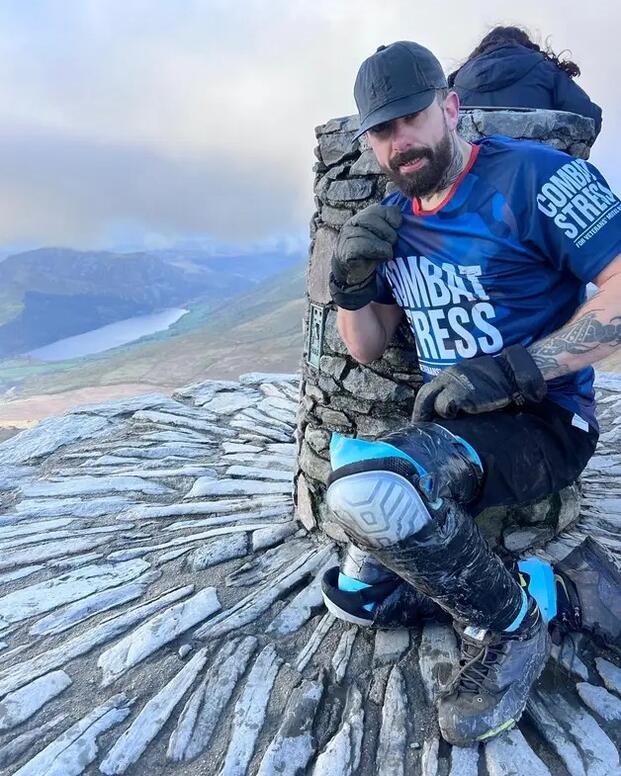

Arms aching, shoulders straining, and knees screaming in agony, Jay Millard kept going.
The former servicemember, who once tried to kill himself, knew he couldn’t stop. He had to keep crawling over the gravel, rocks, dirt and grass until he reached the summit of two of the highest points in the UK. For Millard, the pain was a small price to pay to honor all veterans who’ve died by suicide and to raise awareness of a growing problem in the UK.
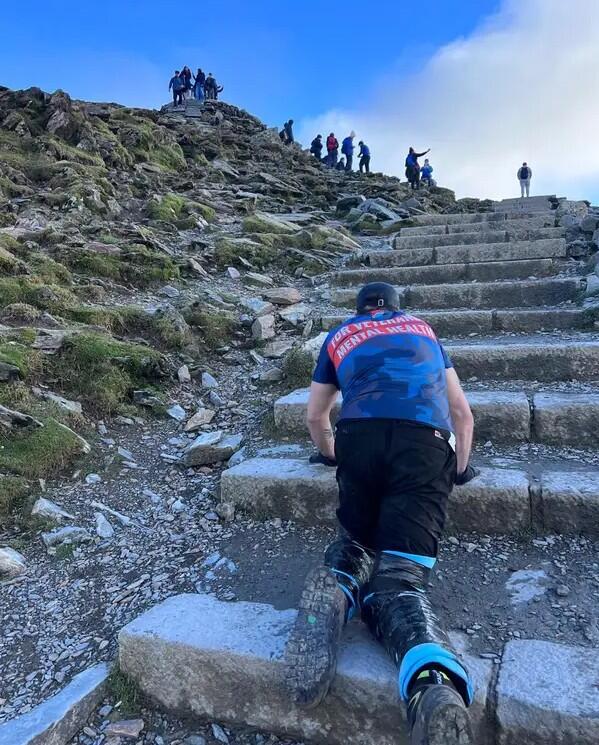
On hands and knees, Millard, who served tours in Iraq and Afghanistan, conquered both Pen y Fan and Snowdon in Wales on successive days in November. He scaled Pen y Fan, 2,907 feet tall, in about three hours and ten minutes, then came back a day later to grunt through the climb of Snowdon, the highest mountain in Wales (3,560 feet) in only five hours.
Millard, from Hull, England, was a lance corporal in the Royal Yorkshire Regiment. He believes the struggle many veterans face after leaving the British military is a “critical issue.” His uniquely grueling climbs were a way to get people to notice and hopefully work to make significant change.
Through this and other physical challenges, Millard has raised over 10,000 pounds ($13,450 in U.S. dollars) for charities to support mental health programs for British veterans.
Millard, 36, admitted to LBC that he “definitely underestimated” how difficult it would be to complete the two climbs, on his hands and knees, no less.
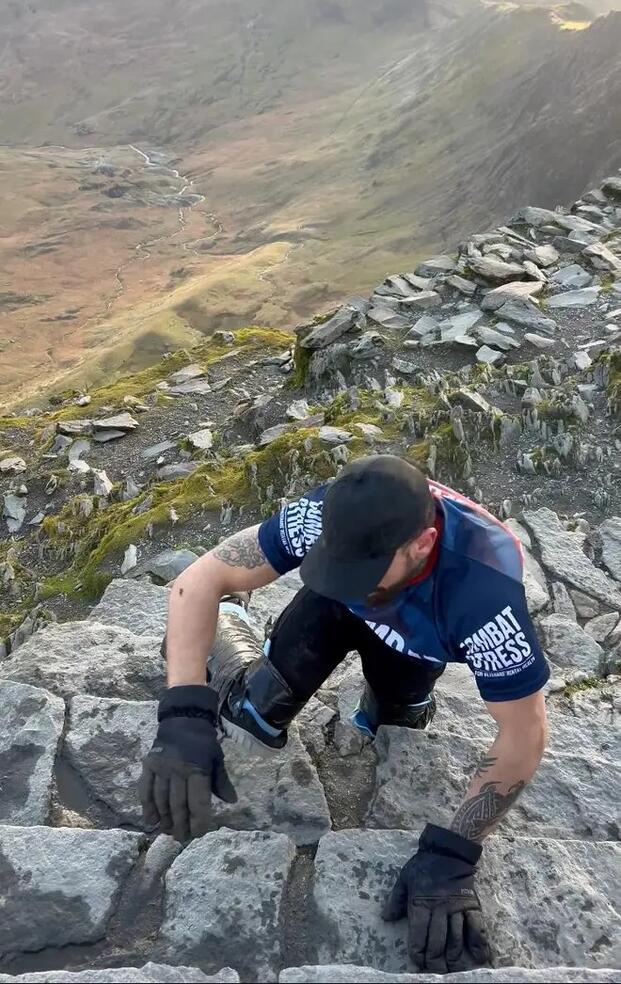
“After doing Fan, I had to really battle my thoughts because my knees were in absolute agony,” he said. “I felt the pain from early on in the challenge. I felt it in my shoulders, traps, and core. I was wearing knee pads, but it was still very painful. When I was on Snowdon, I just wanted to get it done.”
Before embarking on his second climb, Millard said he had to ignore the warning signs from his aching body and steel himself mentally for Snowdon.
“I was so close to backing out on the morning of doing Snowdon, but it was amazing to finish it,” Millard said.
Suicide Numbers Rising
In 2025, Britain’s Ministry of Defence released fresh data on the suicide rate of active-duty military members from 2005 to 2024. The results revealed that 281 servicemembers died by suicide during the 20-year period, with the highest rate being males aged 24 or younger.
The study showed the rate of males who took their own lives had grown since 2017, but the suicide rate among men in the UK Armed Forces remains lower than the nation’s general population.
Wearing a shirt that read FOR VETERANS MENTAL HEALTH in white letters on a red background on his back, Millard completed the climbs for Combat Stress, a large charitable organization that supports veterans’ mental health programs in the UK. The combat veteran plans to scale Mount Fuji, Japan’s highest peak, for his next climb in 2026.
Community Support Fuels Climbs
To prepare for the rigorous climbs, Millard trained for months, incorporating boxing, cardiovascular work, and heavy lifting into his workouts, focusing on building upper-body strength.
The veteran said he had about a 16-hour break between the two climbs. After tackling Fan, he started out on Snowdon the next morning but had to push through to finish.
“I had to take little breaks to allow the blood flow to get back to normal as I had tape around my legs,” Millard said. “There was a lot of cloud cover, but we did manage to get some beautiful views. It was extremely worthwhile at the end when I eventually reached the top.”
He went on to say that while he performs these challenges on his own, he’s backed by a supportive community.
“I have received help from veterans charities in the past, but there needs to be more access out there,” Millard said.
Combat Stress has a very niche focus, according to Millard, focusing on CPTSD (complex post-traumatic stress disorder), properly diagnosing veterans, and helping them with recovery.
“They do something for each individual, which I find is really well needed because everyone is different,” he said. “Mental health conditions can completely vary, so you can’t treat everyone as a complete blanket. Everyone’s very unique.”
Millard knows the issue of veteran suicide looms large. In the UK, many suicides are not reported and fly under the national radar.
“It’s about raising awareness that you don’t have to go through it alone,” Millard said. “It is a political issue that there is not enough funding being rolled out. I also think a lot of veterans’ charities need to start coming to work together now because you sometimes see competition with some of them.”
“We are extremely grateful to Jay for taking on such a grueling challenge for veterans’ mental health,” said Robert Marsh, director of fundraising at Combat Stress. “Crawling to the summit of not one, but two major peaks is a truly staggering feat, and we have no doubt that his efforts will have inspired others to do their bit for those battling with military-related trauma.”
Marsh said about 73 percent of veterans who go through Combat Stress’s treatment programs recover and can move past their clinical PTSD diagnosis.
“This is an incredible impact, much higher than the recovery rate achieved by other mental health services for PTSD,” Marsh said, “yet we simply could not continue being able to provide this life-changing treatment to every veteran who turns to us for help, without the support from incredible and selfless fundraisers like Jay.”
The program is supported largely through donations.
Story Continues
Read the full article here
