



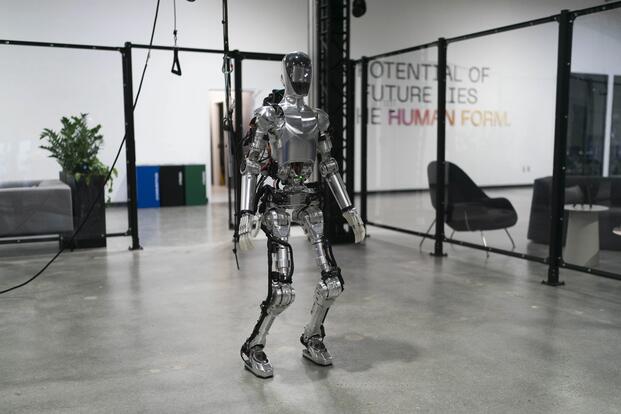

The U.S. Army’s xTechHumanoid competition is part of the Army’s broader xTech innovation program, which connects emerging technology developers with military challenges and accelerates promising solutions for defense missions. The humanoid robotics initiative focuses on technologies that could allow robots to operate in complex environments, including terrain or scenarios that may be hazardous for human personnel, and assist soldiers during reconnaissance, ordinance disposal, logistics, and other difficult or high-risk missions.
Army Program Seeks New Capabilities in Humanoid Robotics
The competition begins with companies submitting technical white papers outlining their technology and development plans. From those submissions, the Army selects finalists that move into a development phase before demonstrating their systems during a final event later in the program. Aptima, a Massachusetts-based engineering and technology firm specializing in artificial intelligence and human-machine collaboration, was selected as one of the finalists during the initial stage.
Jordan Coker, a Research Engineer at Aptima, said the company’s submission focused on a technology designed to address one of the most persistent challenges in robotics: enabling machines to recover when movement does not go according to plan. According to Coker, the early phase of the competition centered on explaining both the concept behind the technology and how it could be developed during the program.
“The first phase was submitting a white paper describing where our technology currently sits and where we want to take it,” Coker said. “That’s how they selected the finalists, and now we’re moving through the technical development phase.”
The finalists are currently participating in a series of technical development reviews with Army officials before demonstrating their technology later in the competition. Coker said the process allows teams to show progress and refine their systems before the final event.
“There’s another technical review coming up in May, and then the finals are expected around September or October,” he said. “That’s when we’ll demonstrate the technology and the development we’ve made throughout the competition.”
A Fully Autonomous Mobility System
Aptima’s role in the competition focuses on a subsystem that allows humanoid robots to move through complex terrain. Rather than building the entire robot platform, the company is developing what Coker described as an adaptive locomotion autonomy core. This is a software system designed to help humanoid robots recover from slips, obstacles, or entanglements while navigating degraded environments.
“What we’re developing is an adaptive locomotion autonomy core that allows a humanoid robot to traverse complex terrain and recover if there’s a slip or an entanglement,” Coker explained. “The idea is to allow the robot to figure out how it should move even when the environment is uncertain.”
A key element of the system is that it operates without human intervention. Coker emphasized that the subsystem being developed for the competition is designed to function autonomously when the robot encounters problems with its movement.
“In terms of something like a foot getting stuck, we’re building this so that there’s no human telling it how to move,” Coker said. “The robot needs to be able to recognize the situation and figure out how to get itself out on its own.”
That autonomy is particularly important in military environments where communication may be limited or conditions change rapidly. Instead of waiting for remote instructions, the robot must be able to react immediately to problems such as slips, unstable terrain, or obstacles.
Most robotic locomotion systems rely heavily on predefined walking patterns known as gait libraries. These systems can work effectively when the robot has accurate information about its surroundings, but they often fail when sensors provide incomplete data or when terrain changes unexpectedly.
Aptima’s approach attempts to give robots greater flexibility by allowing them to adjust their movement dynamically instead of relying entirely on preprogrammed patterns.
“Most robots today fail when they encounter those kinds of unexpected situations,” Coker said. “What we’re trying to do is give the robot the ability to recognize that something unusual has happened and then change its gait pattern so it can recover.”
Training Robots Through Large-Scale Simulation
To teach robots how to respond to unpredictable terrain, Aptima’s engineers rely heavily on simulation and machine learning. The team runs thousands of simulated scenarios simultaneously so the robot’s control algorithms can experience a wide range of terrain conditions and movement challenges.
Coker said these simulations allow the robot to encounter many different situations involving slips, obstacles, and entanglements. The system learns from those experiences through reinforcement learning techniques that reward successful movement strategies.
“We can run thousands of simulations simultaneously where the robots can experience hours, days, or even months of these situations within a day or so of real time,” Coker said. “That allows us to train the system much faster than if we relied only on physical testing.”
Even with those advances, the technology remains in relatively early stages of development. Coker estimated that the system currently sits around Technology Readiness Level three or four, meaning it is still in the experimental or prototype stage rather than ready for operational deployment. The goal during the competition is to continue maturing the technology and demonstrate its capabilities during the final phase.

Why the Army Is Interested in Humanoid Robots
The Army’s interest in humanoid robotics reflects the potential for machines to operate in environments that are dangerous for human personnel. According to Coker, humanoid systems could be used for reconnaissance missions or to assess conditions in hazardous areas before soldiers enter.
One possible application involves chemical, biological, radiological, nuclear, and explosive environments, where sending robots ahead could reduce risk to personnel. Humanoid robots could also support logistics operations or work alongside troops in challenging terrain.
Coker noted that humanoid robots also offer advantages compared with other robotic designs. Because the humanoid structure has a closer resemblance to the human body than quadrupedal robots, they tend to encounter the same kinds of obstacles that soldiers would face in a given environment. That similarity can provide useful information to troops moving through the same terrain.
“If you send the humanoid robot in first, it will run into many of the same situations that a person would encounter,” Coker said. “That can give the team an idea of what they’re going to face before they go into the area themselves.”
Aptima’s Focus on Human–Machine Teaming
Founded roughly three decades ago, Aptima focuses on technologies designed to improve training, performance, and decision-making in mission-critical environments. The company works across defense, healthcare, and education sectors, often developing systems that combine artificial intelligence with insights about human performance and learning.
Coker said a central theme in Aptima’s work is human-machine teaming, which emphasizes designing technologies that assist people rather than replacing them. In that context, the humanoid robotics work reflects a broader philosophy about how advanced systems should operate alongside human operators.
“Aptima does AI, but you’re never going to replace the human,” Coker said. “The goal is to empower people and give them tools that help them execute their mission more effectively.”
If the technology developed during the xTechHumanoid competition proves successful, systems like Aptima’s locomotion autonomy core could become part of future robotic platforms designed to move alongside soldiers and assist them in navigating some of the most challenging environments they encounter.
Read the full article here
