



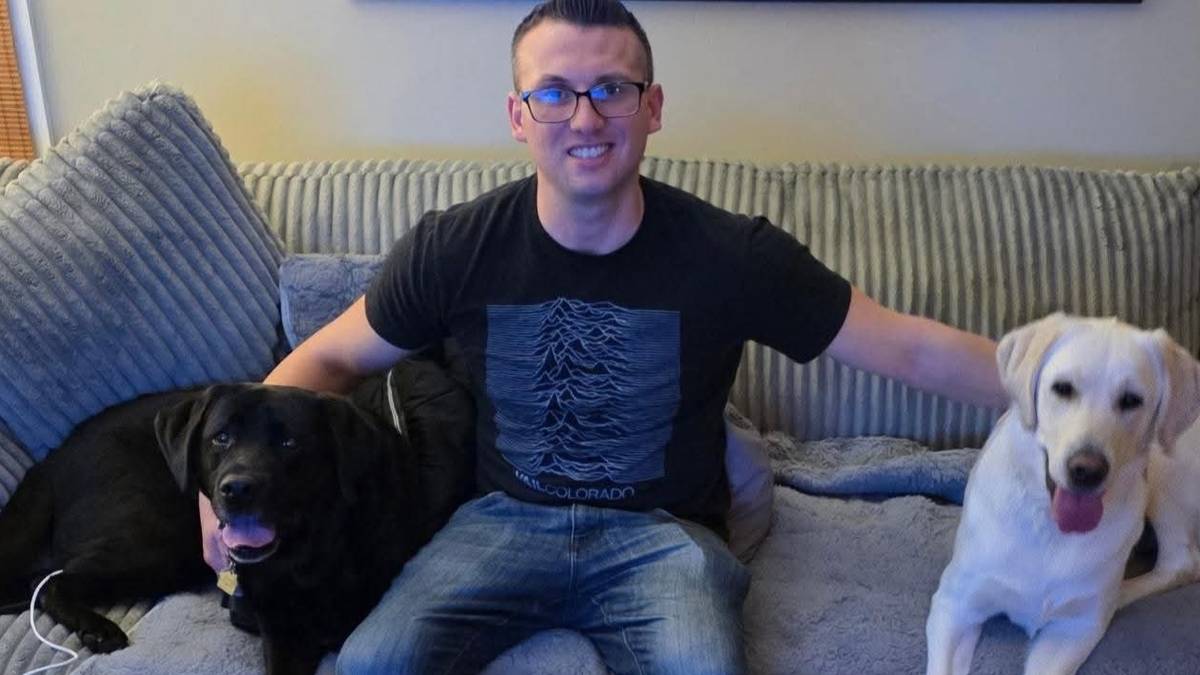

Tyler McGibbon suffered a traumatic brain injury (TBI) while deployed to the Middle East more than a decade ago. But with the help of his spouse and a pair of canines, he’s now looking at the bright side of life.
He is one of many U.S. military veterans who have benefited from the national nonprofit America’s VetDogs, which provides service dogs to veterans and first responders with disabilities, free of charge, and raising awareness about the critical role they play in supporting individuals living with TBI.
McGibbon, 31, of New Jersey, served for four years and six months in the U.S. Army. On Dec. 21, 2014, the sergeant and his colleagues were retraining Iraqi soldiers and traveling back and forth from Iraq to Kuwait in a Humvee. He didn’t know at the time, but that day his life would change forever.
“We were heading back to base and my line of duty report is blacked out,” McGibbon told Military.com. “What I’m told is the Humvee rolled over, and I got thrown about 35 to 40 feet.”
He broke and fractured his entire skull, broke and fractured his whole face, broke and dislocated his jaw, suffered cervical fractures, breaks to the top six vertebrae in his neck (C1 to C6), a broken right clavicle, and a broken and fractured lumbar spine from his L4 down my tailbone.
And that wasn’t all. He suffered two brain injuries, a severe TBI, and a very sphere Diffuse Axonal Injury, or DAI, that occurs upon rapid brain shifts or twists that tear nerve fibers.
McGibbon said he “died seven times” and was in a coma for three months. He required emergency brain surgery.
Long Road to Recovery
When the Army veteran re-emerged from his coma on March 3, 2015, at a hospital in Richmond, Va., he had to relearn how to walk, talk, eat, drink—everything one can imagine.
“It took me, just to be able to get up without assistance and stand up without assistance, probably about six months,” said McGibbon, who speaks with a speech impediment. “And then, when I was able to not use assistance, I would be walking very, very wide. My legs would be like really, really far apart to make sure I didn’t fall.
“But I couldn’t talk or eat or drink or anything. It sucks.”
It resulted in a 2 1/2 year hospital stay, from 2014 into 2017. He underwent therapy at Walter Reed and officially left the service in 2017. The past nine years have been one long attempt to reclaim his individuality.
“It’s been really difficult, but I’ve been just speaking as much as I can for people and spreading awareness about TBIs,” McGibbon said. “You can be passing me and think, ‘Oh, that guy’s fine.’ But there are so many issues I face.
“My memory is awful, I rely heavily on my wife. It’s not just a factor of writing stuff down for me because I can type something down on my notes on my phone, but totally forget to even look at it or even want to look at it.”
Trooper, Cody are Man’s Best Friends
Following his long hospital stint and while still on the road to recovery, McGibbon was provided the opportunity to have service dogs. It provided a light in his life for the first time in a long time.
More than 430,000 service members have been diagnosed with TBI since 2000, according to the Department of Defense. Organizations like America’s VetDogs train these highly skilled service dogs to help mitigate symptoms and increase independence, safety and quality of life.
Such support mechanisms that canines provide those with TBI include retrieval, whether that’s assisting individuals with dropped items, mobility assistance, access to medication, or aiding in case of an emergency. Dogs can also alert smart systems by FaceTiming emergency contacts, reducing anxiety and stress overload, and either provide comfort or seek help when seizures occur.
For McGibbon, who actually never wanted to leave the military, the canines were a savior. He endured more than 5,000 therapy-related appointments and was on the verge of the next phase of his life.
“I got really depressed and I didn’t know what to do,” he said. “Then, I got told I would be getting Trooper and all I cared about was getting out and seeing Trooper. That really gave me a new perspective on life.”
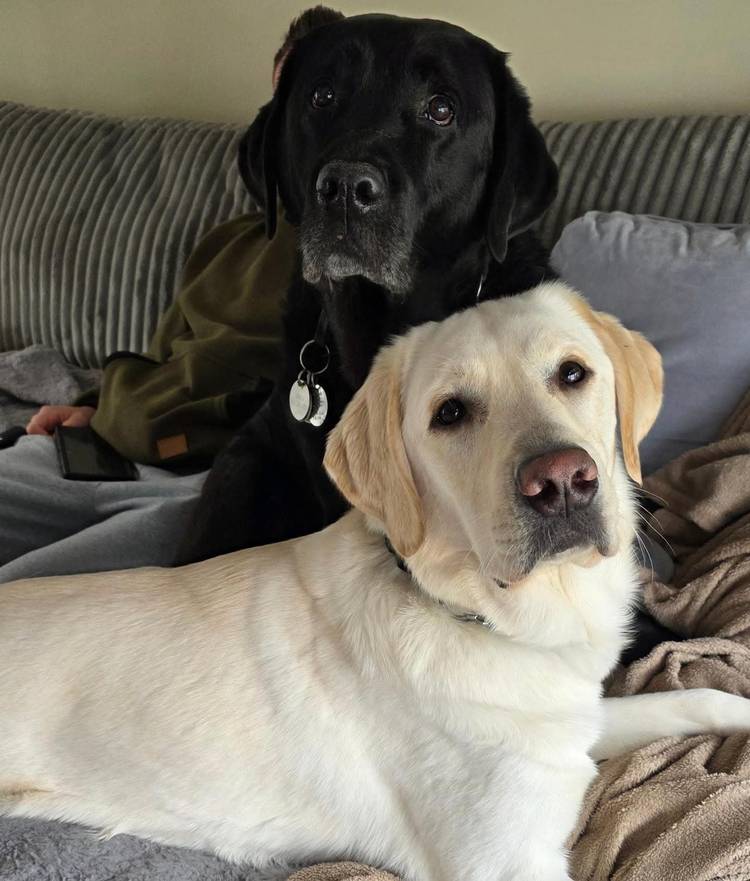
Trooper, a now retired service dog, is a black Labrador “literally the size of a bear,” as described by McGibbon.
The successor for Trooper is Cody, a golden wet Lab mix, who is trained for seizure response, mobility, opening up doors, and retrieving items off the ground due to McGibbon’s back injuries.
“These dogs are trained specifically to your tasks and needs, to what you need that you can’t do anymore,” McGibbon said. “They worked their whole lives just loving you, caring for you, for a portion of your life.
“You love them for their whole life. But their whole life, all they know is you. And all they care for is you. Without Trooper or Cody, I would not be where I am today.”
Wife ‘Blessed’ McGibbon
McGibbon said he wouldn’t know where his life would be today without those canines, as well as his wife.
He met Natalie in 2013 when she was his neighbor, though the two hadn’t yet formally met. McGibbon noticed her walking her dog around the neighborhood, the pair would exchange quick hellos and that was that.
One day, Natalie learned McGibbon’s story when it was posted on social media. She messaged him and the two began to converse. That led to a date, and then in June 2025, the couple got married.
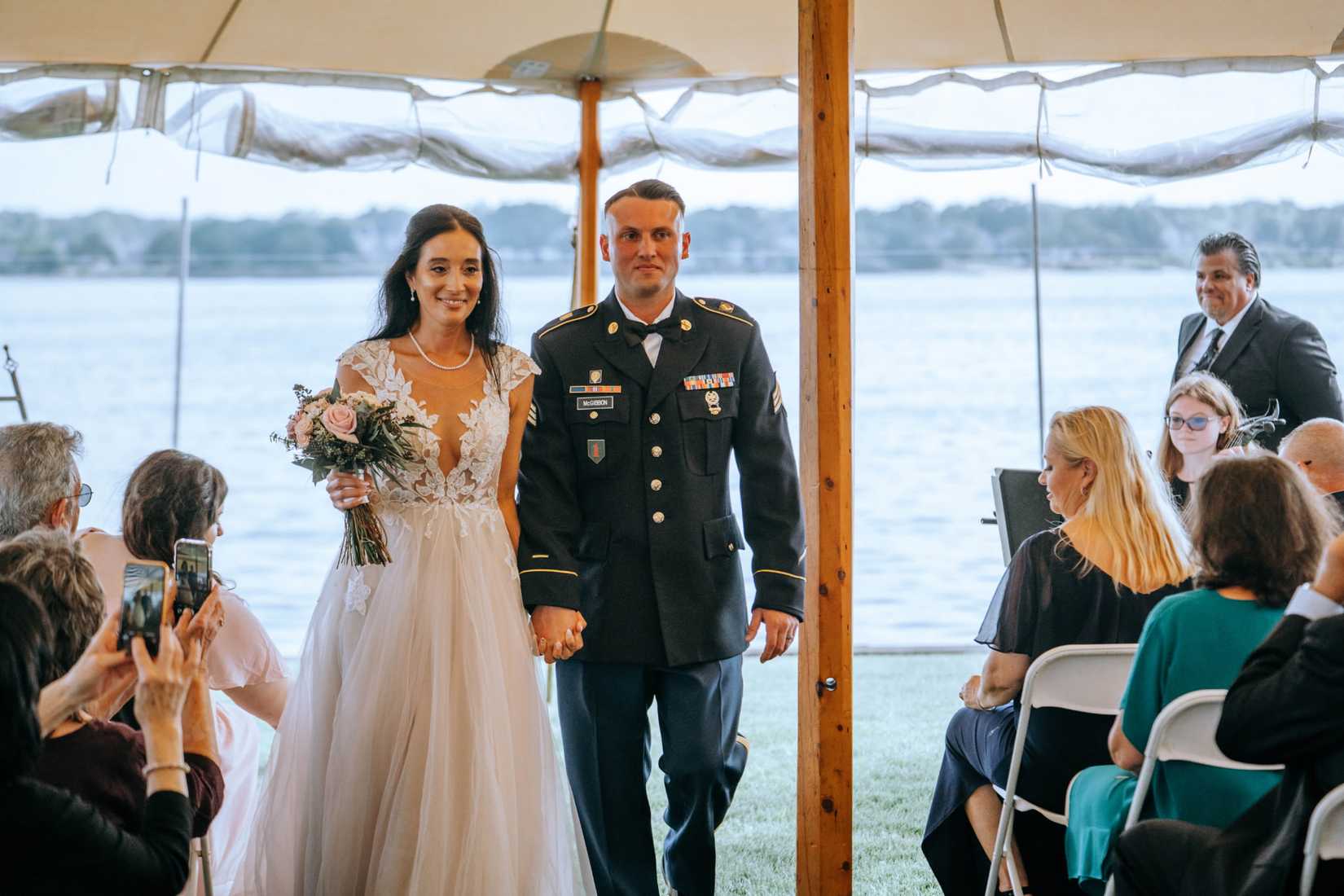
“My wife has really just blessed me because she has been there for me,” he said. “We met after my injury, so she didn’t know me before my brain injury.”
It really feels good to know that she loves me just for who I am and not for who I was, because she didn’t know the old me.
McGibbon cannot work in the usual context, but he does what he’s able to in other ways. That translates to walking the dogs with Natalie, or helping her clean the house.
The pair go to the gym and work out together, though he acknowledges the sessions these days are quite different from his military heyday.
“She also just helps me day to day with my memory, [she] cooks for me because I can’t cut and stuff like that,” he said. “I can’t really feel the rest of my body. My nerves on the rest of my body are shot.”
Spreading Awareness of TBIs
McGibbon said that TBI is perhaps more misconstrued than noticeably physical injuries sustained by service members, or even among the general population that is familiar with PTSD and its effects.
“There is some awareness of TBI or brain injury, but people don’t still take it [seriously] and understand my injury,” he said. “They’re still treating it as if you broke a bone.
“If I broke a bone, yes, it’ll heal. And then maybe later on in life, I can get arthritis in that area. But a brain, you suffer every day with all neurological and cognitive defects of that injury, and at random times you can have a wonderful day and not even be known that you have an injury.”
Some days, McGibbon is fine. Others, he stays inside or in his bed, with his brain “on fire” and his speech not emoting. Walking can feel impossible.
“Just even just thinking of what to say, like, it all goes away,” he added. “It all shuts down, and people don’t understand that. When you try to explain it—some people, not all people—will just go, ‘Oh, well, it’s OK.’ It’s not OK, it’s this big issue I deal with.”
He painted the picture of how TBI causes the brain to slow down, requiring piecing together words like a puzzle inside one’s head before it can vocally be stated.
“That’s why I talk really slow because I’m speaking it out in my head before I even can say the words, so I can make sure that I’m understandable and coherent of my speech,” he said. “It takes a lot of energy out of me having to do that all day long.”
Asked how others like him can find that bright side of life, considering the circumstances, McGibbon recommends a service dog—or two.
“I didn’t think I needed a service dog at first,” he said. “I didn’t think I needed help for this, help for that. But after I got my first service dog, the days of just sitting there and then him coming out to greet me was a huge, huge relief.
“Working with him, I realized I was back on a team. It was, ‘I’m right here with him and he has my back and I have his back.’ This is better than any meds the doctor [can give], the VA can give. It has just been amazing.”
Read the full article here
