



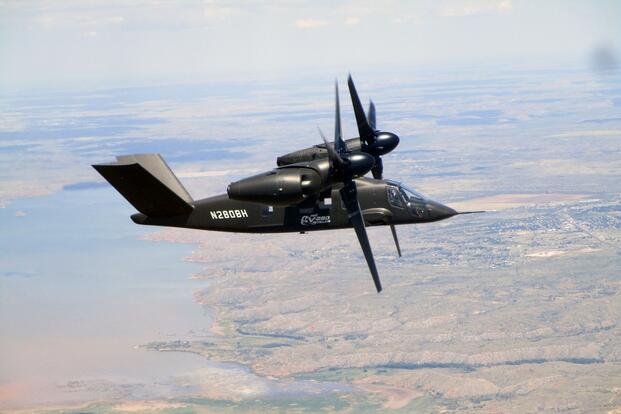

The U.S. Army officially named its next-generation assault aircraft the MV-75 Cheyenne II on April 15, attaching a name with deep roots in Plains warrior history and a lineage that reaches back to a Cold War helicopter program that never made it to the fleet.
The announcement came during the Army Aviation Association of America’s annual Army Aviation Warfighting Summit in Nashville, Tennessee. Members of the Northern Cheyenne Tribe and the Cheyenne and Arapaho Tribes were in the audience for the announcement according to the Army.
The aircraft, built by Bell Textron and previously known as the V-280 Valor, will replace the UH-60 Black Hawk as the Army’s primary assault helicopter.
A Program Three Years in the Making
The MV-75 pairs the vertical agility of a helicopter with the forward speed and reach of a fixed-wing aircraft. Its rotors swivel from vertical for takeoff and landing to horizontal for cruise flight, a configuration the Army says will let it fly roughly twice as fast and twice as far as the current fleet.
Bell’s V-280 demonstrator first flew out of Amarillo, Texas, on Dec. 18, 2017. It cleared its 280-knot target in January 2019 and pushed past 300 knots in later testing. The Army selected Bell over a competing Sikorsky-Boeing design called the SB-1 Defiant X in December 2022, and the Government Accountability Office turned back a Sikorsky protest the following April.
The service attached the MV-75 mission designator in May 2025. The Cheyenne II name was officially announced at the Aviation Warfighting Summit.
Brent G. Ingraham, assistant secretary of the Army for acquisition, logistics and technology, said the aircraft’s performance envelope will allow for “full squad insertion at extended range, expanding medevac reach well beyond today’s golden hour, and enabling large-scale, long-range air assault operations that can reshape the battlefield.”
The letters “MV” stand for multi-mission vertical takeoff, and the number 75 marks the year the Continental Congress established the Army in 1775. The service says it is the first entirely new airframe brought into Army inventory since the 1980s, built around a modular digital architecture designed to take new weapons, sensors and software without a full redesign.
Bell has begun assembling the first six test aircraft at its facility in Wichita, Kansas. Rolls-Royce is testing the AE 1107F engine that will power the platform. The 101st Combat Aviation Brigade at Fort Campbell, Kentucky, will be the first unit to field it.
A Unique Naming Tradition
Army officials said they evaluated more than 500 Native American tribes before landing on Cheyenne, continuing a custom that goes back decades.
The tradition traces to 1947, when Gen. Hamilton Howze was assigned to Army aviation after the Air Force split off as its own service. Howze wanted names that reflected what helicopters could do, not what they looked like.
He disliked the names of the two earliest Army helicopters, the Hoverfly and the Dragonfly. The service’s next helicopter, the H-13 of “M.A.S.H.” fame, became the Sioux, a nod to the Plains tribes who had fought and defeated the 7th Cavalry at the Little Bighorn.
The practice became written policy in 1969 with Army Regulation 70-28, which required aircraft names to be drawn from “Indian terms and names of American Indian tribes and chiefs,” with candidate names supplied by the Bureau of Indian Affairs.
The regulation also demanded that a name “appeal to the imagination without sacrificing dignity,” suggest an aggressive spirit, and reflect mobility, agility, flexibility, firepower and endurance.
The rule has since been rescinded, but the custom stuck. Apache, Black Hawk, Chinook, Kiowa and Lakota names all came out of it.
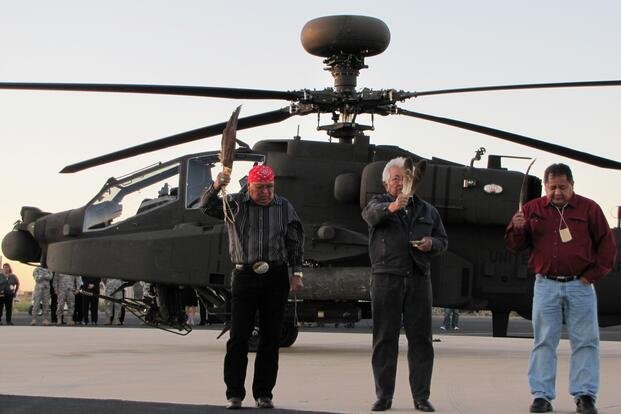
The Army has at times sought formal tribal blessing for the aircraft. In June 2012, Lakota elders blessed two new UH-72A Lakota helicopters belonging to the South Dakota Army National Guard in a ceremony at the Standing Rock Reservation.
On the MV-75, Col. Jeffrey Poquette, the project manager, said in an Army release that the service was “honored to have the Cheyenne tribes’ approval to use their name.”
The Cheyenne inhabited the Great Plains for roughly 400 years as nomadic buffalo hunters, fighting as mounted warriors across a range that once stretched from Montana into Texas. Today the people are represented by two federally recognized governments, the Northern Cheyenne Tribe in Montana and the Cheyenne and Arapaho Tribes in Oklahoma.
The “II” in the new aircraft’s name carries its own history. Lockheed’s AH-56 Cheyenne, developed in the 1960s under the Advanced Aerial Fire Support System program, was an ambitious compound helicopter with a rigid four-blade main rotor and a pusher propeller mounted at the tail.
Its prototype first flew on Sept. 21, 1967, at Van Nuys Airport in California. It hit 245 knots in a dive during testing but was plagued by rotor vibration, rising unit costs and a fatal crash in March 1969. The secretary of the Army terminated the program on Aug. 9, 1972, and the attack helicopter mission eventually passed to the AH-64 Apache.
Why the Black Hawk Is Making Way
The Black Hawk the MV-75 will begin to replace first flew in October 1974. It was built for a different kind of war, one fought in shorter hops between forward operating bases, against adversaries without sophisticated integrated air defenses.
The future fight the Army now plans for looks different. Service doctrine on operations in the Indo-Pacific refers openly to the “tyranny of distance” across the region, and Army aviation has been rehearsing what to do about it.
In November 2025, the 25th Combat Aviation Brigade flew long-range maritime air assault missions across open ocean out of Ford Island, Hawaii, during a joint training rotation.
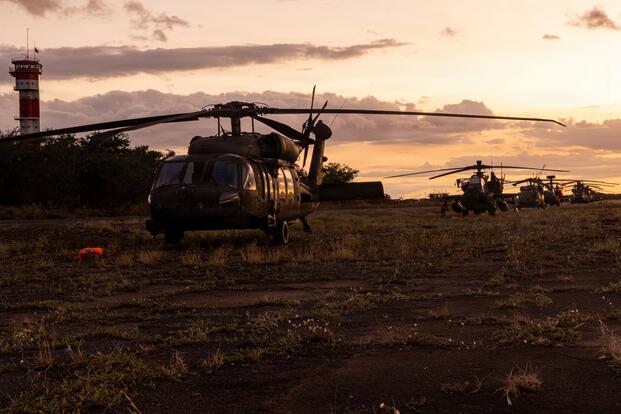
The brigade had spent the prior months partnering with the Marine Corps to learn an expeditionary ground refueling system so its Chinooks and Black Hawks could reach targets across the archipelago. The MV-75 is designed so that kind of workaround is not required.
The Army plans to replace a substantial portion of its more than 2,000 Black Hawks with the Cheyenne II over the coming decades.
Col. Tyler Partridge, commander of the 101st Combat Aviation Brigade, said in an Army release that the speed and range of the new tiltrotor would “fundamentally change how we conduct air assaults.”
His unit is expected to take delivery of the first Cheyenne IIs in 2027.
Read the full article here
