



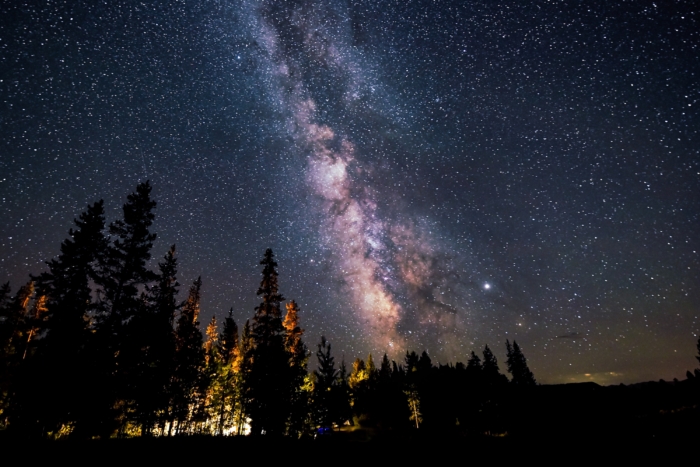

Wyoming by day is a playground without fences — biking, hiking, fishing, four-wheeling, or just picnicking on a carpet of wildflowers. But it doesn’t end when the sun slides behind the horizon. Come nighttime, Wyoming puts on a show unlike any you’ve seen before.
Out here, where pronghorn antelope outnumber people and your campfire is the only light for miles, the cosmos comes alive. There’s just you, your rig, and a sky so dark and clear that you understand for the first time why it’s called the Milky Way.
Wyoming has some of the darkest skies in the Lower 48 — a black velvet backdrop for a banquet of diamonds. Whether you’re an astronomer with serious equipment or someone who wants to see what the night sky looked like in the days before Edison, here are some of the best dark-sky RV camping spots in the state. Just pull off the road and look up. The universe is waiting.
Sinks Canyon State Park, tucked in the Wind River Range near Lander, is the home of a mystical disappearing river, the Popo Agie. (The river disappears into a cave system called The Sinks, and then reappears downstream at The Rise.) Wyoming’s first designated International Dark Sky Park, its towering limestone walls act as a natural amphitheater to view more of nature’s ancient mysteries.
The park hosts ranger-led astronomy programs and offers RV camping at The Sawmill and Popo Agie campgrounds. Summertime visitors can time their trip to coincide with the Perseid meteor shower, which gives onlookers thousands of opportunities to wish on falling stars.
Rising 867 feet with a summit that’s a football field long, Devils Tower is already impressive in daylight. But at night, this geological wonder held sacred by the Northern Plains Tribes becomes a monolith around which the stars and planets dance. America’s first national monument is also an International Dark Sky Park, and it offers some of the most spectacular stargazing in the nation.
The Belle Fourche River Campground sits right at the monument’s base, with full hookups for RVs up to 35 feet. The monument hosts regular evening astronomy programs where rangers set up telescopes and help you navigate the night sky. Bring a red flashlight to preserve your night vision.
Just 24 miles west of Cheyenne, Curt Gowdy State Park is one of the most accessible stargazing sites — and one of the most amenity-rich for RVers. Named after the legendary sports broadcaster who loved fly fishing here, the park straddles the Laramie Mountains and offers exceptional dark skies in close proximity to civilization.
RVers have three reservoirs and 12 camping areas to choose from, with sites accommodating rigs up to 50 feet. The Granite Springs and Lakeview campgrounds both offer electric hookups and access to open areas perfect for watching the stars rise overhead.
When you want to really escape, the Medicine Bow–Routt National Forest is Wyoming in its purest form — vast, pristine, and wild. The high elevations here, between 8,000 and 12,000 feet, offer a sky that’s free from atmospheric moisture and light scatter, which makes for crystal clear stargazing.
The Snowy Range Scenic Byway provides access to dozens of dispersed camping sites where RVs are welcome. There aren’t any developed campgrounds — you’re on your own for facilities — but if you’ve got a self-contained rig, you’re in for a show. For developed options, try Pelton Creek, North Fork, or Silver Lake campgrounds — all can accommodate larger RVs.
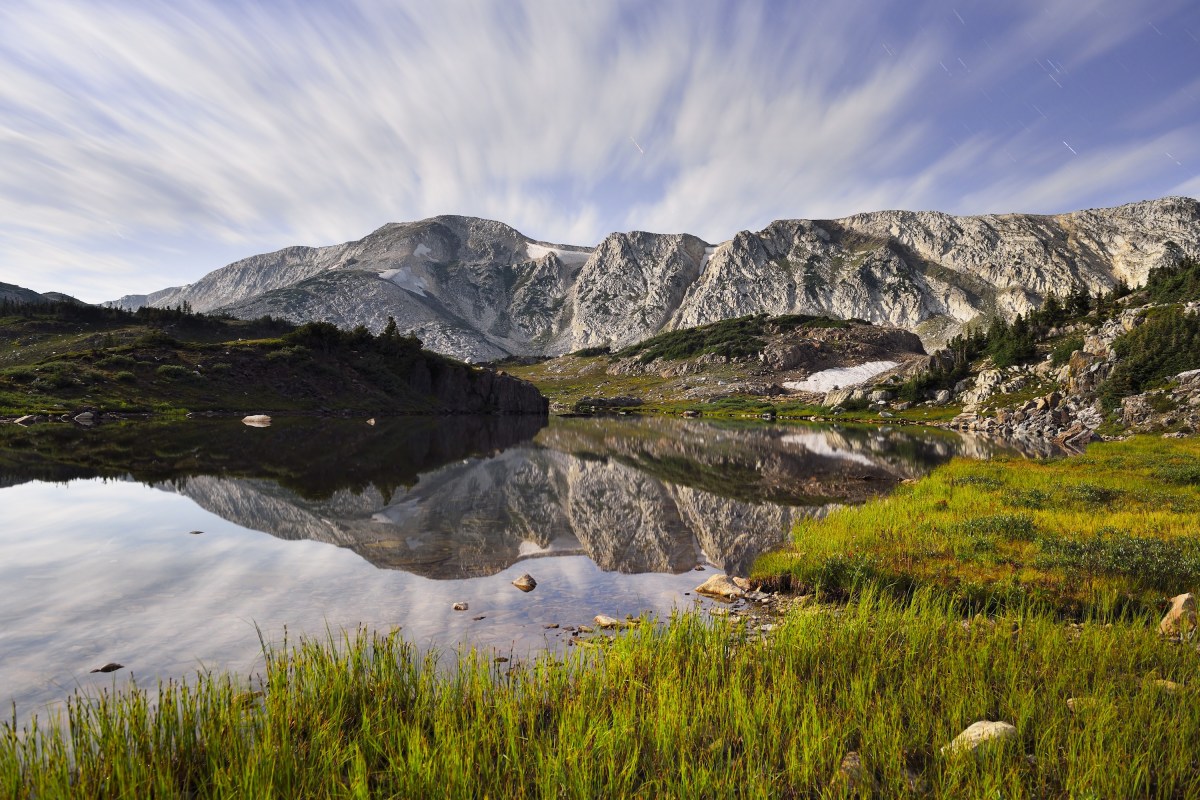
These “singing” dunes of sand, which boom and shift rhythmically, are a unique spot to stargaze, offering open Red Desert skies in every direction. The closest town is Rock Springs, 32 miles away, which means light pollution isn’t a thing out here.
The Open Play Area Campground is free and RV-accessible. For daytime adventure, check out the nearby White Mountain Petroglyphs and Boar’s Tusk geological formation.
Wyoming’s second-largest natural lake sits at an elevation of 7,400 feet at the foot of the Wind River Range near Pinedale. The camping sites are private, lakeside, and RV-accessible, a far cry from a traditional campground. The lake itself is a mirror for the stars above, and the skies are so dark that Pinedale markets itself as a stargazing destination. For a completely unobstructed view, head down to the Fremont Lake Lower Boat Dock for a sunset happy hour followed by the starry show.
Making the Most of Your Dark Sky Adventure
A few tips to maximize your night under the stars:
Time it right. The 2 weeks around the new moon offer the darkest skies. Even a quarter moon significantly reduces visible stars.
Download sky-watching apps. Apps like SkySafari or Stellarium help identify what you’re seeing. Switch them to night mode (red screen) to preserve your night vision.
Dress in layers. Wyoming nights can drop 30-40 degrees after sunset, even in summer.
Give your eyes time. Full dark adaptation takes 20-30 minutes. Use red flashlights during this period.
People always talk about Wyoming’s wide open spaces, but the widest of them all is straight up. So block some time on your calendar, pack your bags, and get ready for the oldest show on Earth.
This article is sponsored by the Wyoming Office of Tourism.
Read the full article here
