



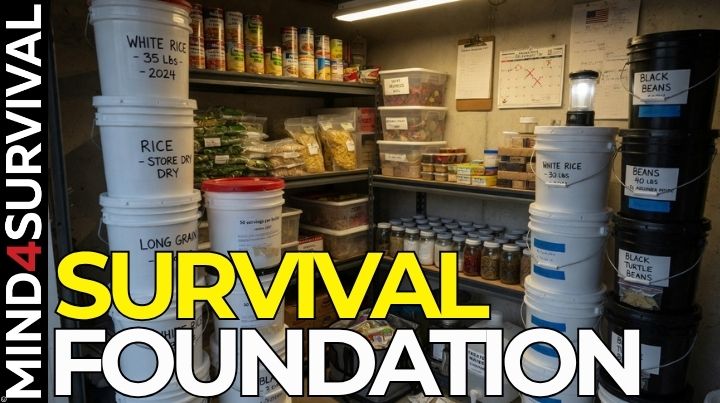

When disaster strikes, there is no room for guesswork when it comes to your food. You need to know what you have, how much, and how long it will last you. A well-prepared food supply addresses one of your most critical needs. When it comes to food prep, the bottom line is that if you run out, you and your family will find yourselves on a survival countdown.
Food prepping is not about throwing random cans of food into a dark cabinet and hoping for the best. It is about building a layered, intentional system on top of a solid foundation that you can live on. And when it comes to long-term storage survival foods, the most practical foundation to build on is bulk dry rice and beans.
Rice and dry beans form the backbone of a long-lasting preparedness pantry. They cost very little, store for 20+ years when properly sealed, and can get you through the toughest of times. While you would not want to live on rice and beans alone for the rest of your life, you absolutely can survive on them. This simple combination provides the energy, protein, and fiber your body requires to function.
By understanding how to use these two everyday staples, you can easily create the confidence that no matter what, you will have something to eat when many others may be going hungry. By establishing a food pantry foundation of rice and beans, you’ll be set with a generation of food preparedness and the peace of mind that comes from knowing your family will always have a warm, filling meal, no matter what happens outside your front door.
Disclaimer: This article contains affiliate links through which I may receive a small commission at no cost to you if you choose to purchase a product through a link on this page.
TL;DR Combining white rice and black beans creates a complete protein profile that supplies all nine essential amino acids necessary for muscle repair and immune strength.
Quick Look at What You’ll Learn
Why Rice and Beans Form a Solid Foundation
One of the smartest advantages of pairing rice with beans is the protein quality they provide. Your body relies on nine essential amino acids that it cannot produce on its own. These building blocks support muscle repair, immune strength, and overall resilience.
Grains like rice provide solid carbohydrates for fuel but lack enough lysine, a crucial amino acid. Beans deliver plenty of lysine but fall short on methionine. When you combine the two, each fills in the gaps left by the other. This natural teamwork creates a complete protein profile. It matches what you would normally get from expensive animal sources.
You do not even need to eat them in the exact same bite. If you consume a bowl of rice at lunch and a serving of beans at dinner, your body efficiently pools the amino acids. You get the full nutritional benefit on the same day.
This plant-based protein supports satiety, keeping you full longer on fewer calories. The fiber from the beans aids digestion and helps maintain steady blood sugar levels. Meanwhile, the carbohydrates from the rice provide sustained energy without sharp spikes and crashes.
Daily Meal Plan: The 3,000-Calorie Foundation
Preppers often ask, how many calories per day do people need. The regurgitated answer, that you’ll hear over and over again, is to plan on 2,000-calories per day. And that’s great. I’d much rather have 2,000 calories per day than zero. For many people, planning to eat only 2,000 calories per day is planning to starve, which is not what we prepare for.
In a crisis, calories are fuel. They keep you moving, thinking, and working. With that, a young, active male needs around 3,000 calories a day to maintain strength. Therefore, if you want a foolproof food stockpile, plan for 3,000 calories per person. That number will ensure everyone is covered. If you have people who need fewer than 3,000 calories per day, it will create a buffer. And when it comes to the possibility of running out of food, a buffer is always a good idea.
Daily Caloric Needs by Age and Sex
If you’re like me, you want to know exactly how much you need and how many days of supply you have on hand. Here are typical daily calorie needs based on standard guidelines. These numbers vary with exact age, weight, height, and activity level, but they provide a clear starting point for planning your pantry.
Note: These portions keep your rice and beans buckets emptying at the same rate, so you never run out of one before the other. Use this table to size meals for everyone in your household.
The Balanced Bucket Ratio
The daily recipe uses a balanced bucket ratio that empties a 5-gallon bucket of rice and a 5-gallon bucket of beans simultaneously. The portions in the daily recipe keep the rice-to-beans ratio steady so both buckets finish together. Meals remain satisfying, affordable, and packed with complementary protein that supports strength and energy.
5-Gallon Bucket Storage Capacity
A standard 5-gallon food-grade bucket lined with a properly sized Mylar bag and sealed using best practices holds approximately:
- Rice: 35–37 pounds of long-grain white rice
- Beans: 32–34 pounds of dry black beans (or similar beans like pinto or kidney)
Food Grade Buckets and Mylar Bags
With best practices—using a 5- or 7-mil Mylar bag that fits the bucket, filling to about 1 inch from the top, gently shaking and tapping to settle the product for maximum density, adding 2,000–3,000 cc of oxygen absorbers, removing as much air as possible, and heat-sealing the bag before snapping on an airtight gamma-seal lid — you create an oxygen-free, moisture-protected environment that keeps rice and beans fresh and viable for 25–30+ years. This method locks out moisture, pests, and oxygen, ensuring your food stays safe and edible for decades.
Rice packs down a bit denser than beans, which is why there is a weight difference even though both fill the same volume. This reliable method gives you a clean, balanced, long-term foundation that pairs perfectly with the rice-and-beans calorie plans while making storage simple and space-efficient. One well-packed bucket of each becomes a solid building block for your pantry.
Pro-Tip: Dry rice and beans are shelf-stable and retain their taste and quality for a year or more. Therefore, if you’re just starting out, you don’t need to get food-grade buckets and mylar bags to get going. Just get your rice and beans set and stored in a cool, dry place, and you’ll be better prepared.
Your Long-Term Storage Goals
Based on the recipe above. How much rice and beans should you store? That answer depends on your prepping tolerance. If you think a week of food is more than enough, then that’s what you should prep. However, if you’re like most preppers, you think in terms of months (30-days) and years.
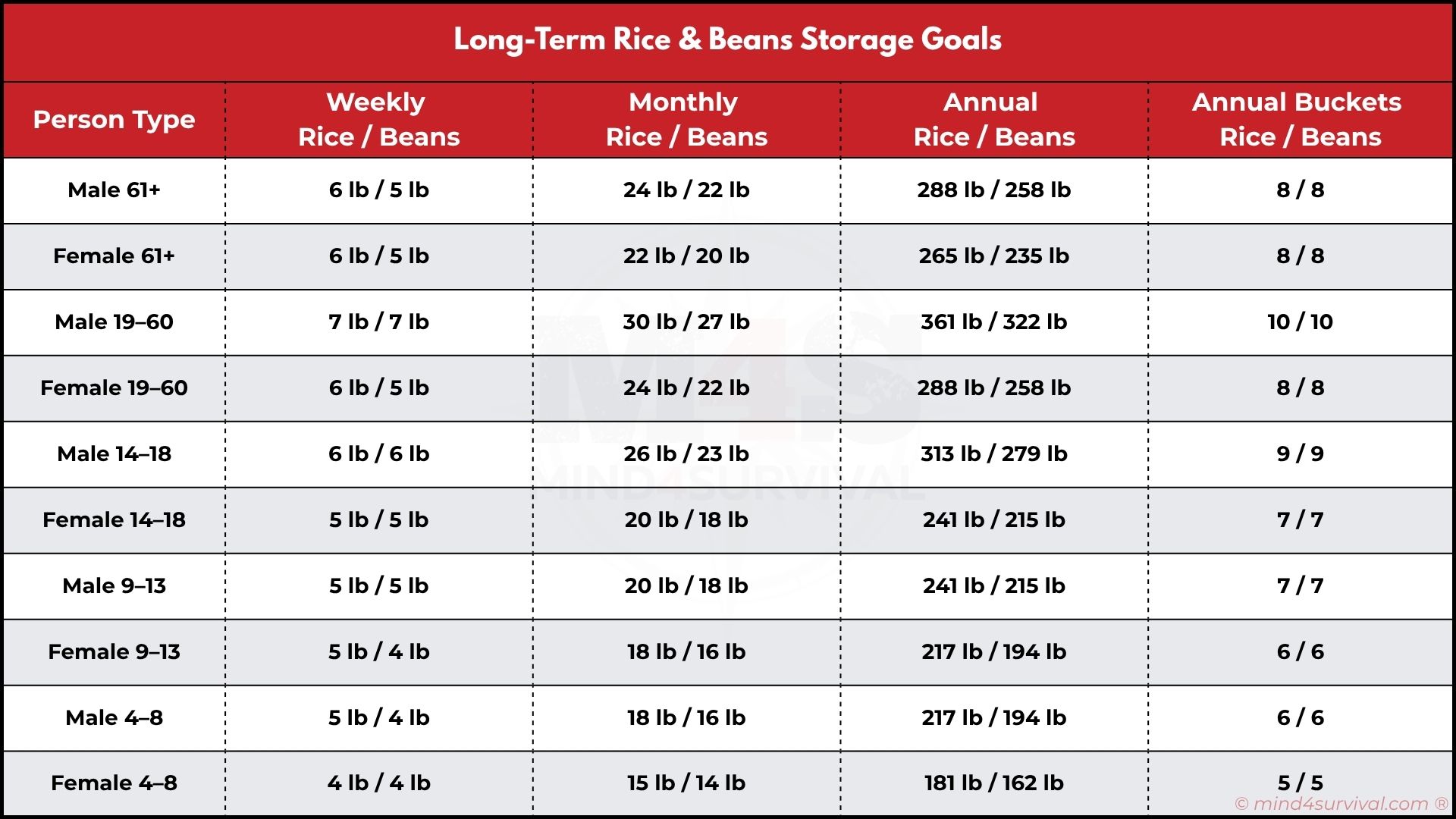
Note: All weights are rounded up to the nearest pound, so you always have a small safety buffer. Start with the 30-day column and scale up when you’re ready.
Rice and beans make an affordable, space-saving foundation that delivers complete protein and steady energy for everyone in the household.
Pro-Tip: Many preppers freeze their rice for a few days before storing it to kill any bugs/eggs that may be inside. Might be worth mentioning.
The True Cost of a Rice and Beans Stockpile
Building a practical food stockpile does not require draining your bank account. You can create a solid foundation of calories and protein for a fraction of the cost of commercial survival meals. By focusing on bulk dry goods, you can create an affordable food pantry that will feed you and your family when others don’t know where their next meal is coming from.
Currently, a 10-pound bag of dry white rice costs about $8.98 on Amazon. A 4-pound bag of dry black beans runs roughly $7.08. Using these prices and the amounts above, you can accurately project the cost of building both a short-term and a long-term survival food pantry.
The 30-Day Supply
A one-month supply is the perfect starting point for any family. To meet the highest level, the 3,000-calorie daily baseline for one active adult for 30 days, you need 29 pounds and 10 ounces of rice, alongside 26 pounds and 7 ounces of beans.
- Rice: You will need six 5-pound bags. This costs approximately $27.
- Beans: You will need seven 4-pound bags. This totals roughly $50.
- Total Monthly Cost: For under $80, you can secure a reliable 30-day supply of foundational food to get you through the worst of times. That’s less than $20 for a week of food, which, while not ideal, will keep you going.
This budget-friendly approach makes preparedness accessible to nearly anyone. You can build this one-month buffer simply by adding an extra bag or two to your normal grocery runs.
Scaling Up to a One-Year Supply
Once you establish your 30-day foundation, you can easily scale up to a one-year supply. An active adult requires 361 pounds of rice annually. For beans, you need 322 pounds to maintain the correct nutritional ratio.
- Annual Rice: Purchasing 36 bags (10 pounds each) costs around $323.
- Annual Beans: Buying 81 bags (4 pounds each) totals roughly $573.
- Total Annual Cost: You can build a complete, one-year food foundation for just under $900.
If a year’s worth of food is something you’re concerned with, spending $900 to ensure an entire year of food preparedness is, in my opinion, an incredibly smart investment. You lock in today’s prices and protect your family from future supply chain disruptions or inflation.
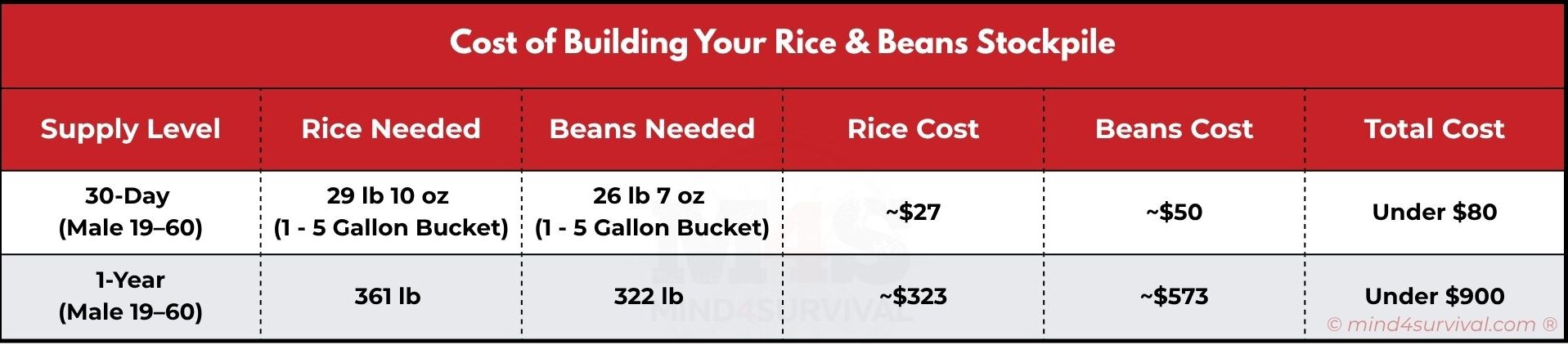
Note: Prices are based on current Amazon bulk-bag costs in the article. Add extra bags to your regular grocery run — no big upfront hit required.
Take Action Today
Preparedness starts with simple, actionable steps. You do not need to buy a one-year supply all at once. Start small, build your 30-day baseline, and practice storing your food in proper buckets. Grab your first few bags of rice and beans this week, and take immediate control of your family’s readiness.
How Long Should You Prepare For?
When building a food stockpile, the big question many people have is: how much is enough? It’s easy to feel overwhelmed when trying to figure it all out, but it’s not that hard to make it happen with a plan to scale up your preps over time. So, let’s discuss your 7-day minimum stockpile and the 30-day base that I recommend.
The Critical 7-Day Base
Start with a seven-day supply. This foundation allows you to outlast everything you’re likely to experience in the form of immediate disasters, such as power grid failures or severe weather events. In most modern emergencies, help usually arrives in less than a week. Therefore, for less than $20.00, you can create a seven-day buffer that should handle anything you’ll face in your lifetime.
Expanding to a 30-Day Stockpile
However, for those who want to be prepared for an extremely unlikely SHTF event that forces you to sustain yourself for longer, I recommend aiming for at least 30 days of self-sufficiency. This level of events causes our society of modern conveniences to buckle, bend, and sometimes break.
Whereas a seven-day supply is about waiting for help, a 30-day supply is about taking control of your future. It buys you the most valuable asset: time. With a month’s worth of food, you can assess the ongoing situation and plan your next moves as things develop. If needed, it also gives you time to find additional food without the pressure of being out of food and hungry with no guarantees.
Your 30-day food stockpile starts with your seven-day food supply. Then, add more rice and beans to expand your supply to 30 days. Sure, it’s 30 days of bland rice and beans—and you now have a fallback that, while not an exciting meal, will keep you alive and ready to go.
You’ll be happy knowing you have a full month of readiness to handle whatever comes your way. Besides, if you don’t need the full month’s worth of food, you’ll have extra to help others who may not be as forward-thinking as you. That’s a good thing.
Recommended Daily Macronutrients
When planning your emergency food stockpile, it’s essential to understand the recommended daily macronutrient intake to ensure balanced nutrition. While individual needs can vary based on age, gender, and activity level, general guidelines for an average adult are:
- Protein: 10-35% of daily calories, roughly 75-263 grams for a 3,000-calorie diet. Protein is critical for muscle repair, immune function, and overall body maintenance.
- Carbohydrates: 45-65% of daily calories, approximately 338-488 grams for a 3,000-calorie diet. Carbs are your body’s primary energy source and help maintain stamina and focus.
- Fat: 20-35% of daily calories, around 67-117 grams for a 3,000-calorie diet. Fats are essential for energy, brain health, and nutrient absorption.
Adjust these ratios based on personal circumstances, such as health conditions or physical demands, but aim to maintain a balance that supports sustained energy and overall well-being during emergencies.
Look at the macronutrient breakdown. This is your baseline. It takes care of your calories so you survive. And that is where you start customizing. Use this basic plan as your foundation and adjust it to meet your specific dietary needs. Your goal is to fill those gaps, transforming a survival diet into one that truly sustains you and your family. Do you want more fat, fewer carbs, or different flavors? It’s your pantry, make it your own.
Macronutrient Breakdown of Rice and Beans Meal Plan
Let’s break down what these meal plans give you in terms of macronutrients. Understanding your macro needs helps you see what you have on hand and what you need to add to achieve a well-rounded diet.
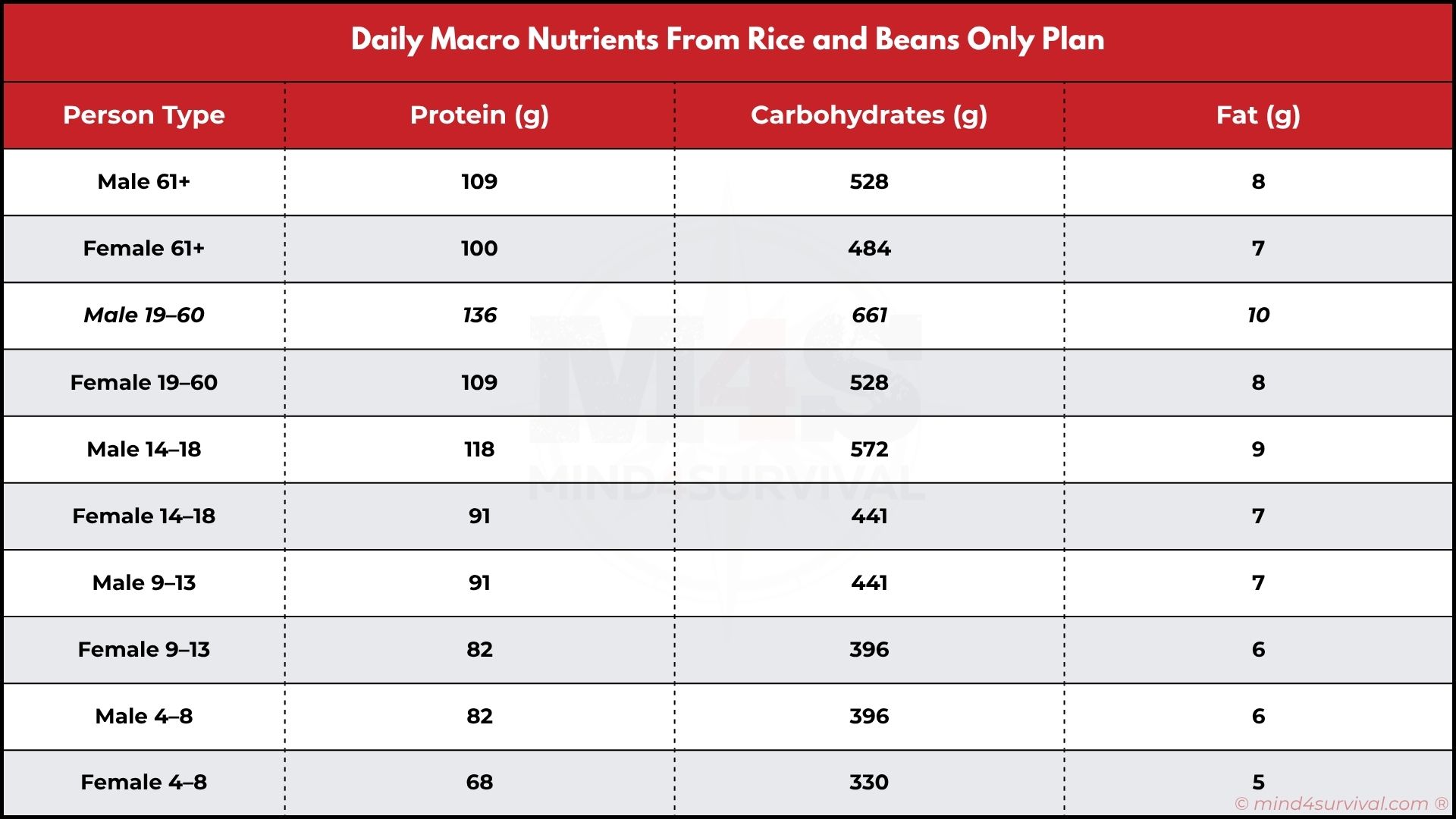
Note: This is your daily baseline. Use it to decide what to layer on top — canned meat for fat, powdered milk for calcium, or vitamins for the gaps.
Look at the macronutrient breakdown. This is your baseline. It takes care of your calories so you can survive. And that is where you start customizing. Use this basic plan as your foundation and adjust it to meet your specific dietary needs. Your goal is to fill those gaps, transforming a survival diet into one that truly sustains you and your family. Do you want more fat, fewer carbs, or different flavors? It’s your pantry, make it your own.
Dialing in Your Nutrients
For those of you who want to calculate your nutrients down to the ounce, here are the numbers for rice and beans.
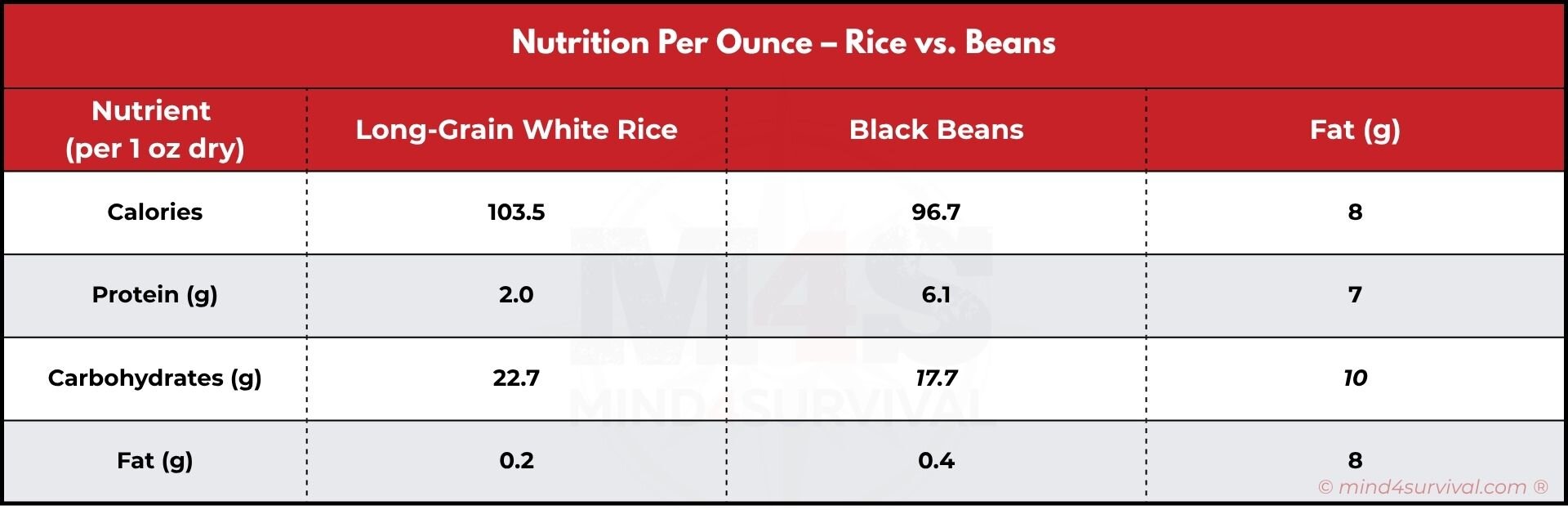
Note: Combine these two, and you get complete protein without expensive meat. Perfect starting point for your pantry.
The Nutritional Gaps
You can survive on a strict diet of rice and beans, but this combination is not perfect. While it covers your carbohydrates, protein, and fiber beautifully, it misses key items over the long haul.
A diet consisting solely of rice and beans lacks vitamin C, which is vital for immune support and iron absorption. It also falls short on vitamin A, vitamin D, calcium, and certain B vitamins. White rice actually loses some of its natural nutrients during the milling process.
If you eat nothing but rice and beans for months on end, you will eventually face vitamin deficiencies. This is exactly why rice and beans should be viewed as your foundation, not your entire house.
You can easily address these nutritional gaps by building on this base. Stock up on daily vitamins to cover your immediate blind spots. Add canned fruits and vegetables to your pantry to boost your intake of essential vitamin C. Stock up on canned meats to increase your intake of fat and protein. Add powdered milk to ensure your family gets enough calcium and vitamin D.
Simple One-Pot Recipe Steps:
You may not have much time or many conveniences if the world takes an unexpected turn. When that happens, efficiency and effectiveness are critical to saving the day. This simple one-pot recipe will show you how to prepare a full day’s worth of food, delivering the energy you need to keep moving.
- If possible, soak dry beans overnight to shorten cooking time. Drain the water before cooking.
- Combine the soaked beans, dry rice, and 10–12 cups (~3/4 gallon) of fresh water in a large pot.
- Bring to a rolling boil, then reduce to a simmer and cook for 20–40 minutes, until both are tender.
- Season with salt or whatever else you have available.
- Divide into three meals to maintain steady energy throughout the day.
This method keeps things simple and requires minimal cooking fuel—a huge plus when your resources are limited.
Pro-Tip: If the world’s gone to heck and you’re having to survive on rice and beans alone, you might need some alternative cooking sources ready to go as well. So, take some time now to think about how you’d prepare your food if your primary source of cooking fails.
Choosing the Right Staples for Long-Term Storage
Not all grains and legumes are created equal when it comes to long-term storage. If you want your foundation to last for decades, you must choose the right varieties.
Long-grain white rice stands out as the absolute best choice for prepping. It has a very low oil content, which prevents it from going rancid. It stores reliably for up to 30 years when kept in proper conditions. You must actively avoid brown rice for ultra-long storage. The natural oils trapped in the bran of brown rice severely shorten its shelf life, often causing it to spoil within six months.
When it comes to beans, black beans rank incredibly high for taste, versatility, and nutrition. Pinto beans match them closely in both protein content and storage life. Kidney beans work great as well, adding a different texture and a mild flavor shift to your meals. All three varieties store similarly and hold up exceptionally well when kept completely dry.
To maximize your investment, purchase these staples in bulk bags to keep your costs down to pennies per serving. When you’re able, transfer the dry goods into mylar bags with oxygen absorbers, then seal them inside sturdy, food-grade buckets. This method locks out moisture, pests, and oxygen, ensuring your food stays safe and edible for decades.
📣 Jasmine vs. Basmati RiceJasmine rice is a long-grain variety known for its soft, slightly sticky texture and subtle floral aroma, making it ideal for Southeast Asian dishes. Basmati rice, on the other hand, is also long-grain but has a firmer, fluffier texture and a nutty fragrance, commonly used in Indian and Middle Eastern cuisines. Both are aromatic, but their distinct textures and flavors suit different culinary styles.
The Bottom Line on Rice and Beans
Rice and beans provide you with a practical, affordable foundation for your food preparedness. It may not be the most exciting meal, but it’s easy to assemble and prepare, and it will keep you alive.
With this as the foundation, you do not need thousands of dollars to build a safety net for your family. Start small. Go to the store, grab a few bags of white rice and black beans, and start filling up some pantry space.
One solid step like this guarantees you have a fallback ready to go, a fallback that can last 30 years. Build your foundation, layer in your supplementary foods, and take control of your family’s readiness today.
Additional Resources
Read the full article here
