




Boris Langenstein is the type of skier who pioneers lines on 8,000m peaks. His June descent of Nanga Parbat’s Rupal Face is a perfect example of the kinds of objectives this ski mountaineering folk hero pursues. His old-school alpinist demeanor contrasts with his fast-and-loose skiing style. I couldn’t help feeling a little starstruck chasing him around a powder-plastered Chamonix for a few days last winter.
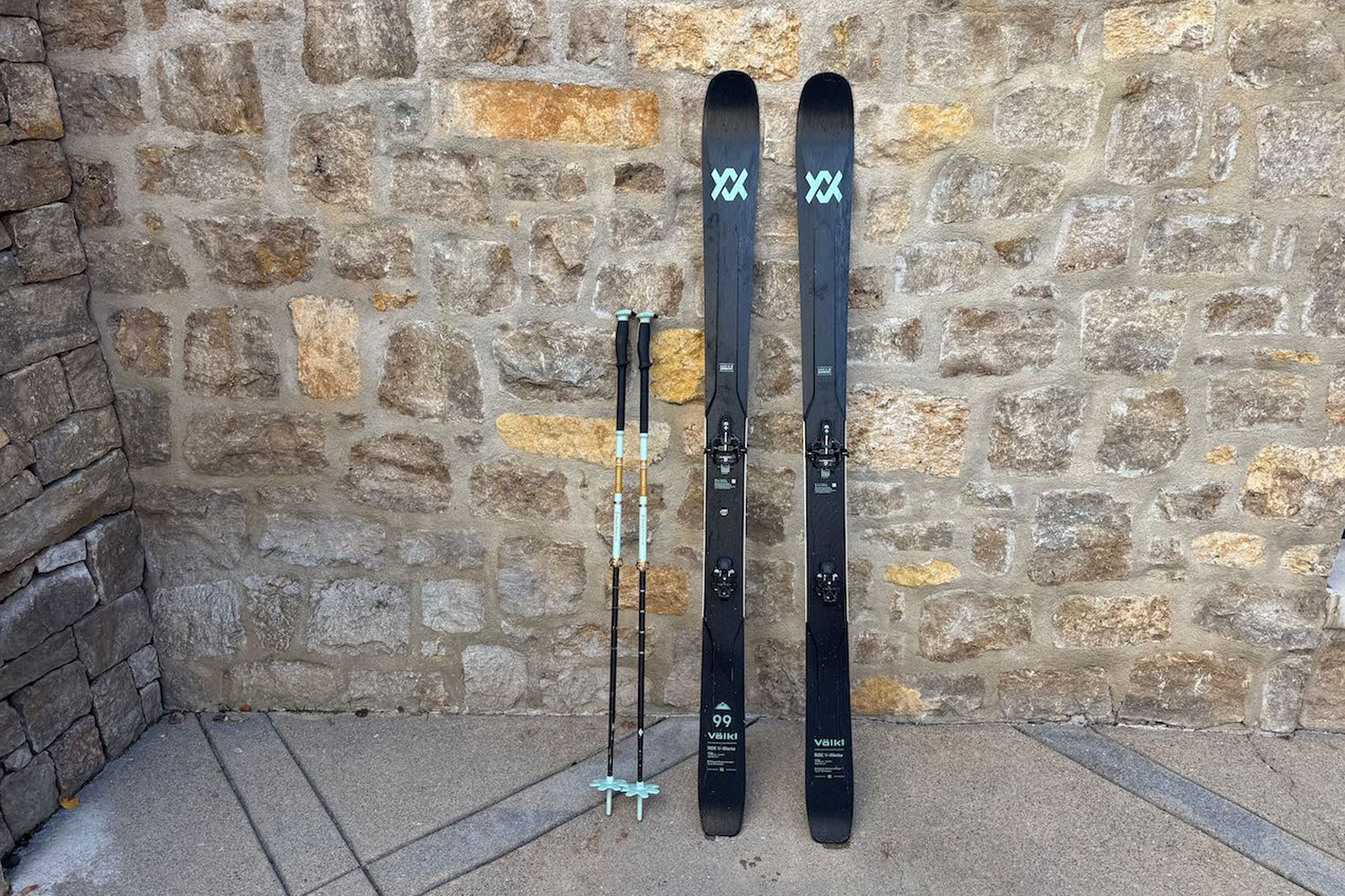
On his feet were a mean-looking pair of skis: Volkl’s new (secret-at-the-time) V-Werks Rise 99s. This pair of black carbon knives has subtle branding and an irregular core shape. What Langenstein did with them struck me. I struggled to keep up as he bounced through powder, slashed through crevasse tunnels, and carved through firm snow both on and off piste.
At one point, as I melted in the sun, he pulled away from me on the skin track, barely breaking a sweat despite his cotton hoodie under a shell.
Skiers of that caliber can make lightweight backcountry skis look really good. Still, Volkl’s new high-end skis intrigued me. There was something interesting hiding in a stealthy package, no doubt being tested by gear-smashing sponsored athletes like Langenstein.
I didn’t squander the chance to test a pair for myself before they were released to the public for the ‘25/26 skis season. Did I bend them like Boris? I gave it everything I had, and the rewards were splendid. However, the premium construction came with a few surprising idiosyncrasies that may not suit every skier.
In short: Volkl’s new V-Werks Rise 99s ($1,500) sport a ton of carbon, but they’re no featherweights — neither in terms of weight nor character (nor price). The V-Werks Rise 99s offer an interesting blade-like shape, mellow camber, plenty of rocker, and a medium-soft, smooth profile that makes turns feel like art. They are one of the most premium-feeling pairs of backcountry skis available, but they come with a catch, and it’s not just price.
Check out GearJunkie’s guide to the Best Backcountry Skis.
-
Damp and torsionally stiff -
High quality turn initiation -
Premium ski feel -
Excellent grip on hard snow
-
Expensive -
Relatively heavy for dedicated carbon touring skis -
Heavy/Aggressive skiers will find the tails too soft -
Unpredictable in breakable crust
Volkl V-Werks Rise 99 Review

Anyone who has spent a lot of time skiing Volkls knows that they share a DNA throughout the lineup. It’s the way they turn and feel on the snow. They tend to share a distinct level of precision, edge grip, and stability. The German company has mastered the art of The Turn over 100 years of making skis.
But those aren’t the characteristics I typically look for in a backcountry ski. In the vast backcountry playgrounds of Colorado, I’m looking for something that’s relatively easy to ski, confident and capable in mixed snow conditions, and of course, floaty and pivoty when the powder is ripe. Oh, and if I find myself cliffed out on an icy face, I want those edges to bite.
The V-Werks Rise 99s are — gulp — mean-looking. The stealthy black topsheets, blade-like shovels, and ice-carving racing heritage had me feeling a little bit intimidated as I clicked my lightweight two-buckle ski touring boots into the bindings. But I needn’t have fretted. I realized quickly that they’re not as mean as they look.
Build

Volkl’s V-Werks program is essentially where its ski designers are given free rein to create the best skis they can, without pricing limitations. Historically, skis from the V-Werks program are characterized by a lot of carbon, an incredible damp feel, and interesting shapes. Oh, and a price tag that will make your credit card flinch.
I’m not going to dance around it — the new V-Werks Rise 99s are downright gorgeous. I haven’t been struck by a pair of skis in a long time. They’re a work of art. Aside from the carbon topsheets — Volkl calls it a full-carbon jacket — and low-profile graphics, the Rise 99s look mean.
Volkl’s signature lightweight multilayer woodcore is on display under the torsional stiffness-boosting carbon jacket. A hardwood backbone, paired with a vertical band of titanal, gives the ski structure and depth down the middle. Lighter wood extends out to the ski’s margins.
The edges are where things get interesting. The wood core tapers down to the edges to the metal edge, and there’s basically no sidewall around the shovels or tails. The sidewall underfoot tapers down right in front of and behind the boot. They’re blades compared to other skis on the market. Volkl calls it 3D Ridge Construction, which is a design characteristic shared with generations of V-Werks skis.
The V-Werks Rise 99s dimensions land at 135-99-117. Although they sport a somewhat traditional rocker/camber/rocker profile, the camber and rocker are all quite subtle and low profile. The tips and underfoot camber don’t rise particularly high off the snow. It’s a schematic that strongly suggests an all-rounder. It has plenty of sidecut and rocker for agility, with camber and a medium underfoot width for a strong edge.
Test Setup

I’ve been testing the 178cm V-Werks Rise 99’s in lightweight touring mode, mounted with my favorite ski touring binding, Marker’s Alpinist 12. They’re about as light as you can go without losing heel elasticity, and they’ve proved dang dependable.
The 178cm length is on the shorter side for my 195-pound, 6’1” build, which lands them squarely in little boot territory. I was able to swap in a variety of different boots to see how each one fared, ranging from Tecnica’s powerful Zero G Tour Pros to La Sportiva’s exceptionally light Kilos.
I kept the weight low and glide smooth by pairing the setup with Pomoca’s updated Climb Pro S-Glide skins. Combined with the skis’ deep rocker fore that kept the tails and shovels off the snow, the skis were hardly a chore on the skin track despite the V-Werks Rise 99s middle-of-the-road 1,625g weight.
On the Snow

I’ve been able to test the V-Werks Rise 99s in just about every condition I’d typically encounter in a full Colorado season. At just 99mm underfoot, they’re the widest skis in Volkl’s touring range. When the snow is falling, and the backcountry is fluffy, that’s about my bottom width limit when I’m rifling through my roofbox. But I wasn’t disappointed when I pulled them out for a sunny powder day in Colorado’s Gore Range.
When I pointed it down a big, fluffy north-facing slope, the V-Werks Rise 99s transformed. They went from planted to surfy, pivoty, smooth, and nimble. They felt intuitive as I smeared down the run. The long, low rocker does a good job at keeping them afloat and lively. It wasn’t a chore to keep the tips afloat while making a mix of big open turns and shorter, quicker pivots.
I felt like I had the choice to drive them from the tips in an aggressive forward stance or relax a little bit and ski them from the center in a more upright, modern style. It’s not unlike Volkl’s Blaze skis that light up when they hit powder. They were lots of fun to ski hard when conditions were right, which is not something I say often about skis under 2,000g.
They were easy to throw around when the run transitioned from an open face to tight, powdery trees. Again, those deep rocker lines and soft flex kept them loose and easy. The soft tails also disappeared when I needed them to. A small taper helped them release from each turn without any fuss in soft snow and chunky snow alike
Despite rock-solid torsional stiffness, they’re softer fore and aft than you’d think. That helped broaden the overall skiability, especially in soft snow. Less experienced skiers will appreciate that characteristic in particular. They bend in and out of turns intuitively and engage even at slower speeds.
Soft Flex vs. Hard Snow

The soft tails took some getting used to. There wasn’t a ton of support when I got thrown into the back seat in hard, chunky snow. It limits their hard-charging freeriding capacity. And I would’ve liked a little more support back there when I was hauling a ski mountaineering pack load-out last spring.
But thanks to the unique construction of the Rise 99s, soft does not mean skittish on hard snow and ice. They felt steadfast on crust and ice, as well as on hardpack pistes. I chalked it up to a mix of torsional stiffness, a damp core, and narrow biting edges.
The grip felt reliable, and I pushed them into deep arcs on the resort. They can hold an edge significantly better than most lightweight touring skis in firm conditions.
Ripping big GS turns isn’t typically what skiers are looking for in a backcountry setup (me included), so thankfully that grip transferred to tight, steep, icy couloir snow and early morning spring crusts. Skis with deep rocker lines, relatively low effective length, and soft flex don’t typically bite so confidently. But I had no problem planting the edges and dropping into a jump turn when the consequences ticked up. I can see how steep skiers like Langenstein can trust them in huge, steep terrain.
Bad Snow

Like with most softer and light skis, I got tossed around in really hard, chunky snow. That’s typically the case with skis under about 2,000g, so I wasn’t surprised. They’re not quite stiff enough to just point it straight through the chunk like a beefy freeride ski. I was rewarded with slower, shorter, more intentional turns in those scenarios.
Still, the multi-wood core, titanal ribbon, and carbon jacket give these skis an impressively damp character considering they’re so far south of 2,000g. They were smooth and generally quite composed rather than erratic and poppy.
Breakable Crust

The Volkl V-Werks Rise 99s performed valiantly in most ski conditions. But toward the end of last season, I found their Achilles’ heel. These skis are distinctly challenging to ski in breakable crust. They felt like they had a mind of their own. They veered off course and felt almost unpredictable.
To be fair, breakable crust is objectively the worst snow condition. Most skis suffer, especially lightweight touring skis. But there was something about the knifeblade shovels that had these skis slicing away from me. I tumbled more than once just trying to get back to the car from a morning mission. It was a weird sensation.
If breakable crust is your norm, you should find a better place to ski. Also know that the V-Werks Rise 99s may not be right for you.
Ski Mountaineering Quiver With Boris Langenstein

I caught up with Langenstein, a Volkl athlete, to talk about the V-Werks Rise 99s after he’d had an extensive guiding and mountaineering season aboard the skis. Having been on Volkl’s BMT 90s for 10 years, he’d recently switched to the new V-Werks Rise 99s. We shared similar experiences on the skis, especially in regards to edge grip and versatility.
Boris uses two different setups — the 170cm version with Marker Alpinist Free bindings as his “real mountain skis” which he said were “perfect for couloirs, hard snow conditions (this is where it excels), and long touring days. On steep slopes and in tricky snow conditions, with short turns and little speed, the grip is excellent,” he said.
He also uses a 178cm version with burlier Marker Kingpin bindings and stiffer boots for his freeriding-oriented setup.
“With Kingpins, the ski becomes even more efficient — it’s like a mini giant slalom ski,” Langenstein said. “You can carve real turns on piste, ski fast, and the ski is a bit more progressive when changing edges and transferring weight. The grip is incredible, especially for a touring ski! It’s still very predictable and reassuring.”
Volkl V-Werks Rise 99s: Conclusion

Soft, light(ish), damp, and torsionally stiff — it’s a tall order for a single pair of skis. And that clearly made it a great challenge for Volkl’s V-Werks program.
The V-Werks Rise 99s offer a legitimately unique feel on the snow. They bite into hard snow when rolled on edge without feeling like 2x4s everywhere else. They were easy and fun in soft snow, composed and steady in less-than-ideal conditions, and quick in tight spaces.
The descriptor I keep coming back to is “intuitive” (except in breakable crust!). And that’s truly what I’m looking for in a backcountry ski more than anything else, even if the tails were a little bit soft for my taste.
There aren’t many skis with an approachable flex, steadfast torsional stiffness, a damp ride, and a touring ski weight. Yes, they come with a big price tag, but if those four characteristics tickle your fancy, you’ll get what you pay for in the V-Werks Rise 99s. They’re a solid set of sticks that will appeal to a very wide variety of backcountry skiers, especially those wanting a versatile midwinter ski that still bites when conditions get firm.
Read the full article here
