





Fresh off the energy of Team USA’s hockey gold and staring down a 20-inch snow forecast, I finally sat down to write about a tool that’s earned its keep over the last month: the Kizer Rook.
I’m a big fan of the Nessmuk knife style; the fat belly on a drop-point blade sets the tone for opportunity. Whether you’re hunting, gathering, or just completing a few random tasks, the Nessmuk exudes “old reliable.”
Knifemaker Vincent Rizzo nailed the materials of the Rook — AEB-L steel and Micarta were great choices for a knife of this ilk. However, the real stars are the thin profile and multi-mount Kydex sheath. Both features allow the Rook to perform beyond its sub-7-inch overall length.
In short: A hunting and gathering knife must feature quality materials that withstand the elements, liquids, and goop. It also needs to provide comfortable, versatile hand grips and the ability to work in tight spaces. The Kizer Rook meets these demands with welcomed ease of use, while its sub-$100 price tag is a significant added benefit.
-
AEB-L is razor-sharp and maintains that edge -
Overall shape and ergonomics -
Slender profile to work in tight places -
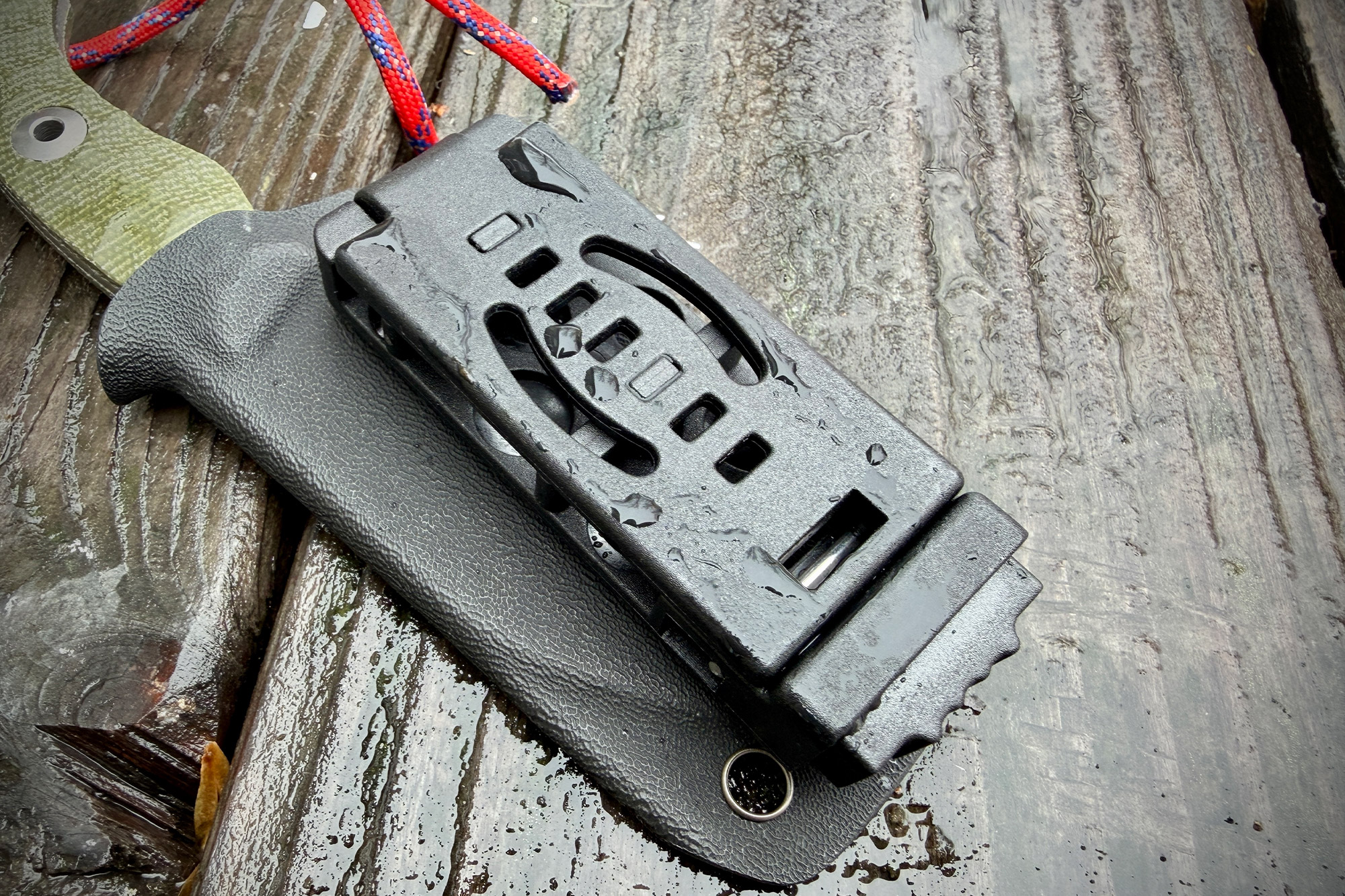
Belt clip offers numerous ways to carry the Rook
-
AEB-L can easily take off your finger if you’re not paying attention
Kizer Rook Review
Design & Features

The Kizer Rook is a modern take on the classic Nessmuk knife style that didn’t stray too far from home. It is made from a solid, skeletonized piece of 6.8-inch–long AEB-L that swoops and flows from tip to tail.
The spine of the Rook has an ample amount of jimping that allows for a lot of blade control, under strain, in a variety of handholds. This permits the user to get into tight places without losing their ability to cut, slice, trim, and glide through meat and other materials.
To help with that grip, Kizer went with slender Micarta handle scales that have been scalloped and shaped to make up for the lack of thickness. Outdoor work knives like this usually benefit from a palm swell in the handle for grip and stabilization. Kizer went with the low-key approach with heavy patterning, and it helps make up for that difference.
For carry, the Rook has a simple pancake sheath with a Tek-Lok style belt clip, which lets you position it in a variety of ways. Because of this, the sheath is tighter, but has a relief for your thumb to push against to release the knife. You can adjust the tension of the sheath’s tightness around the blade via a screw at the top.
The Steel: AEB-L

Using AEB-L for the Rook makes it incredibly effective for food and fire prep, and hunting. It’s the only blade steel that has ever made me think, “Yeah, that’s gonna need stitches,” after a passing glance off my skin. It’s aggressively sharp and maintains that edge for prolonged periods of time. When it gets dull, it’s easy to bring the edge back as well.
The trade-off is corrosion resistance.
Yes, AEB-L is considered a stainless steel. It was originally developed for razor blades. Where its fine granular structure allows it to be sharp and stay sharp, its lack of chromium makes it susceptible to surface rust.
I have only experienced this with AEB-L that has been bead-blasted, instead of polished or stonewashed. So, no issues with the Rook so far, even after days out in the rain and snow. However, I highly recommend that this knife be wiped down and its Kydex sheath be allowed to dry out before long-term storage.
First Impressions

As an early subscriber to the small-form fixed-blade craze, which has a wonderful grip on the outdoor knife world, I really like the size of the Rook.
Nessmuk originally designed this style of knife as part of the “Nessmuk Trio.” That set consisted of a double-bit hatchet, a folding pocket knife, and a fixed-blade belt knife, which the Rook is based on. Coined the “Nessmuk Knife,” it was 5 inches long and designed to be used for skinning and harvesting meat — even for eating off of.
That puts the Rook at almost 2 inches longer than its inspiration, and I find it to be a good size for a belt knife. It adds a touch of leverage for scooping, whether it’s bone marrow or peanut butter. It also allows for the knife to be a 3½-finger knife, where your pinky lands in the curved butt.
Having your finger on the back of the handle allows you to push and dig more efficiently. Overall, the look and feel of the Rook marries the past with the present for a knife that can take you into the future.
In the Field
I did most of my testing for the Rook before winter really took off in Connecticut. There was snow on the ground, but not nearly as much as there is now (or as much as there will be by the time I am done writing this review).
Based on my past experiences with AEB-L and its low rankings in corrosion resistance, I had expected to see some surface spotting on the blade by this point; however, there is none. The blade remains clean and in top form, aside from a little sap residue from the white pine tree I harvested needles from multiple times.

White pine needles were used by the Algonquins and Pequots this time of year to clear up congestion. You can leave them whole or chop them up to steep in warm water. When you’re out on the trail, or if you just don’t want to deal with all the adjuncts found in modern cold medicine, this remedy comes in handy.
The rolling belly of the Rook makes for some nice chopping, but if you don’t have something to filter the fine bits of needle out with, I recommend you leave them whole — or you’ll end up with a bigger tickle in your throat.
I didn’t have any meat to harvest from a fresh kill, but I did make some incredible grilled chicken one night. I used this knife both before and after grilling it up for more proficient grilling, and then for smaller bites to mix in with spinach and rice. Based on that performance alone, I assume a hunter could make quick and proper work, with little waste, using the Rook on their favorite fresh game without needing to stop and resharpen.
Additionally, based on the size and shape, removing a pelt could be a clean and easy task as well. It would make a fine tool to scrape bits and pieces from the underside of a pelt or hide.
Who’s It For?

Kizer has its finger on the pulse of what people want and need in the current knife market. It continues to launch new knives that meet a lot of demands without costing a fortune.
In the case of the Rook, it’s $60 — less than a nice steak and potato dinner. The proliferation of both Micarta and AEB-L in the market makes them affordable, aiding in their desirability.
That said, a Nessmuk-style knife isn’t for everyone. Unless you’re harvesting flora or fauna, you may not need the big belly on the blade. The average hiker will do just fine with a standard drop-point blade on their adventures in the outdoors.
Unfortunately, once you’re exposed to it, especially in a well-executed knife like the Rook, you’ll either adjust to its benefits or adjust your habits. A Nessmuk blade is hard to leave behind, and you’ll find a need for it for sure.
Overall, $60 is a fair price for a reliable fixed-blade knife of this quality. The benefit of the multi-mount sheath is chef’s kiss. If you’re someone who spends a lot of time outdoors but may not necessarily hunt or gather, the Rook could be a nice entryway to the Nessmuk form.
Read the full article here
