



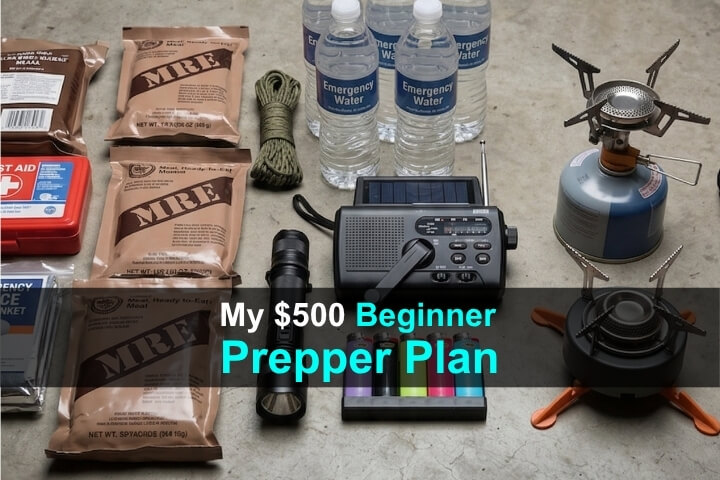


If you haven’t prepared for some kind of disaster or emergency scenario, now is the time. With the ongoing war in Iran, markets going crazy, and the tension between the East and West higher than it’s been in decades, there’s no time to waste. Especially if prices keep going up.
If you have at least $500, then you have enough money to get prepared for all the most likely disaster scenarios. The question is, how exactly do you spend that money? It’s easy to freeze up from analysis paralysis or blow hundreds of dollars on some tactical gear you’ll never actually use.
Don’t make either of those mistakes. With a tight budget, the goal is simple: cover the basics, skip the fancy stuff, and build a foundation you can add to over time. There’s plenty of debate about what to prioritize first. Should you start with food storage? Water filtration? A bug out bag?
We’ve already created several beginner prepping lists on this website, but I recently came across a YouTube video from the channel TheOneRow that really impressed me. David has been prepping for over 25 years, and the way he breaks down a $500 beginner kit is very practical and exactly what someone just getting started needs to hear.
Want to save this post for later? Click Here to Pin It On Pinterest!
You can video the video below, but I’m also going to walk you through his plan. If you haven’t started prepping, this is a great place to begin. If you’re already an experienced prepper, send this breakdown to a friend or family member. It really makes preparedness feel a lot simpler.
The $500 Beginner Prepper Plan
As David points out, this list assumes you already own the really basic stuff like shoes, a jacket, and maybe a backpack. What you’re doing here is filling in the gaps so you can handle a temporary emergency scenario.
He also keeps firearms off the main list (since not everyone can or wants to own one), though he does recommend allocating an extra $500 for a budget pistol, holster, and ammo if that’s an option for you.
With that said, here’s how he’d spend the $500:
1. Water ~$80
This is first for a reason. In any emergency, clean water becomes your most urgent need fast.
- Sawyer Mini Water Filter (~$25 each) — David recommends picking up two or three of these if you can. They’re compact, reliable, and can filter hundreds of gallons. For a single person, one is a solid start.
- 7-gallon Aquatainer water jugs (~$20 each) — These let you store a meaningful amount of clean water at home. Grab one or two to start.
- Water purification tablets (~$15) — A backup to the filter. Cheap insurance.
The combination of storage, filtration, and chemical purification means you’ve got multiple ways to get safe drinking water no matter what the situation is.
2. Food Storage ~$100
The goal here isn’t gourmet. It’s calories, shelf life, and cost efficiency.
- Bulk rice, beans, oats, and peanut butter — These are the workhorses of budget food storage. High calorie, long shelf life, and dead cheap per serving.
- Extra pantry staples you already eat — David’s smart suggestion: spend about $50 of this buying extra of stuff you’d normally buy anyway. Macaroni and cheese, canned goods, whatever your family actually eats. That way nothing goes to waste even if you never need it.
If you’re thoughtful about it, $100 can realistically get you 2–3 weeks of calories for one person. More if you’ve got a family and you’re cooking from the bulk stuff.
3. Cooking ~$60
All that food does you no good if you can’t cook it when the power’s out.
- Small propane camp stove + two 1 lb isobutane canisters (~$40) — Simple, portable, and gets the job done. Works outside, in a garage, or anywhere with ventilation.
- Lighters and fire-starting kit (~$20) — A handful of quality lighters and some basic fire-starting material. Don’t overthink it — just make sure you can reliably start a fire if you need to.
4. Lighting and Power ~$50
When the grid goes down, you’ll be very glad you spent this fifty bucks.
- Rechargeable headlamps (~$15–20) — You can get a 3-pack on Amazon for a reasonable price. Hands-free lighting is a game-changer.
- Solar lantern (~$20) — Great for lighting up a room at night without burning through batteries.
- USB battery pack (~$15–20) — Lets you keep your phone charged, which keeps you connected to information, maps, and communication.
5. First Aid and Hygiene — ~$50
This one’s easy to underestimate until you actually need it.
- Pre-built first aid kit (~$30) — You’re not going to get a fully kitted trauma bag at this price point, but a solid basic kit covers cuts, burns, sprains, and common injuries.
- Personal hygiene supplies (~$20) — Extra toothbrushes, toothpaste, soap, and hand sanitizer. When things get rough, staying clean becomes more important, not less. It affects morale, health, and disease prevention.
6. Tools and Self-Defense ~$100
This is where you start building the capability to handle physical problems, whether that’s cutting cordage, preparing food, or protecting yourself.
- Fixed-blade knife (~$50) — Look for something with a 4.5–5.5 inch blade and a comfortable handle. You don’t need to spend a lot here — decent overseas-made knives in this price range are plenty capable for a beginner kit.
- Multi-tool (~$30–50) — A Gerber or similar brand gives you pliers, a screwdriver, a saw, and a dozen other things in one package. Worth every penny.
- Pepper spray (~$10–15) — David recommends this even if you do own a firearm. There are plenty of situations where you want to deter someone without escalating to lethal force. It’s cheap, legal almost everywhere, and easy to carry.
7. Information and Communication ~$50–60
This one often gets skipped by beginners, and it’s a mistake.
- Paper maps of your local area — If your phone dies or cell towers go down, GPS goes with them. Know your area on paper.
- Emergency radio (battery-powered or rechargeable) — This is how you stay informed when the internet and TV are down. Weather alerts, emergency broadcasts, local news, which are all accessible without a grid connection.
- Extra cash — David mentions this as a catch-all for whatever’s left: having a few extra $20s tucked away means you’re not completely helpless if card readers go down or ATMs run dry.
What You End Up With
When you step back and look at the full picture, $500 gets you the ability to filter and store water, feed yourself and your family for a few weeks, cook without electricity, stay informed, treat basic injuries, light your home, and protect yourself. Combined with whatever you already own (boots, a jacket, a backpack, some basic tools, etc.), you’ve suddenly got a legitimate 72-hour kit and a reasonable bug-in setup.
That’s a pretty solid foundation. If you’re a newbie prepper, start with this list and build from there. You’ll thank yourself later.
Like this post? Don’t Forget to Pin It On Pinterest!
You May Also Like:

Read the full article here
