




Podcast: Play in new window | Download
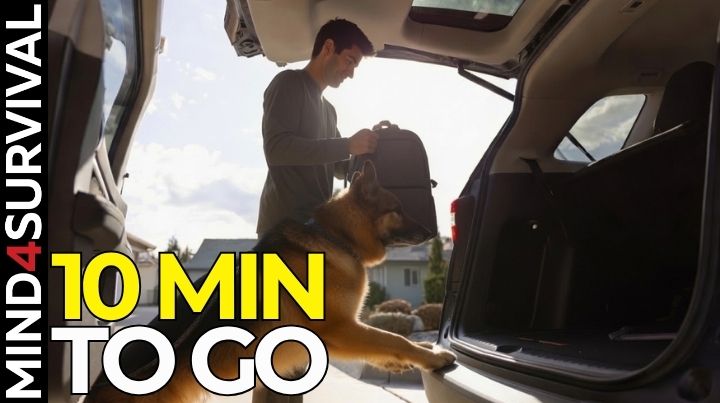
Ten minutes is not a scenario. It is a kitchen fire, a gas leak, a fast-moving wildfire, a chemical spill on the nearby rail line, or a deputy pounding on your door, screaming for you to go—and go now! You get the warning, and the clock starts. What you carry out is whatever you can think of, find, and load in the precious little time you have.
That is the problem. Most people don’t struggle from a lack of gear and supplies to pack. Most people struggle with indecision about what to bring. They stand in the hallway running an inventory of possibilities while the clock burns.
In that vein, I asked the Mind4Survival Facebook group a simple question: if you had to evacuate in 10 minutes, what would you grab first? The answers were excellent and in line with what I’ve come to expect from seasoned preppers. They also fell into a pattern worth paying attention to.
TL;DR: A 10-minute evacuation checklist works because the decisions are made before the evacuation clock starts. Get people and pets moving first, grab the bag you staged in advance, then take medications, documents, cash, and weather-appropriate clothing. Everything else stays. Practice it once, and you will find the gaps.
Quick Look at What You’ll Learn
What the Group Actually Said
Frank’s answer was one word: his wife. Lee said wife and kids. Gabrielle said her pups and cat. Pete listed the dog, the cat, and the family members, then the usual items—phone, keys, wallet, cash.
The people who did not name a person or an animal named a bag. Will said his BOB—bug-out bag, the pack you keep loaded so you do not have to think. John said go bag. Chris said his BOB and his tactical harness. Rebecca had hers by the door with the dog leashes and her wallet sitting in the same spot. One member described grab-and-go containers holding two weeks of food, water filters, spare cash, a change of clothes, and a folder of vital information.
Then there was a third group. Christine keeps Post-it notes in every room listing the top five things to grab from that room. Jeff and his wife each keep a written list, with their get-home bags already in the vehicles. Pete has run the drill more than once and knows how fast he can pack his truck.
Notice what all three groups have in common. From the answers, I can tell that people answered with confidence. The people, the pets, the bag, the list—every one of them came across as an answer they didn’t have to think twice about. That is the whole game. Ten minutes (or less) is not enough time to think. It is barely enough time to grab your family and go.
Normalcy bias is your enemy here. It’s the indecision that keeps people rooted and immobile as precious time passes.
The 10-Minute Evacuation Checklist
This list is ordered by what kills you fastest and what you can never replace. Work top to bottom. When the clock runs out, you stop where you are, and you leave.
- People (minute 0–1). Everyone accounted for, shoes on, moving toward the door or the vehicle. Nothing on this list matters if you leave someone behind. If you have kids old enough to help, give them a job. Denielle’s kids are part of her process, and they know the dog is coming.
- Pets (minute 1–2). Leashes, carriers, and crates staged with the bags, not in the garage rafters. Rebecca keeps the leashes with the go bag and the wallet—one location, one grab.
- The bag you already packed (minute 2–3). This is the entire reason to own one. Sling it and move. If you are searching for it, packing it, or wondering what is in it, then you’re not as prepared as you could be. A bag exists to get you moving expeditiously from unsafe point A to a safer, more survivable point B.
- Medications (minute 3–4). Prescriptions, dosing information, and anything a family member cannot go three days without. This is an item that many people forget. Pharmacies in an evacuation zone are closed, and the ones outside it need your prescription.
- Documents and data (minute 4–6). Identification, insurance policies, titles, birth certificates, account information, and a contact list. Heather keeps hers in a safe, with an external hard drive backing up documents, photos, and videos, and she keeps digital copies she can access from her phone. Stuart makes the point that matters most: his evacuation bag is not built to live out of in the wilderness. It is built to recover after losing the house. Insurance information. Account records. Copies of everything. That is what you actually need at 3 a.m. in a motel room two counties over.
Keep a hard copy of your contact list. If your phone dies, gets crushed, or gets left somewhere, a paper list lets you borrow a phone and still reach people.
- Cash (minute 6–7). Card readers need power and a network. In an evacuation, one or both will be down somewhere along your route. Small bills. Keep it with the documents so you can grab everything at once and have less chance of forgetting something.
- Phone, keys, wallet, chargers (minute 7). The everyday items that run your life. Charging cable and a battery bank if they are staged. If they are not staged, do not go hunting for them.
- Weather-appropriate clothing (minute 7–8). Christine’s top item right now is her coat. Paul lives where evacuation orders mean fire or flood, so his answer is jackets and wallets. If you evacuate in a t-shirt in February, your first problem after the fire is the cold. Boots. Coat. Layers. Gloves.
- Defensive tools (minute 8–9). Daniel, John, and Bryan all named firearms. That is a smart answer for people. Obviously, be sure you know how to operate your firearms well. Also, be sure you know your state’s laws regarding the use and transport of firearms. Be mindful that if you’re evacuating to a shelter, many facilities do not allow weapons.
- Irreplaceables, only if time remains (minute 9–10). Photo albums. The urn. The one thing that cannot be bought again. Choose it now, write it down so you don’t forget, and know exactly where it is. If the time to leave runs out, you leave without it. Nothing, at this point of loading and going, is worth your time.
Build the List Before You Need It
Do this today. Walk your house room by room. In each room, write down the top five things you would take from that room, in order. Chris puts hers on a Post-it note in the room itself. Jeff and his wife each carry a copy. Either works. What matters is that the thinking is finished before the alarm goes off.
Next stage what you can. The bag by the door. The leashes on the same hook. The documents in a SINGLE container you can carry with one hand. Heather can get her load to the car alone in two trips, because she’s thought it out and knows what to do.
Pro-Tip: Photograph or video every room in your house, including inside closets and drawers. Store it in the cloud and on an external drive in your document container. That footage is what turns the effort of completing an insurance claim from a difficult memory exercise into an easy-to-provide itemized list.
Run the Drill
A plan you have never executed isn’t a plan—it’s a guess.
Set a timer for ten minutes. Start it from wherever you actually are—on the couch, in the shower, asleep at 2 a.m. if you want an honest run-through and assessment of your plan. Load the vehicle as if you were leaving and not coming back. Stop when the timer stops.
Then look at what you’ve packed and what didn’t make it before the timer sounded. That gap is your homework. That gap is your vulnerability, with vulnerability being a measurement of your lack of preparedness. Maybe the bag had become buried under a pile of other bags in the closet. Maybe you couldn’t find the passports. And maybe the dog decided it was playtime rather than load-and-get-out-of-dodge time. Fix your shortcomings, and run it again next quarter.
Pete has done this. He knows he can fill a vehicle fast, and he also knows he could leave with nothing and rebuild his immediate needs from a store two states away if he had to. That is not carelessness. That is a man who has tested his plan and knows what it gets him. That’s someone with both feet firmly planted in preparedness reality rather than normalcy-bias Nirvana.
The Bottom Line
When you only have minutes to flee your home, you do not rise to the occasion. You fall to your level of preparation, and preparation here is mostly a matter of decisions already made and items already staged.
People first. Pets second. The bag you already packed. Medications, documents, cash, clothing, and the things you need to survive the next day or three. Everything else is replaceable, including the house.
Ten minutes is enough—if you spend the time it takes to plan it today.
What is the first thing you would grab, and where is it right now? Tell us in the comments.
Stay safe,
Brian Duff
Additional Resources
Read the full article here
