



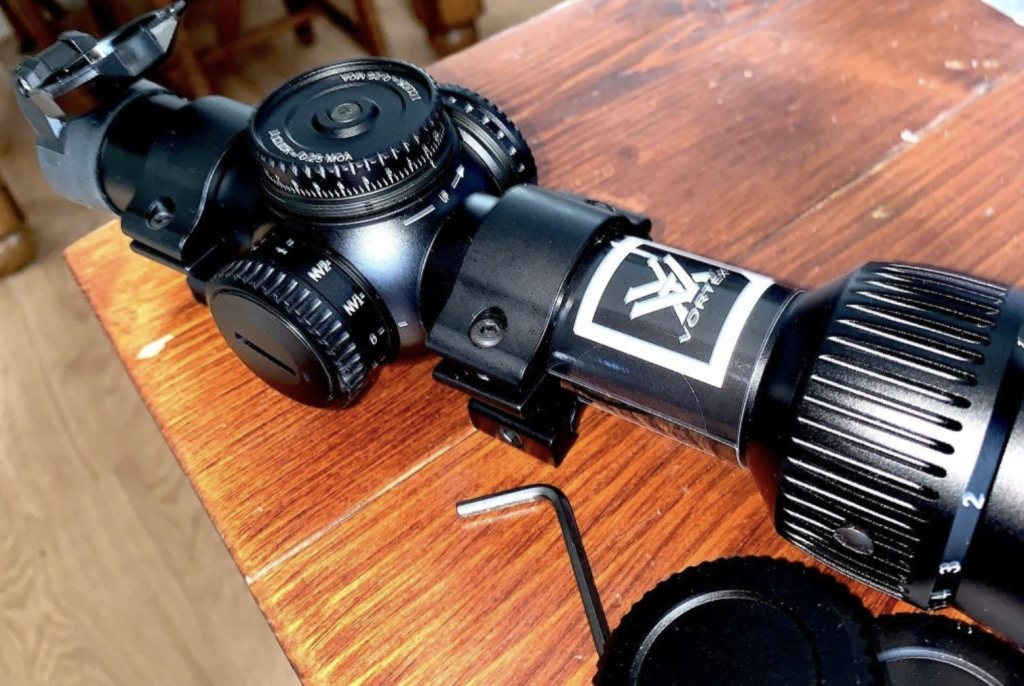

Images by the author unless otherwise noted
(This review is a complimentary piece to a recent hands-on review done by fellow TTAG writer, Luke. You can see his review here. This is a first-impression article, and this will be more of a background-type piece on the Strike Eagle.)
It seems that right now, it’s LPVO time in my neck of the woods. I just got out my Monstrum Ladon 1-6×24 LPVO from a previous review, and had mounted my Griffin Armament 1-8×24 on my Ruger Scout .308. (Look for a review of the Griffin Armament scope soon).
Needless to say, I like LPVOs. These scopes have all the magnification I need in our wooded, Hoosier hunting areas and are suitably compact and light. I have gravitated towards these tactical-use, smaller scopes over the years. Plus, their illuminated reticles help in dim light. As I just said, I don’t need 24x magnification to shoot at a deer at most 150 yards away. Those scopes have a purpose, as well… I just don’t need them.
Vortex recently sent me a few items to review, including binoculars, a spotting scope, and a range finder, which will be featured in a future review. They also sent me their new 1-8×24 Strike Eagle LPVO. I was anxious to get my hands on one after reading about it. I was not disappointed. So, let’s do what I call a “desktop dive” into this scope.
Features
The Strike Eagle uses an AR-BDC3-SFP reticle, pictured here from its website…
It is tuned to perform well for an AR in 5.56mm. It has a large, 16.25-MOA “circle” to get your eye centered, and a smaller 1-MOA dot for precise aiming. The BDC hash marks are good out to 625 yards.
For those who are curious about such things, here’s a subtension view:
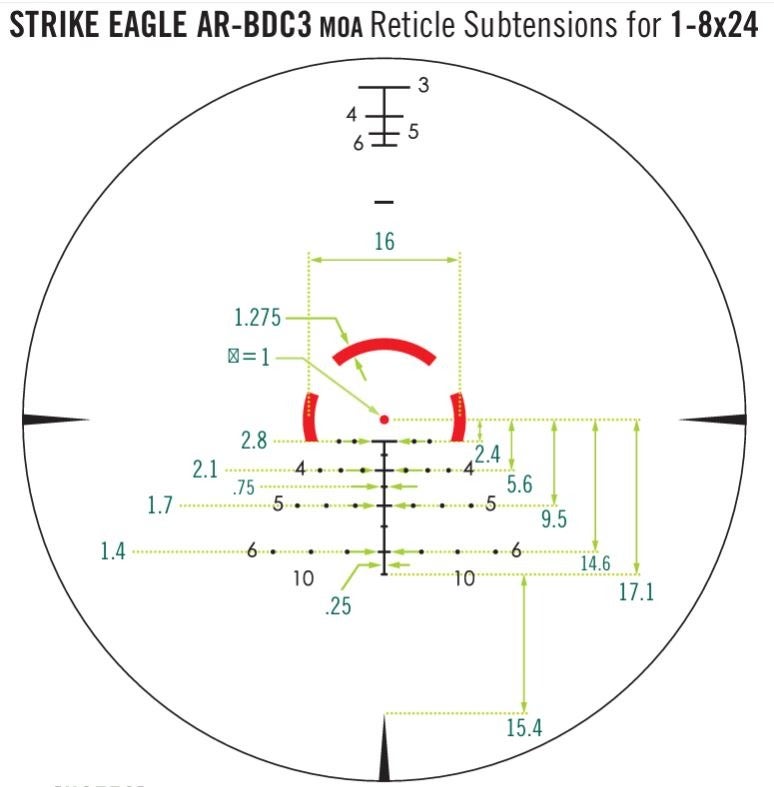
Images: vortex.com
Other features include:
Fully Multi-Coated Lenses: Anti-reflective coatings on all air-to-glass surfaces provide increased light transmission for greater clarity and low-light performance.
Illuminated Reticle: Provides precise aiming under low-light conditions.
Nitrogen Gas Purged: Gas purged and O-ring sealed for fogproof and waterproof performance in all conditions.
Fast-Focus Eyepiece: Allows for quick, easy reticle focusing.
Aircraft Grade Aluminum: Constructed from a solid block of aircraft-grade aluminum for strength and rigidity.
ArmorTek®: Ultra-hard exterior lens coatings defend against scratches, oil, and dirt.
Low-Glare Matte Black Anodize: Corrosion and wear-resistant anodization provides a low-glare matte surface and helps camouflage the shooter’s position.
Waterproof: Designed to withstand harsh weather conditions.
Fogproof: Designed to withstand a wide range of temperatures.
Shockproof: Designed to withstand the highest levels of recoil and impact.
Specifications
- Magnification 1-8x
- Objective Lens Diameter 24 mm
- Focal Plane Second Focal Plane
- Reticle AR-BDC3
- Eye Relief 3.5″
- Field of View 109.0′ – 14.4′ @100 yds
- Turret Style Capped
- Tube Size 30mm
- Adjustment Graduation 1/2 MOA
- Travel Per Rotation 44 MOA
- Max Elevation Adjustment 140 MOA
- Max Windage Adjustment 140 MOA
- Parallax Setting 100 yds
- Length 10.0″
- Weight 17.4 oz
- MSRP: $559.99
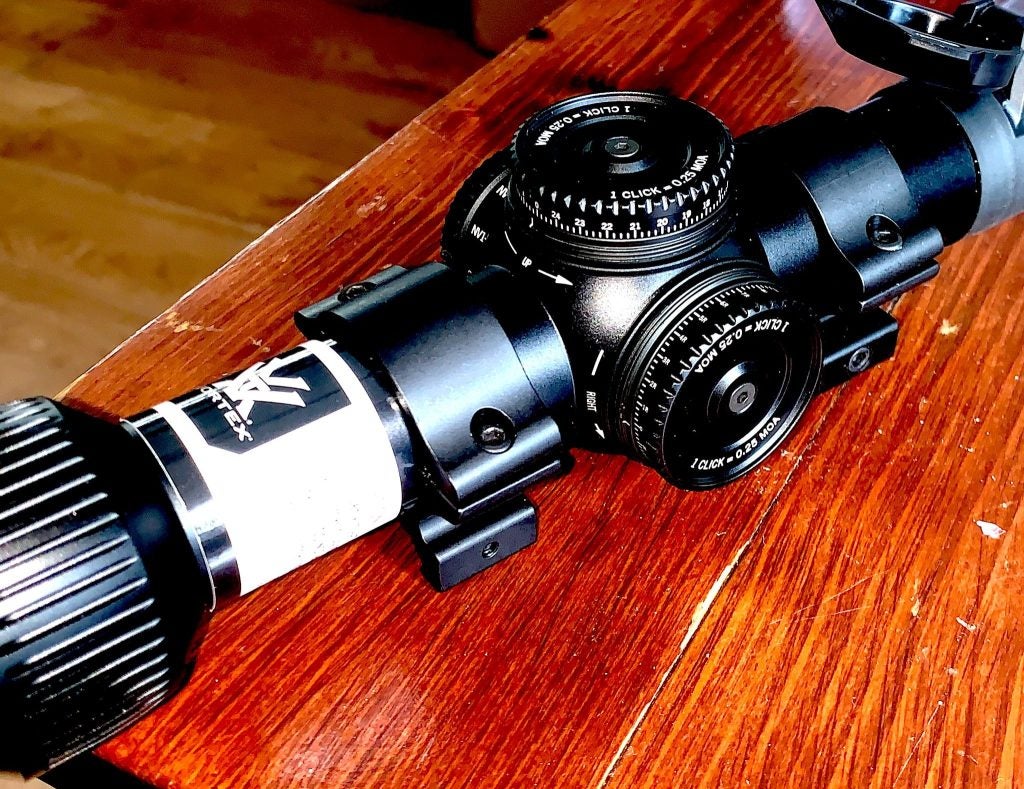
Note the large turrets. You won’t need a screwdriver to adjust them. Another thing I really appreciate is the fine machining and finishing that this scope exhibits. When you replace the turret cover caps, you can give them a spin, and they will rotate all the way down… the threads are that clean. Also, I left the “brand band” on, since this was a review loaner, and added a medium-height set of Leupold rings.

Observations
First up, let me state that I am continually learning about scopes. I started my shooting hobby in earnest during a time when shooters had no red dot or other non-glass optics… You had iron sights or a scope. In today’s shooting world, there are options galore for those who want something different. If we stick with the ranges I mentioned above… close to mid… There are red dots, prism sights, scopes, and several solutions that work. I am partial to low-power, variable-optic scopes because of the reasons I stated at the top. I don’t need high magnification, and I appreciate the light, compact nature of the LPVO.
The Strike Eagle fits my needs perfectly. Some shooters may think that 8x is not enough. There are 10x LPVOs out there, for sure, but 8x works for most situations where a scope like this would be used. And, as we all know, there are a ton of 3-to-whatever-power-you-need scopes if an LPVO is not your cup of tea.
I also appreciate the BDC reticle. It is designed for typical 5.56mm ballistics from a 16-inch AR barrel. The holdover marks go to 625 yards… somewhat further out there than other BDC scopes I’ve used. One note about that… if I decided to use this scope on my Ruger .308 Scout rifle, the BDC marks would be off. It was designed with 5.56mm ballistics in mind.
This scope is exceptionally clear and bright. Even in complete darkness, the reticle is very visible, and the markings stand out. You can tell that Vortex has put some effort into lens coating, and probably not a few bucks.
Three other included items make this scope a better buy. You don’t have to buy lens covers… There are flip-ups in the box. I like those a whole lot more than the elastic-corded slipover caps that some scopes come with… where do you put them when you’re ready to shoot? I’ve actually taped the cords to the scope body and just let the caps dangle, but that’s not the best solution. Flip-ups are.
The other two things that stand out are an included CR-2032 battery and a throw lever on the magnification ring. Every variable-power scope needs a throw lever… it makes adjusting magnification easy. And, the battery is easily found at your local store, but it’s nice that you don’t need to go buy one.
A small thing is the tube diameter. Most of the scopes I’ve reviewed recently use one-inch tubes. This one is 30mm, which lets just a little more light in. That’s a good thing.
I also noticed that this scope uses the MOA system, not the MIL (or MIL-RAD). Typically, LPVOs I review use the MIL system, which the military and the rest of the world use, but American shooters tend to be more familiar with the yardage-based MOA system. They both work; you use what you’re familiar with.
Lastly, this is a second focal-plane scope (SFP). That means that the reticle doesn’t “grow” with higher magnification, as it’s always the same size. That’s not necessarily a bad thing. I have another LVPO that is a first focal-plane (FFP) scope, and the reticle is difficult to acquire at low magnification.
Summary
In the world of LPVOs, finding a good one that’s repeatable and long-lasting can be a bit of a deal. Here, for under $600, you can get one with a multi-level, illuminated, BDC reticle that uses the MOA system that many U.S. shooters are familiar with.
Some things that aren’t readily apparent when you examine a scope include the lens coatings. The Strike Eagle’s premium lens coatings serve to help the image “pop” and aid in clarity, something you’d expect considering Vortex’s vaunted quality and reputation. Plus, its parallax correction is set to 100 yards, a good compromise distance for many types of shooting. Let it be known that parallax wasn’t a problem at all during testing.
Small features like flip-up caps and a throw lever are a welcome addition to this lower-priced optic and show that the company is serious about serving shooters.
If you are looking for a scope that flies above many others on the market, check out the Vortex Strike Eagle.
Read the full article here
